
Subscribe to our newsletter and get insights on how to grow your personal brand.
Thank you! Your submission has been received!
Oops! Something went wrong while submitting the form.



A prettier bio won't fix unclear positioning. More posts won't make an unsupported claim believable. And making every detail public isn't a growth strategy. Social media profile optimization should help the right people find you, verify your expertise, and take a useful next step without exposing information they don't need.
Treat your profiles like a buyer conversation, not a collection of keyword boxes. Decide who you want to reach, show evidence you can help, and control what strangers can learn. Then build a publishing routine you can maintain.
Stop copying your founder bio onto every platform. Consistent identity matters, but identical wording isn't the same thing as consistent positioning.
In Pew Research Center's survey of social media use, 5,733 U.S. adults surveyed in 2023 reported substantially different platform adoption: 83% had ever used YouTube, 68% Facebook, and 47% Instagram, while Instagram use reached 58% among Hispanic adults, 57% among Asian adults, 46% among Black adults, and 43% among White adults. Those differences are a reason to investigate your actual audience, not permission to stereotype individual buyers.
Start with where your prospects already evaluate people like you. Ask customers which profiles they checked before reaching out. Look at where relevant conversations happen and where your existing inquiries originate.
YouTube and Facebook may deserve attention. LinkedIn doesn't automatically win because you sell to businesses, and Instagram doesn't automatically lose because your offer is technical. Prioritize evidence from your own buyers over your personal preference for a platform.
Use this distinction when deciding what stays consistent and what changes.
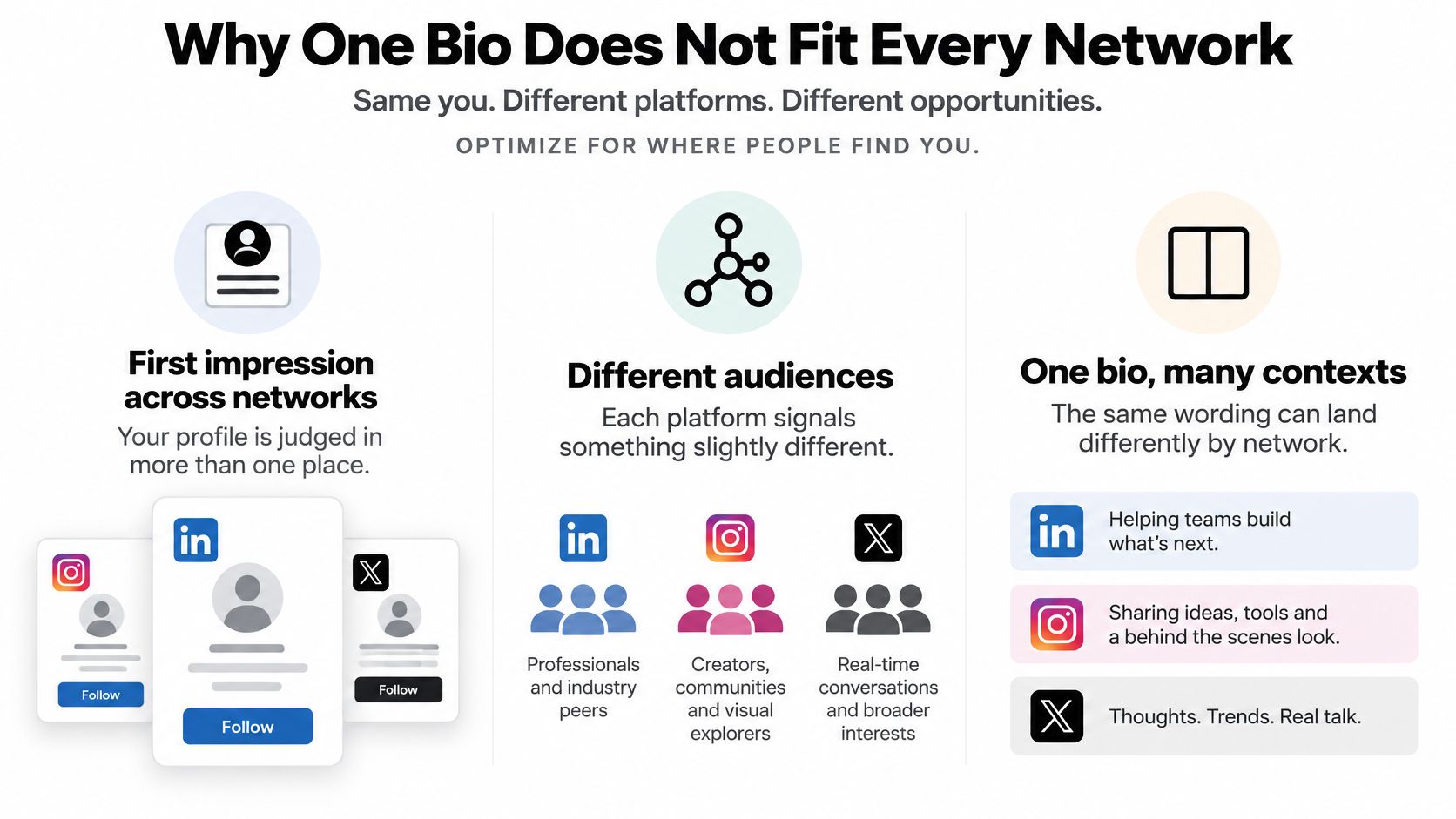
Consider a hypothetical founder whose LinkedIn describes a current software business, whose Instagram still promotes consulting, and whose X profile links to an abandoned newsletter. A prospect can't identify the offer. A recruiter can't establish the current role. A podcast booker can't confidently describe the founder's expertise.
None of them should have to investigate which version is accurate.
Practical rule: Keep your identity recognizable. Adapt the explanation to the person arriving.
Keep the same recognizable name, face, and core promise. Change the examples, vocabulary, and next action to match the audience's reason for visiting.
A prospective buyer might need a relevant project. A potential collaborator might want your working philosophy. A podcast producer might need a clear topic you can discuss with authority.
Optimization means platform selection, consistent identity, audience-specific positioning, and accurate cross-links. Keywords support that work. They don't replace it.
Don't start by polishing sentences. Start by finding missing information, contradictions, and dead ends.
A peer-reviewed study on LinkedIn profile completeness published in 2025 found that incomplete information lowered perceived hireability in an experiment involving 460 participants, even when qualifications were present; a second study involving 363 participants found that the effect weakened when viewers also had a complete résumé. That's hiring evidence, not proof of a sales conversion lift, but it supports a useful operating principle: don't make visitors reconstruct your qualifications elsewhere.
Use this visual as a working checklist before editing the copy.
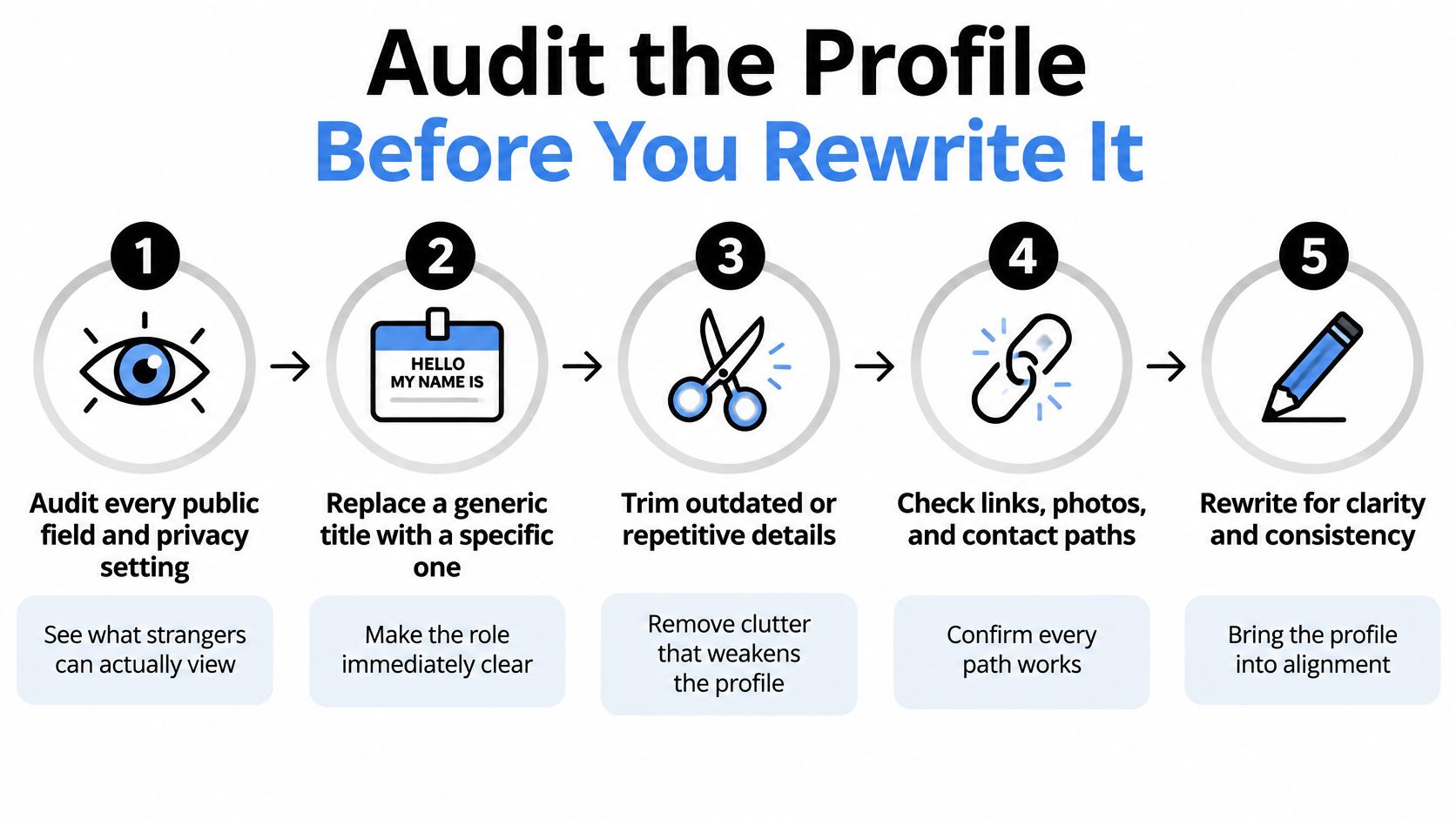
An executive with an unexplained role change doesn't need more adjectives. They need an accurate current role and a clear account of what they do. A founder with impressive claims but no supporting work needs evidence, not another keyword.
Use the accompanying video as a prompt for your own profile review.
Finish the audit with a working contact path. A visitor who understands your expertise should also understand how to approach you, and what kind of conversation you welcome.
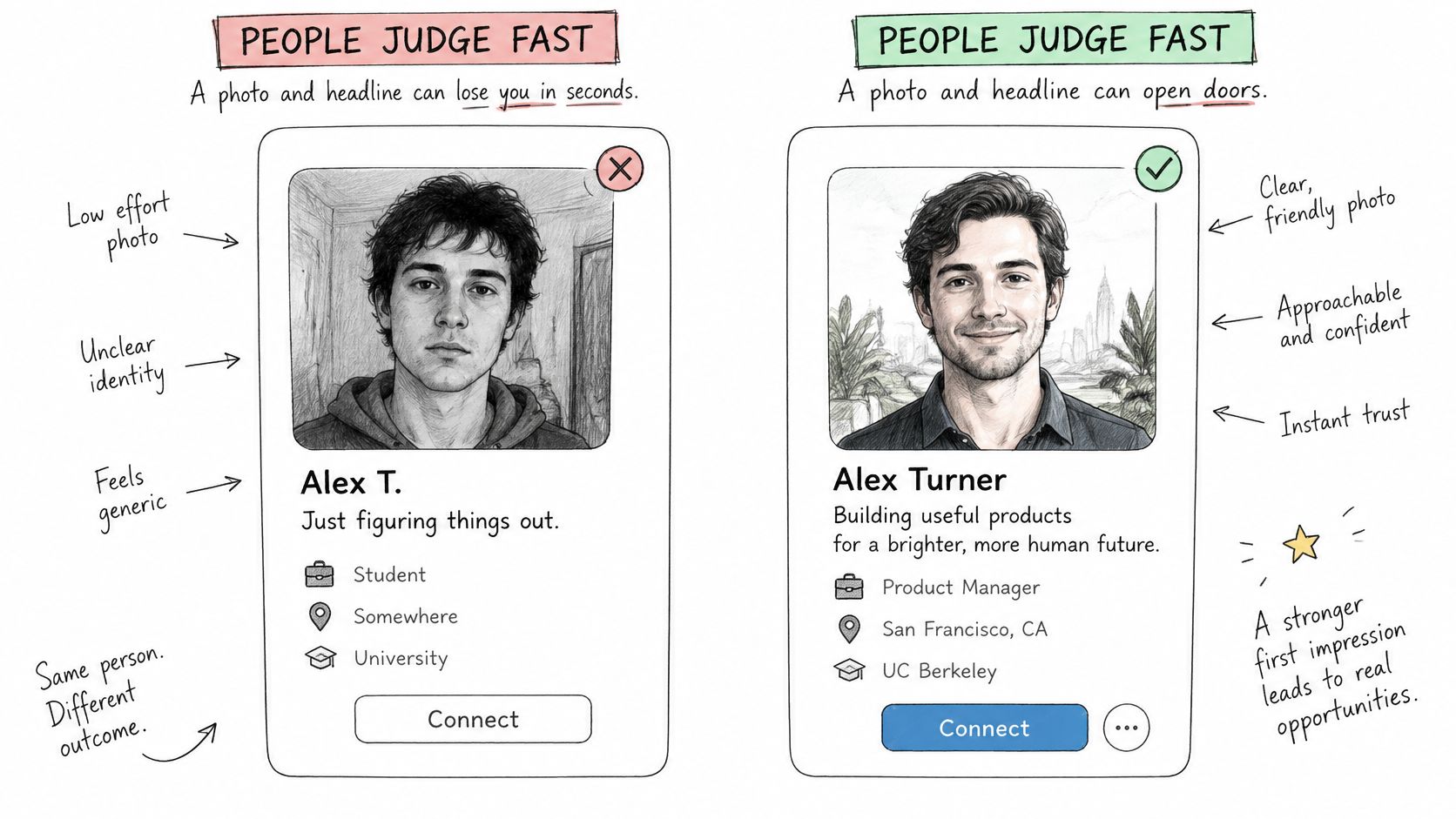
Your favorite photograph isn't necessarily the photograph that communicates the right impression.
In research on profile-image selection, internet-based studies with a combined 610 participants found that strangers selected images producing more favorable impressions than people selected for themselves; related research examining 1,316 first impressions associated photographs showing people smiling, outdoors, or with others with greater agreement among observers. Agreement doesn't establish accuracy, and a smile isn't a universal prescription for professionalism.
Gather current photographs and show them to independent reviewers outside your company. Explain the target audience before asking which image communicates competence and approachability.
Ask what each photograph suggests, not which looks nicest. Someone may prefer a dramatic portrait while finding a simpler photograph easier to approach. You're testing contextual fit, not running a beauty contest.
For practical preparation and framing, use this founder's guide to professional profile photos.
The comparison below is a useful reminder to evaluate the photograph and wording together.
Use audience, work, and substantiation as your drafting pattern. These illustrative lines aren't claims about real clients:
Founder headline: Founder building onboarding software for customer success teams.
Supporting bio: I share product decisions and onboarding lessons from building the business. Explore the product walkthrough below.
Operator headline: Customer success operator focused on onboarding and implementation.
Supporting bio: I document handoff processes, rollout decisions, and implementation lessons. See the linked workflow example.
Use only the version your actual work supports. Don't imply you've published a walkthrough or built a workflow unless visitors can inspect it.
If you're stuck generating alternatives, AiHeadshots' LinkedIn headline writing tool can serve as a drafting aid. Reject any suggestion that exaggerates your experience or sounds unlike you. A useful headline makes your work legible, not grander than it is.
Give each profile a job. LinkedIn can explain your professional context, X can introduce your perspective, and Instagram can organize a visual introduction to your work. Treat these as editorial choices, not universal rules about how every buyer behaves.
Use the same hypothetical onboarding-software founder across the rewrites. The offer stays stable; the presentation changes.
| Platform | Primary text field | Visual to check | Best CTA | Search cue |
|---|---|---|---|---|
| Headline and About | Portrait and banner | Book a relevant call | Role, audience, and specialty | |
| X | Name line, bio, and pinned post | Avatar and header | Read a specific post | Plain-language work description |
| Name field and bio lines | Portrait and highlight covers | Follow for a named topic | Descriptive specialty and captions |
Before: Founder. Builder. Passionate about customer success.
After: Founder building onboarding software for customer success teams.
Use the About section to explain the customer problem, your approach, and what you're currently building. Put inspectable work in Featured. Write experience bullets around your contribution and documented outcomes, rather than copying a job description.
Choose skills that match the work you want to discuss. Provide a business contact path and make the invitation specific: Book a call about your onboarding workflow. The destination should explain what happens next.
Before: Building cool things. Thoughts are my own.
After: Building onboarding software. Sharing product decisions and customer success workflows.
Make the name line useful even when someone doesn't see the full bio. Pair your name with a concise work description where appropriate, rather than adding an unexplained slogan.
Use the pinned post to demonstrate your thinking through a specific product decision or workflow breakdown. Point the profile link toward a relevant destination. The CTA might be Read my breakdown of onboarding handoffs, provided that post exists.
Before: Entrepreneur. Dreamer. Follow the journey.
After: Building software for customer onboarding. Product walkthroughs and workflow lessons. Explore the demo below.
Use the name field for your name and a clear specialty. Give bio lines separate jobs: identify the work, explain the content, and direct the next action. Organize highlights with descriptive covers such as Product, Workflows, and About.
Gainsty's tips for a better Instagram bio offer a useful drafting companion. Keep captions descriptive, write alt text for accessibility rather than keyword repetition, and send visitors to a focused link or clearly organized link hub.
Your CTA could instead be Follow for customer onboarding workflows if audience building is the priority. Don't ask visitors to book, subscribe, download, and follow in the same breath.
Maximum visibility is the wrong target. Controlled discoverability means deciding what the intended audience should find and what strangers shouldn't learn.
Research on social media privacy settings distinguishes awareness of settings from the accessibility and discoverability of those settings. Knowing a control exists isn't the same as finding it, understanding it, and using it deliberately.
Don't treat every empty field as an instruction to add something. Separate professional usefulness from personal exposure.
| Information category | Recommended treatment |
|---|---|
| Public positioning | Publish the role, audience, and professional work you want associated with your name |
| Restricted contact details | Prefer a business contact route over a personal mobile number |
| Optional personal facts | Share only when relevant and intentionally public |
| Sensitive material | Keep off public profiles and out of content intended for indexing |
A hypothetical founder might remove their address from the bio but leave clues elsewhere: a child's school in a photograph, a home location in a caption, or an old employer's confidential material in a featured document. Review what someone can infer across the account, not just what you explicitly state.
Use this visual to weigh findability against unnecessary exposure.
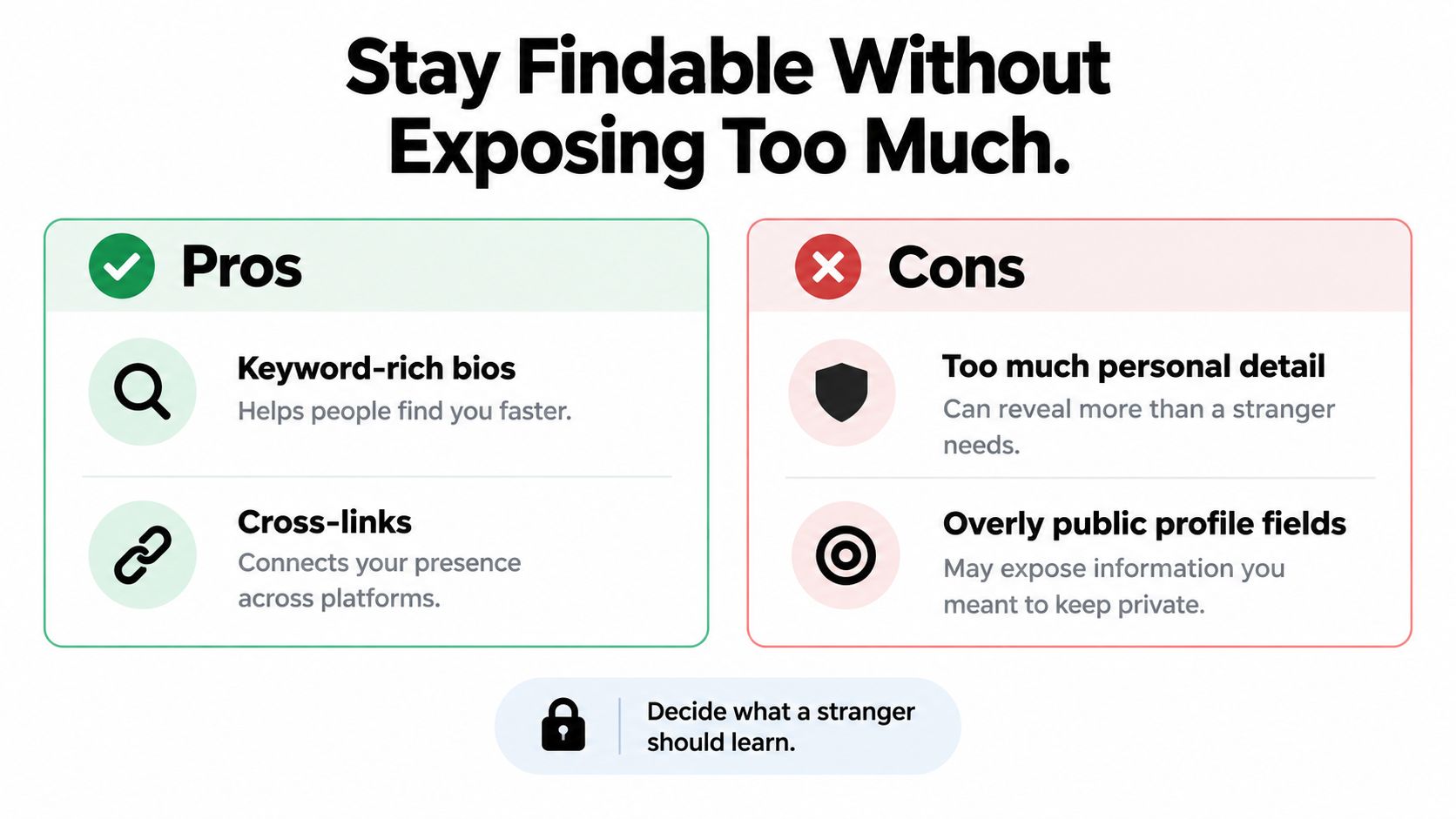
Check whether the account is public or private, whether available controls permit discovery through email or phone, and which connected accounts reveal additional information. Don't assume every platform offers identical controls or that a private account hides every profile field.
To work through available controls, use the guide to secure social profiles with Digital Footprint Check. Record your decisions so future edits don't casually reverse them.
Being approachable doesn't require being personally exposed.
Name the ideal visitor, list sensitive information, document settings, and inspect the profile in a logged-out browser. Where a platform requires login, ask a trusted non-connection to check the visitor view.
My recommendation is to treat accidental exposure as a trust problem, not just a privacy problem. Visitors should be able to distinguish an intentional business invitation from a personal detail you forgot to remove. That boundary belongs in any plan for building lasting trust online.
A completed profile needs upkeep, but a full calendar isn't evidence of a useful publishing system.
A content analysis of university social media publishing examined 90,000 posts from 70 universities and found an inverse relationship between posting activity and engagement. That institutional evidence doesn't dictate a founder's schedule, but it's a good reason not to prescribe volume before evaluating relevance.
DIY works when you'll do the maintenance. Keep a record of current positioning, approved proof, content ideas, and changes to your offer. The weak version is rewriting once, then posting whenever you remember. The stronger version includes scheduled review and actual replies.
Light help works when execution is the bottleneck. An editor can sharpen drafts, and a designer can organize visual material while you retain responsibility for ideas and conversations. Choose this when you have a clear perspective but struggle to package it consistently.
A done-with-you system works when coordination is the bottleneck. Look for an in-depth consultation about your narrative and goals, followed by writers, designers, strategists, and a success manager coordinating profile updates, publishing, and audience interaction. A generic calendar service that produces interchangeable polished posts isn't the same arrangement.
| Approach | Your responsibility | Main failure to prevent |
|---|---|---|
| DIY | Ideas, production, updates, and replies | Inconsistency |
| Light support | Perspective, approval, and relationships | Unclear ownership |
| Coordinated system | Personal input, factual approval, and boundaries | Losing your voice |
Metricool's reporting on social media trends describes a 2026 dataset with average LinkedIn engagement of 2.60% for personal profiles versus 1.74% for company pages, roughly a 49% relative advantage, and discusses social search through captions, subtitles, alt text, and question-based content. Treat the comparison as context, not a promised result for your account.
Authenticity means verifiable personal perspective, not deliberately rough production. Require first-person evidence, specific experiences, opinions you'll defend, and replies that address people's questions.
Use brand voice guidelines that remain practical to document vocabulary, examples, boundaries, and phrases you wouldn't say. If AI helps draft, require human verification and clear disclosure when its role could otherwise mislead the audience. Never publish generated experiences as your own.
Measure qualified profile visits where you can identify them, substantive comments, repeat interactions, and relevant inquiries. When analytics can't identify visitor quality, use the conversations that follow rather than pretending every view represents a buyer.
Pick the profile your intended buyers are most likely to inspect. Don't turn this into a redesign of your entire online presence.
Before editing, note the available baseline: profile views, relevant messages, and the kinds of people reaching out. Keep the observation period and any limitations in your notes. If the platform doesn't expose a metric, leave it out rather than substituting a guess.
Open the profile logged out and read it as someone who doesn't know you. Can you identify the current work, inspect supporting evidence, and understand the next action without opening unrelated tabs?
Fix the photograph and headline using the decisions you've already made. Remove a sensitive detail you don't need public. Add a proof item you're comfortable sharing, then choose a clear CTA and test its destination.
Finish line: A relevant stranger can understand the offer, check the evidence, and contact you through an intentional route.
Avoid changing your offer, landing page, posting style, and profile wording simultaneously if you want a useful read on what happened. This isn't a controlled experiment, but keeping a change log makes your observations more interpretable.
Write down what you changed and why. Note whether subsequent inquiries mention the featured work, ask more relevant questions, or reveal continued confusion. A smaller number of suitable conversations can be more useful than a larger number of unrelated messages.
Move to the next priority network and update only what needs platform-specific treatment. Reuse approved identity assets and evidence, but adapt the presentation. Don't reopen settled decisions just because another profile gives you more room to write.
Then assign an owner for upkeep. That might be you, an editor, or a coordinated team, but “we'll get to it” isn't ownership. Decide who updates the profile when your role, product, evidence, or availability changes.
If you know maintenance won't happen alone, bring your current profiles, approved work samples, and privacy boundaries to a discovery conversation. Ask how the consultation maps your story and profile gaps, what input ongoing writing requires, and who handles design, distribution, and replies. Choose between a manageable DIY routine and shared execution based on the work you'll sustain.
Legacy Builder offers a consultation-led personal-brand service combining profile optimization, writing, design, strategic distribution, and audience interaction. Visit Legacy Builder to discuss your story, identify profile gaps, and decide whether a done-with-you publishing system fits your goals.


You could – but most in-house teams struggle with the nuance of growing on specific platforms.
We partner with in-house teams all the time to help them grow on X, LI, and Email.
Consider us the special forces unit you call in to get the job done without anyone knowing (for a fraction of what you would pay).
Short answer – yes.
Long answer – yes because of our process.
We start with an in-depth interview that gives us the opportunity to learn more about you, your stories, and your vision.
We take that and craft your content then we ship it to you. You are then able to give us the final sign-off (and any adjustments to nail it 100%) before we schedule for posting.
No problem.
We have helped clients for years or for just a season.
All the content we create is yours and yours alone.
If you want to take it over or work on transitioning we will help ensure you are set up for success.
We want this to be a living breathing brand. We will give you best practices for posting and make sure you are set up to win – so post away.
Subscribe to our newsletter and get insights on how to grow your personal brand.
