.svg)
Subscribe to our newsletter and get insights on how to grow your personal brand.
Thank you! Your submission has been received!
Oops! Something went wrong while submitting the form.
.svg)


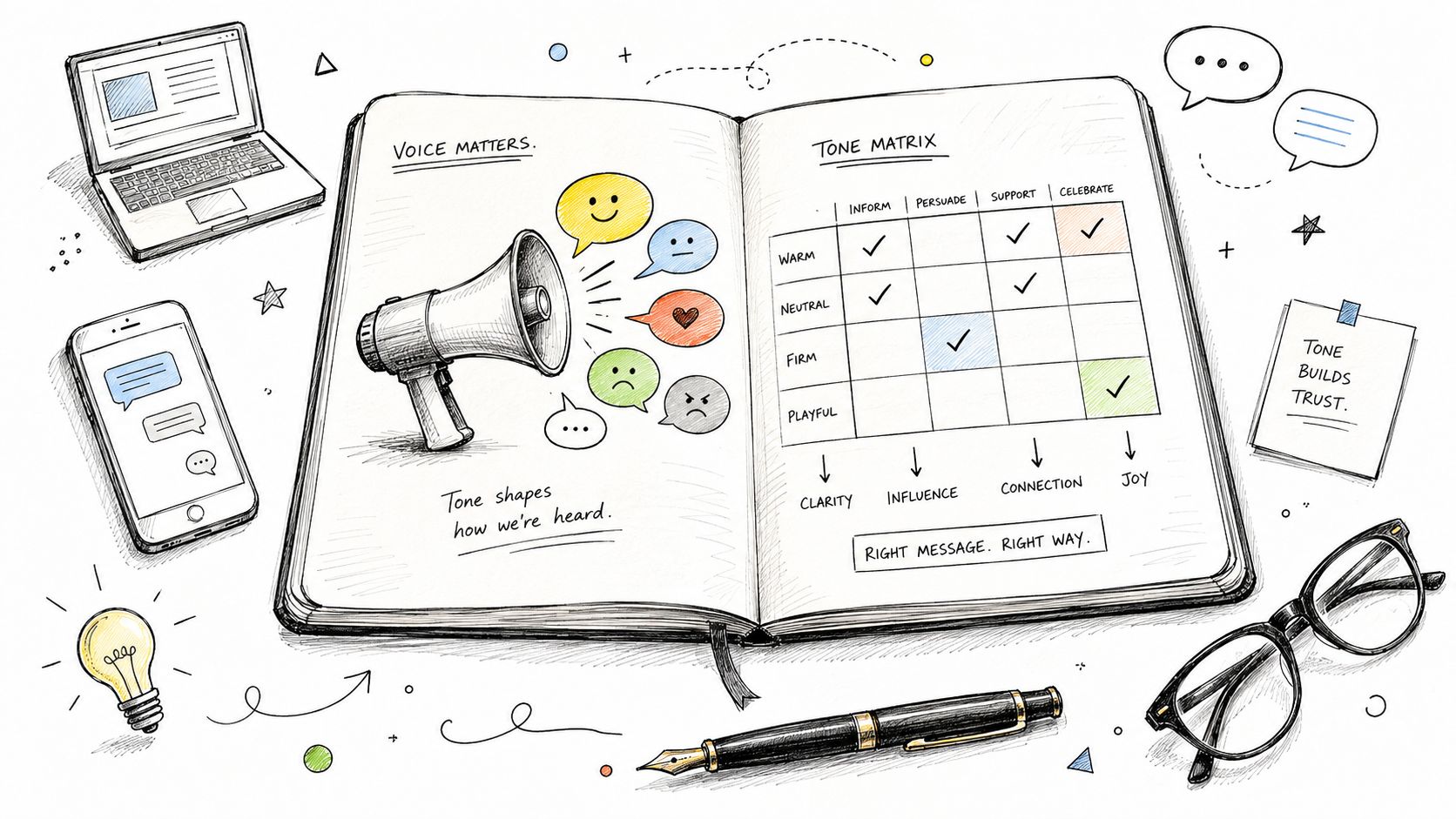
You can feel the problem before you can name it. On Monday, you write a sharp LinkedIn post. On Tuesday, you answer a prospect DM like a friendly operator. On Wednesday, your newsletter sounds like it was drafted by a different person entirely. Same name. Same offer. Different voice every time.
That inconsistency is expensive. People trust patterns, not intentions, and brand voice guidelines are what turn your communication from improvisation into something repeatable. For solo founders and personal brands, that matters even more, because your voice is the brand. There's no logo system to hide behind when your post, your pitch, and your reply all land on the same person.
The point isn't to sound scripted. The point is to sound like yourself on purpose, every time.
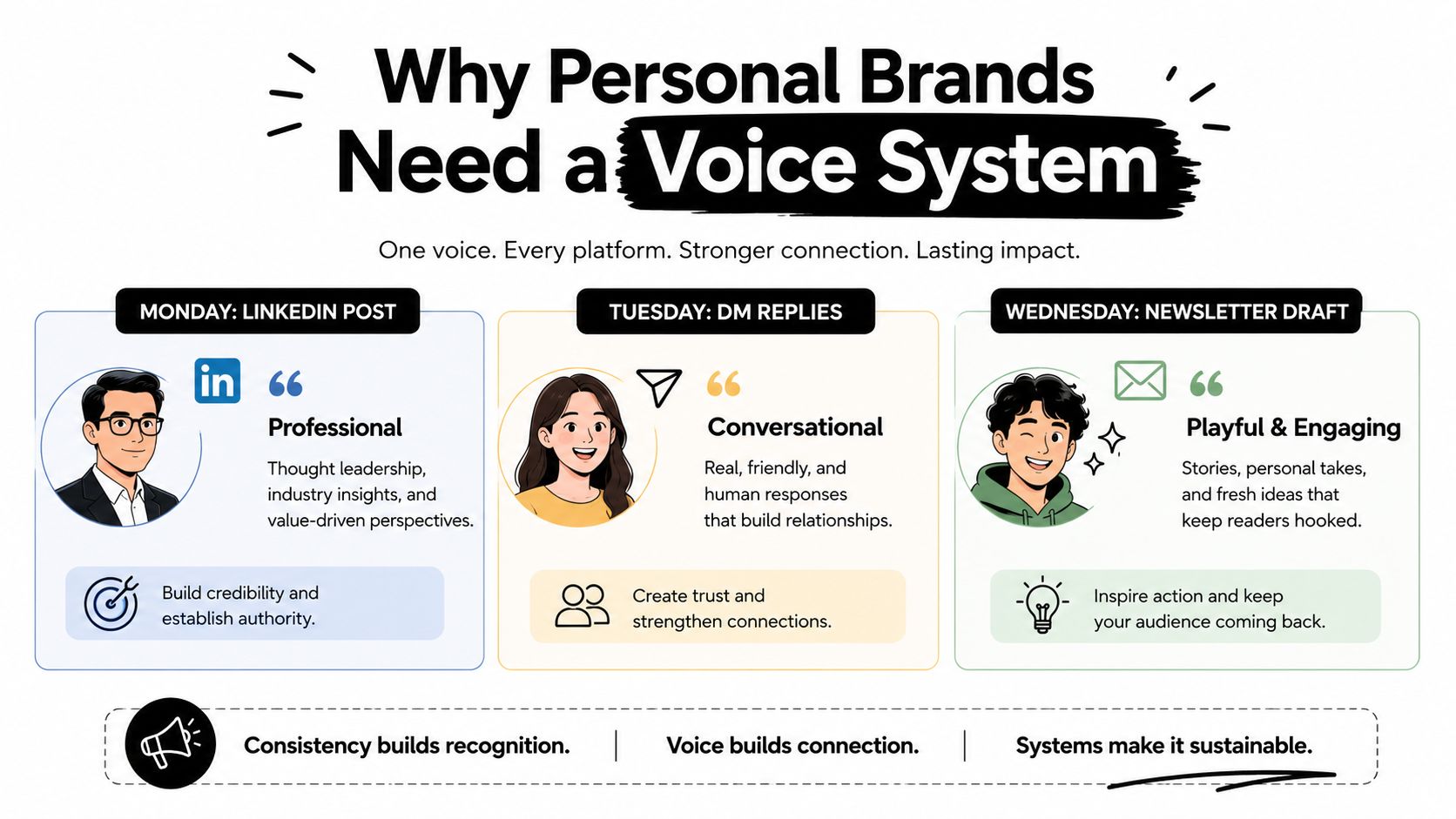
A useful way to think about this is simple. Brand voice is your consistent personality in writing. Tone shifts with context, a sales DM sounds different from a launch email. Messaging is the substance, the actual claim, offer, or point you're making. If you mix those up, every piece of content starts fighting with the others.
The business case is plain. In a 2024 branding statistics roundup, 68% of companies said consistent branding contributed 10% to 20% revenue growth, and 67% of customers said they would continue buying only from brands they trust (Vistasocial). A 2026 analysis also reported that posts using a consistent brand voice earned 23% more engagement (Vistasocial). For a founder, that translates into more replies that feel warm instead of awkward, more DMs that move forward, and less rewriting every time AI gives you something bland.
If you want a creator-focused example of how voice shows up across formats, see use cases and compare the patterns to your own content stack. If you're leading with a personal brand instead of a company page, the same logic applies even harder, as described in this modern playbook for personal branding for leaders.
A founder can't afford a split personality in public. One day you're thoughtful and measured, the next day you're punchy and overexplaining, and the audience never gets a stable read on who's talking. That instability doesn't just make the content feel messy, it makes the buyer hesitate.
The fix is a voice system, not a mood. Corporate teams need it to align departments, but solo founders need it because every touchpoint is yours. Your post, your DM, your landing page, your podcast intro, and your support reply all carry the same signature, so one weak or off-tone message can distort the whole impression.
Practical rule: If you wouldn't want a prospect to describe your writing with three different adjectives in the same week, your voice isn't documented well enough.
The reason brand voice guidelines work is that they separate what stays fixed from what can change. Visual identity gives you a look. Positioning gives you a niche. Voice gives you a recognizable way of speaking inside that niche. For a personal brand, that's the difference between sounding like “a person in the market” and sounding like your person.
There's another reason to document it. In major markets, people meet you in fragments. They see a post on LinkedIn, then a newsletter, then a reply in the comments, then an AI-assisted follow-up. If those fragments don't line up, trust gets thin fast. Consistency isn't polish, it's evidence that there's a real operator behind the words.
Your operating definition should be short. Voice is your stable communication style. Tone is the emotional adjustment you make for the moment. Messaging is the point you're making. When you keep those lanes separate, you stop overcorrecting every draft.
A solo founder voice guide should answer one question very clearly. If someone read ten pieces of your writing with the names removed, what would they say feels unmistakably you? That's the standard. Anything less is just content with your byline on it.
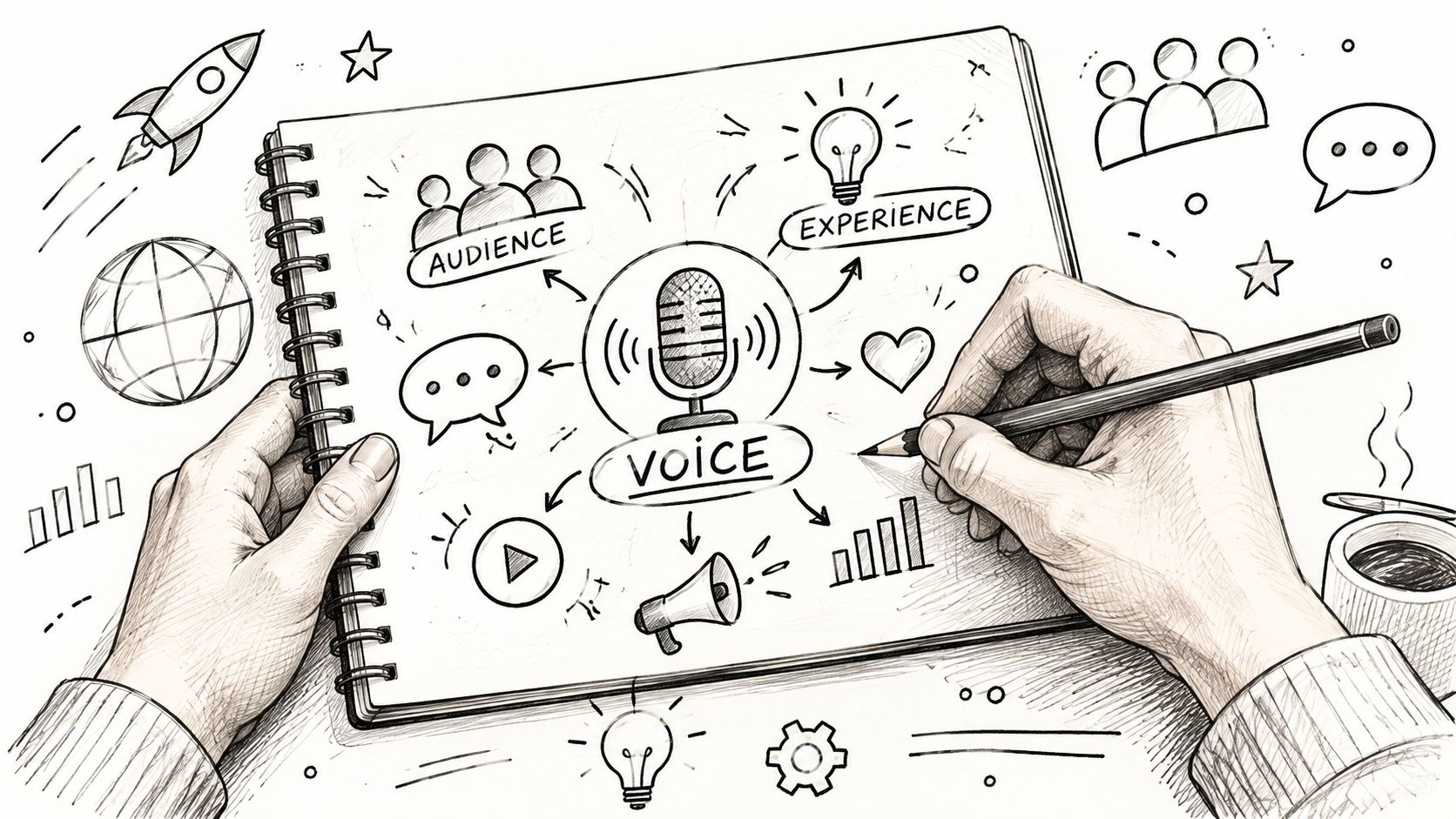
Most voice guides fail right here because people start with adjectives and stop before they do the work. “Clear.” “Friendly.” “Expert.” Those words look useful, but they don't tell a VA, a ghostwriter, or an AI tool what to do. You need traits that are grounded in your real output, not your self-image.
Start with the content you've already published. Pull 40 to 60 artifacts, including posts, newsletters, sales emails, DMs, and landing page copy, then score each one on five dimensions, clarity, distinctiveness, consistency with peers, alignment to positioning, and reader-centricity (The Starr Conspiracy). Then talk to three people who know your writing well, ideally customers or warm audience members, and ask what your writing feels like to them. Their words will expose the pattern faster than your own introspection.
Don't write traits as standalone vibes. Write them as pairs with opposites attached. That's how you make them usable. The shape should look like this, direct but warm, expert but plain-spoken, confident but never arrogant.
Here's a quick extraction template you can use:
Trait pair: direct but warm
What it means: You state the point fast, but you don't sound clipped or cold.
Not this: “Attached is the revised draft. Please review.”
This instead: “I tightened the draft and kept the core idea intact. Take a look when you have a minute.”
Trait pair: expert but plain-spoken
What it means: You know the subject well, but you don't hide behind jargon.
Not this: “We use cross-functional teamwork to put a scalable content plan into action.”
This instead: “We turn your ideas into content people can follow and trust.”
Trait pair: confident but never arrogant
What it means: You make clear claims without sounding like you're performing authority.
Not this: “Obviously, this is the only serious approach.”
This instead: “This is the approach I use because it holds up when the content volume gets real.”
The point of the antonym is discipline. It keeps the trait from drifting into the nearest cliché. If you say “friendly,” you'll end up with fluff. If you say “direct but warm,” you can make cleaner decisions.
For founder-led brands, the audience validation matters a lot. A practical three-question check is enough: “What do you notice first in my writing?” “What should I sound more like?” “What should I never sound like?” You're looking for patterns, not poetry.
If you want another frame for identifying what already sounds right, the breakdown in crafting your brand voice is worth comparing against your own raw drafts. The goal isn't to borrow their phrasing, it's to pressure-test whether your traits are specific enough to survive contact with real writing.
Your voice traits should be so concrete that a stranger can use them without asking you what you meant.
A founder can sound sharp in a DM and measured in a public reply without losing recognizability. That is the job of the tone matrix, it keeps the voice fixed and gives you clear defaults for each channel and situation.
Use it to turn traits into decisions. “Direct but warm” is not a slogan, it tells you how much context to include, how much energy to show, and how fast to get to the point. A cold DM should cut straight to the value. A warm reply should match the reader's energy without turning into flattery. A tense public response should slow down, stay exact, and avoid anything that sounds performative.
| Channel or Moment | Tone Rule | Sample Line |
|---|---|---|
| Cold DM | Keep it concise, useful, and non-needy. | “Saw your post on onboarding friction. I've got one idea that usually reduces the back-and-forth.” |
| Warm reply | Match the reader's energy without overdoing it. | “That win matters. You solved the part most teams avoid.” |
| LinkedIn long-form | Add depth, but keep the first layer readable. | “The problem isn't content volume. It's that most founders write without a repeatable voice.” |
| Sales call recap email | Be crisp, accountable, and specific. | “Here's what I heard, here's what I'd change, and here's the next step I recommend.” |
| Conference bio | Sound credible without sounding inflated. | “I help founders turn scattered insights into a voice people recognize fast.” |
| Public complaint from a customer | Stay calm, own the problem, and avoid defensiveness. | “You're right to call this out. I'm looking at the issue now and I'll post the fix.” |
The matrix works because it prevents tone from turning into a personality costume. Excitement calls for more energy. Frustration calls for less friction. Public tension calls for precision. The same founder should sound like the same person in every case, just calibrated to the moment.
A founder who answers praise with exaggerated enthusiasm sounds fake. A founder who jokes through a complaint sounds careless. The trait pair, direct but warm, should produce different copy depending on where the message lives. In a DM, it can be short and inviting. In a public reply, it should be measured and accountable.
Channel rules matter more than adjectives. You are not telling AI or a VA to “be friendly.” You are defining what friendly looks like in that exact surface. That is what makes a voice system usable for one person plus AI tools, because the system gives clear inputs instead of vague taste tests.
Write one rule for each major channel. Add one sample line beside it. Then pressure-test it in live work. If you want a clean benchmark for phrasing and structure, the examples in content writing best practices show how tight copy supports consistency without flattening the voice. A future collaborator should be able to apply the rule in ten minutes and land close to your standard.
Abstract rules collapse the moment someone has to write a real sentence. That's why the strongest voice guides pair principles with hard examples. If you want consistency, build a page that shows people exactly what to do and exactly what to avoid.
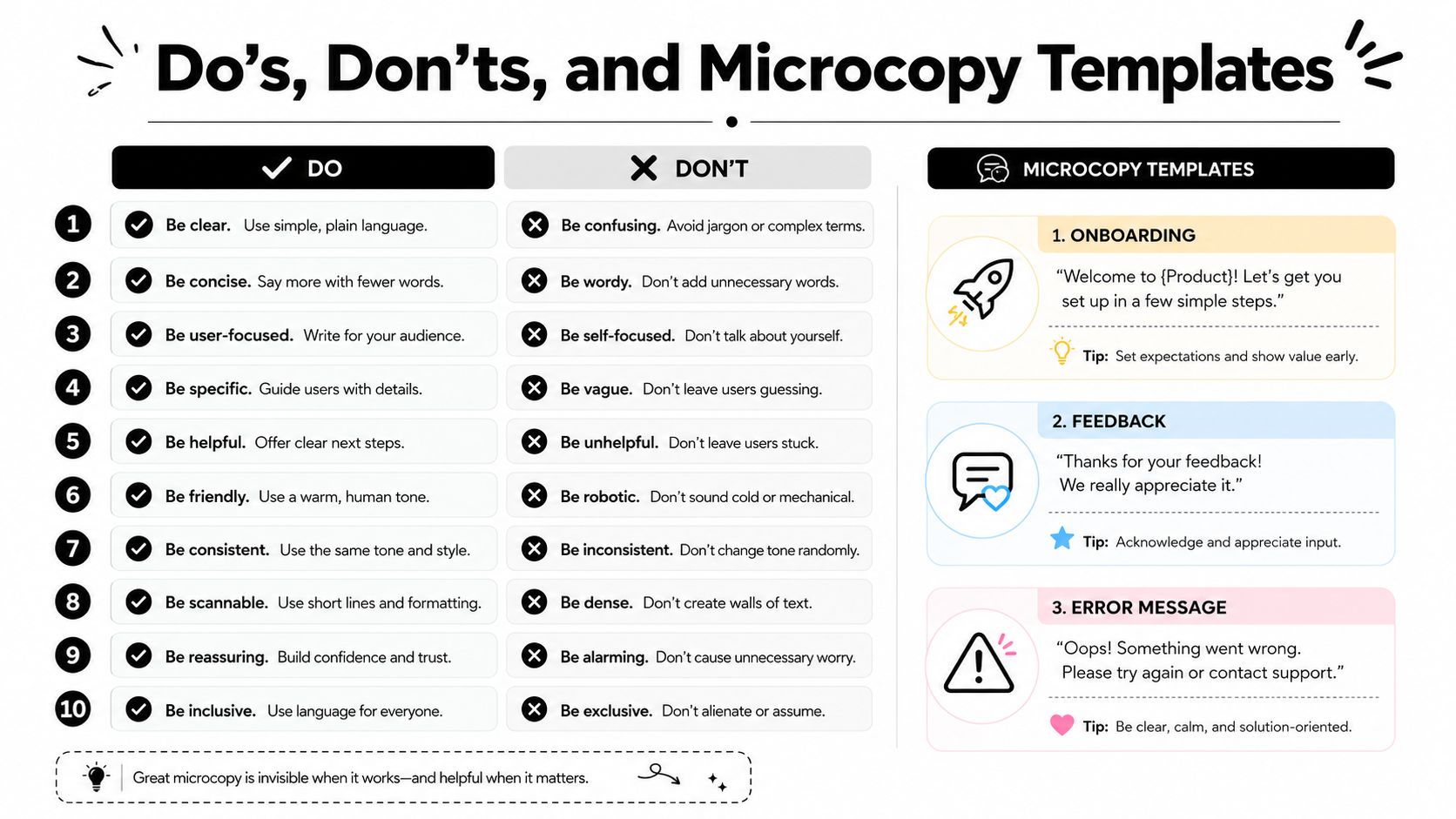
Here are ten pairs you can adapt immediately:
A strong guide also needs microcopy templates, because the hardest lines are usually the shortest ones. Your hook, DM opener, and subject line carry a lot of weight. If they're weak, the whole piece feels off.
LinkedIn hook
“Most founders don't have a content problem. They have a voice problem.”
Cold DM opener
“Saw your post on [topic]. I have one idea that may help with [specific friction].”
Email subject line
“Quick idea for your [specific goal]”
Those templates work because they're clear, specific, and easy to adapt. They don't try to be clever. They create momentum. If you want a rule behind them, it's this, lead with relevance before style.
For the same reason, approved and banned words belong in the guide. Pick a short approved list, maybe “clear,” “sharp,” “plain,” “useful,” and “calm” if those fit your positioning. Then list the words that make you sound generic or bloated, like “unlock,” “leverage,” or “revolutionary” if they don't belong in your voice. Your actual banned list should reflect your own habits, not somebody else's brand deck.
If you're building content systems with a team or with AI prompts, pair those rules with the workflow advice in content writing best practices. The point is not to write more. The point is to make every line more you.
A voice guide that sits in a folder is a souvenir. The actual work begins when it shows up in your weekly writing, edits, and approvals.
Start with training. If a VA, ghostwriter, or AI tool is part of the process, give them the guide and make them use it on a live task, not a mock exercise. Have them rewrite an actual post, DM, or newsletter intro, then compare the output against your trait pairs and banned terms. If they cannot apply the rules under real pressure, the guide is too vague.
Put the rules where the work happens. Pin them in Slack, place them in Notion, or build them into the content brief with your trait pairs, tone matrix, and approved vocabulary. A living template can sit inside production instead of outside it, and brand guidelines templates for creators are useful for that kind of setup.
Every 90 days, score the last 30 days of content on a 1 to 5 scale for voice fit, clarity, and consistency, using the same simple rubric every time (Watson Creative). That cadence catches drift early, before your content starts feeling split across formats. It also gives you a record for why you changed something.
Use the review to answer three questions:
If your content starts sounding “fine” instead of unmistakable, the drift has already begun.
Some moments call for a deliberate voice break. Trend-jacking can justify a temporary change in energy. Breaking news may call for a more restrained or more urgent tone. Fundraising announcements can lean more formal than your default. Name those exceptions in the guide so nobody mistakes them for the baseline.
You also need authority rules. If AI-generated copy, a VA draft, or a collaborator's rewrite conflicts with your core voice, you decide. Not the tool. Not the fastest person on the team. That part is required. For a broader framework on operational control, what is content governance is a useful companion read.
A voice guide should age with the business, not against it. If it's not changing, it's probably getting stale. The trick is knowing what to watch and when to rewrite.
Don't overcomplicate measurement. Track whether people respond more clearly to the way you write. Look at save rate, DM replies, and qualified inbound as practical signals that your voice is doing useful work. Those are not vanity numbers. They tell you whether the words are creating momentum or just filling space.
You should consider a full rewrite when one of four things happens.
Localization is the other place where founders get sloppy. Some voice elements should stay global, especially the core traits and the essential words that define you. Other elements can flex, like idioms, references, and level of formality. The simple rule is this: if changing it would make you sound like a different person, keep it fixed. If changing it helps the reader understand you faster in their market, let it flex.
A clean review cadence helps you avoid guessing. Check the guide at 30 days for obvious friction, 60 days for repeat patterns, and 90 days for formal scoring and updates. That rhythm keeps the system alive without turning it into another maintenance burden.
The point of all of this is simple. You're not building a style doc. You're building a decision system that helps you write faster, stay recognizable, and sound like one coherent person across every channel.
If you want your personal brand to sound consistent without trapping you in corporate language, Legacy Builder builds content systems around the way founders speak and publish. They help turn your story, insights, and positioning into a repeatable voice system that can hold up across posts, emails, and AI-assisted workflows.


You could – but most in-house teams struggle with the nuance of growing on specific platforms.
We partner with in-house teams all the time to help them grow on X, LI, and Email.
Consider us the special forces unit you call in to get the job done without anyone knowing (for a fraction of what you would pay).
Short answer – yes.
Long answer – yes because of our process.
We start with an in-depth interview that gives us the opportunity to learn more about you, your stories, and your vision.
We take that and craft your content then we ship it to you. You are then able to give us the final sign-off (and any adjustments to nail it 100%) before we schedule for posting.
No problem.
We have helped clients for years or for just a season.
All the content we create is yours and yours alone.
If you want to take it over or work on transitioning we will help ensure you are set up for success.
We want this to be a living breathing brand. We will give you best practices for posting and make sure you are set up to win – so post away.
Subscribe to our newsletter and get insights on how to grow your personal brand.
