.svg)
Subscribe to our newsletter and get insights on how to grow your personal brand.
Thank you! Your submission has been received!
Oops! Something went wrong while submitting the form.
.svg)



Most advice on how to build trust online starts with “just be authentic.” That's incomplete advice. Authenticity matters, but strangers don't experience your intentions. They experience your profile, your response patterns, your proof, your policies, and the amount of effort required to verify that you're legitimate.
Trust is an operational system. It combines identity cues, behavioral consistency, useful evidence, third-party validation, and low-friction security signals. In 2026, that system matters because shoppers are actively looking for reasons to pause. Research found that 82% of shoppers were more likely to trust a site displaying a prominent third-party verified trust badge, while 40% interpreted the absence of such indicators as a possible sign of fraud (Usercentrics Digital Trust Report 2026).
The practical implication is simple: stop asking whether your brand feels authentic and start asking whether a skeptical stranger can verify you quickly, understand your promise, and see evidence that you keep it.
“Be authentic” is useful as a personal standard. It's weak as a growth strategy.
A person can be sincere and still look unreliable online. An incomplete profile, a vague bio, an outdated website, inconsistent contact details, and generic content create doubt even when the person behind them is honest. Authenticity is the baseline. Trust comes from visible patterns that make authenticity easy to verify.
Audiences now scan for missing cues. They notice when there's no real photograph, no clear explanation of what you do, no identifiable business, no recent activity, or no way to contact you outside a platform. They're not necessarily conducting a formal investigation. They're pattern-matching under uncertainty.
That behavior has a commercial consequence. The same Usercentrics research found that 89% of shoppers had abandoned a purchase because a site raised doubts, and 51% cited questionable business legitimacy as a reason, up from 46% in 2024 (Usercentrics Digital Trust Report 2026). A polished claim can't compensate for missing legitimacy signals.
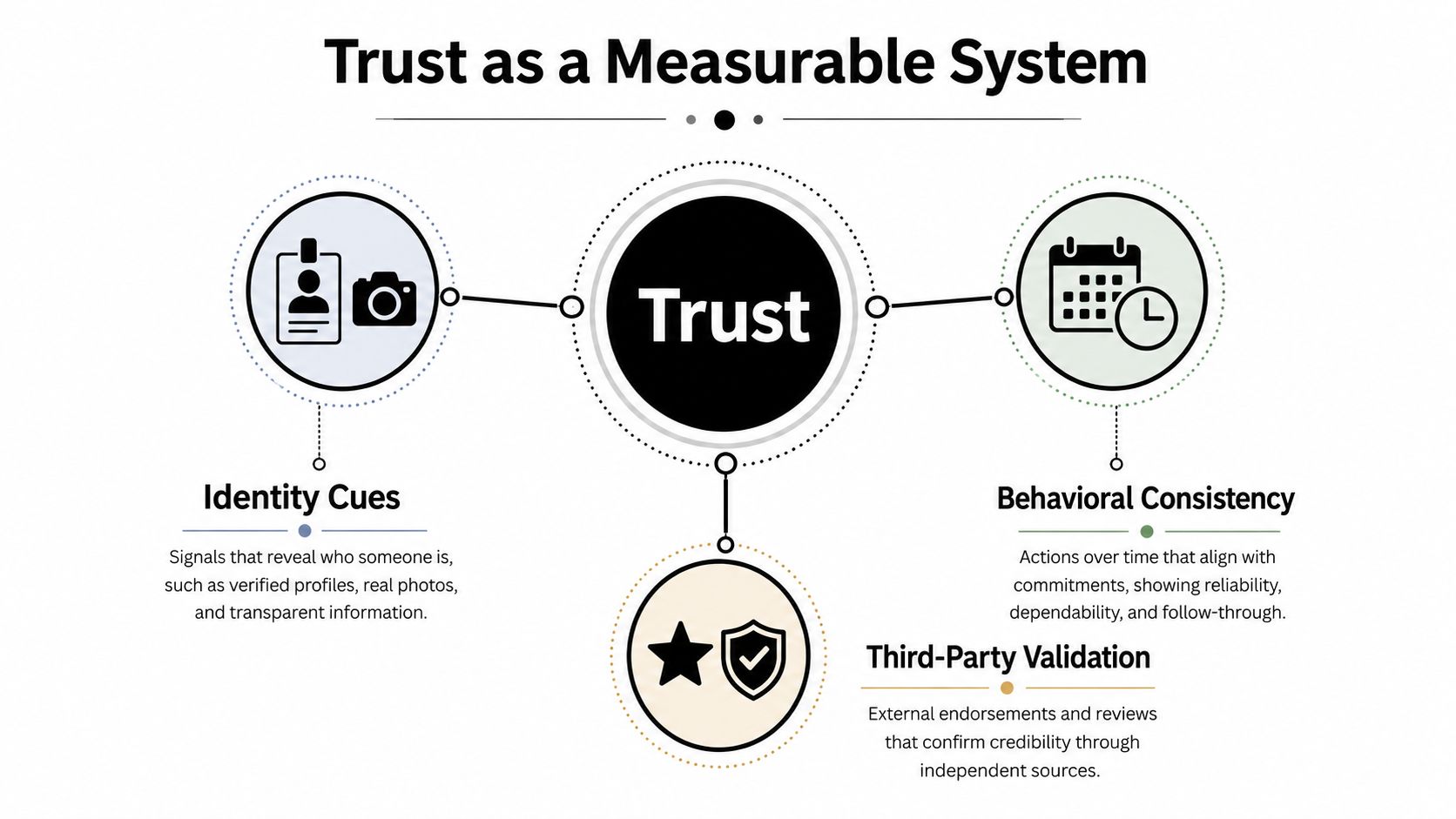
Your audience expects your voice to sound like you. They expect your credentials to be accurate. They expect you to disclose relevant limitations and correct mistakes. Meeting those expectations prevents distrust, but it doesn't automatically create authority.
Trust compounds when you stack four things:
The MIT study on web credibility found that website characteristics explained 76% of the variance in perceived web trust, with navigation contributing about 27%, brand about 17%, advice about 14%, and both error-free presentation and privacy/security about 11% each (MIT web trust study). That finding challenges the belief that security badges or personal warmth can rescue a confusing experience. They can't.
Practical rule: If a stranger has to trust your personality before they can understand your identity, your system is backwards.
Build the cues first. Then let your personality strengthen a foundation that already makes sense.
Your profile isn't a biography. It's a credibility interface. A stranger should be able to identify who you are, who you help, and why your claims deserve attention without hunting through old posts.
Start with the photograph. Use a professional headshot with a consistent background across LinkedIn, X, Instagram, and your personal site. It doesn't need to look corporate, but it must be recent, recognizable, and clearly connected to the same person. Anonymous logos and heavily edited images create unnecessary distance for founders, consultants, and creators selling expertise.
Your headline should name the audience and outcome. “Marketing consultant” says almost nothing. “Helping B2B founders turn complex expertise into a consistent authority platform” gives a visitor a subject, a customer, and a result. Your bio should then add one proof line and one promise. Proof might be a credential, a specialization, or a type of work you've completed. The promise should explain what someone can expect from following or contacting you.
Use this definitive guide to LinkedIn profile optimization when you're rebuilding your LinkedIn presence, but apply the same audit logic everywhere.
Run this checklist while viewing each profile as someone who doesn't know you:
Pronunciation guidance and name clarification also matter, especially for professionals who regularly speak, teach, or appear on video. Certifications should be visible when they're relevant, but don't bury them beneath a wall of badges. One clear credential with context is more useful than a crowded collection nobody can interpret.
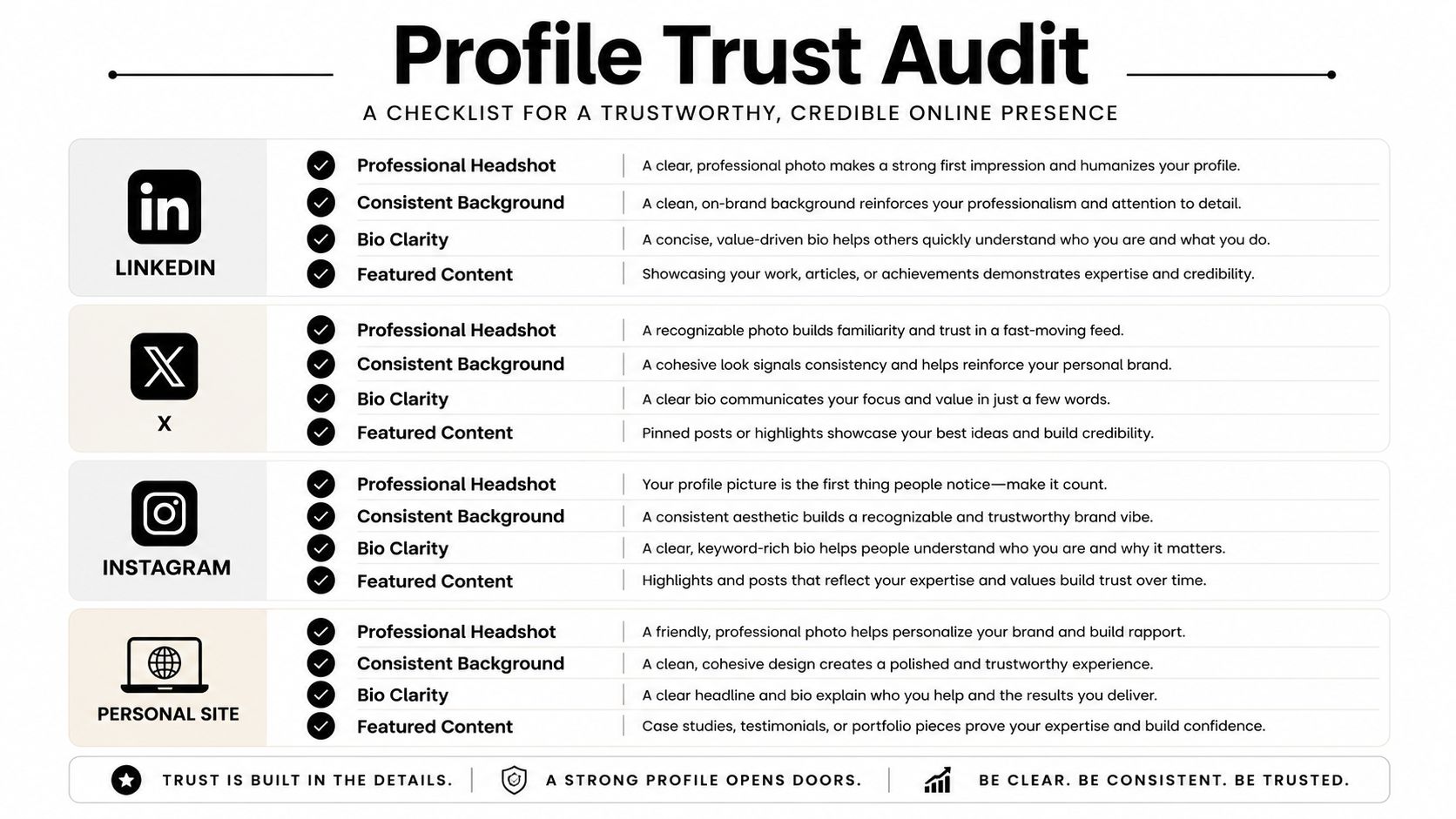
A profile passes the audit when a visitor can answer three questions quickly: Who is this? What do they know? What should I do next?
Use the following walkthrough for a practical visual example of profile positioning and presentation:
Credibility grows when your publishing system shows expertise, proof, and judgment in a pattern people can recognize.
A strong cadence balances depth, evidence, and conversation. Long-form work demonstrates how you think. Proof posts show what that thinking produces. Conversational posts reveal judgment and make the relationship feel human. Remove one category, and your audience sees only part of the picture.
Use this operating rhythm:
| Format | Weekly Frequency | Trust Signal Reinforced | Example |
|---|---|---|---|
| Pillar long-form | One | Depth and expertise | Essay, newsletter, or detailed video |
| Short-form proof posts | Two | Evidence and results | Case example, data point, process breakdown, or before-and-after |
| Conversational posts | Three | Relatability and judgment | Opinion, question, response, or industry hot take |
For the first 30 days, prioritize clarity. Publish around three evergreen pillars that define your expertise, one timely pillar connecting your perspective to current conversations, and one behind-the-scenes pillar showing how you work. Familiarity should come before novelty.
From day 31 through day 60, repeat the strongest themes with sharper examples. Turn questions from comments and DMs into posts. Repetition builds association when it helps an audience connect your name with a specific problem.
From day 61 through day 90, refine the system. Keep themes that generate thoughtful replies, direct requests, referrals, or repeat mentions. Retire formats that attract attention without creating a meaningful relationship.
Aim for a 70/20/10 split across educational, narrative, and promotional content. Educational posts teach a method or clarify a decision. Narrative posts explain the experience behind your point of view. Promotional posts make a direct invitation without forcing every post to sell.
A one-page weekly calendar can look like this:
Use this social media content calendar template to turn the cadence into a repeatable workflow.
Stop publishing when you are repeating a claim without adding evidence, filling a slot without a clear purpose, hiding a weak offer behind more content, or sharing advice you would not defend in a direct conversation. Credibility comes from deliberate repetition, while content noise makes your signals harder to read.
Reach is useful only when people stay long enough to understand you. A thoughtful reply that helps a reader make a decision can do more for trust than several generic posts that disappear in the feed.
The best engagement feels like public proof of your standards. Respond to skepticism without defensiveness. Answer questions with enough detail to be useful. Admit when a point depends on context. Readers who never comment still watch how you handle disagreement.

When someone challenges your claim:
“That's a fair objection. My view depends on [specific condition]. If that condition doesn't apply, I'd use [alternative]. The useful question is whether [decision criterion] is true in your situation.”
This response shows reasoning instead of performance.
When a stranger sends a cold DM:
“Thanks for reaching out. I saw your question about [specific topic]. The most useful place to start is [relevant public resource or practical step]. If you share what you've already tried, I can point you toward the most relevant next move.”
You've helped without forcing a sales conversation. If the person needs your service, the context will emerge naturally.
When someone criticizes your work publicly:
“Thanks for flagging that. You're right about [specific point]. I've updated the explanation and added [clarification]. The broader recommendation still applies when [condition], but I should've stated that boundary.”
A correction handled in public can strengthen credibility because it makes your standards visible.
Respond during your active business hours rather than pretending to be available constantly. For important conversations, prioritize the people who ask follow-up questions, add useful context, or help other readers understand the topic. These participants often drive the quality of the discussion, even when they aren't the loudest accounts.
A practical daily routine is short:
Track your reply-to-follower ratio, not follower count alone. A smaller audience that responds, returns, refers, and asks better questions is more valuable than a large audience that never enters a conversation. For a broader framework, use this complete guide to audience engagement for 2026.
Trust signals don't carry equal weight. The strongest ones reduce uncertainty with evidence that a visitor can inspect. The weakest ones ask visitors to accept your self-description.
Start with named testimonials that describe a specific experience. “Great to work with” tells a stranger almost nothing. A useful testimonial identifies the problem, explains what changed, and names the context in which the work mattered. Get permission to publish the person's name, role, company, or profile link when appropriate.
Third-party case studies come next. They're stronger because the story appears in a place you don't fully control. Verification badges and media features can reinforce legitimacy, but they shouldn't replace substance. Self-reported credentials still have value, especially for regulated or specialized work, but they're the easiest signal to overstate.
| Signal Tier | Example | Believability | Cost | Decay |
|---|---|---|---|---|
| Named testimonial | Client describes a specific problem and experience | High when detailed and attributable | Low to moderate | Increases as the client's context remains relevant |
| Third-party case study | Independent platform documents the work | High because the evidence sits outside your site | Moderate to high | Can decline if the example becomes outdated |
| Verification or media feature | Verified account, recognized publication, or professional badge | Moderate to high when the source is clear | Varies | Can weaken if the profile or feature becomes stale |
| Self-reported credential | Bio claim, award, or certification listed by you | Moderate, depending on verification | Low to moderate | Declines quickly without supporting proof |
Avoid generic “as seen in” logo walls without context. Stock-photo testimonials, unverifiable “top 1%” labels, and awards with no explanation create the exact suspicion they're meant to remove. If negative reviews exist, address the underlying issue and document your response. This resource on how to manage damaging reviews effectively offers a useful reputation-management perspective.
During the first phase, fix identity and presentation. During the next phase, publish process evidence and collect attributable feedback. During the final phase, pursue independent validation that accurately reflects the quality of your work.
Don't place every badge, quote, and logo above the fold. A visitor needs a clear promise first, then the evidence that supports it, then a low-risk next step. Trust signals convert when they answer a doubt at the moment it appears.
Trust is visible in the details surrounding identity, payments, and personal information. Before someone submits a form or books a call, they look for who operates the account, how to contact that person, what information gets collected, and what happens after they take action. Treat those details as part of your public brand system, not as legal housekeeping.
Research from the Thales Digital Trust Index found that 64% of consumers said stronger security and privacy technology would increase their confidence in a brand, including passwordless authentication, biometrics, multifactor authentication, and responsible AI use (Thales Digital Trust Index 2025). You do not need to cover your website in technical language. Explain the safeguards people encounter and place that information where decisions happen.
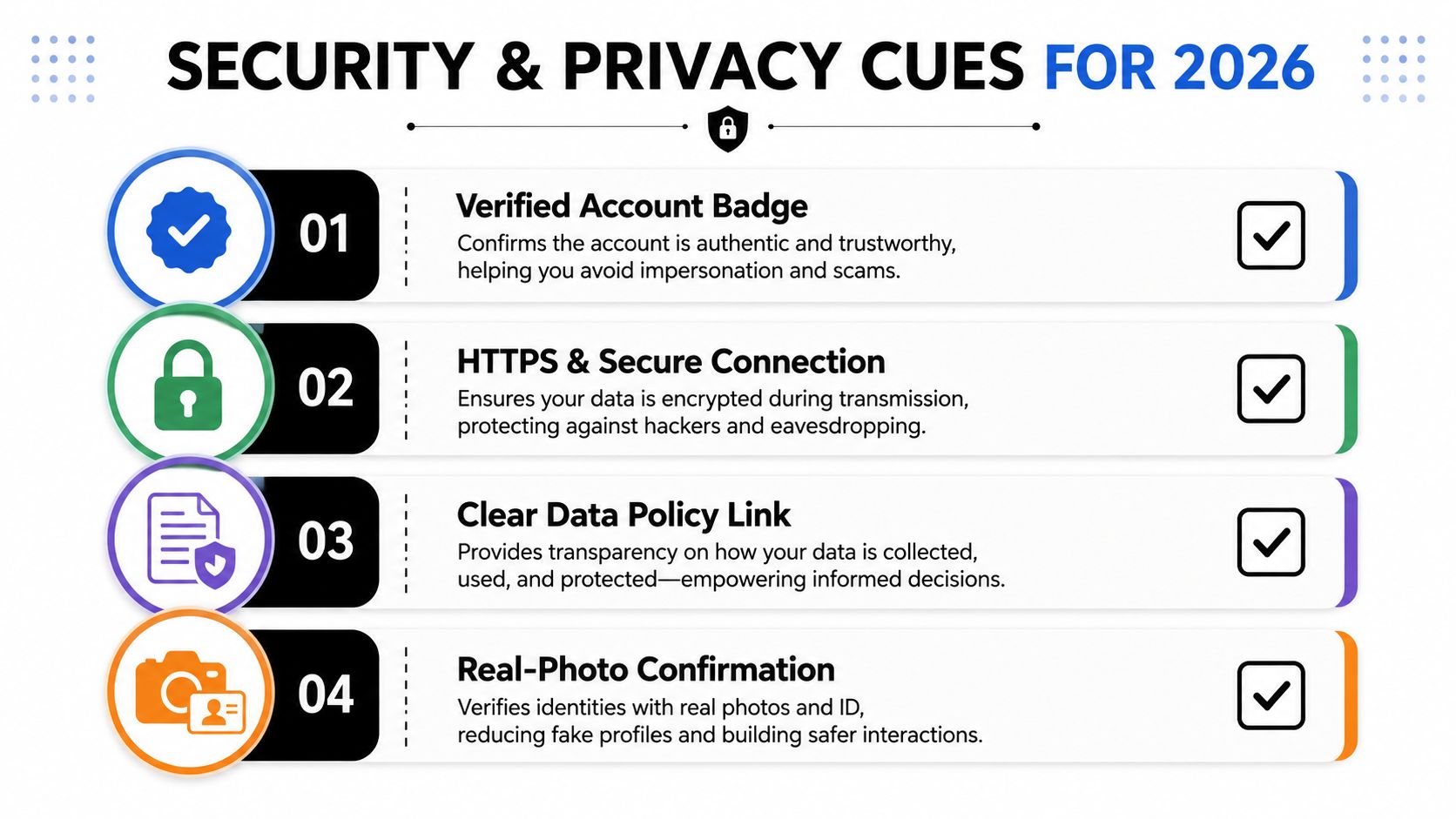
Write the policy in language a customer can understand. A bio might say, “I share practical guidance for founders, disclose AI-assisted content, and never sell subscriber information.” An About page should identify who runs the business and where customer questions go. A pinned post can explain what happens before booking, what information you request, and how you protect it.
PwC's customer experience guidance recommends pairing AI with empathy, human handoffs, transparency, and choice when data interactions become sensitive (PwC customer experience survey). Creators collecting information through video, newsletters, or community tools can also consult this privacy guide for video creators.
Place privacy information beside the form, booking button, or signup request. A footer link alone forces visitors to search for answers at the moment they are deciding whether to trust you. Clear security cues reduce that friction.
Trust becomes manageable when you track behavior instead of relying on confidence. You can't measure a feeling directly, but you can measure whether people move from recognition to interaction, interaction to inquiry, and inquiry to referral.
Run a weekly audit that takes ten focused minutes. Use a simple traffic-light system:
Review these five indicators:
A red score doesn't mean your brand has failed. It tells you where to make the next operational fix. If profile visits are healthy but follows are weak, rewrite the headline and featured content. If comments are strong but DMs are empty, make the next step clearer. If inquiries arrive but referrals don't, improve the client experience and request specific testimonials.
Credibility bio
“I help [specific audience] achieve [specific outcome]. My work focuses on [specialization], informed by [relevant proof or credential]. I share [content promise], and you can contact me through [clear route].”
Ninety-day calendar skeleton
Keep the overall balance weighted toward education, supported by narrative, with promotion used selectively.
Warm outreach message
“Hi [Name]. I read your post about [specific public artifact]. Your point about [specific detail] stood out because [relevant observation]. I've been working on [related topic], and this resource may be useful: [relevant link]. No pitch. I wanted to contribute something connected to the question you raised.”
Maintain the system with a quarterly profile refresh, a monthly testimonial review, and a weekly engagement audit. Update outdated links, remove stale claims, replace weak proof, and check whether your public promise still matches the experience you deliver. That's how trust stops being a vague brand goal and becomes a repeatable operating discipline.
Legacy Builder helps professionals and founders turn their expertise into consistent content, short-form video, newsletters, profile optimization, and strategic audience interaction in their own voice. If you want a partner to build the visible authority system behind your brand, visit Legacy Builder and explore how its done-for-you content process can support your next stage of growth.


You could – but most in-house teams struggle with the nuance of growing on specific platforms.
We partner with in-house teams all the time to help them grow on X, LI, and Email.
Consider us the special forces unit you call in to get the job done without anyone knowing (for a fraction of what you would pay).
Short answer – yes.
Long answer – yes because of our process.
We start with an in-depth interview that gives us the opportunity to learn more about you, your stories, and your vision.
We take that and craft your content then we ship it to you. You are then able to give us the final sign-off (and any adjustments to nail it 100%) before we schedule for posting.
No problem.
We have helped clients for years or for just a season.
All the content we create is yours and yours alone.
If you want to take it over or work on transitioning we will help ensure you are set up for success.
We want this to be a living breathing brand. We will give you best practices for posting and make sure you are set up to win – so post away.
Subscribe to our newsletter and get insights on how to grow your personal brand.
