.svg)
Subscribe to our newsletter and get insights on how to grow your personal brand.
Thank you! Your submission has been received!
Oops! Something went wrong while submitting the form.
.svg)



Most advice on short form vs long form content is lazy. It tells founders to pick a side, then act surprised when the strategy stalls.
That framing is the mistake.
If you're building a personal brand, attracting buyers, or trying to stay visible without turning into a full-time creator, you don't need a winner in the short-form versus long-form fight. You need a system. Short form gets attention. Long form builds conviction. The smart move is to make them feed each other instead of compete.
Busy leaders lose months by publishing disconnected content. A LinkedIn post here. A podcast there. A blog no one repurposes. Then they wonder why output feels heavy and results feel scattered. If you want to improve AI visibility with content, that fragmented approach gets weaker over time because your ideas aren't packaged in a way search systems, social platforms, or human readers can easily reuse and recognize.
The better model is simple. Create one strong long-form asset around an idea you want to be known for. Then turn that asset into a stream of short-form content that spreads the idea, tests angles, and pulls the right people back to the deeper piece.
Founders keep asking, "Should I focus on short form or long form?"
Wrong question.
The question is this: What content format moves this specific audience from first impression to business trust? Once you ask that, the fake debate falls apart. You're no longer choosing a format based on trend anxiety. You're choosing a sequence based on buyer behavior.
Short-form content and long-form content solve different problems.
Short form helps you earn attention in crowded feeds. It gives people a quick reason to care. Long form helps you explain your thinking, show your method, and prove you're not just recycling obvious advice. If you pick only one, you create a bottleneck.
A short-form-only strategy often makes you visible but forgettable. A long-form-only strategy often makes you insightful but hard to discover.
Founders don't need more content. They need tighter content architecture.
That means your content should work like a funnel, not a pile. A founder video clip on LinkedIn should lead naturally to a deeper article. A podcast clip should point toward a framework page. A contrarian post should connect to a full explanation that handles objections, examples, and nuance.
They build around core ideas, not isolated posts.
If you advise on pricing, your long-form asset might be a detailed article explaining your pricing philosophy. From that, you can pull a myth-busting Reel, a LinkedIn carousel, a sharp X thread, an email note, and a short FAQ video. Same idea. Multiple surfaces. Different levels of commitment.
That's how you stop reinventing the wheel every week.
Here's the blunt version:
People love neat definitions, but word count alone doesn't help you make better decisions. Length matters less than job to be done.
Industry benchmarks still give you a useful starting point. Written short-form content is commonly treated as under 1,000 to 1,200 words, while long-form content starts around 1,000 to 1,200 words or more. In video, short form is often 60 to 90 seconds or less. Longer formats go well beyond that, as outlined in this breakdown of short-form and long-form benchmarks.
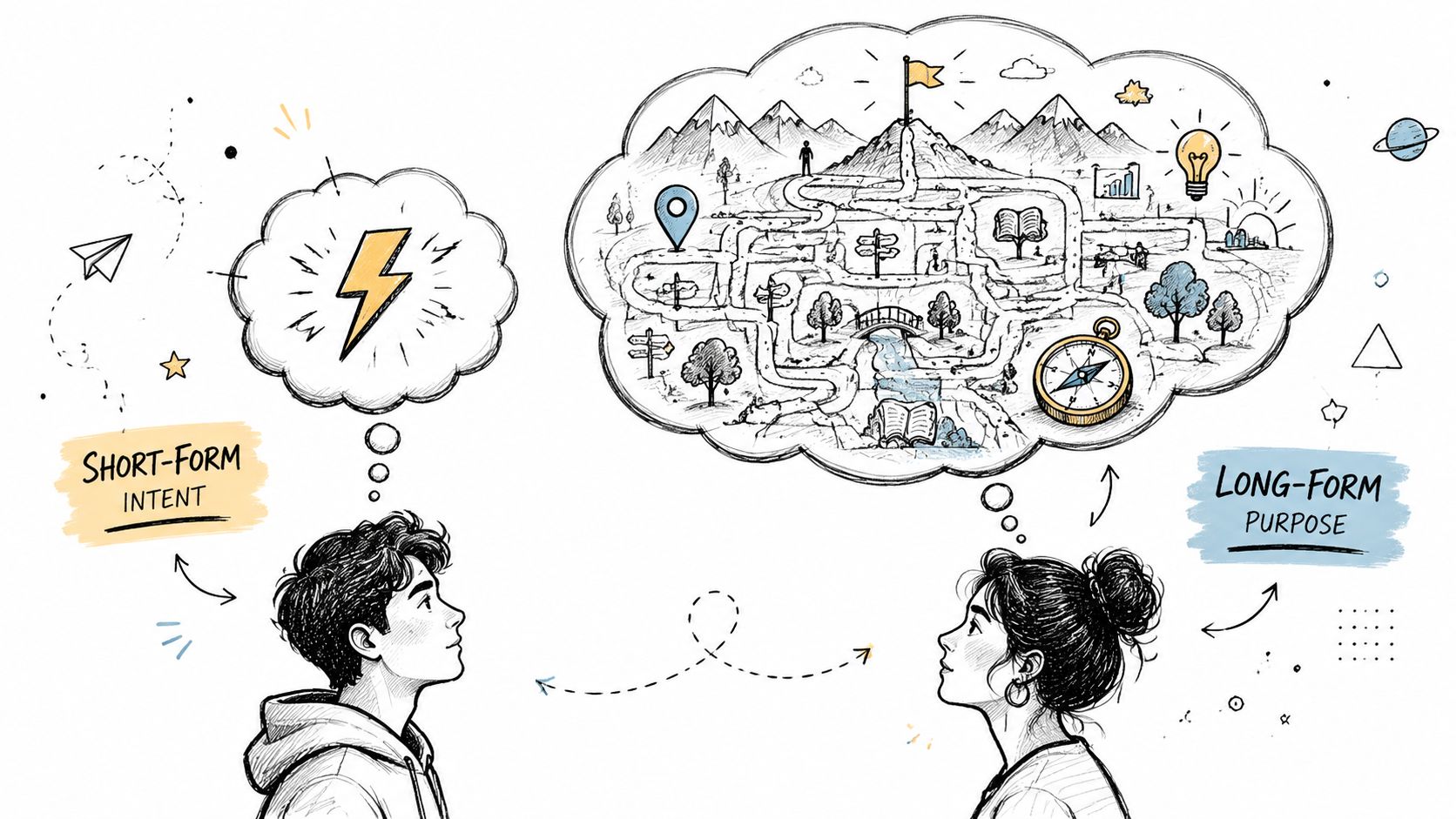
Short form is built for speed, clarity, and low-friction consumption.
Think about the moments when your audience doesn't want a seminar. They want a sharp opinion, a useful takeaway, a quick reaction, or one idea they can apply today. That's where short form wins.
For a founder, that might look like:
Short form works best when the audience is browsing, skimming, or deciding whether you're worth more of their time.
Long form is built for context, proof, and depth.
Use it when the idea needs framing. Use it when objections matter. Use it when you want someone to understand how you think, not just what you think. A founder's long-form content should usually do one of three things: teach a method, document a point of view, or answer a high-intent question in detail.
Good examples include:
Practical rule: If the audience can act after one idea, go short. If they need confidence before they act, go long.
For teams trying to sharpen their execution, this guide on creating engaging content that resonates with audiences is useful because it pushes past format and into message fit.
Don't define format by size alone. Define it by intent.
| Format | Best used for | Typical founder example |
|---|---|---|
| Short form | Discovery, reactions, quick education, testing angles | LinkedIn post, Reel, X post, email insight |
| Long form | Authority, trust, explanation, conversion support | Article, webinar, guide, whitepaper |
That's the useful mental model. Length is a production detail. Intent is the strategy.
Founders waste time on the wrong fight. The key question is not which format is better. The key question is which format does each job in your content system.
Short form wins distribution. Long form wins conviction. Build around that and the format debate gets a lot less dramatic.
| Metric | Short-Form Content (e.g., Reels, X posts) | Long-Form Content (e.g., Articles, Whitepapers) |
|---|---|---|
| Awareness | Excellent for reach and discovery | Slower, but stronger once discovered |
| Engagement | Strong on social and quick interactions | Better for sustained attention from serious readers |
| Trust building | Limited depth | Strong for explanation, nuance, and proof |
| Conversion support | Useful for prompts and entry points | Better for informed decisions and high-consideration offers |
| SEO value | Can work for concise intent, but limited depth | Stronger for competitive informational topics |
| Repurposing value | Fast to publish, easy to test | Best source material for a full content engine |
| Risk | Can create shallow familiarity | Can be slow to produce and hard to distribute without support |
Short form is your testing and distribution layer. It helps you earn attention fast, spot which messages get a reaction, and stay present without turning every idea into a production project.
That speed matters because feed-based platforms reward frequency and clarity. Wistia's video marketing research found shorter videos hold attention better than longer ones overall, especially once viewers are browsing rather than researching, as shown in Wistia's State of Video data. For a founder, that makes short video a practical tool for visibility, not a trust-building substitute.
Use short form when your priority is:
If you need ideas that fit that role, this list of short-form content ideas for founders and professionals is a strong place to start.
Long form carries the heavier strategic load. It gives buyers enough detail to understand your method, compare your point of view against alternatives, and explain your approach internally.
That is why it keeps outperforming in high-consideration contexts. Semrush-reported content over 3,000 words earned 21% more traffic, 24% more shares, and 75% more backlinks than average-length articles of 901 to 1,200 words, as summarized in this analysis of long-form performance.
Use long form when you need to:
One strong article, webinar, or founder memo can supply weeks of short posts. That is the model busy operators should use.
Short form creates familiarity. It does not automatically create understanding.
There is also a platform-level risk. Researchers studying YouTube's recommendation system found that Shorts and long-form videos can behave like separate attention streams, with different recommendation patterns and audience behaviors, in this Pew Research Center analysis of YouTube Shorts and long-form content. For founders, the takeaway is simple. If your audience only sees fragments from you, do not expect them to suddenly invest ten minutes in your full argument.
This is why a pure short-form strategy underperforms for serious operators. It gets exposure without enough depth to close the loop.
Use short form to attract attention and test angles.
Use long form to explain the idea fully, earn trust, and give your audience something worth saving, sharing, and citing.
Then connect the two on purpose. Your long-form content should be the source. Your short-form content should be the distribution. That is how you get more output from the same thinking, build a stronger personal brand, and make content contribute to the business instead of draining time.
Founders waste time asking which format is better in the abstract. The useful question is simpler. What job does this piece need to do this week, and what larger asset should it feed?
That shift changes everything. A launch post, an investor memo, a hiring manifesto, and a customer education piece are not competing content ideas. They are different outputs from the same body of thinking.
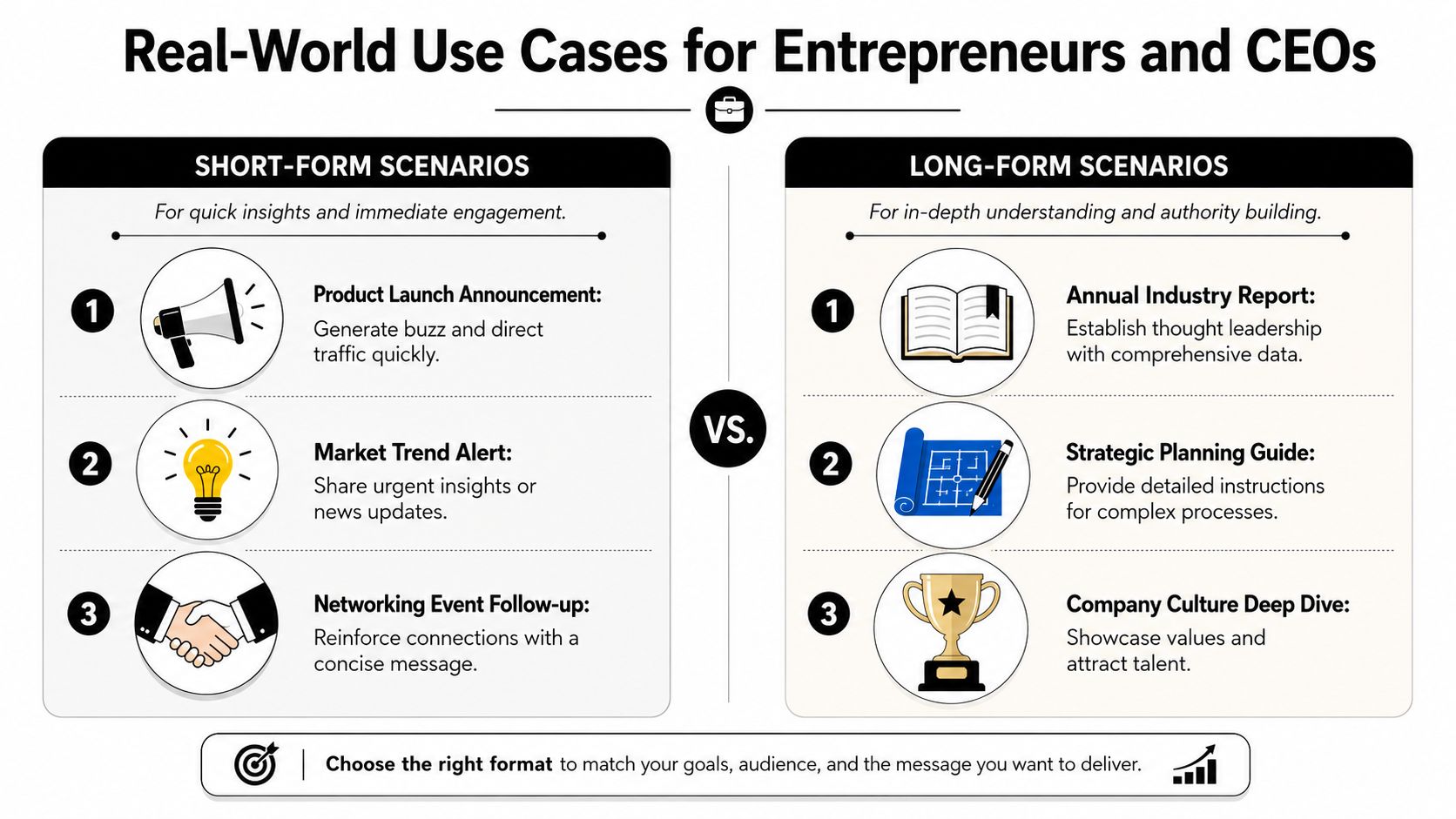
Use short form when timing matters, the point is narrow, or you need a reaction before you need a commitment. The goal is not to explain everything. The goal is to earn the next click, reply, or conversation.
Good founder use cases:
Product launch announcement
Post a tight founder video or text update that answers three things fast. What changed, who it helps, and why it matters now.
Market trend response
If regulation shifts, a platform changes policy, or a competitor reframes the category, publish your point of view while the topic is still active.
Conference follow-up
Turn one insight from a panel, dinner, or customer conversation into a quick post while people still remember the event.
Myth correction
Call out one bad assumption in your market. Short form works well here because sharp disagreement earns attention.
If you need more prompts tied to actual business scenarios, this list of engaging content ideas for founders and professionals in 2026 is more useful than generic creator tips.
Use long form when the audience needs context, proof, or a clear line of reasoning. This is the format for ideas that affect buying decisions, hiring quality, strategic positioning, or category authority.
A few strong use cases:
Strategic planning guide
If clients need to implement a process, write the full article or run the webinar. A short post can introduce the issue. It cannot carry the whole decision.
Annual industry analysis
If you want to shape the conversation in your niche, publish a serious point of view with examples, patterns, and implications.
Culture and leadership document
High-caliber operators do not join because of slogans. They join because your standards, expectations, and operating principles are clear.
Buyer education asset
If your offer is expensive, technical, or unfamiliar, long form answers the questions prospects hesitate to ask live.
The mistake is treating these as separate tracks. They work better as a sequence.
A founder memo can become six short posts. A webinar can become clips, quotes, and a customer FAQ. A strong article can supply a month of distribution without forcing you to invent new opinions every day.
Use this test before you publish:
If the idea needs speed, publish short form.
If the idea needs trust, publish long form.
If you need both, build the long-form core first, even if it starts as a rough memo. Then turn that source asset into the short-form pieces that spread the argument, reinforce your positioning, and keep content tied to business results.
Most content decisions get overcomplicated because teams ask, "What should we post this week?" That's too tactical. Better question: Where is the audience in their decision process, and how much effort will they give this topic right now?
That gives you a cleaner framework.
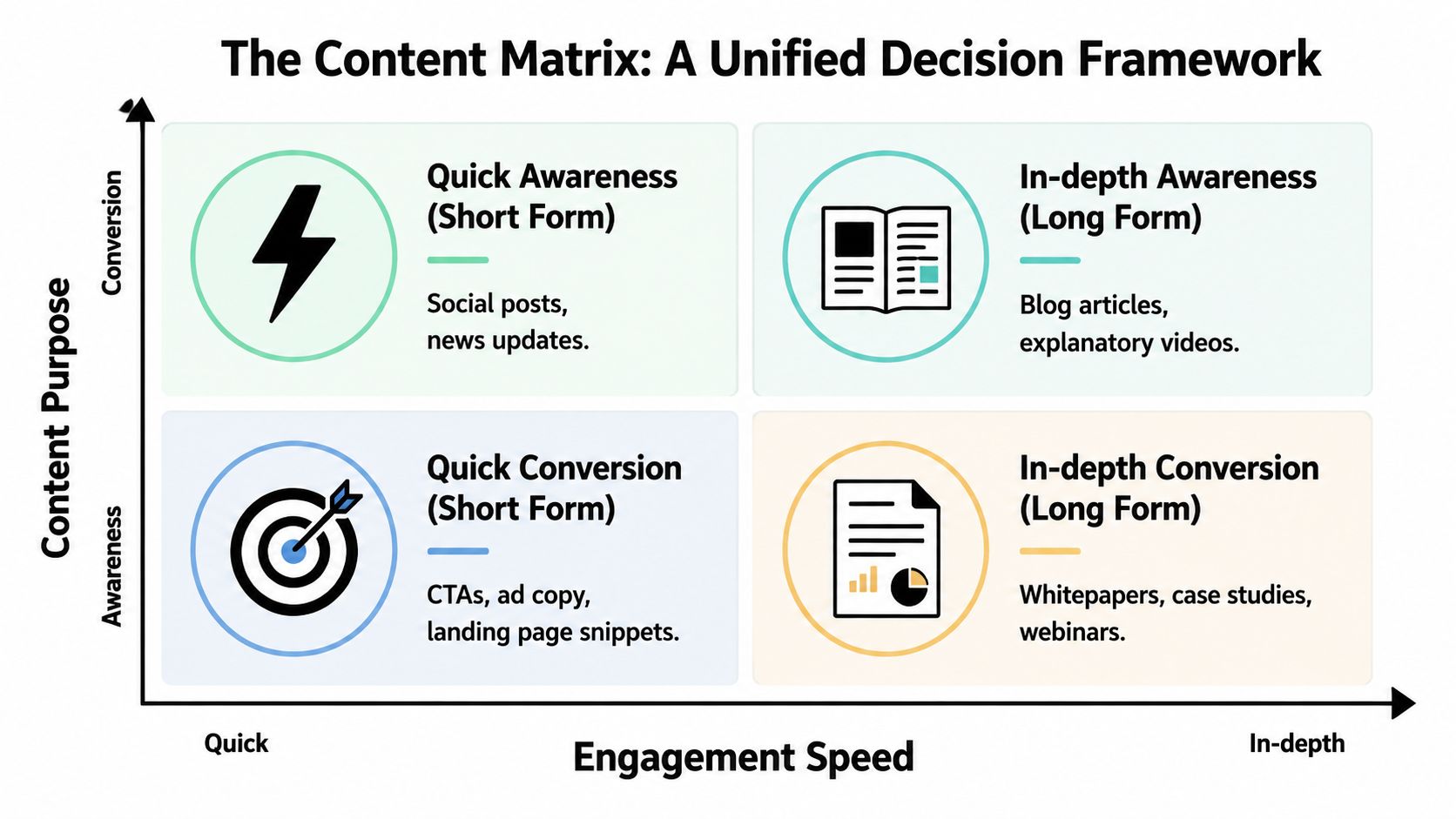
Use a simple matrix with these dimensions:
Engagement speed
Is the audience willing to give you a few seconds or several minutes?
Content purpose
Are you trying to create awareness or help drive conversion?
Those two axes are more useful than platform-first thinking. They force you to match content to audience readiness.
This is short form at its best.
Use LinkedIn posts, X posts, short videos, opinion clips, event reactions, and concise carousels. The audience is browsing. They don't want a lecture. They want a reason to stop scrolling.
Good founder use: a sharp post on why most onboarding systems fail after the first week.
Long-form educational content shines before the sales conversation even starts.
Think blog articles, explanatory YouTube videos, or podcast episodes that answer broad but meaningful questions. People are still early, but they want more than a soundbite.
Good founder use: a detailed article on how to structure a category narrative in a crowded market.
This quadrant is underrated. Short form isn't only for top-of-funnel reach.
Use short CTAs, landing-page snippets, comparison blurbs, short testimonial clips, and concise email nudges. The audience already has context. They need a push, not a dissertation.
Good founder use: a short email that reframes one objection and points to the booking page.
This is your decision support layer.
Use whitepapers, webinars, detailed service pages, deep-dive founder letters, and thorough guides. People in this quadrant are evaluating risk. They need clarity, proof, and structure.
Good founder use: a long-form article that explains your exact process, common failure points, and how clients should judge fit.
The biggest shift in content strategy is this: length alone isn't the key variable. Search and AI systems increasingly reward structure and clarity, and the strongest funnel is often short-to-long, where short form attracts attention while structured long-form content supports SEO, backlinks, conversion, and AI retrieval, as explained in this analysis of long-form and short-form content for AI search.
That means your long-form content shouldn't be a wall of prose. It should be built to produce extractable assets.
Operator rule: Write long-form pieces in blocks people can quote, clip, summarize, and search.
Use question-based headings. Add concise answer sections. Include clear takeaways, FAQs, and sharp statements that can stand alone. If your article can't produce five clean short-form posts, it probably isn't structured well enough.
A busy founder can run this matrix in five minutes:
| Question | If yes | Format bias |
|---|---|---|
| Is the audience cold? | They need a hook first | Short form |
| Is the problem nuanced? | They need context | Long form |
| Is this tied to search or AI retrieval? | Structure matters | Long form with extractable sections |
| Is this message time-sensitive? | Speed matters | Short form |
| Do I want this idea reused for weeks? | Build a content asset | Long form first |
This is the answer to short form vs long form content. Not either-or. Sequence and structure.
Repurposing is not a distribution trick. It is the operating system.
Founders who publish one idea once are wasting effort. The smart move is to build one strong source asset, then turn it into a controlled stream of short-form pieces that point back to it. That is how you stay visible without turning your content calendar into a full-time job.
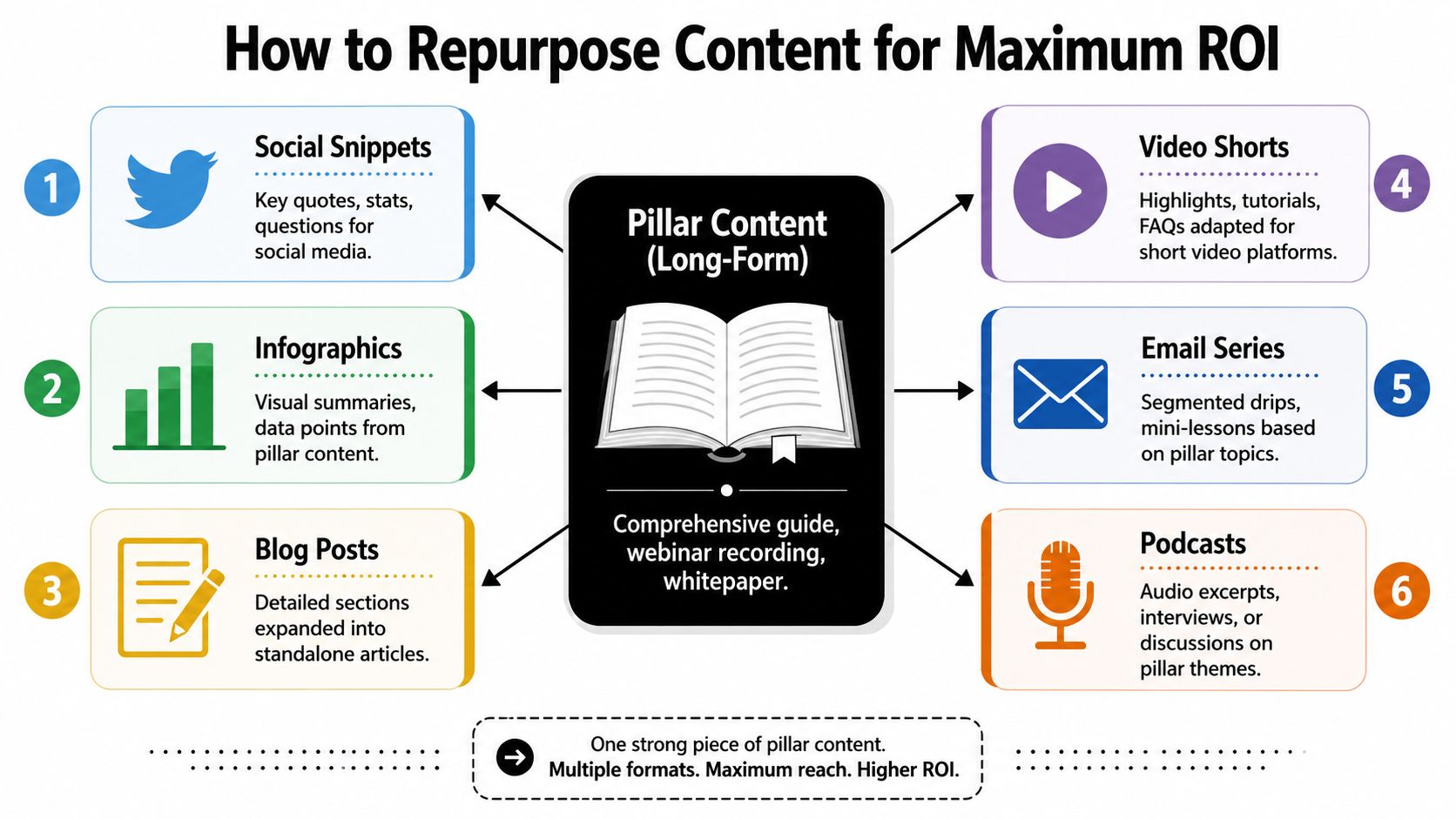
Begin with one long-form piece built around a topic you want associated with your name. Use a detailed article, podcast interview, webinar, founder memo, or keynote transcript. The format matters less than the substance. If the original piece has no clear opinion, no useful structure, and no quotable lines, it will not repurpose well.
Then extract assets with intent.
A long article on authentic personal branding can become:
If you want a practical playbook, these content repurposing strategies are useful because they force you to plan for distribution before you hit publish.
Here's a practical walkthrough worth watching before you build your workflow:
Short form gets attention fast. It also scatters attention fast if every post feels disconnected.
That is the primary risk. Not short form itself, but random short form.
Analysts at Buffer have noted that platform behavior keeps fragmenting audience attention across feeds, formats, and discovery loops, which makes message consistency more important, not less. Your short-form posts need a visible relationship to the source asset so the audience can move from awareness to trust instead of consuming isolated fragments.
Every short asset should do one job clearly:
Tease the full idea
Deliver the sharp takeaway, then direct people to the complete article, video, or memo.
Pull one useful lesson
Extract a single argument, example, or answer that can stand on its own without losing the thread.
Translate the idea into another medium
Turn written logic into video, audio, visuals, or slides for people who prefer a different format.
Build a sequence
One long-form piece should produce several posts around the same theme, each attacking the topic from a different angle.
Repetition builds authority. Randomness kills it.
For teams that need a repeatable system, this guide on how to repurpose content and multiply your reach is useful because it focuses on workflow discipline, editorial planning, and reuse.
Keep the process tight.
Choose one topic with business value
Tie it to revenue, authority, hiring, fundraising, or category ownership.
Create one structured long-form source asset
Write clear sections, direct subheads, strong opinions, and lines people can quote without context.
Extract short-form pieces by function
Pull social posts for reach, email for nurture, video clips for personality, and sales collateral for conversion.
Track response, then feed it back into the source
If a short-form angle gets traction, expand it into the next pillar or update the original asset.
This is how busy operators should approach content. Long form creates the intellectual property. Short form distributes it. Used together, they give you reach, recall, and a body of work instead of a pile of disconnected posts.
If you want a team that can turn your ideas into a real content engine without making your brand sound generic, Legacy Builder helps founders and professionals turn raw insights into consistent, high-impact personal brand content.


You could – but most in-house teams struggle with the nuance of growing on specific platforms.
We partner with in-house teams all the time to help them grow on X, LI, and Email.
Consider us the special forces unit you call in to get the job done without anyone knowing (for a fraction of what you would pay).
Short answer – yes.
Long answer – yes because of our process.
We start with an in-depth interview that gives us the opportunity to learn more about you, your stories, and your vision.
We take that and craft your content then we ship it to you. You are then able to give us the final sign-off (and any adjustments to nail it 100%) before we schedule for posting.
No problem.
We have helped clients for years or for just a season.
All the content we create is yours and yours alone.
If you want to take it over or work on transitioning we will help ensure you are set up for success.
We want this to be a living breathing brand. We will give you best practices for posting and make sure you are set up to win – so post away.
Subscribe to our newsletter and get insights on how to grow your personal brand.
