.svg)
Subscribe to our newsletter and get insights on how to grow your personal brand.
Thank you! Your submission has been received!
Oops! Something went wrong while submitting the form.
.svg)



If you want to create content that actually connects with people, you can't just start posting and hope for the best. That’s a recipe for burnout and disappointment.
The real magic happens before you ever hit "publish." It starts with a solid foundation built on understanding who you're talking to and what you stand for.
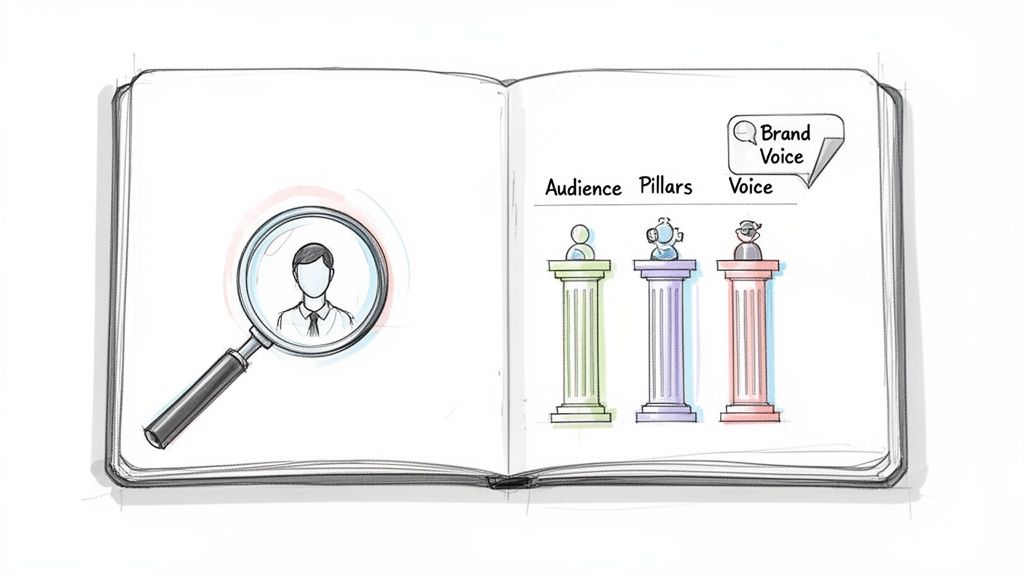
Look, truly great content doesn't happen by accident. It’s the result of a deliberate strategy, one that’s built on empathy and a crystal-clear message. This isn’t about just churning out material; it's about asking the right questions upfront.
It all boils down to looking past basic demographics to figure out what your audience is really struggling with. What are their biggest fears? What do they secretly hope to achieve? Answering these questions lets you create content that solves actual problems, making you instantly valuable.
Stop trying to be everything to everyone. It's exhausting, and it doesn't work.
Instead, pick three to five core content pillars. These are the big themes where your expertise directly solves your audience's biggest headaches. Think of them as the main topics you want to completely own in your space.
For instance, if you're a financial consultant for tech startups, your pillars might look something like this:
These pillars act as your north star, making sure every single thing you create is relevant, targeted, and hammers home your authority. This focus keeps your message sharp and builds an audience that genuinely trusts you.
Your goal is to own a specific conversation in your industry. When your audience has a question related to one of your pillars, your name should be the first one that comes to mind.
Your brand voice is simply the personality that comes through in your content. It’s how you package up your unique experiences, professional insights, and personal perspective into a style that's consistently you. An authentic voice is what builds that real human connection.
To nail down your voice, ask yourself:
A well-defined voice makes you recognizable. Whether it's a deep-dive article or a quick post on social media, your audience should immediately know it's from you. If you really want to dig into this, our guide on how to find your target audience for a personal brand is a great place to start.
Let's break down the foundational pieces of a content strategy that actually works. This table gives you a quick overview of what matters most.
Getting this foundation right is non-negotiable, no matter what platform you're on. For more ideas on putting this into practice, check out this guide on how to create engaging social media content.
Trust me, investing time here at the beginning sets you up for content that doesn't just get attention—it builds a loyal community.
Once you’ve nailed down who you’re talking to, it’s time to figure out what to say. Analytics and data are great, but they don't create loyalty. Stories do.
As a founder or leader, your experiences are your single greatest content asset. People connect with other people, not with polished value propositions. Turning your expertise into compelling narratives is how you transform passive followers into a real community.
This isn't about making things up. It's about framing your actual experiences in a way that resonates on a human level.
Your professional journey is already packed with powerful stories waiting to be told. Don't make the mistake of thinking your experiences are too boring or ordinary. Trust me, the most relatable stories often come from everyday challenges and hard-won lessons.
The trick is to move beyond just stating facts. Share the context, the struggle, and the transformation. I’ve found that sharing lessons from a past failure often builds more trust than just talking about wins. Vulnerability creates connection and shows the real person behind the brand.
To start digging for these stories, ask yourself a few questions:
These prompts will help you uncover the raw material for stories that don’t just inform—they inspire.
Great stories almost always follow a pattern. You don’t need a complex screenwriting formula; a simple model is all you need to organize your thoughts and make sure your message hits home.
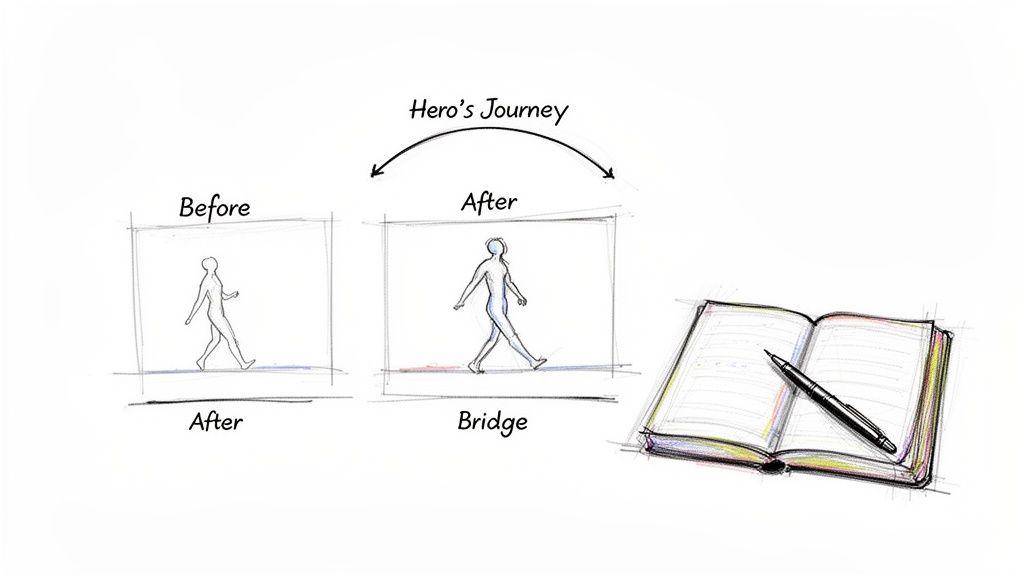
Two of the most effective frameworks I use constantly are the Hero's Journey and the Before-After-Bridge.
The Hero's Journey is a classic. It positions your audience as the hero of their own story, while you act as their trusted guide. Your content helps them tackle a challenge, learn a skill, and get to their desired outcome. It’s perfect for educational content.
The Before-After-Bridge model is even simpler and killer for social media posts or short articles. Here’s how it breaks down:
This framework hooks people emotionally by first validating their struggle, then giving them hope, and finally providing a clear path forward.
Storytelling is the most powerful way to put ideas into the world today. It’s not just about sharing your successes; it’s about sharing the journey—the struggles, the insights, and the transformation—that makes your message unforgettable.
Let's say you're a productivity consultant for busy founders. Instead of writing a generic post like "5 Tips to Manage Your Inbox," you frame it as a story.
Before: "I used to open my laptop to 300+ unread emails every morning. My most important tasks were buried, my stress was through the roof, and I felt like I was constantly reacting instead of leading. My day was owned by my inbox."
After: "Now, I reach inbox zero in under 30 minutes each day. I feel in complete control, my strategic priorities always get my best energy, and my team gets timely responses. My day is my own again."
Bridge: "The change wasn't a magic app. It was a simple three-step system I developed called 'The 3-D Method'—Delete, Delegate, Do. Here’s how you can implement it today..."
See the difference? The second version connects because it tells a relatable story of transformation. This approach makes your advice stick and positions you as a credible guide who actually gets it.
You can find more practical ways to frame your unique insights in our guide on building a brand storytelling framework that wins hearts.
A killer story told in the wrong format is like shouting into the wind—it just won’t land. The medium you choose is just as critical as the message itself. If you really want to create engaging content, you have to master the art of matching your idea to the perfect format for your audience.
This isn’t about chasing every shiny new trend. It’s about being strategic. You need a content mix that aligns with your core topics and, more importantly, with how your audience actually likes to consume information.
The goal is simple: build a mix that establishes you as the go-to expert, forges real connections, and keeps people coming back for more.
It's impossible to ignore the power of short-form video. The data is just overwhelming. Video is crushing it across the board, with short-form formats leading the pack at 60% usage. Sure, longer videos and blog posts are still strong contenders, but the quick, punchy nature of short clips has completely captured our attention spans. If you want the full picture, check out these content marketing ROI statistics for marketing leaders.
The best part? You don’t need a professional film crew. In fact, most audiences prefer raw, authentic videos over slick, over-produced content.
Here’s how to start creating simple, effective clips right now:
All you need is your smartphone, a window with some decent light, and clear audio. Video’s real power is its ability to show your personality and build a human connection faster than anything else.
While video is king for connection, nothing beats a well-researched article or blog post for establishing deep authority and credibility. This is where you go beyond the surface-level tips and give your readers a comprehensive solution to a real problem.
But let's be clear: an engaging article isn't just a wall of text. It has to be a structured, scannable resource built for how people read online today. People rarely read word-for-word; they scan for answers.
Your job isn’t just to write, but to guide the reader’s eye. Use formatting—short paragraphs, bold text, subheadings, and lists—to make your key points impossible to miss.
To make your articles hit hard, make them easy to digest. Break up long explanations into smaller, bite-sized chunks and use visual elements to make the page feel more inviting. Remember, a user on a typical webpage only reads about 20% of the text, so scannability is everything.
In a noisy social feed, a sharp graphic can be the difference between getting noticed and getting scrolled past. We process visuals 60,000 times faster than text, making graphics a non-negotiable tool for grabbing attention instantly.
And no, you don't need to be a designer. Tools like Canva have made it ridiculously easy for anyone to create professional-looking visuals in minutes.
Here are a few graphic formats you should add to your mix:
Think of your graphics as the hooks that pull people into your deeper content. They’re perfect for summarizing key takeaways and are highly shareable, which helps extend the reach of your core message.
There’s no magic bullet here. The most effective personal brands use a strategic mix of formats to hit different goals. Think of your content strategy as a balanced ecosystem where every format has a specific job to do.
My advice? Start with one core format you genuinely enjoy creating. Once you've got that down, strategically add others to complement it. This balanced approach is the key to creating engaging content that not only attracts an audience but also builds a lasting brand.
Look, great ideas are worthless without execution. I see it all the time with busy founders and professionals—the real roadblock isn't a lack of expertise. It's the total absence of a sustainable system to get that expertise out into the world.
Inconsistency is a momentum killer.
Posting sporadically just confuses your audience and tanks your authority before you even get a chance to build it. Winning at this game isn’t about creating more content. It's about building a realistic workflow that keeps you from burning out and ensures you show up consistently with high-quality stuff.
This is about shifting from a reactive, "what the heck do I post today?" mindset to a proactive, structured approach. A solid workflow turns content from a daily source of stress into just another manageable part of your business.
If there's one strategy I recommend to every busy leader, it's content batching. It’s the simple practice of blocking out a chunk of time to create and schedule a ton of content at once, instead of trying to chip away at it every single day.
Forget scrambling for an idea each morning. You can knock out an entire month's worth of content in just one or two focused sessions. This single shift frees up so much mental energy to focus on your actual business.
Here’s a practical way to do it:
This process takes content from a chaotic daily chore and turns it into a predictable, systemized workflow.
"I don't know what to post" isn't an idea problem; it's a system problem. Your goal is to build a repository of inspiration—an idea bank—so you never have to stare at a blank page again.
This can be as simple as a note in your phone, a spreadsheet, or a board in a project management tool. The trick is to capture ideas the second they hit you.
The best content ideas rarely show up when you're sitting at your desk trying to think of them. They come from client calls, industry news, and the questions you answer over and over. Your job is to build a system to catch them.
Anytime you hear a great question or have a unique insight, toss it into your bank. I like to organize mine by core content pillars. Then, before your batching session, you've got a goldmine of validated topics ready to go. It makes the creation part incredibly smooth.
Your workflow is only as strong as the tools you use to manage it. You don't need a complicated, expensive tech stack. Just focus on simple, effective tools that get the job done.
This diagram shows a simple but powerful flow for turning one core idea into multiple pieces of content.
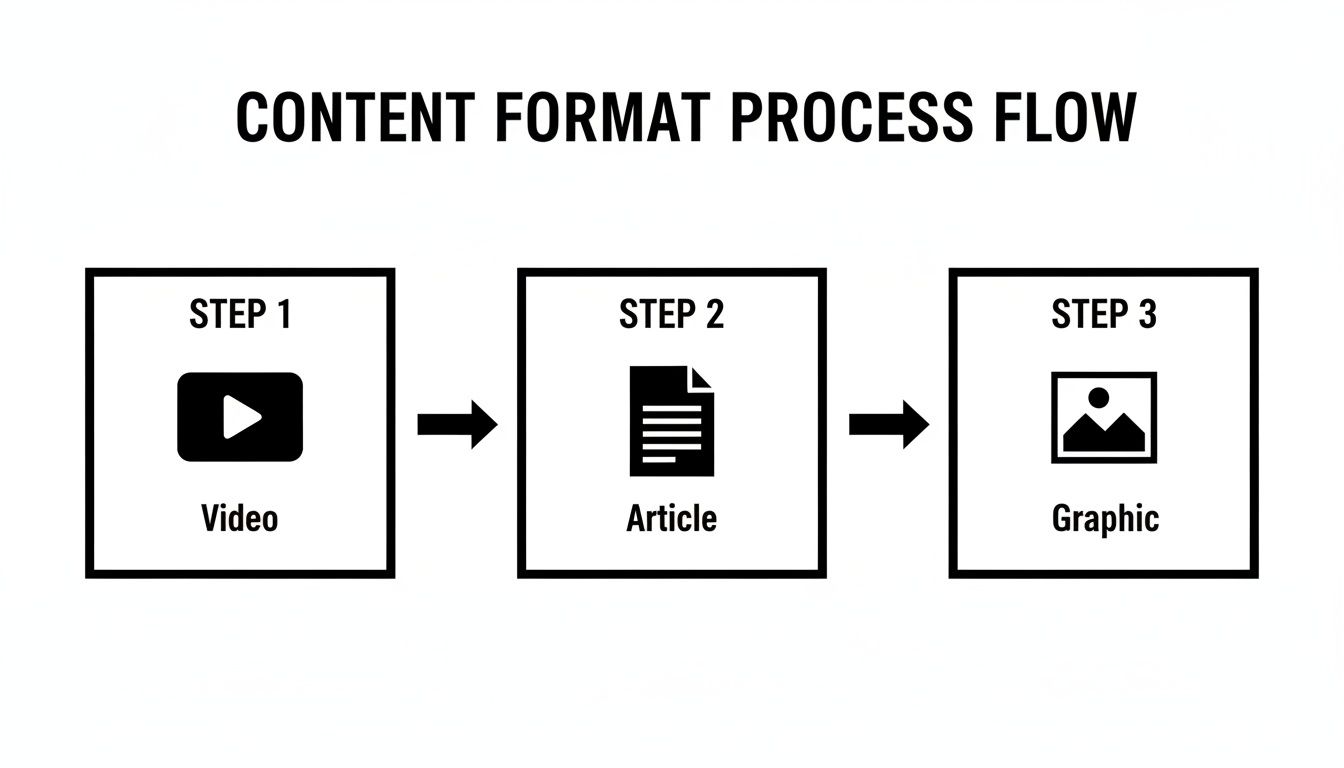
This is what I mean by working smarter. One long-form video can be efficiently repurposed into written articles, social media graphics, and more. You maximize your output without multiplying your effort.
Hitting "publish" on a great piece of content and just walking away is like cooking a five-star meal and leaving it on the kitchen counter. It doesn't matter how incredible it is if no one ever gets to see it.
The best creators know that creation is just one half of the equation. Smart distribution is what separates great work from a recognized brand. This isn't about spamming your links across the internet. It’s a deliberate strategy to get your content in front of the right people, on the right platforms, exactly when they need to see it.
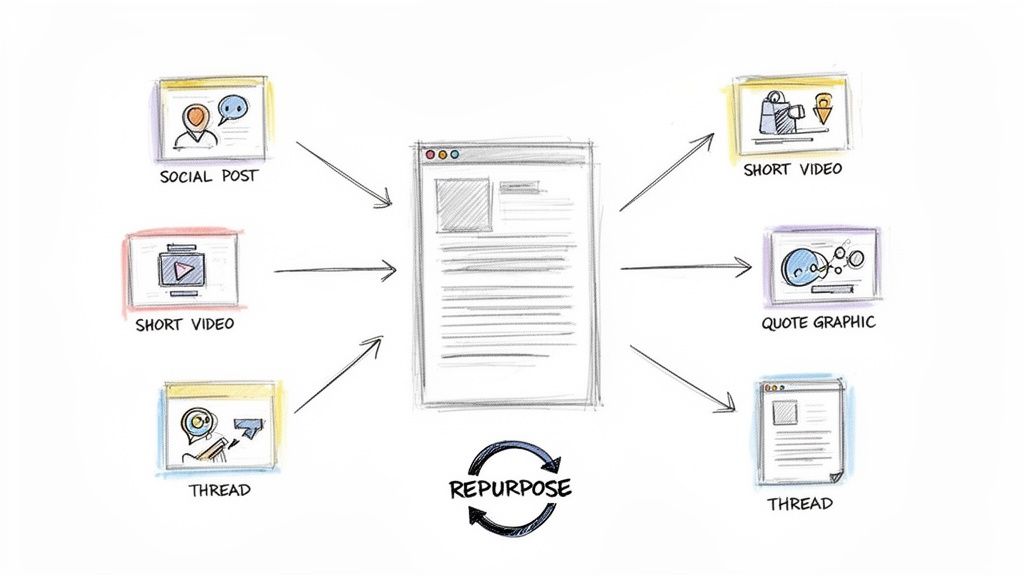
The most efficient way to get more eyes on your work is to stop thinking in terms of single posts. Look at every piece of pillar content—a deep-dive article, a webinar, a podcast episode—as raw material for a dozen smaller assets.
This "create once, distribute forever" mindset is a total game-changer, especially when you're strapped for time.
One solid blog post can easily become:
This approach saves you a ton of time, but more importantly, it lets you meet your audience where they already are. The person who loves video might skip your article, but they’ll stop scrolling for that repurposed clip.
Posting on your own profile is table stakes. Real growth happens when you step outside your bubble and plant your content in communities where your ideal audience already hangs out.
Find niche groups on LinkedIn, Facebook, or even forums like Reddit. The key is to add value first, not just drop a link and run. Share a relevant insight from your article and ask a question to get a real discussion going. Answering questions and participating like a human builds trust and naturally pulls people back to your work.
Don't just broadcast your message. Weave it into the conversations your audience is already having. The goal is to become a valuable contributor, not just another promoter.
This is where the industry is heading. With 46% of B2B organizations planning to increase their content marketing spend, the game is changing. That money, projected to push the industry to over $107 billion by 2026, is flowing toward authentic, story-driven strategies that build real connections. When AI is helping draft nearly half of all articles, the creators who win are the ones focused on genuine community interaction. To see the data for yourself, you can discover more insights on content marketing statistics.
At the end of the day, distribution isn't just about reach—it's about engagement. The real win is turning passive viewers into an active community. And that happens in the comments.
When you post, write captions designed to get a response. Ask an open-ended question. Share a slightly controversial opinion. Ask people to share their own experiences. Make it easy for them to jump in.
Then comes the most important part: respond thoughtfully. Acknowledge every meaningful comment. Ask follow-up questions. Your engagement shows you’re actually listening. This two-way dialogue is how you transform a simple platform into a thriving community hub.
Even with the best playbook, you're going to have questions. It’s just part of the process. So, let's tackle some of the most common ones I hear from founders who are serious about building a personal brand that actually works.
Forget the hustle-bro advice that tells you to post five times a day. The real key isn't frequency—it's unwavering consistency. Pick a schedule you can actually stick to for the long run.
For faster-moving platforms like LinkedIn or X (formerly Twitter), daily posts can work wonders if you can keep the quality high. But for bigger lifts like a blog post or a YouTube video, once a week is a much more realistic—and sustainable—goal.
A predictable rhythm builds trust and anticipation. Sporadic bursts of content followed by radio silence just confuses your audience.
Easy. They make it all about themselves instead of for their audience.
Nobody cares about your latest company award unless there's a lesson in it for them. People don't follow you to hear a sales pitch; they follow you for value. Truly great content solves a problem, offers a new way of looking at things, or tells a story that makes them feel understood.
Before you hit "publish," ask yourself one simple question: "What is someone actually getting from this?" If you can't answer that clearly, the content is probably self-serving. Make it a rule: audience value first, always.
Stop obsessing over vanity metrics like likes. They’re nice for the ego, but they don't tell you if you're building a real connection. True engagement is all about the quality of the interaction, not the quantity.
Instead, keep an eye on the metrics that matter:
Track your comment-to-like ratio. Track the DMs you get. Those are the numbers that show you’re not just making noise, you’re making an impact.
Absolutely not. In fact, sometimes it hurts.
Today’s audiences are sharp—they can smell overly polished, corporate-style content from a mile away. What they're really craving is authenticity and genuine connection.
Your smartphone, a window for good lighting, and clear audio are all you need to get started. The clarity of your message and the conviction in your delivery will always matter more than the camera you use. Don't let a lack of fancy equipment be the excuse that holds you back.
Building a personal brand that connects and converts takes consistent effort and a clear strategy. At Legacy Builder, we turn your expertise and stories into high-impact content that grows your influence, so you can focus on what you do best. If you're ready to build your legacy, visit us at https://www.legacybuilder.co.


You could – but most in-house teams struggle with the nuance of growing on specific platforms.
We partner with in-house teams all the time to help them grow on X, LI, and Email.
Consider us the special forces unit you call in to get the job done without anyone knowing (for a fraction of what you would pay).
Short answer – yes.
Long answer – yes because of our process.
We start with an in-depth interview that gives us the opportunity to learn more about you, your stories, and your vision.
We take that and craft your content then we ship it to you. You are then able to give us the final sign-off (and any adjustments to nail it 100%) before we schedule for posting.
No problem.
We have helped clients for years or for just a season.
All the content we create is yours and yours alone.
If you want to take it over or work on transitioning we will help ensure you are set up for success.
We want this to be a living breathing brand. We will give you best practices for posting and make sure you are set up to win – so post away.
Subscribe to our newsletter and get insights on how to grow your personal brand.
