.svg)
Subscribe to our newsletter and get insights on how to grow your personal brand.
Thank you! Your submission has been received!
Oops! Something went wrong while submitting the form.
.svg)



In a crowded online space, generic advice and surface-level content are invisible. For founders, professionals, and visionaries, the challenge isn't just to be seen-it's to be remembered, trusted, and followed. This requires a shift from simply publishing content to building a legacy through authentic storytelling and strategic engagement.
The pressure to maintain consistency, showcase genuine expertise, and connect with an audience on a human level is immense. This is where many personal brands falter, caught between the desire for authenticity and the daily struggle with content creation. To truly captivate your audience and solidify your position as an influencer, understanding how to create engaging social media content is crucial. This article moves beyond bland tips to provide a clear roadmap.
Here, you will find 12 actionable and engaging content ideas designed specifically for leaders who want their message to resonate. Each idea is a complete blueprint, offering prompts, execution notes, and distribution tips aligned with a storytelling-first approach. We will explore how to turn your unique insights and journey into high-impact content that captivates and converts, including:
This guide provides the structure needed to consistently produce compelling content that builds authority and forges genuine connections with your audience. Let's get started.
A narrative-driven series is one of the most powerful and engaging content ideas for building a loyal audience. Instead of a one-off post, you unfold a personal or professional journey across multiple installments, creating a sustained connection with your followers. This format transforms raw experiences into a compelling narrative that reveals authentic insights, vulnerabilities, and lessons learned.
By breaking a larger story into episodes, you build anticipation and encourage your audience to return. This method is exceptionally effective for establishing a personal brand because it moves beyond surface-level advice and anchors your expertise in real, lived experience. The serialized format allows you to explore nuances and complexities that a single article or post cannot capture.
Key Insight: People don't just follow experts for information; they follow people for connection. A storytelling series makes your journey relatable and turns passive observers into active supporters.
This approach is perfect for founders sharing their startup journey on LinkedIn, creators documenting a project on YouTube, or professionals detailing their career transitions in a newsletter. For more inspiration on crafting your own narrative, check out these powerful brand storytelling examples.
An Educational Content Pyramid is a structured approach that organizes your expertise into a hierarchy, guiding your audience from foundational concepts to advanced insights. Instead of creating random educational posts, you design a deliberate learning path. This model positions you as a thorough and thoughtful expert, capable of serving newcomers and seasoned followers alike.
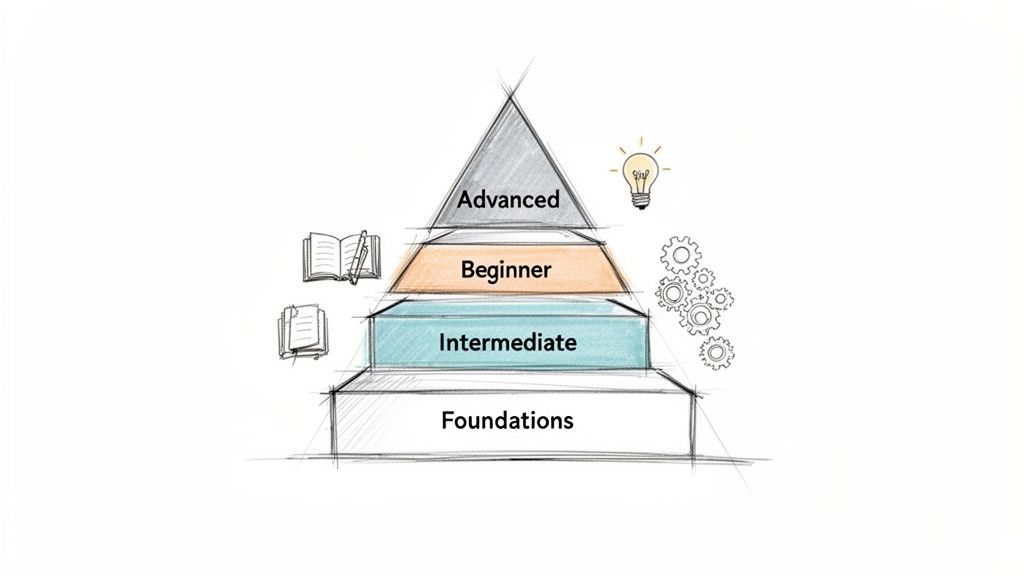
This method allows you to create a deep, interconnected library of content where each piece has a purpose. Foundational "101" content attracts a wide audience, while advanced tutorials and deep dives build authority and loyalty with a more committed segment. This is one of the most effective engaging content ideas for demonstrating the full scope of your knowledge.
Key Insight: A content pyramid turns your expertise into a guided curriculum. It allows you to serve an entire audience spectrum, from beginners seeking awareness to experts looking for mastery, all within a single ecosystem.
This strategy is ideal for B2B SaaS companies like HubSpot, which guide users from basic marketing principles to complex automation strategies. It's also perfect for creators and coaches building a comprehensive knowledge base that can eventually be packaged into courses or workshops.
Behind-the-scenes (BTS) content is a powerful tool for building trust by offering unpolished glimpses into your daily operations and decision-making process. This format strips away the veneer of perfection common in professional content, revealing the authentic, human side of your work. It shows the effort, the challenges, and the small wins that lead to the final polished result.
This approach makes your brand or professional persona more relatable and transparent. When your audience sees the real process-including the messy parts-they feel a stronger connection. It’s one of the most effective engaging content ideas for demonstrating authenticity and building a community that is invested in your journey, not just your outcomes.

Key Insight: Perfection creates distance, but process creates connection. Sharing your behind-the-scenes journey invites your audience to be part of the story, transforming them from passive consumers into loyal advocates.
This method works well for founders documenting product development on X (formerly Twitter), agencies showing their creative process on Instagram Reels, or professionals sharing their daily work routine in a newsletter. For a great example of this in action, see how Notion shares its product development journey with its user community.
Collaborating with other experts is one of the most effective engaging content ideas for expanding your authority and reach. By hosting a roundtable, co-creating a resource, or conducting an interview, you bring diverse perspectives to your audience. This format pools credibility, giving your content a richer, multi-faceted authority that is difficult to achieve alone.
This approach immediately broadens your audience by tapping into your collaborators' networks. It also provides immense value by presenting a well-rounded discussion on a specific topic, much like panels at an industry conference. When multiple experts validate a concept, the insights become more powerful and trustworthy for the audience.
Key Insight: Collaboration is a credibility multiplier. When you stand next to other respected figures, their authority reflects onto you, and your audience benefits from a richer, more diverse set of insights.
This method is demonstrated by podcasts like The Tim Ferriss Show and B2B thought leadership platforms that feature panels with industry leaders. For a great example of how to facilitate conversations that produce deep insights, explore the interviews on the Lenny's Podcast page.
Publishing original research is one of the most authoritative and engaging content ideas for positioning your brand as an industry leader. Instead of recycling existing information, you generate proprietary data through surveys, studies, or internal analysis. This creates a valuable asset that offers unique insights, attracts high-quality backlinks, and fuels your content calendar for months.
This approach transforms your brand from a commentator into a primary source. By answering pressing questions with hard data, you provide undeniable value and build immense credibility. Reports like ConvertKit's Creator Economy Report or HubSpot's State of Marketing Report become go-to resources for journalists, creators, and other businesses, establishing the publisher as an authority.
Key Insight: Original research is the ultimate form of evergreen content. A single well-executed study can become an industry benchmark that earns mentions and traffic for years, solidifying your authority.
This strategy is especially effective for B2B companies looking to establish thought leadership, media outlets wanting to break original stories, and consultancies aiming to substantiate their expertise. For a masterclass in annual research, explore the Pew Research Center and its extensive studies on social trends.
A micro-learning series delivers short, digestible content pieces focused on a single, actionable concept. This format respects the audience's limited attention by providing valuable information in under three minutes, allowing for quick consumption and immediate implementation. It's one of the most effective and engaging content ideas for building daily touchpoints and demonstrating expertise consistently.
This approach excels on platforms dominated by short-form media like TikTok, Instagram Reels, and YouTube Shorts. By breaking down complex topics into bite-sized lessons, you can teach a skill or share an insight without overwhelming your audience. It positions you as a go-to resource for quick, reliable information, encouraging followers to save your content and return for more.
Key Insight: Value is not measured in length but in impact. A 60-second video that solves a real problem is more powerful than a 30-minute one that doesn't.
This strategy is ideal for sales experts sharing negotiation tactics on LinkedIn carousels, productivity creators demonstrating a new app feature on Instagram Reels, or marketing consultants offering quick tips on YouTube Shorts. To see how to turn longer content into smaller pieces, explore these powerful content repurposing strategies.
A case study deep-dive is a detailed examination of a specific project or client success, offering tangible proof of your expertise. More than a simple testimonial, this format provides an in-depth look at a real-world challenge and breaks down the exact steps you took to achieve a measurable outcome. It builds authority and trust by demonstrating your methodology in action.
This approach is one of the most effective engaging content ideas for B2B companies, consultants, and service providers because it answers the ultimate client question: "Can you actually get results?" By presenting a clear narrative with quantified achievements, you move from telling people what you do to showing them what you can accomplish. This format transforms your past successes into a powerful sales and marketing asset.
Key Insight: Prospects don't just want to hear about your process; they want to see evidence that it works. A well-crafted case study is your most compelling proof of performance, turning abstract claims into concrete results.
This method is ideal for agencies showcasing client wins, SaaS companies demonstrating product value, or freelancers proving their impact. For a complete guide, learn more about how to write business case studies that actually convert.
Presenting an unconventional perspective that challenges established norms is one of the most effective engaging content ideas for capturing attention. Instead of echoing consensus views, you offer a "hot take" that forces your audience to reconsider their assumptions. This approach carves out a unique space for your voice and positions you as a bold, independent thinker.
Well-executed contrarian content sparks immediate conversation and debate, driving high levels of engagement. It differentiates you from competitors and demonstrates the confidence to question conventional wisdom. When grounded in logic and evidence, these opinions establish you as a thought leader who isn't afraid to pave a new path, attracting a following that values critical thinking and fresh perspectives.
Key Insight: The most valuable opinions are not the most popular ones; they are the most thought-provoking. A contrarian view, presented thoughtfully, can shift an entire industry's conversation and cement your authority.
This strategy is frequently used by tech leaders like Paul Graham, whose essays challenge startup orthodoxies, and venture capitalists who share unpopular market predictions. For a masterclass in building a brand around strong, well-reasoned opinions, explore the work of Naval Ravikant.
Interactive content transforms your audience from passive consumers into active participants, making it one of the most effective engaging content ideas available. Instead of simply broadcasting a message, you invite your followers to contribute through polls, Q&A sessions, challenges, or user-generated content (UGC) campaigns. This approach directly involves them in the conversation, fostering a strong sense of community and belonging.
By making participation a core element of your content strategy, you significantly increase engagement rates and gather valuable real-time feedback. Formats like LinkedIn polls on industry trends or Instagram Stories with question stickers create a direct line of communication. This two-way dialogue makes your brand more accessible and human, showing that you value your audience's opinions and contributions.
Key Insight: The most powerful brands aren't just built on what they say; they're built on the communities they cultivate. Interactive content is the fastest way to turn an audience into a community.
This method works exceptionally well for community managers building a following on social media, brands looking to source authentic marketing material, and thought leaders hosting Reddit AMAs (Ask Me Anything) to connect directly with their audience.
Framework-based content involves creating and sharing proprietary models or methodologies that offer a repeatable system for solving a specific problem. Instead of offering one-off tips, you provide a structured, memorable process that your audience can apply consistently, positioning you as a true strategist in your field. This is one of the most effective engaging content ideas for establishing intellectual property and authority.
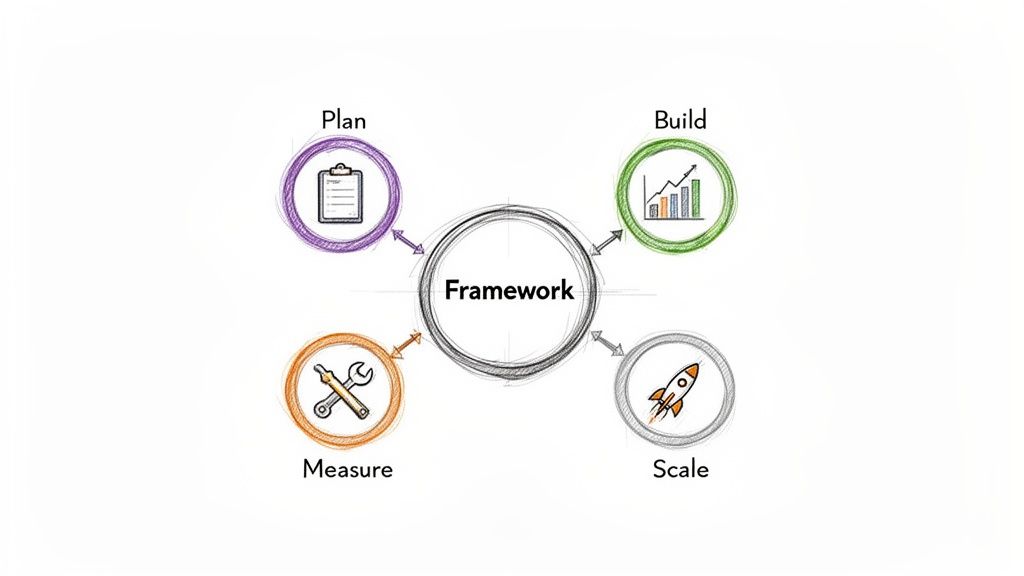
Models like Simon Sinek's "Golden Circle" or the "Jobs to be Done" framework became famous because they simplify complex ideas into actionable steps. By developing your own framework, you create a distinct tool that becomes intertwined with your brand identity, giving people a reason to return to your work whenever they face a similar challenge.
Key Insight: A framework turns your expertise from an abstract concept into a tangible asset. It gives your audience a tool, not just advice, making your value proposition concrete and repeatable.
This approach is ideal for consultants, coaches, and founders who want to codify their unique process and scale their thought leadership. For a deeper look into creating proprietary systems, explore how successful brands use this to their advantage in these business strategy case studies.
Thought leadership long-form content is a cornerstone among engaging content ideas for establishing deep authority. This involves creating comprehensive articles, essays, or white papers that explore complex topics with original analysis and a distinct point of view. Instead of just reporting facts, you synthesize information and offer new insights, solidifying your position as a credible expert.
This approach moves beyond fleeting trends to provide lasting value. By tackling challenging subjects with rigor and depth, you attract a high-quality audience of peers, decision-makers, and potential clients who are seeking substantial knowledge. Think of figures like Paul Graham, whose essays shape startup discourse, or Bill Gates, whose annual letters influence global conversations on health and technology. This type of content becomes a reference point in your industry.
Key Insight: True thought leadership isn't about having an opinion; it's about having an informed, well-reasoned, and original perspective that guides others' thinking. This content serves as an intellectual asset that pays dividends in credibility and influence over time.
This method is ideal for founders explaining their company’s vision, VCs outlining investment theses, or seasoned professionals sharing hard-won industry wisdom. For a modern masterclass in this approach, explore the in-depth research papers and guides published by Stripe.
Video testimonials are one of the most persuasive and engaging content ideas because they offer authentic, third-party validation for your products or services. Instead of you telling the audience how great your offer is, satisfied clients do it for you. This format moves beyond written reviews by capturing genuine emotion and credibility through real voices, faces, and success stories.
Featuring client transformations builds trust far more effectively than traditional marketing copy. The visual and auditory elements of video make the endorsement feel personal and relatable, allowing potential customers to see themselves in the success of others. It’s a powerful way to demonstrate tangible results and prove the value of your work, as seen with platforms like Kajabi highlighting creator journeys or HubSpot showcasing customer wins.
Key Insight: Prospects don't trust what you say about yourself nearly as much as they trust what others say about you. Video testimonials turn satisfied customers into your most convincing sales team.
This method is ideal for SaaS companies, coaches, and service-based businesses looking to build credibility. For a deeper understanding of how this works, learn more about what social proof is in marketing and how it builds trust.
| Format | Implementation Complexity 🔄 | Resource Requirements & Speed ⚡ | Expected Outcomes 📊 | Ideal Use Cases | Key Advantages & Tips 💡⭐ |
|---|---|---|---|---|---|
| Narrative-Driven Storytelling Series | High 🔄 (episodic planning, consistency) | Medium‑High ⚡ (moderate production, slower ROI) | Deep emotional connection, repeat engagement, brand differentiation 📊 | Founders, leaders, entrepreneurs building personal brand | Builds loyalty & shareability; tip: plan arc and publish consistently 💡 |
| Educational Content Pyramids | High 🔄 (mapping multi-level learning) | High ⚡ (extensive content creation, slower payoff) | Comprehensive expertise, learner progression, SEO growth 📊 ⭐ | Course creators, SaaS customer education, consultants | Scales authority and upsells; tip: link levels and audit regularly 💡 |
| Behind-the-Scenes (BTS) Content | Low‑Medium 🔄 (boundary-setting, cadence) | Low ⚡ (fast to produce, minimal editing) | Increased trust, relatability, quick engagement 📊 | Emerging entrepreneurs, creators humanizing brands | High authenticity with low overhead; tip: set clear sharing boundaries 💡 |
| Expert Roundtables & Collaborative Content | Medium‑High 🔄 (coordination & facilitation) | Medium ⚡ (moderate production; repurposable) | Expanded reach, credibility amplification, richer insights 📊 ⭐ | Leaders expanding networks, thought platforms, conferences | Cross-audience amplification; tip: prep research-backed questions & co-promote 💡 |
| Data‑Driven Insights & Original Research | High 🔄 (methodology, validation) | Very High ⚡ (research resources, time) | Strong authority, media pickup, backlinks, referenceable content 📊 ⭐ | SaaS, consultants, founders seeking defensible thought leadership | Reference-worthy credibility; tip: partner for rigor and visualize results 💡 |
| Micro‑Learning Content Series | Low‑Medium 🔄 (single‑focus creation) | Low ⚡ (quick production, high frequency) | High engagement, daily visibility, easy shareability 📊 | Creators seeking daily visibility, algorithm-focused content | Fast, scalable reach; tip: one actionable tip per piece and batch-create 💡 |
| Case Study Deep‑Dives | Medium‑High 🔄 (data capture, permissions) | Medium ⚡ (research & documentation time) | Demonstrates ROI, builds client trust, supports premium pricing 📊 ⭐ | Agencies, consultants, service providers proving results | Concrete proof of value; tip: capture metrics early and structure clearly 💡 |
| Contrarian Hot Takes & Opinion‑Driven Content | Medium 🔄 (evidence + confident framing) | Low‑Medium ⚡ (quick to publish; needs substantiation) | High engagement and visibility, potentially polarizing 📊 | Visionaries, leaders challenging industry norms, emerging brands | Distinctive voice and debate; tip: ground claims in evidence and acknowledge counterviews 💡 |
| Interactive & Participatory Content | Medium 🔄 (design & moderation) | Medium ⚡ (ongoing engagement effort) | Dramatic engagement lift, community growth, user insights 📊 ⭐ | Community builders, founders seeking loyalty and feedback | Builds belonging & UGC; tip: provide clear guidelines and active moderation 💡 |
| Framework‑Based Strategic Content | High 🔄 (original thinking, validation) | Medium‑High ⚡ (development and teaching time) | Ownable IP, repeatable value, licensing and teaching opportunities 📊 ⭐ | Consultants, founders, leaders packaging methodologies | Signature differentiator; tip: create memorable visuals and templates 💡 |
| Thought Leadership Long‑Form Content | Very High 🔄 (deep research & synthesis) | Very High ⚡ (time‑intensive, slower cadence) | Enduring authority, SEO value, speaking and advisory opportunities 📊 ⭐ | Seasoned professionals, founders shaping industry conversation | High credibility and depth; tip: publish on reputable channels and cite sources thoroughly 💡 |
| Video Testimonials & Social Proof Content | Medium 🔄 (client coordination, authenticity) | Medium ⚡ (logistics and basic production) | Faster trust-building, conversion uplift, persuasive social proof 📊 ⭐ | Service providers, consultants, course creators demonstrating outcomes | Compelling proof of results; tip: collect immediately after wins and ask for specific metrics 💡 |
The twelve engaging content ideas we've explored offer a blueprint for building an influential and authentic personal brand. This is not about chasing trends or shouting into the digital void. It's about moving beyond generic updates and transforming your unique journey, hard-won expertise, and professional story into content that truly connects. The common thread woven through each concept is authenticity, a commitment to sharing real value from your distinct perspective.
From the emotional pull of Narrative-Driven Storytelling to the intellectual authority of Data-Driven Insights, these strategies are designed to capture attention and build trust. We've seen how Behind-the-Scenes Content humanizes your brand, while Expert Roundtables position you at the center of your industry's most important conversations. Each idea provides a specific, actionable path to create meaningful interactions.
Knowing what to create is the first step. The true challenge, however, lies in consistent execution. This is where many busy professionals and founders find themselves stuck. The demands of running a business often leave little room for the sustained effort required to turn great content ideas into a powerful personal brand. This is the gap that must be bridged to achieve real results.
Here are the critical takeaways to remember as you move forward:
To turn this knowledge into action, start small but think big. Select the one idea from this list that most excites you or aligns best with your current business goals. Don't try to implement all twelve at once.
For example, you could commit to creating a three-part Micro-Learning Content Series on a topic you know inside and out. Or, you could reach out to two peers to schedule your first Expert Roundtable discussion. The key is to begin. To further enrich your content strategy and discover fresh perspectives, explore these additional 12 Next-Level Content Creation Ideas for a deeper well of inspiration.
Ultimately, these engaging content ideas are more than just a marketing tactic. They are tools for building a legacy. They allow you to codify your knowledge, share your vision, and shape the conversation in your field. By consistently showing up with value and authenticity, you aren't just building a brand; you are building an asset that will serve you and your audience for years to come.
Ready to turn these ideas into a powerful content engine without sacrificing your focus? Legacy Builder integrates expert strategists, writers, and designers to manage your entire content lifecycle, transforming your expertise into a world-class personal brand. Book a discovery call today to learn how we can help you build your legacy, one piece of content at a time.


You could – but most in-house teams struggle with the nuance of growing on specific platforms.
We partner with in-house teams all the time to help them grow on X, LI, and Email.
Consider us the special forces unit you call in to get the job done without anyone knowing (for a fraction of what you would pay).
Short answer – yes.
Long answer – yes because of our process.
We start with an in-depth interview that gives us the opportunity to learn more about you, your stories, and your vision.
We take that and craft your content then we ship it to you. You are then able to give us the final sign-off (and any adjustments to nail it 100%) before we schedule for posting.
No problem.
We have helped clients for years or for just a season.
All the content we create is yours and yours alone.
If you want to take it over or work on transitioning we will help ensure you are set up for success.
We want this to be a living breathing brand. We will give you best practices for posting and make sure you are set up to win – so post away.
Subscribe to our newsletter and get insights on how to grow your personal brand.
