.svg)
Subscribe to our newsletter and get insights on how to grow your personal brand.
Thank you! Your submission has been received!
Oops! Something went wrong while submitting the form.
.svg)


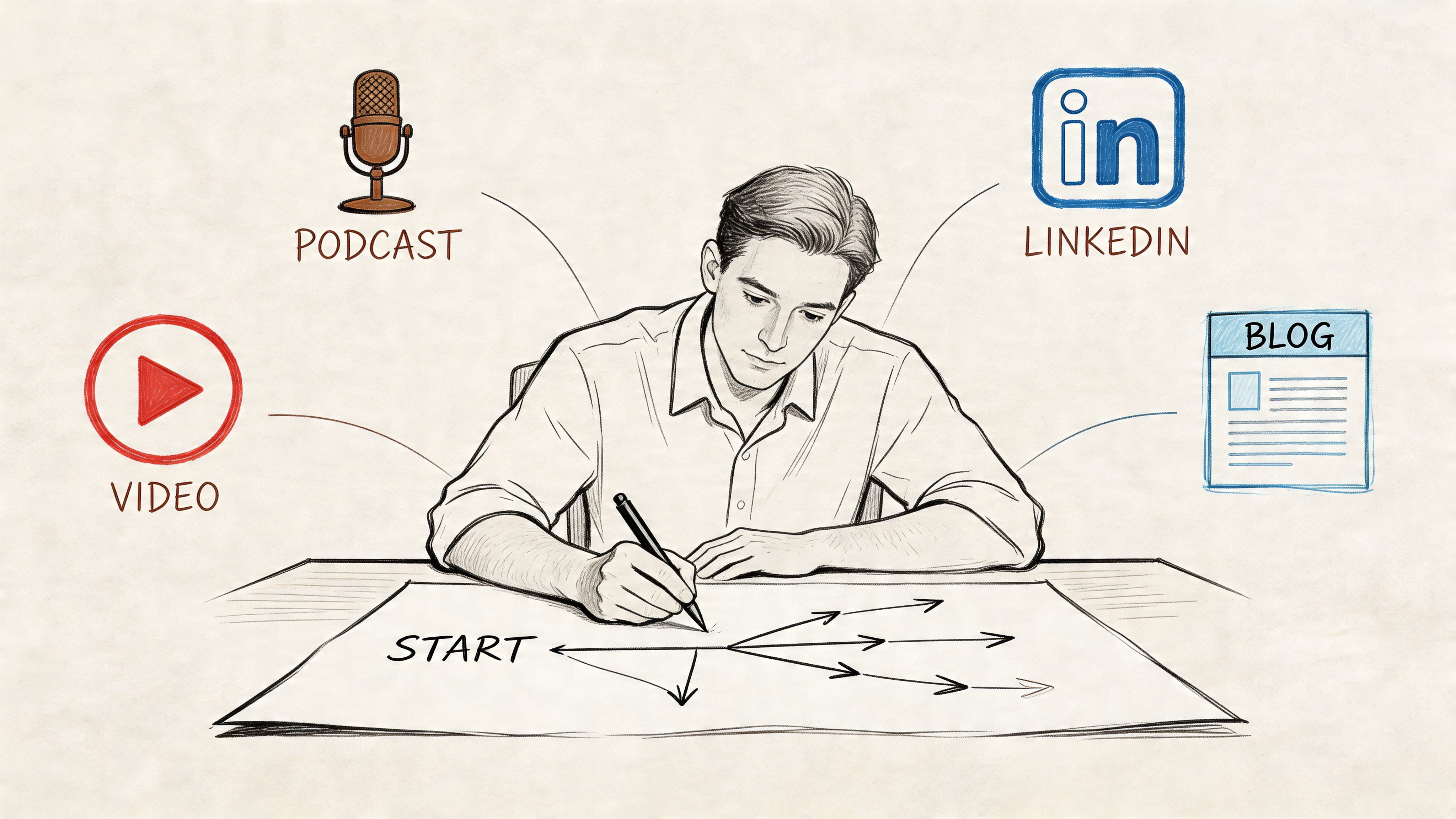
Most advice about how to share your story online is wrong.
It tells founders to post more, reveal more, and “be authentic” as if volume alone builds trust. It doesn’t. Random vulnerability is not a strategy. A pile of personal anecdotes is not a brand. And product-first content, which most founders default to, rarely gives buyers a reason to remember you.
Your story does.
Not because people are sentimental. Because story is the shortest path to trust, positioning, and recall. Buyers can compare your pricing, features, and delivery model against ten competitors in an afternoon. They cannot copy your lived experience, your judgment, or the way you frame a problem you’ve earned the right to speak on.
That matters in a world with over 4.9 billion social media users worldwide, where consistent story sharing compounds attention over time. Statista notes that profiles with daily story shares see up to 5 times more follower growth than sporadic posters in its coverage of social sharing trends. The point isn’t to post for the sake of posting. The point is to build a recognizable signal in a noisy market.
Founders love to believe their product is the star. It isn’t.
Your product proves capability. Your story creates belief. People buy from people they trust, and trust forms long before the demo, the proposal, or the sales call. If your online presence says nothing about how you think, what you value, and why you built what you built, you’re forcing the market to guess.
Most buyers won’t do that work for you.
A useful personal brand starts with three decisions.
Audience
Pick the specific people you want your story to move. Not “everyone in business.” Be tighter. Early-stage SaaS founders. Operators moving into CEO roles. Technical experts trying to become visible.
Angle
Choose the lens you own. Your experience then becomes a market position. Maybe you bootstrapped and learned disciplined growth. Maybe you came from enterprise and now simplify complex systems for smaller teams. Your angle is your interpretation, not your biography.
Aspiration
Decide what change you want your audience to make after hearing from you. Think bigger than engagement. Do you want them to trust your judgment, adopt your framework, join your newsletter, refer you, or invite you into bigger rooms?
Ask yourself:
If you can’t answer those quickly, don’t post more. Clarify first.
Practical rule: If your story doesn’t help a specific person make a specific decision, it’s content for your diary, not your brand.
If you need a grounded primer on how this works in practice, this guide to personal branding on social media is useful because it frames visibility as a strategic asset, not an ego exercise.
Most founders don’t have a storytelling problem. They have a clarity problem.
They sit down to write and try to sound insightful, but they haven’t defined the one idea they want to be known for. So their posts drift. One day they’re talking about leadership. The next day about hiring. Then productivity. Then some vague lesson from failure. Nothing connects. Nothing compounds.
A core message fixes that. It turns scattered experience into a recognizable narrative.

Your angle is the part of your story that changes how people interpret your advice.
A founder who built a company after years inside a slow-moving enterprise sees execution differently from a founder who grew up freelancing and learned to sell from day one. Both can talk about growth. Only one can talk credibly about escaping bureaucracy. Only one can talk credibly about building with zero institutional support.
That difference matters.
Here are prompts that surface your angle fast:
When a founder says, “I help technical teams explain complex products in language buyers understand,” that’s a sharper angle than “I’m passionate about innovation.”
Values only matter when they shape behavior.
Don’t say you value transparency, resilience, or impact unless you can point to a decision that proves it. The market is tired of abstract virtues. It pays attention to choices.
Use a simple test. Complete this sentence three times: “We chose X even though Y would have been easier.” That’s where values become visible.
For example:
Values become believable when they cost you something.
Many personal brands fall apart because they tell a founder story but never connect it to what the audience gains.
Your story is not the end product. It is the delivery system for transformation.
Ask:
That shift can be practical or perceptual. A buyer may become more confident choosing a vendor. A founder may stop hiding behind features and start leading with conviction. A professional may finally understand how to package expertise into public content.
Different stories surface different parts of your brand. Use these deliberately.
This works when your background explains your mission. A cybersecurity founder who started after watching a previous employer mishandle a serious breach has more than a résumé line. They have a reason.
This works when your strongest asset is judgment. A consultant who says, “Most companies don’t need more content. They need fewer messages repeated with discipline,” is planting a flag. That’s memorable.
This works when a mistake rewired how you work. A CEO who publicly reflects on a bad hire, a failed launch, or a muddled repositioning can turn an error into authority if the lesson is precise.
This works when your audience needs to see themselves in someone else’s change. Tell a client journey without hype. Focus on confusion, decision, and outcome in human terms.
Use this formula:
I help [audience] achieve [transformation] by using my experience in [angle] guided by [values].
Examples:
That sentence is not public copy. It’s a compass. It tells you what stories belong and which ones don’t.
A strong founder doesn’t need endless originality. A strong founder needs repeatable narrative patterns.
That’s how you share your story online without staring at a blank screen every week. You stop treating every post like a creative miracle and start using a few signature frameworks that fit your expertise.
One fact matters here. Harvard Business School highlights that adding data to narrative can increase retention by up to 65%, and for B2B founders, LinkedIn posts that combine personal journey with key metrics can generate three times more qualified leads in its discussion of data storytelling. Don’t read that as permission to stuff posts with numbers. Read it as a reminder that story works harder when it includes evidence.
Use this when people need to understand why you built the company or chose the niche.
Structure:
Example: a SaaS founder writes about leaving a bloated enterprise stack because internal teams spent more time managing tools than serving customers. The takeaway becomes their product philosophy: simplicity is not a feature, it’s a cost saver.
Use this when one realization changed your direction.
Structure:
This framework performs well on LinkedIn because the audience rewards clear professional lessons. It also adapts well to short video because the shift is easy to dramatize.
Use this when you want to demonstrate judgment, maturity, and pattern recognition.
Structure:
Don’t sanitize this one. If you make yourself look flawless, it won’t land. Credibility comes from specificity.
Founders waste energy by posting the same story in the same shape everywhere. Different platforms reward different behavior.
| Platform | Best story use | What the audience expects |
|---|---|---|
| Origin stories, lessons, client reflections | Professional relevance, clear takeaways, credible voice | |
| X | Sharp insights, contrarian takes, live reactions | Brevity, speed, opinion, conversational energy |
| Newsletter | Deeper founder thinking, behind-the-scenes context | Substance, intimacy, a stronger point of view |
| Personal website or blog | Evergreen stories and long-form authority pieces | Depth, search value, a clear archive of your thinking |
If you’re building a system around narrative, this article on a brand storytelling framework that wins hearts is a useful companion because it helps tighten the connection between story structure and brand perception.
One founder story can become multiple assets.
A “failure to pivot” post might look like this:
That’s not duplication. That’s intelligent packaging.
A quick visual breakdown helps if you want to see story structure in action.
This is the mistake that gives personal branding a bad name.
Your audience doesn’t need a stream of self-celebration. They need stories that help them interpret their own problems. Sometimes you are the main character. Sometimes your client is. Sometimes the conflict is a market misunderstanding. Sometimes the story is about a belief you had to unlearn.
A signature story framework should reduce friction for you and increase clarity for the audience. If it does only one of those, it needs work.
Good stories underperform all the time because founders distribute them badly.
They spread themselves thin, post everywhere, and wonder why nothing sticks. The fix is simple. Stop asking, “Where can I publish?” Start asking, “Where does my buyer already pay attention, and what format do they trust there?”
That question immediately narrows your options.
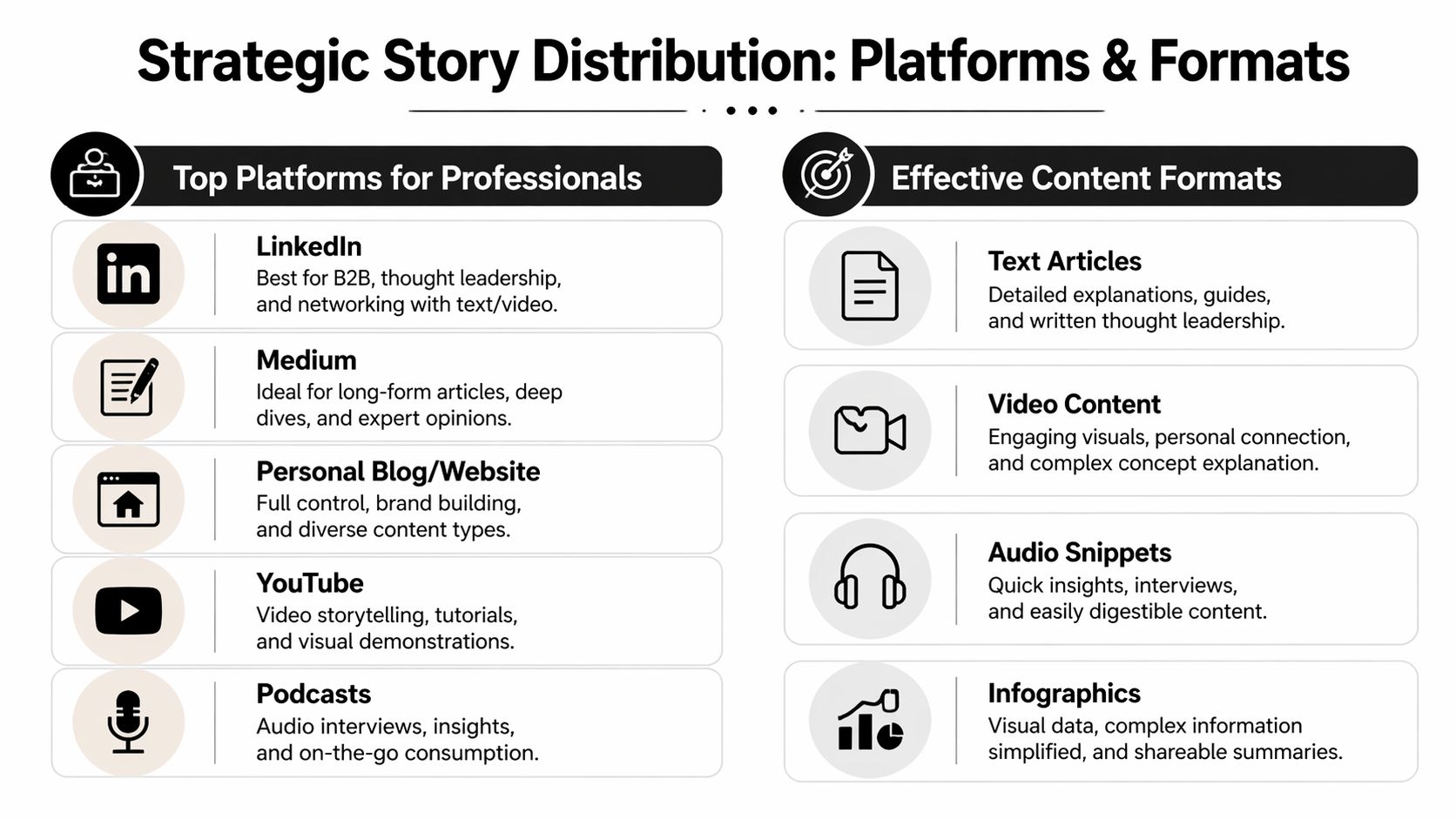
For most founders and leadership professionals, a clean model works best:
That often means LinkedIn plus a personal website, or YouTube plus an email newsletter, or a blog plus selective amplification on social. You do not need five active channels. You need one place where your audience finds you and one place where you fully own the narrative.
Medium can work for long-form thought leadership. A personal blog works better if you care about durable brand equity. YouTube works if you explain visually or teach through demonstration. Podcasts work if your strength is spoken nuance and interviews.
For examples of how AI-assisted teams think about audience attention and content ecosystems, the lunabloomai blog is worth browsing. It’s useful for understanding how format choices shape discoverability and reuse.
Different formats do different jobs. Most founders choose based on comfort. Choose based on outcome.
| Format | Best For | Key Platforms |
|---|---|---|
| Text Articles | Detailed explanations, opinion pieces, founder lessons | Personal Blog/Website, Medium, LinkedIn Articles |
| Video Content | Demonstrations, emotional connection, teaching nuance | YouTube, LinkedIn |
| Audio Snippets | Interviews, commentary, portable insights | Podcasts, social clips |
| Infographics | Simplifying ideas, visual summaries, shareable frameworks | Personal Blog/Website, LinkedIn |
Busy founders don’t need more discipline lectures. They need a workflow.
Use this three-part system:
Set aside one block to think, one block to draft, and one block to refine. Don’t switch between strategy and execution every day. Context switching kills consistency.
Use tools like Buffer, Hypefury, Typefully, Notion, or a simple spreadsheet. The tool matters less than the cadence. You want content queued before the week begins, not written under pressure five minutes before publishing.
Take one strong idea and split it intelligently:
Many teams use support. A service like Legacy Builder handles interviews, content creation, and strategic distribution for professionals who want their stories turned into consistent brand assets without doing all the production work themselves.
Operator’s note: Repurposing is not copy-paste. It’s adaptation. The same idea should feel native everywhere it appears.
If you’re still deciding where to start, use a blunt filter.
The right platform is the one you can sustain long enough for people to associate your name with a clear idea.
Daily panic-posting is not a content strategy. It’s a burnout plan.
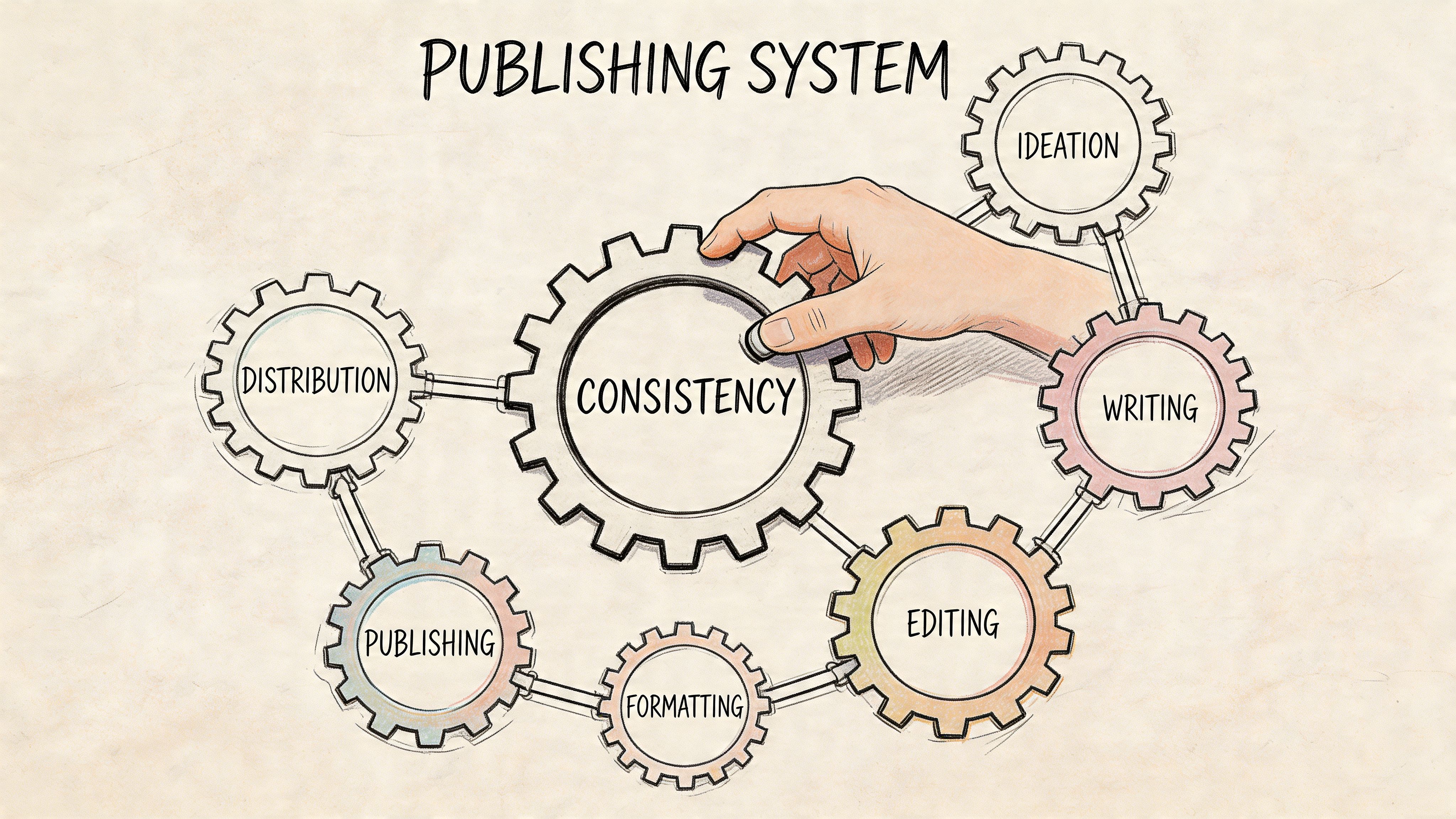
Founders quit storytelling because they build their process around bursts of motivation. That always fails. The answer is a publishing system that makes consistency boring, predictable, and hard to break.
The structure is straightforward: define your objective, pull in the right evidence, turn it into a human narrative, and publish with a specific call to action. MemoryFox outlines that kind of data storytelling process and notes that consistent daily posting with a structured method can produce 2-3x audience growth in 90 days for professionals.
Create three to five recurring themes tied to your core message.
A founder in B2B SaaS might use:
Those pillars become your content inventory. Once they’re set, you no longer ask, “What should I post?” You ask, “Which pillar needs a story this week?”
A sustainable week often looks like this:
| Day or block | Job |
|---|---|
| Strategy block | Review audience questions, note themes, choose stories |
| Draft block | Write multiple posts or scripts in one sitting |
| Edit block | Tighten hooks, remove fluff, sharpen takeaways |
| Publish block | Schedule content and prepare responses |
| Review block | Note which conversations led to useful signals |
That’s enough. You don’t need a complicated editorial board.
If you want a practical planning structure, this content calendar template for social media is a helpful reference because it turns vague consistency goals into an actual publishing rhythm.
Most content advice ignores a growing threat. As your story gets more visible, someone can distort it.
The risk isn’t theoretical. Deeptrace Labs reported that voice cloning incidents rose 430% in 2025, a point highlighted in discussion around digital storytelling and authenticity risks. If you’re building a public-facing founder brand, you need basic safeguards.
Do these now:
The stronger your brand gets, the less optional verification becomes.
If your story becomes an asset, someone will eventually try to borrow it, distort it, or impersonate it.
Most founders think reputation management begins when there’s a problem. It begins much earlier. It starts by making it easy for real people to confirm what is yours and hard for bad actors to create confusion around your identity.
The first move is operational, not technical. Build a clean trail back to you. Your personal site, your main social profiles, your newsletter, and your speaking pages should all point to each other. Buyers, journalists, podcast hosts, and partners should never have to guess which profile is legitimate.
A lot of professionals react to impersonation risk by posting more. That doesn’t solve the trust problem. Proof does.
Use:
This matters because once your content circulates, the market often sees fragments, screenshots, and clips before it sees context.
Protection is tied to measurement. If you only watch likes, you’ll miss the signals that tell you whether your narrative is landing correctly.
Track:
Those are stronger indicators of narrative ownership than vanity engagement.
For professionals formalizing this process, this online reputation management guide for building a powerful brand is useful because it approaches reputation as an active system, not damage control after the fact.
The founders who protect their story well don’t act paranoid. They act organized.
Posting is only half the job. Value appears in the conversation that follows.
A founder can get plenty of attention and still get weak business results. That happens when they measure applause instead of movement. Likes are easy. Retweets are flattering. Neither automatically means your network got stronger, your brand got clearer, or your pipeline improved.
A good example comes from X. Socialinsider Analytics found that reply-driven callouts produced 3 times more retweets but only 17% conversion to network expansion in a 2026 analysis covered by America Amplified’s engagement tools page. That’s the difference between visibility and progress.
Use this filter.
| Vanity metric | Useful business signal |
|---|---|
| Likes | DMs that reference a specific insight |
| Impressions | Profile visits from the right audience |
| Retweets or reposts | New relationships with buyers, peers, or partners |
| Generic comments | Thoughtful replies that show understanding or intent |
This doesn’t mean top-line metrics are worthless. It means they are incomplete.
If you want better engagement, stop ending every story with “Thoughts?”
That invites lazy replies.
Use prompts that force specificity:
Those questions attract operators, not spectators.
You do not need enterprise analytics to know if your story is working. You need a small set of founder-relevant signals reviewed consistently.
Track each month:
If you care about discoverability beyond social feeds, it’s also worth understanding how narrative content supports AI Search Visibility. Founders who publish clear, original perspective in owned channels give both people and machines a stronger signal about what they should be known for.
Your story is performing when the right people repeat your ideas back to you and act on them.
The comment section is not admin work. It’s market research.
When someone asks a sharp follow-up, answer with intent. When several people misunderstand the same point, your positioning needs tightening. When one short story leads to unusually strong DMs, turn that into a longer asset. The audience is telling you what resonates. Most founders ignore that data because they’re too focused on the post they just published.
Don’t make that mistake.
You don’t need more tips. You need a decision.
Decide that your story is a business asset. Decide that visibility is part of leadership. Decide that hiding behind product updates and generic expertise posts is no longer enough.
When you share your story online with discipline, you create something competitors can’t clone easily. You create context around your work. You shorten trust. You make your name mean something before the sales conversation starts.
Use a simple checklist.
Keep it lean. Keep it honest. Keep it repeatable.
Most founders wait too long because they think they need a polished personal brand before they start. They don’t. They need clarity, structure, and the willingness to be seen.
If you want help turning your experiences, insights, and perspective into a consistent personal brand, Legacy Builder works with founders and professionals to turn story into strategic content that supports visibility, trust, and long-term brand equity.


You could – but most in-house teams struggle with the nuance of growing on specific platforms.
We partner with in-house teams all the time to help them grow on X, LI, and Email.
Consider us the special forces unit you call in to get the job done without anyone knowing (for a fraction of what you would pay).
Short answer – yes.
Long answer – yes because of our process.
We start with an in-depth interview that gives us the opportunity to learn more about you, your stories, and your vision.
We take that and craft your content then we ship it to you. You are then able to give us the final sign-off (and any adjustments to nail it 100%) before we schedule for posting.
No problem.
We have helped clients for years or for just a season.
All the content we create is yours and yours alone.
If you want to take it over or work on transitioning we will help ensure you are set up for success.
We want this to be a living breathing brand. We will give you best practices for posting and make sure you are set up to win – so post away.
Subscribe to our newsletter and get insights on how to grow your personal brand.
