.svg)
Subscribe to our newsletter and get insights on how to grow your personal brand.
Thank you! Your submission has been received!
Oops! Something went wrong while submitting the form.
.svg)


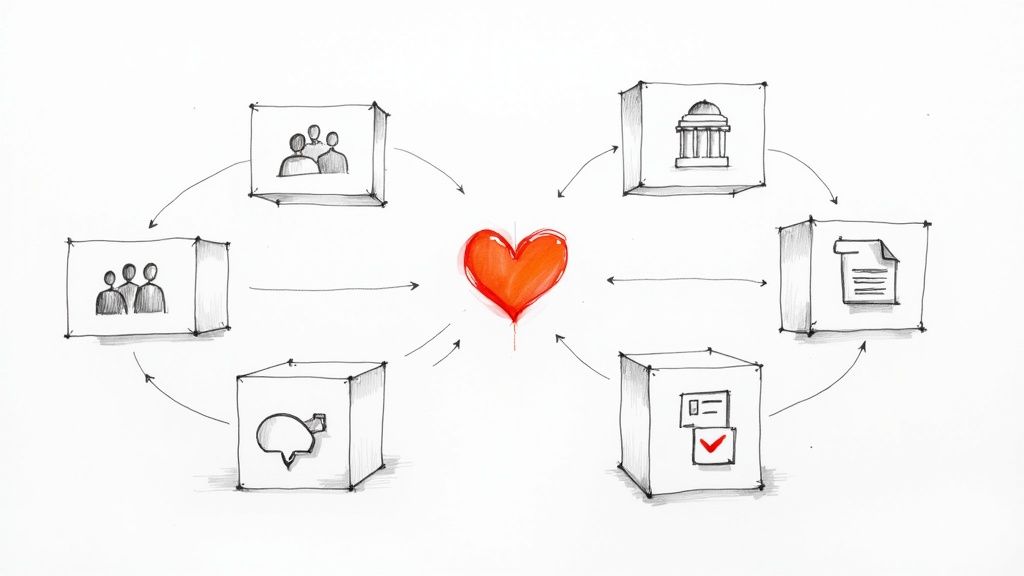
A brand storytelling framework isn't just one story.Think of it as your repeatable playbook, the single source of truth that guides every single message you put out into the world.
Let's be real—the market is absolutely saturated with noise. To stand out, a good product or service isn't enough. You need a narrative that actually sticks.
This is where a brand storytelling framework comes in. It's your compass. It ensures every piece of content, from a quick tweet to a massive campaign, tells the same consistent, compelling story. It’s the difference between shouting random facts into the void and building a saga your audience genuinely wants to follow.
Without a framework, your messaging gets fragmented and confusing, which just dilutes your brand's impact. With one, you start building a cohesive identity that people actually trust and recognize.
I see so many businesses fall into this trap. They create content reactively. A new trend pops up on TikTok, so they rush to make a video. A competitor launches a new campaign, and they scramble to respond.
This approach gives you a jumbled mess of messages with no central theme. It leaves your audience wondering what you even stand for.
A framework forces you to get intentional. You define your core narrative first. It's about proactive communication, not chaotic, reactive marketing. The goal is to build a universe around your brand where every little thing reinforces the main plot.
Your framework isn't about restricting creativity. It's about providing the rails on which your creativity can run faster and more effectively, ensuring every story serves a larger purpose.
Putting a brand storytelling framework in place delivers real, measurable results. We're not talking about fuzzy metrics here; this directly impacts how customers see you and how loyal they become. The data is crystal clear: customers don't just buy products, they buy into stories.
Statistics show that a staggering 92% of consumers want brands to make ads that feel like a story. That emotional connection is what drives them to act. In fact, companies that nail their narrative can see a 20% increase in customer loyalty.
These aren't just vanity numbers. They show how a structured story is a powerful business asset, not just a fluffy creative exercise.
A huge reason to adopt this approach is to achieve seamless integrated marketing communications. When every message aligns to tell one cohesive brand story, you build the kind of brand people remember, trust, and choose over the competition, every single time.
Ultimately, this strategic alignment is how you establish your authority. When your story is clear and consistent, you don't just get more customers—you start building a real https://www.legacybuilder.co/authority.
A killer brand story doesn't just happen. It’s not a lightning strike of creative genius. It's built, piece by piece, from a handful of core components that all have to work together.
Think of it like building a house. You can't skip the foundation and go straight to painting the walls. Leave one of these elements out, and the whole structure feels shaky.
Let’s get practical and break down the six non-negotiable elements that form the bedrock of any brand story that actually works. This isn't just theory; it's a gut-check for your own narrative.
Seriously, everything starts here. You can't tell a story if you have no idea who you're talking to. And I'm not talking about surface-level demographics like age or job title. That's entry-level stuff.
To build a framework that connects, you have to dig deeper. You need to map out their real motivations, their hidden fears, and what they secretly hope for.
What problem are they really trying to solve? What keeps them tossing and turning at 3 AM? When you get a handle on their internal struggles, your story suddenly becomes their story. It’s relevant because it mirrors their own life.
Once you know your audience inside and out, it's time to define what you stand for. Your message pillars are the two to four unshakable truths about your brand. These are the big ideas you'll hit again and again in your content, hammering home your central narrative.
These aren't catchy taglines. They're foundational concepts that spell out your value, your mission, and your unique point of view. For a SaaS company, the pillars might be something like "Radical Simplicity," "Data That Drives Decisions," and "Support That Actually Cares."
Your message pillars are the ultimate filter for your content. Before you hit "publish," ask one simple question: "Does this reinforce one of our core pillars?" If the answer is no, you're going off-script.
Every story that's ever stuck with you has a beginning, a middle, and an end. But here's the mistake 99% of brands make: they cast themselves as the hero.
Let me be clear: Your customer is the hero.
They are the one on a journey, facing down challenges and looking for a resolution. Your brand plays the role of the mentor or the guide—think Yoda or Mr. Miyagi. You're the one with the tools, the plan, and the wisdom to help the hero win the day. This structure, often called the "Hero's Journey," is pure gold because it’s hardwired into our DNA.
To make sure you've got all the essentials covered, here's a quick breakdown of how these components fit together.
This table summarizes the six key pieces you need to build a narrative that not only resonates but also drives action. Think of it as your high-level checklist.
Getting these six elements right isn't just a marketing exercise—it's the foundation for building a brand that people genuinely connect with and trust over the long haul.
How you say something is just as critical as what you say. Your brand voice is its personality. It’s what makes you sound like you in every email, social post, and blog article. Are you the witty expert? The supportive friend? The inspiring mentor?
A well-defined voice creates consistency, and consistency builds trust. It’s the difference between a brand that feels like a faceless corporation and one that feels like a real person you know. Document it. Write down adjectives like "clear, confident, and empathetic," and create a "do's and don'ts" list with real examples.
A great story is just a nice fairytale without proof. Proof points are the cold, hard evidence that turns your marketing claims into undeniable facts. This is where trust is built or broken.
Your goal isn't just to find proof, but to build an entire library of it that you can pull from at any time.
Finally, you need to decide where and how you'll tell this story. The format and channel should always serve the narrative and the audience—never the other way around. Don't just chase the latest shiny object. Be strategic.
A B2B brand telling stories of complex business transformations will probably crush it with detailed case studies on its blog and deep-dive posts on LinkedIn. A direct-to-consumer brand, on the other hand, might use raw, behind-the-scenes videos on Instagram and TikTok to share its founder's journey.
The goal is to meet your audience where they already are, with a format that feels natural to that space. That’s how you make sure your story actually lands.
Alright, we’ve covered the essential building blocks. Now for the fun part: forging those pieces into a brand storytelling framework that is uniquely yours.
This isn't about grabbing a generic template and just filling in the blanks. We're talking about a thoughtful process of discovery, collaboration, and synthesis to create something authentic.
The end goal is a living document—a true north for your entire team. It should turn those abstract brand ideas into a practical guide that anyone in the company can use to create consistent, powerful content.
Look, the best stories aren't cooked up in a marketing meeting. They're already living inside your company—in the experiences of your team, the memories of your founders, and the unwritten culture that guides you every single day.
To get to these gems, you need to bring your people together for a discovery workshop.
This isn’t just another brainstorm. It’s a facilitated session designed to pull out the core truths of your brand. Make sure you invite a mix of people from across the company—leadership, sales, product, customer support. The more diverse the perspectives, the richer your story will be.
Here’s a simple way to structure it:
Your internal workshop uncovers your brand's soul, but it's your customer research that makes it relevant. The real magic happens when you bring these two worlds together.
Take all those amazing insights from your discovery sessions and filter them through what you know about your audience’s deepest pains and desires.
This is where you connect the dots. For example, if your team is obsessed with building elegant, simple software (an internal truth), and your customer research shows your audience is drowning in clunky, bloated tools (an external pain), you've just found a powerful narrative thread.
The most effective brand stories sit at the intersection of what you authentically are and what your audience desperately needs. One without the other is just noise.
This process turns a bunch of scattered ideas into a focused narrative. Suddenly, you see how your brand’s journey is the answer to the transformation your customer is looking for. It’s no longer just a product; it’s the guide they’ve been searching for. This is the foundational work for developing memorable legacy builder content that truly lasts.
This simple flow shows how you turn raw insights into a real framework.
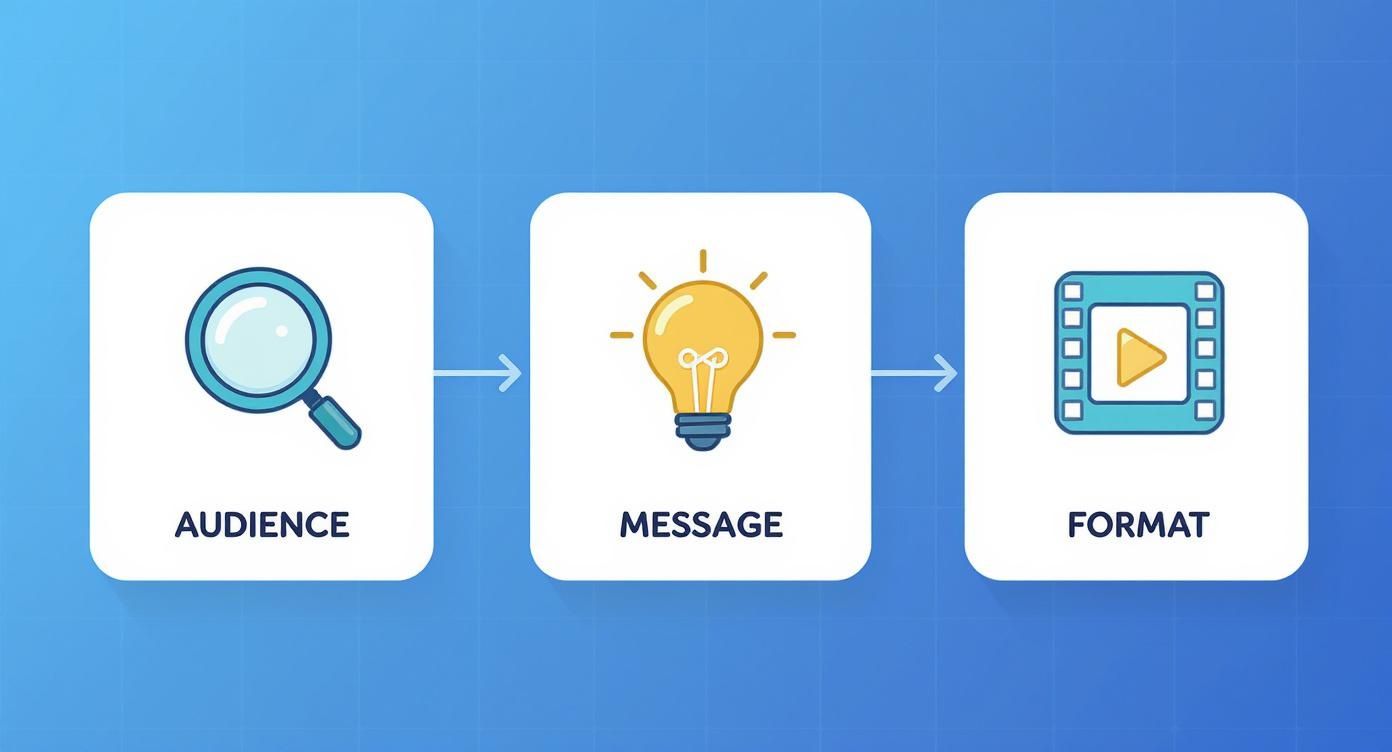
As you can see, a winning framework always starts with the audience, builds the message around their needs, and then picks the right format to deliver it.
Now that you've got your story straight, it's time to get it down on paper. Create a clear, concise, and super practical guide—not some dense, 50-page brand book that will collect dust on a shelf.
Keep it simple and actionable. This document should be easy to share and serve as a quick reference for anyone creating content. It's the playbook that keeps everyone telling the same story, no matter what team they're on.
Your document should cover each of the core building blocks we discussed earlier:
A framework is totally useless if no one uses it. Getting your team on board isn't the final step—it's something you do throughout the entire process. By including people from different departments in that initial workshop, you create champions who already feel a sense of ownership.
When you present the final document, frame it as a tool that makes their jobs easier, not a set of restrictive rules. Show them how this guide provides clarity and removes the guesswork.
Run a quick training session to walk the team through it, using practical examples of how to apply it to a social media post, a sales email, or a new landing page.
Then, make the framework impossible to ignore. Pin it in your company's Slack channel. Add it to your new-hire onboarding. Reference it constantly in content reviews. When you embed it into your daily workflows, it stops being a document and becomes part of your company's DNA. That's how you build a brand that tells one consistent, powerful story everywhere.
Theory is great, but seeing how this stuff works in the real world is where the lightbulbs really go off. The best brands don't just push products; they pull you into a story. They make you feel something.
Let's break down how a few different types of businesses use storytelling frameworks to get what they want.
We're not just going to rehash famous ad campaigns. Instead, we'll look under the hood at the strategic engine that makes them work. You'll see how the core pieces—the audience, message pillars, and narrative arc—get bent and shaped to fit different goals.
And here’s the thing: you don't need a Super Bowl-sized budget to do this. A powerful story is a tool any business can wield to connect with people and grow.
Picture a SaaS company selling project management software to big construction firms. Their audience isn't just a generic "project manager." They're talking to seasoned pros who are in a constant war against budget overruns, blown deadlines, and communication breakdowns that cost them millions. The stakes are sky-high.
So, their storytelling framework doesn't drone on about software features. It creates a single, expensive villain to fight: chaos.
By telling this story, they aren't just selling software. They’re selling predictability, control, and making their hero look like a rockstar.
Now, let's switch gears to a direct-to-consumer skincare brand. Their audience isn't hunting for a technical spec sheet. They want trust, authenticity, and a product that fits their personal values.
The entire brand is built around the founder's own struggle with sensitive skin. That’s the narrative.
This move immediately humanizes the brand. It’s no longer a faceless corporation; it's a real person on a genuine mission. The framework is wired for emotional connection, not just clinical results.
The founder’s journey—their vulnerability, the endless research, and that final breakthrough—creates an incredibly compelling story. It builds a tribe of loyal fans who feel like they're part of that journey with them.
This is where social proof becomes absolutely crucial. When you see how great brands leverage things like effective website testimonials, you realize each review is a mini-story that reinforces the founder's original narrative and builds a mountain of trust.
Finally, think about an email marketer at a financial education company. Their job is to nurture leads from "just curious" to "take my money." They don't do it with a hard sell. They use their email welcome series like an episodic TV show.
Each email is a new chapter in the customer's own journey toward financial freedom.
This serialized approach builds anticipation and trust over time. By the end, the call-to-action doesn't feel like a sales pitch. It feels like the natural next step in the reader's own story.
And it works. Stories that forge an above-average emotional bond can drive sales increases of around 23% compared to standard ads. It’s all about making them feel, not just think.

Look, a brilliant brand storytelling framework is completely useless if you don't actually put it to work. Creating the perfect narrative doc is one thing, but proving its value and scaling its impact? That's where the real growth happens.
This is the point where your story stops being a strategic plan and becomes a daily habit. It's about weaving your narrative into every single touchpoint—from social media posts and sales decks to customer support emails—so everything feels consistent and authentic.
More importantly, it’s time to move beyond vanity metrics. We need to dig into what truly matters: tracking how your narrative is landing with people and tying it directly back to tangible business goals.
The only way to scale your story is to make it a non-negotiable part of your content creation process. Your framework shouldn't be a document you dust off once a quarter; it needs to be the starting point for every single piece of communication.
To make this happen, embed it directly into your team’s tools. Build content brief templates in your project management system (think Asana, Monday, etc.) that have required fields for your core message pillars and narrative arc. This forces everyone to think through the story before they even start writing or designing.
Another tactic I've seen work incredibly well is holding a quick, weekly "story sync." It's a chance for teams to share how they've used the framework, show off wins, and get help with challenges. This creates a culture of storytelling and keeps the narrative fresh in everyone's mind. A solid framework is the backbone for a modern B2B social media strategy that works, because it ensures every post is adding a brick to the same house.
A framework is useless if it lives in a forgotten folder. The goal is to make using it a muscle memory for your entire team, so telling the brand story becomes second nature, not an extra step.
Impressions and likes are easy to count, but they don't tell you if your story is actually connecting with people. If you want to understand the real impact of your brand storytelling framework, you have to look at deeper, more meaningful metrics.
It's a mental shift from quantity to quality. Here are the metrics that show the true health of your narrative:
At the end of the day, your storytelling has to contribute to the bottom line. This is the final and most crucial step—drawing a clear line from your narrative work to real business outcomes. This is how you prove ROI and get the budget to scale up.
Smart brands are ditching one-off campaigns for continuous "story systems." These are integrated frameworks that deliver a consistent narrative across every digital touchpoint. This approach doesn't just boost impressions; it moves the needle on things like story recall, emotional resonance, and lead velocity. In a world where attention is the scarcest resource, stories that build hope and trust are the ones that cut through the noise and create real growth.
Start tracking how your story influences different stages of the customer journey. For example, analyze the lead quality from story-driven content versus your old product-focused stuff. Are the leads who came in through your narrative-based emails converting at a higher rate?
And here’s the big one: track the customer lifetime value (CLV) of audiences who have engaged with your core brand stories. You'll almost always find that the customers who connect with your "why" don't just spend more—they become your loudest champions, creating a powerful, self-sustaining growth loop.
Once you have a brand storytelling framework on paper, the real work begins. Moving from a document to actually telling your story out in the wild is where the tough questions pop up.
Let's walk through some of the most common hurdles I see founders and leaders face. Getting your story right isn't a one-and-done task; it’s about constantly refining and adapting.
Honestly, there's no magic word count. A story's power isn't in its length, but in its ability to hook someone, hold their attention, and make them feel something. The right length is whatever it takes to do that on a specific platform.
I hear this all the time, and my answer is always the same: No industry is actually boring. It's just full of untold stories. Every business, no matter how technical or niche, solves a human problem. That's your goldmine.
Stop talking about your product's features and start talking about the people it helps. In fact, B2B brands that focus on customer success in their storytelling generate 3x more leads.
Focus on the transformation, not the transaction. How does your service make someone's workday less stressful? What bigger problem are you helping your clients solve? That's where you'll find compelling stories.
A cybersecurity firm isn't just selling software; it's selling a good night's sleep to a CTO who was tired of worrying about data breaches. That's a story people connect with.
This is the big one. Tying your stories to revenue is how you prove the value and get the resources to do more. It can feel tricky, but you absolutely can track the impact.
You need to look at both direct and indirect results. A great starting point is to use specific UTM parameters to track conversions from your story-driven content versus your more direct, product-focused content. You'll quickly see which approach resonates more.
But the real magic is in the long-term data. Measure the lifetime value of customers who came to you through your core brand stories. What we often find is that these story-engaged customers have a much higher LTV—sometimes by as much as 2.4x. That's the kind of metric that shows the true business impact of a great story.
At Legacy Builder, we turn your unique experiences into a powerful personal brand story that connects with your ideal audience and drives growth. If you're ready to build an authentic narrative that works, let's build your legacy together.


You could – but most in-house teams struggle with the nuance of growing on specific platforms.
We partner with in-house teams all the time to help them grow on X, LI, and Email.
Consider us the special forces unit you call in to get the job done without anyone knowing (for a fraction of what you would pay).
Short answer – yes.
Long answer – yes because of our process.
We start with an in-depth interview that gives us the opportunity to learn more about you, your stories, and your vision.
We take that and craft your content then we ship it to you. You are then able to give us the final sign-off (and any adjustments to nail it 100%) before we schedule for posting.
No problem.
We have helped clients for years or for just a season.
All the content we create is yours and yours alone.
If you want to take it over or work on transitioning we will help ensure you are set up for success.
We want this to be a living breathing brand. We will give you best practices for posting and make sure you are set up to win – so post away.
Subscribe to our newsletter and get insights on how to grow your personal brand.
