.svg)
Subscribe to our newsletter and get insights on how to grow your personal brand.
Thank you! Your submission has been received!
Oops! Something went wrong while submitting the form.
.svg)


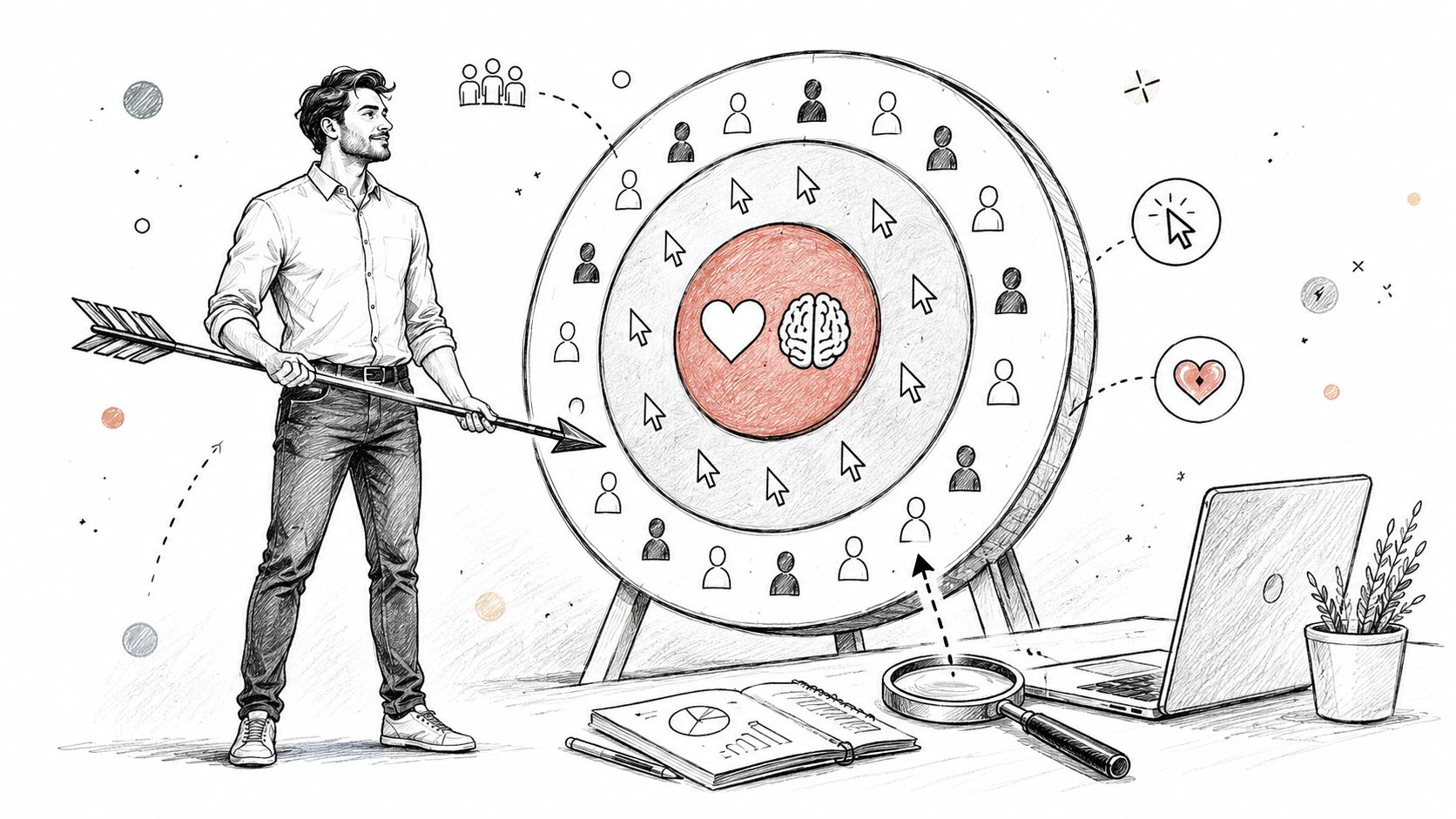
You've published every week for six months. The posts look polished, the follower count is moving, and people leave polite likes. Yet your replies are thin, your DMs are quiet, and qualified clients still seem to find someone else.
That pattern usually isn't a reach problem. It's a relevance problem. Your content is reaching people, but your message may not reflect what they're trying to protect, prove, escape, or become. Psychographic targeting gives personal brands a way to research those motivations and turn them into sharper positioning, better content, and more useful conversations.
The approach isn't an ad-tech shortcut. It's a research discipline. You're looking for meaningful differences in worldview, risk tolerance, identity, and decision-making, while staying honest about how much personality can be inferred from online behavior.
A founder I've worked with had built the kind of publishing habit many want. She posted weekly, commented on industry conversations, and shared practical advice from her experience. Her audience grew steadily, but the business stayed strangely quiet. People recognized her name, yet few asked for help.
The problem became obvious after reviewing the content side by side. Every post was designed for “business owners,” a category broad enough to include a cautious operator, an ambitious first-time founder, and a consultant trying to escape client work. The advice was accurate, but it gave none of those people a reason to feel personally understood.
We replaced broad topics with sharper questions:
The resulting posts didn't become louder. They became more specific. One series addressed operators who valued control and needed transparent processes. Another spoke to founders who wanted a visible point of view but feared sounding self-promotional. The difference was not a new publishing tool. It was a clearer understanding of the people behind the audience label.
Practical rule: If your content earns attention but not conversation, investigate the audience's identity and decision pressure before increasing your posting frequency.
Most personal brands optimize for reach first. They choose topics based on what might attract the largest possible audience, then wonder why engagement stalls. Psychographic research reverses that order. It asks which beliefs and tensions make a person stop, respond, save a post, or start a buying conversation.
The rest of the playbook depends on that shift. You're not trying to label people with impressive personality categories. You're trying to identify segments you can recognize, write to, and serve without stereotyping them.
Psychographic targeting groups people by the mental and emotional factors behind their decisions. Those factors can include values, attitudes, fears, aspirations, identity, lifestyle, trust triggers, and preferred ways of processing information. A useful overview of the broader concept is this audience segmentation definition, especially when you're building a structured view of who belongs in each audience group.
Demographic targeting answers who someone is. It uses details such as role, location, age, or company type. Behavioral targeting answers what someone has done, such as clicking a post, downloading a guide, visiting a page, or buying before.
Psychographics ask why the action matters. Two founders can hold the same title, work in the same industry, and have similar budgets while responding to entirely different messages. One may want a proven process that reduces uncertainty. Another may want a bold partner who helps them stand apart. Their observable behavior might look similar until you understand the motive behind it.
A coffee shop offers a simple analogy. Demographics might tell you a regular's neighborhood and occupation. Behavioral data might show that they visit often and order coffee. Psychographic observation adds the useful detail: they choose oat milk, ask for a quiet table, and read alone. Those choices suggest priorities around routine, autonomy, and concentration. They're not proof of a fixed personality, but they're useful clues for creating a more relevant experience.
For personal brands, the most useful variables usually include:
| Targeting Layer | Question It Answers | Data Source | Best Use |
|---|---|---|---|
| Demographic | Who is this person? | Role, location, company, basic profile data | Define broad eligibility and reach |
| Behavioral | What did this person do? | Clicks, visits, downloads, purchases, replies | Identify interest and timing |
| Psychographic | Why might this person care? | Interviews, surveys, language patterns, values, attitudes | Shape positioning, creative, tone, and offers |
A working definition is simple: psychographic targeting is the practice of identifying motivation-based audience differences and using them to make your message more relevant. For a personal brand, that means research should influence what you say, how you say it, where you publish it, and what action you invite next.
Psychographic research didn't begin with social media ads. A 2020 review in Frontiers in Communication places its emergence in the 1960s, when consumer researchers began moving beyond demographic categories toward personality traits, activities, interests, opinions, needs, values, and attitudes.
The early promise was practical. If marketers understood what people valued, they could build lifestyle and values-based groups instead of treating everyone in an age or income bracket as interchangeable. Frameworks associated with values research and lifestyle segmentation gave advertisers a vocabulary for discussing motivations, even when the available data remained limited.
Mass advertising then brought those ideas into broader campaigns. Television and print could present different creative ideas to different lifestyle audiences, but the segmentation still depended heavily on surveys, panels, and strategic interpretation. Marketers could tailor the story, but they couldn't continuously infer a person's psychological profile from every digital action.
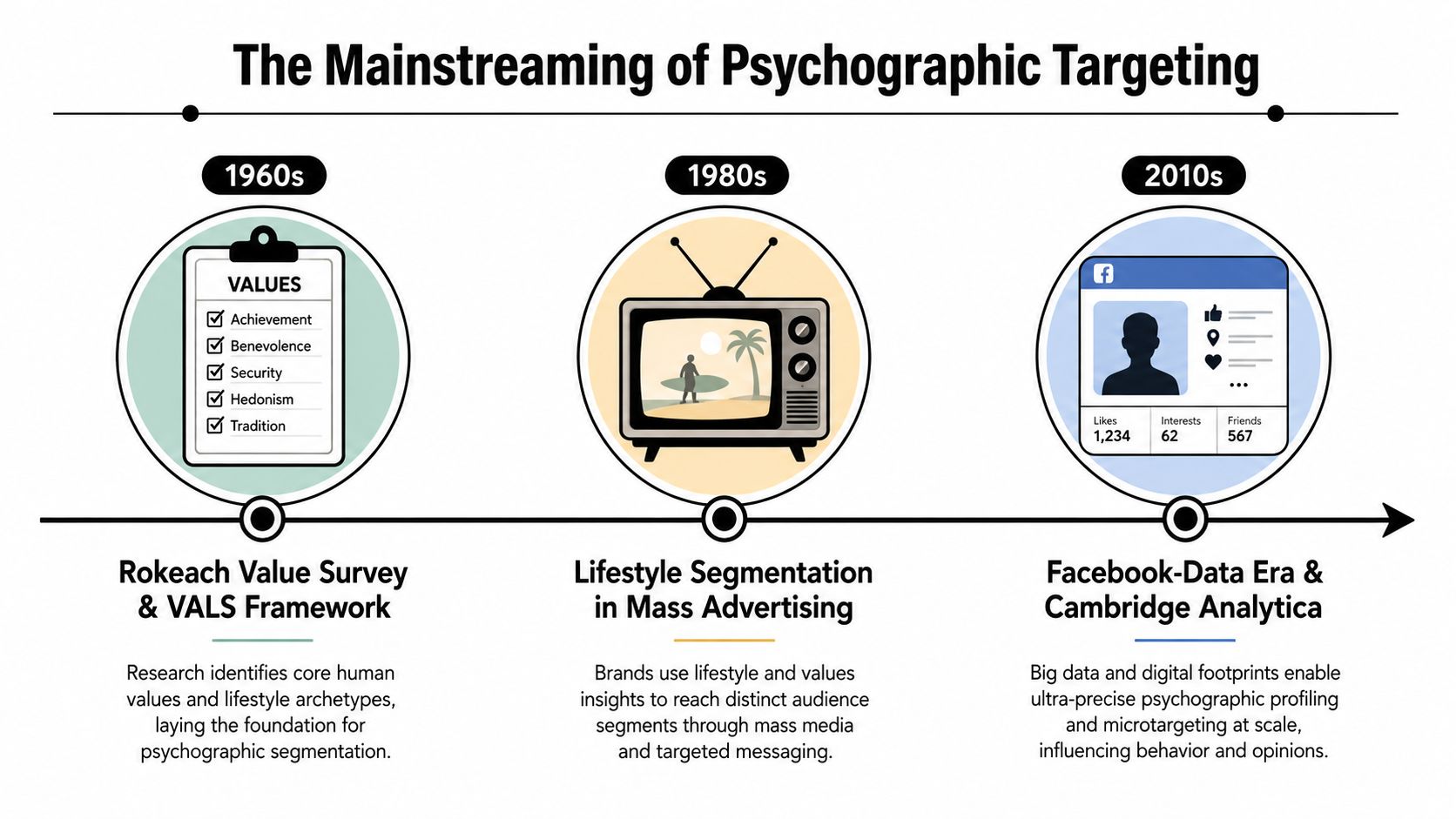
The Facebook-data era changed the public perception of what psychographics could do. Reporting on the Cambridge Analytica scandal said the firm had inferred profiles for about 87 million Facebook users, using a personality-quiz app called “This Is Your Digital Life” and friends' data without informed consent. The same reporting described claims of 4,000 to 5,000 data points for each of roughly 220 million U.S. adults. Those figures made psychographic-style profiling feel like an industrial persuasion system rather than a qualitative research method. The Cambridge Analytica reporting also connected the controversy to the extensive political microtargeting associated with the 2016 U.S. presidential election.
Earlier academic work helped fuel the story. Research on Facebook likes reported that 68 likes could predict traits such as skin color, sexual orientation, and political preferences with about 90% accuracy. That result helped move psychographics from a marketing idea into the popular imagination as a machine for reading personality from behavior.
The practitioner lesson is less dramatic. Scale moved faster than certainty. Large datasets can support useful hypotheses, but they don't automatically reveal stable motives or justify invasive personalization. Personal brands should borrow the research discipline, not the surveillance mindset.
You don't need a research department to build a useful first profile. You need a repeatable process that compares what people say, what they discuss publicly, and what they choose.
Recruit five to eight past buyers or engaged followers for 25-minute interviews. Don't select people who all look alike. Choose variation in role, relationship length, buying objection, and outcome so you can hear where motivations diverge.
Ask questions that reveal change and tension:
Avoid asking whether someone is “an introvert” or “a risk-taker.” Those labels invite self-conscious answers. Ask about a recent decision instead.
Review discussions on LinkedIn, Reddit, and relevant niche forums. Capture the phrases people use for the problem, the metaphors they repeat, the outcomes they envy, and the influencers or approaches they challenge.
Social listening is valuable because people often describe their frustrations more plainly in public than they do in a formal survey. Separate direct language from your interpretation. “I don't want another agency rewriting my voice” is evidence. “This person values authenticity” is a hypothesis to test.
Create a survey with no more than 12 questions. Pair closed questions about values, confidence, or risk tolerance with open prompts such as:
Keep the survey focused on decisions connected to your offer. A personality quiz may be interesting, but it won't necessarily tell you which message earns trust.
For a practical structure covering motivations, objections, and audience context, the Quso buyer persona guide can help you organize the questions without turning the exercise into a fictional character profile.
Compare interview notes, public language, and survey responses. Look for patterns that appear across sources, then create a profile card containing:
The result doesn't need to represent a statistically valid population. It needs to produce segments you can write to and distinguish in practice. Document the evidence behind each segment, and revisit the cards every six months rather than treating the first version as permanent.
For a personal-brand-specific approach to the wider segmentation process, use this personal brand audience segmentation guide alongside your interview notes.
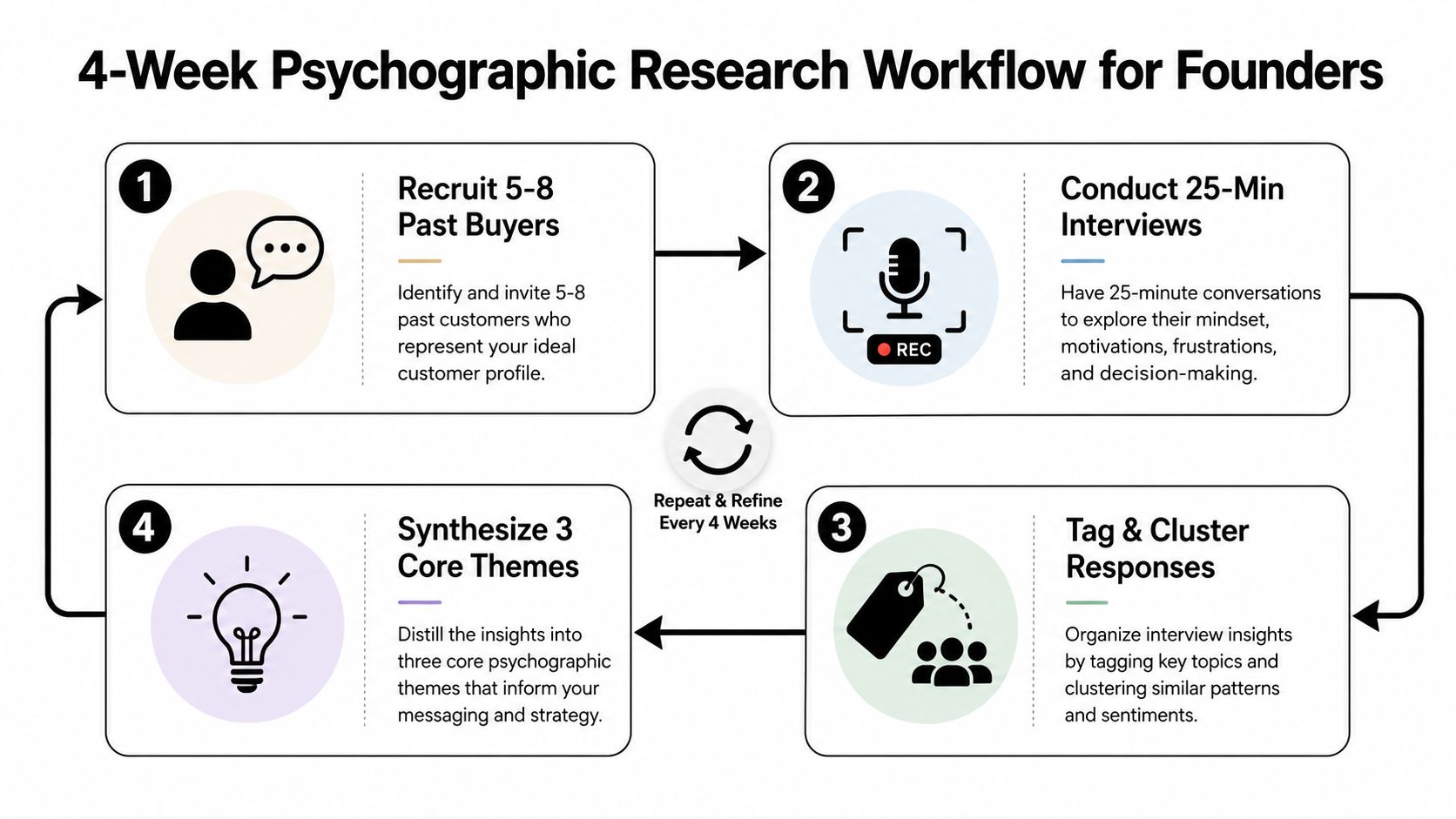
A simple way to keep the workflow moving is to assign each research activity to a distinct work block. Don't spend the entire process polishing labels. Your first job is to find language and decision patterns that change what you publish.
A profile card becomes valuable only when it changes a publishing decision. Start by choosing one primary fear or aspiration for each segment. Add three supporting proof points, then identify two objections you can address inside the content.
That hierarchy keeps the message from becoming a biography of the audience. A cautious operator may care about growth, but the immediate emotional driver could be avoiding a decision that creates operational chaos. A values-driven early adopter may also want growth, but respond more strongly to independence, experimentation, or visible progress.
Channel choice should follow the segment's information habits, not your personal preference. Risk-averse operators may prefer detailed LinkedIn posts and email because those formats let them inspect the reasoning. Growth-stage founders may respond more readily to short video or live audio because they want speed, energy, and direct access.
| Segment | Primary Trigger | Lead Message Angle | Best Content Format | Call to Action |
|---|---|---|---|---|
| Values-driven early adopter | Be distinct without losing integrity | Build a recognizable point of view before copying the market | Short video with a strong opinion | Share the principle you refuse to compromise |
| Skeptical operator | Reduce risk and retain control | See the process, assumptions, and limits before committing | Long-form LinkedIn post or email | Reply with the decision you're evaluating |
| Visibility-seeking expert | Be known for more than a service | Turn lived experience into a clear public position | Founder story with practical lessons | Send the topic you want to own |
| Overextended founder | Create consistency without adding another burden | Use a focused system that protects attention and voice | Checklist, carousel, or concise guide | Book a focused diagnostic conversation |
The same offer should sound different when the underlying motivation changes. For an early adopter, a headline might say, “Turn your unconventional point of view into a brand people remember.” The opening could challenge imitation and frame the offer as a way to make values visible.
For a skeptical operator, the headline might become, “A practical content system you can inspect before you scale.” The opening would lead with process transparency, constraints, and the cost of publishing material that doesn't sound like the founder.
The offer hasn't changed. The persuasion strategy has. A controlled field study found that appeals aligned with extraversion or openness generated up to 40% more clicks and up to 50% more purchases than mismatched or non-personalized messages, as reported in this Journal of Retailing and Consumer Services study. Treat that as evidence for testing message congruence, not as permission to assume personality from a profile.
Message test: Can you explain why this segment would care about the offer in a way that another segment wouldn't?
Publish one anchor piece per segment per month. Repurpose that idea into channel-native formats, but don't turn every variation into a separate strategy. If the segment insight is strong, the difference should appear in the hook, example, proof, and call to action, not only in a swapped adjective.
A deeper guide to turning audience understanding into usable profiles is available in this founder buyer persona guide. Use it to sharpen the profile, then let actual audience language decide the final copy.
More personality data doesn't automatically produce better targeting. A 2025 meta-analysis in the Journal of Marketing reported that only about 5% of the variance in personality could be predicted from digital footprints, and found personality-based messages had negligible behavioral effects when design and evaluation flaws were controlled. The implication is uncomfortable but useful: online behavior can provide clues, yet it may be a weak proxy for stable motives.
That finding should change your buying criteria. Don't pay for an elaborate personality layer because a platform makes the segments look precise. A segment is useful only when it improves a decision you can make, such as the angle of a post, the structure of a sales call, or the proof you put on a landing page.
Skip psychographic segmentation for now if:
The case for investing becomes stronger when your offer has a high price or a long consideration cycle. It also improves when people look identical demographically but make decisions according to different values, or when your personal brand competes primarily on trust and point of view.
A study of over 45,000 participants found that psychographics performed better for some media behaviors, while demographics performed better for some purchase behaviors. The researchers recommended combining the approaches rather than treating one as a replacement for the other, as described in this study of demographic and psychographic segmentation.
Contrarian test: Before collecting more personality data, rewrite the offer around a sharper problem, a clearer identity, or a more credible proof point.
For most founders, better questions and cleaner positioning will outperform another layer of inference. Use psychographics to refine a working hypothesis, not to manufacture certainty about people you barely know.
Measurement should help you learn, not decorate a dashboard. Personal-brand audiences are often small enough that a single post can distort your interpretation, so use a rolling view and compare patterns across related content.
Start with one north-star metric tied to the business outcome. That might be qualified bookings, new clients, or revenue. Then track two leading indicators:
| Layer | Metric to Track | Why It Matters |
|---|---|---|
| Business outcome | Qualified bookings, clients, or revenue | Connects content to the actual business |
| Audience response | Replies, saves, and qualified DMs | Shows whether the message creates relevance |
| Conversion path | Calls or inquiries from each message variant | Reveals which angle produces action |
| Learning record | Hook, format, segment, and result | Prevents vague conclusions and repeated tests |
Test one variable at a time inside one channel. You might publish two hooks for the same segment, then compare the quality of replies. In another sequence, keep the hook stable and change the call to action. Don't change the segment, format, offer, and distribution at once, or you won't know what caused the difference.
For surveys and structured feedback, choose a tool that lets you ask focused questions without creating unnecessary friction. This comparison of why switch from SurveyMonkey can help you evaluate alternatives, but the platform matters less than question quality and follow-up.
Keep a simple attribution note for every serious inquiry. Record the first content or conversation that created awareness, the message that prompted the reply, and the reason the person said they were ready to talk. That qualitative detail often explains a result better than a surface engagement count.
Use rolling windows rather than declaring victory after one post. Compare several pieces aimed at the same segment, review the language in the responses, and look for repeated objections. If the numbers look positive but the replies are irrelevant, the segment may be attracting curiosity rather than demand.
A practical framework for connecting marketing activity to business results is this marketing ROI guide for founders. Your measurement system should stay light enough that you'll keep using it after the initial enthusiasm disappears.
You can put this into practice without buying a personality database or rebuilding your entire content system. Protect privacy, use direct language, and treat every segment as a provisional explanation that real people can correct.
Run five interviews with customers or engaged followers this week. Ask what made the problem urgent, what they feared getting wrong, what alternative they considered, and what outcome would make them feel more capable or credible. Store their exact language in a shared document, and don't attach psychological labels that the evidence doesn't support.
Distill the conversations into two segments. Give each segment a plain-language name based on a decision tension, such as “needs proof before commitment” or “wants visibility without performance.” Write one custom message for each and publish one piece of content per segment. Change the hook, example, and call to action, not just the headline.
Set a two-week review window. Compare replies, saves, qualified DMs, inquiries, and the quality of conversations generated by each message. Then decide whether to deepen the segmentation, expand it to another channel, or drop it because the distinction didn't produce a useful business signal.
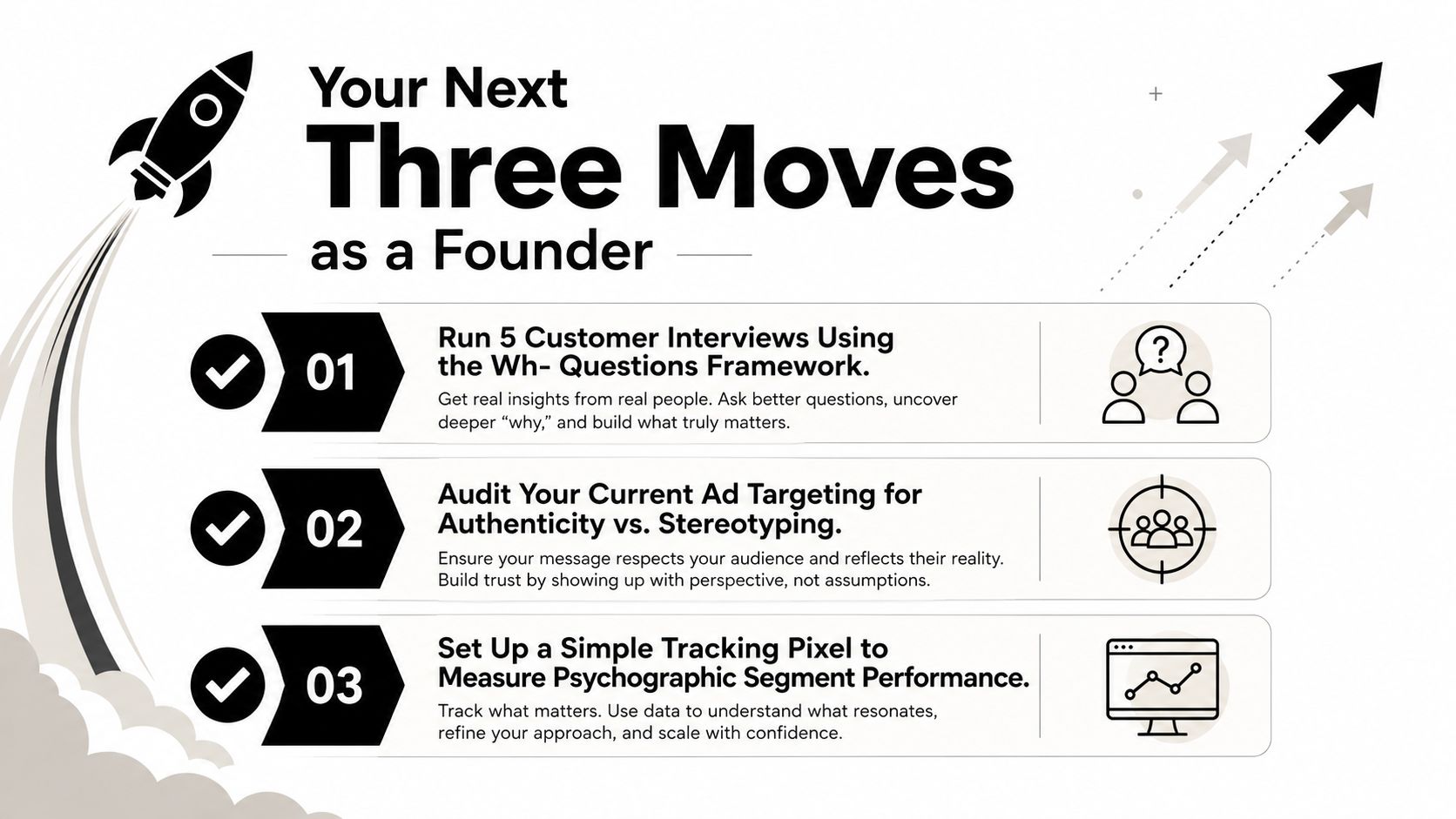
Audit your targeting for authenticity as well. Don't infer sensitive traits from casual digital behavior, and don't use private information people didn't knowingly provide for that purpose. Stanford describes psychological targeting as extracting psychological profiles from digital footprints to influence attitudes, emotions, or behaviors, while related privacy research raises concerns about whether users understand how this processing works. The Stanford perspective on psychological targeting and privacy is a useful reminder that trust is part of the strategy, not an afterthought.
The objective isn't more data. It's sharper questions, clearer segments, and more honest communication. Personal-brand psychographic targeting works best when it helps you understand people well enough to serve them, while leaving room for them to tell you that your interpretation is wrong.
Legacy Builder helps founders and professionals turn their stories, expertise, and audience insight into consistent content in their own voice. If you want support translating psychographic research into a practical publishing system, visit Legacy Builder and explore how its content strategists, writers, designers, and success managers can support your next stage of brand growth.


You could – but most in-house teams struggle with the nuance of growing on specific platforms.
We partner with in-house teams all the time to help them grow on X, LI, and Email.
Consider us the special forces unit you call in to get the job done without anyone knowing (for a fraction of what you would pay).
Short answer – yes.
Long answer – yes because of our process.
We start with an in-depth interview that gives us the opportunity to learn more about you, your stories, and your vision.
We take that and craft your content then we ship it to you. You are then able to give us the final sign-off (and any adjustments to nail it 100%) before we schedule for posting.
No problem.
We have helped clients for years or for just a season.
All the content we create is yours and yours alone.
If you want to take it over or work on transitioning we will help ensure you are set up for success.
We want this to be a living breathing brand. We will give you best practices for posting and make sure you are set up to win – so post away.
Subscribe to our newsletter and get insights on how to grow your personal brand.
