.svg)
Subscribe to our newsletter and get insights on how to grow your personal brand.
Thank you! Your submission has been received!
Oops! Something went wrong while submitting the form.
.svg)


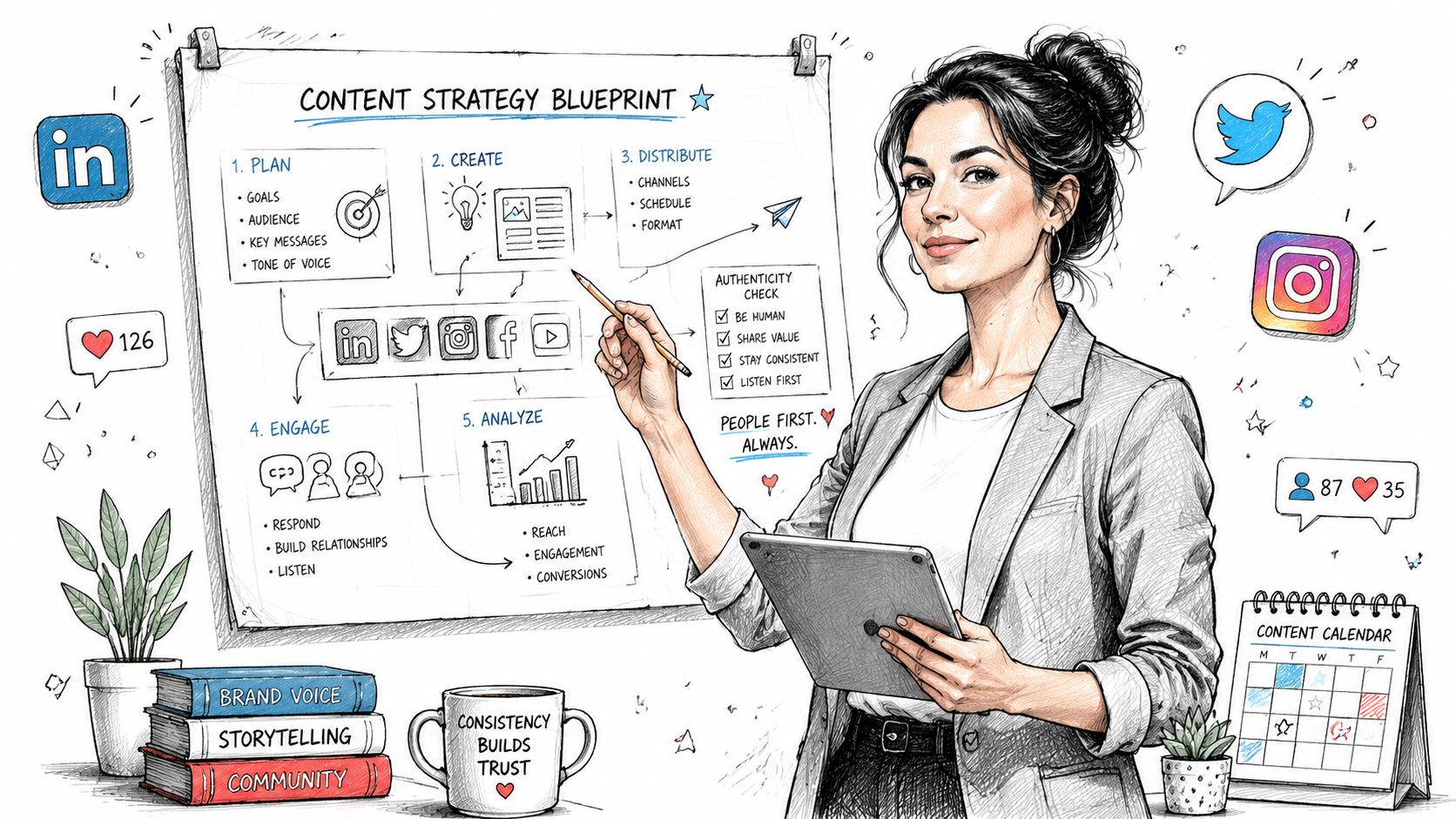
Most advice about a professional social media presence is stuck in the old playbook. It tells leaders to post every day, stay visible, and trust that consistency will win.
That advice now backfires.
Plenty of smart founders, executives, and consultants are publishing constantly and getting weaker results because they're feeding platforms filler. They're visible, but forgettable. Worse, they're training their audience to ignore them. A strong professional social media presence isn't built by volume. It's built by relevance, clarity, and conversion.
The most repeated advice in social media is also the most misleading: just be consistent.
Consistency matters, but mechanical consistency is not the same thing as strategic growth. If you post daily generic quotes, recycled blog links, shallow takes, or lifeless company updates, you're not building authority. You're publishing noise.
A 2025 Harvard Business Review analysis of algorithmic updates found that high-frequency, low-signal posting triggers a 35% reduction in reach compared to strategic bursts of high-value content. That should change how you think about your entire content plan.
Most professionals don't have a consistency problem. They have a signal problem.
They're active, but they're not memorable. They're posting because they were told to maintain cadence, not because they have something useful to say. Platforms have gotten better at spotting that pattern, and audiences have too.
Practical rule: If a post could be published by anyone in your industry, it probably won't help your brand.
Daily posting can work. But only when the content is sharp, opinionated, useful, and tied to a clear professional point of view. If it isn't, frequency becomes a tax on your brand.
Strategic consistency means you show up regularly with a purpose. You don't publish to satisfy a calendar. You publish to move someone toward trust.
That usually means:
Here's what I tell leaders who feel stuck: if your content calendar is full but your pipeline is quiet, the calendar is the problem.
A professional social media presence should create business outcomes. It should attract the right people, make your expertise easier to understand, and give others a reason to contact you. Posting more often without a strategy doesn't solve that. It usually hides the problem.
Stop asking, “How often should I post?” Start asking, “Would the right person care enough to respond?”
Before you write a post, fix the strategy.

Most weak social media efforts fail long before content goes live. They fail in the planning stage because there is no real positioning, no defined audience problem, and no decision about what the account is supposed to do for the business.
Social media isn't optional anymore. As of 2025, 83% of B2B marketers actively use social platforms to build a credible professional presence, and 96% of American small businesses have a social media footprint, according to Dreamgrow's social media marketing statistics. If nearly everyone is present, random posting won't separate you.
If your first question is “What should I post?” you're already behind.
Your first question should be: What business outcome should this presence produce?
Pick one primary objective. Not five.
Write that objective down in one sentence. If you can't define it clearly, your audience won't understand your profile or your content either.
A weak strategy says, “My audience is founders between 30 and 45.”
That's not useful.
A better strategy says, “My audience is B2B founders who know their offer is strong but struggle to explain it in public.” That gives you a content direction immediately. You can now speak to confusion, differentiation, sales friction, hiring pressure, or trust gaps.
Use this short filter:
That last question is where good content comes from.
Your audience doesn't care about your title first. They care whether you understand the problem they're living with.
You do not need to be everywhere. You need to be where your buyers, partners, and industry conversations already happen.
For most professionals, LinkedIn is the obvious base. It rewards expertise, creates direct access to decision-makers, and gives your profile a long shelf life. X can work for sharper industry commentary. Instagram can support founders with visual products or strong behind-the-scenes storytelling. YouTube works if teaching is central to your brand.
Use one simple rule: pick the platform where your reputation can compound.
Here's the mistake I see all the time. A leader spreads attention across four channels, publishes mediocre content everywhere, and calls it omnipresence. It's just dilution.
Your profile is not a résumé. It's a landing page.
Most professionals treat it like a storage unit for credentials. They list roles, employers, awards, and a vague mission statement, then wonder why profile visitors don't turn into conversations. Your profile should answer three questions fast: who you help, how you help, and what someone should do next.
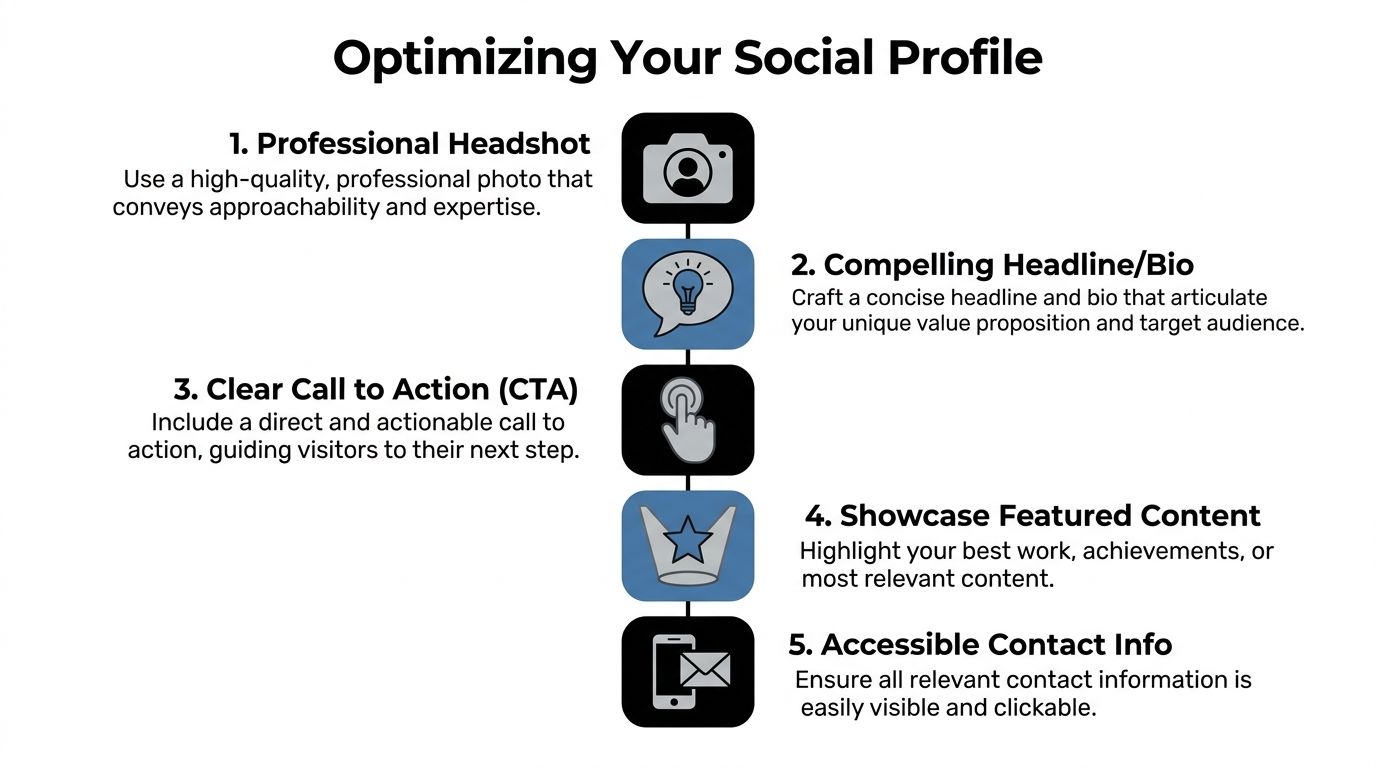
The top section of your profile does most of the work. If it's vague, the rest won't save you.
A strong profile needs:
If you need help tightening the wording, an AI LinkedIn headline writer can help you generate variations faster before you refine them in your own voice.
Here's the difference.
| Element | Optimization Goal |
|---|---|
| Headline | State who you help and the outcome you create |
| Profile photo | Build trust and approachability |
| Banner | Reinforce positioning at a glance |
| About section | Turn background into a persuasive narrative |
| Featured section | Direct visitors to your most valuable asset |
| Contact info | Remove friction from the next step |
Your About section shouldn't read like corporate copy. It should read like a credible operator explaining what they do, why it matters, and how they think.
Use a simple flow:
Keep it clean. Skip buzzwords like “passionate” and “results-driven.” Those words tell me nothing. Specificity builds trust.
For a deeper walkthrough, this guide on how to stand out on LinkedIn with stronger profile optimization is worth reviewing before you rewrite your page.
A short visual breakdown helps if you're rebuilding from scratch:
Your Featured section is where most professionals waste easy opportunity. Don't fill it with random posts. Put the assets there that help trust move forward.
That might include:
If someone lands on your profile after seeing one good post, your profile should make the next step obvious.
Professionals who struggle with content usually don't lack ideas. They lack structure.
That's why content pillars work. They turn your professional social media presence from a random stream of thoughts into a system and stop the daily panic of “what should I post today?”
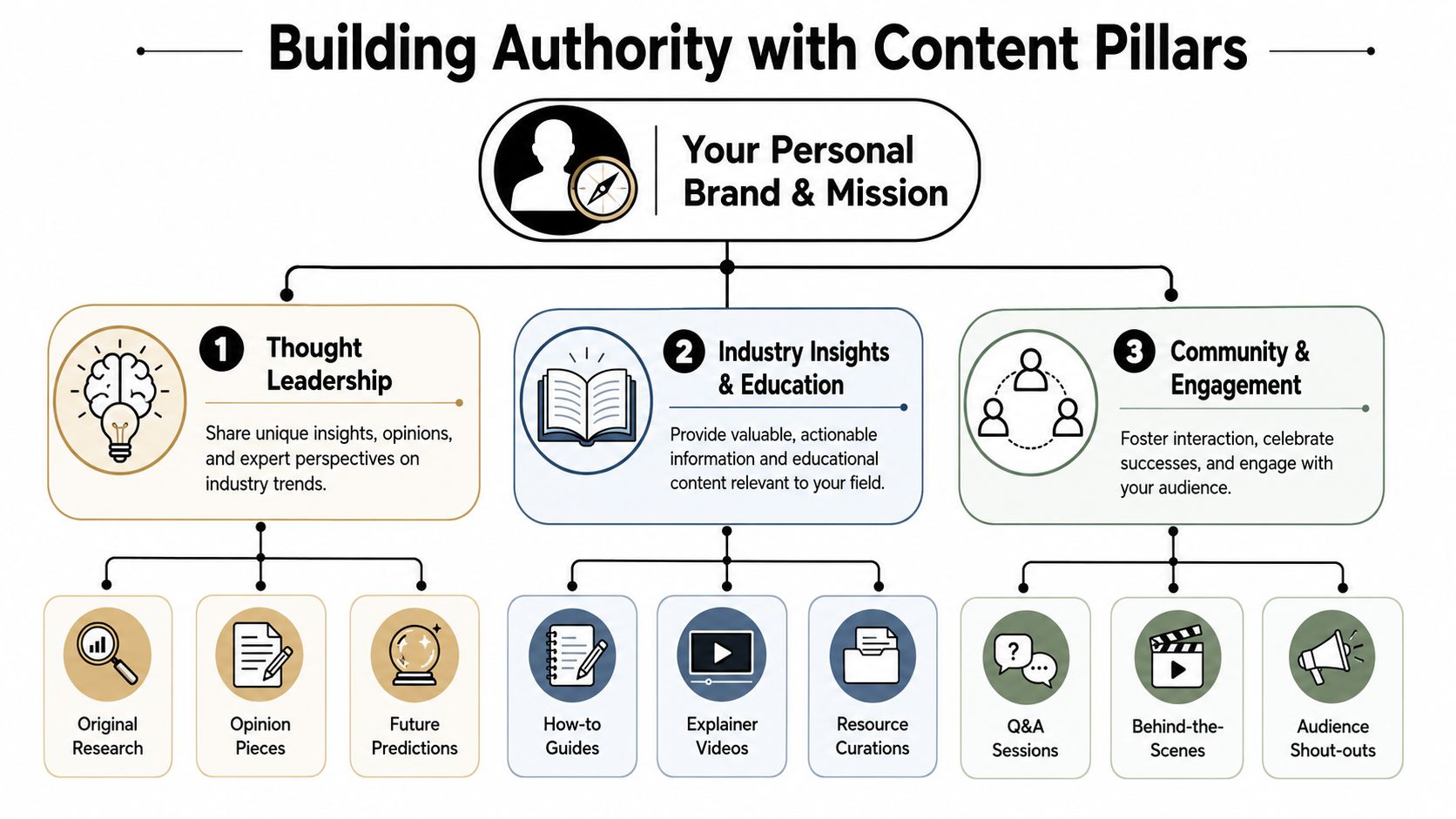
There's a good reason to use them. Profiles that follow a structured content pillar framework achieve 35% higher audience growth in the first six months, while 58% of professionals fall into the inconsistency trap by failing to maintain a posting cadence for over 30 days, according to content strategy analytics data.
The cleanest structure is still the most practical.
| The Content Pillar Framework | Purpose |
|---|---|
| 60% core expertise | Teach, explain, challenge assumptions, solve audience problems |
| 20% community and industry engagement | Respond to trends, spotlight others, join conversations |
| 20% personal narrative | Share values, lessons, stories, and the human context behind your work |
This mix works because it creates trust from different angles. Expertise earns attention. Community builds familiarity. Personal narrative creates memorability.
Professionals often get this backward. They either post pure promotion, which gets ignored, or pure personality, which gets applause but no commercial traction. Authority comes from the combination.
The first pillar is your bread and butter. If you're a SaaS founder, write about onboarding friction, product adoption, pricing mistakes, customer education, or why certain feature requests are distractions. If you're a consultant, break down decision-making failures, messaging gaps, operational waste, or what clients misunderstand before they hire help.
The second pillar is where you prove you're part of the market, not shouting from the sidelines. Comment on industry shifts. Share what you agree with and what you don't. Highlight someone else's smart insight and add your own interpretation.
The third pillar is where your brand stops sounding sterile. This doesn't mean oversharing. It means showing the experiences, values, and moments that shape your thinking.
Good personal brand content doesn't say, “Look at me.” It says, “Here's why I see this problem differently.”
One sharp idea can feed every pillar.
Say your core idea is this: most companies create too much content without a real positioning strategy.
From that, you can create:
That's how strategic consistency works. You don't invent from scratch every day. You extract multiple angles from a point of view.
If you want examples of stronger authority-driven formats, this resource on thought leadership content creation is a useful reference.
A weak content system produces filler because it depends on momentum. A strong one produces insight because it depends on structure.
Some leaders opt to bring in support. Tools like Notion, Buffer, and simple editorial spreadsheets can help. For people who want execution support, Legacy Builder offers a service that turns a recorded interview into voice-matched content and distribution across platforms. That kind of model can work if the strategy is clear first. Without strategy, outsourced volume is still just volume.
Posting is only half the job. Relationships are built in the interaction.
A lot of professionals spend hours polishing posts and almost no time engaging with the people they desire to know. That's backwards. If your goal is business growth, reputation, and access, targeted engagement is often more valuable than publishing another average post.
Create a private list of the people who matter to your brand. Clients. Prospects. Peers. Referral partners. Podcast hosts. Investors. Industry operators you want to learn from.
I call this your working relationship map. Others call it a Dream 100. The label doesn't matter. The discipline does.
Your daily engagement should include:
Don't spray comments everywhere. Spend your attention where trust can compound.
Most comments are useless. “Great post.” “So true.” “Love this.” They signal presence, not intelligence.
A useful comment does one of three things:
For example, instead of “Great point on hiring,” try: “I've seen the same issue when founders hire for output before clarity. The role gets defined around tasks, not outcomes, and the new hire inherits the confusion.”
That kind of comment gets remembered because it contributes.
The goal of engagement isn't to be seen everywhere. It's to be remembered by the right people.
If you want practical examples of better interaction habits, WaveGen's tips for better engagement offer useful prompts you can adapt without sounding scripted.
Vanity metrics make professionals lazy. They reward visibility without asking whether that visibility leads anywhere useful.
The stronger lens is business relevance. Look at:
If your engagement routine produces better conversations, more inbound interest, and stronger name recognition among the people who matter, it's working.
If you want a professional social media presence that drives business, measure it like an operator.

Follower count is the easiest metric to watch and the least helpful on its own. It can flatter you while your pipeline stays flat. The numbers that matter are the ones tied to response, action, and trust.
According to social media ROI metrics data, profiles with an engagement rate above 3.5% see a 2.4x higher conversion rate for leads. The same data says a successful presence should include a call to action in 80% of posts, which can produce a 45% increase in lead capture.
Use a simple dashboard in Google Sheets, Notion, or Airtable. You don't need fancy software to build discipline.
| Metrics That Matter vs. Vanity Metrics | Why it matters |
|---|---|
| Engagement rate | Shows whether content actually resonates |
| CTA clicks | Tells you whether interest turns into action |
| Profile visits from relevant people | Signals brand curiosity from the right audience |
| Leads or conversations started | Connects content to business outcomes |
| Follower count | Secondary context, not a primary success metric |
| Impression spikes alone | Misleading without action or audience quality |
A healthy review habit asks:
Once a post performs, don't admire it. Rework it.
Turn one strong LinkedIn post into a newsletter section, a short video script, a carousel, a founder email, or a thread. Repurposing is how professionals stay visible without falling back into low-signal posting.
If you want another perspective on attribution and platform ROI, especially from a creator angle, this breakdown of ROI for TikTok creators is a useful contrast to B2B measurement models. For a personal-brand-specific framework, this guide on how to measure social media ROI for your personal brand gives you a cleaner way to tie content effort to business outcomes.
The point is simple. Stop rewarding yourself for publishing. Reward yourself for resonance, response, and results.
If you want help building a professional social media presence that's strategic instead of noisy, Legacy Builder helps professionals turn their ideas, stories, and expertise into structured content that supports profile growth, audience engagement, and business visibility.


You could – but most in-house teams struggle with the nuance of growing on specific platforms.
We partner with in-house teams all the time to help them grow on X, LI, and Email.
Consider us the special forces unit you call in to get the job done without anyone knowing (for a fraction of what you would pay).
Short answer – yes.
Long answer – yes because of our process.
We start with an in-depth interview that gives us the opportunity to learn more about you, your stories, and your vision.
We take that and craft your content then we ship it to you. You are then able to give us the final sign-off (and any adjustments to nail it 100%) before we schedule for posting.
No problem.
We have helped clients for years or for just a season.
All the content we create is yours and yours alone.
If you want to take it over or work on transitioning we will help ensure you are set up for success.
We want this to be a living breathing brand. We will give you best practices for posting and make sure you are set up to win – so post away.
Subscribe to our newsletter and get insights on how to grow your personal brand.
