.svg)
Subscribe to our newsletter and get insights on how to grow your personal brand.
Thank you! Your submission has been received!
Oops! Something went wrong while submitting the form.
.svg)



Thought leadership isn’t just about creating content. It’s about consistently publishing your unique insights to build real authority and influence in your space.
This is what separates you from the noise. It’s how you stop being just another marketer and start shaping the conversation in your industry, turning your expertise into your most powerful asset for growing your business.
Forget the buzzwords for a second. At its heart, thought leadership means you become the go-to expert in your field. Not by shouting the loudest, but by sharing valuable, forward-thinking ideas that actually help people.
It’s not just about what you know. It’s about how you frame that knowledge to help your audience see a problem—or an opportunity—in a completely new way. This isn't random blogging or posting on social media whenever you feel like it. It's a deliberate strategy to build a reputation that pulls in your ideal clients and opportunities.

In a market flooded with generic content, real expertise is the only thing that cuts through. Buyers today are skeptical. They do their own research long before they ever think about talking to a salesperson. Your thought leadership content is their first impression—and your first chance to build trust.
The game has changed. It's no longer enough for a company to have a slick brand. People want to see the experts behind it. They want to connect with the individuals.
This is why you see founders, executives, and specialists stepping up and building their personal brands. The data backs this up.
Recent findings show over 50% of companies now have their CEOs and top-level managers front and center in their thought leadership efforts. They're often working alongside subject matter experts, who contribute in nearly 49.4% of businesses. But here's the catch: while there's been a 66% surge in this type of content, only about 48% of it actually generates direct leads and sales.
That gap tells you everything. There's a massive opportunity for anyone willing to create high-quality, strategic content that actually connects with an audience.
The most respected consultants don’t have an expertise problem; they have a visibility problem. Thought leadership is the bridge that connects your deep knowledge to the audience that needs it most, turning invisible expertise into tangible influence.
To build a strategy that works, you need to focus on a few core pillars. These are the non-negotiables for turning your ideas into a real platform.
| Pillar | Objective | Key Action |
|---|---|---|
| Positioning & Audience | Define your unique angle and who you serve. | Identify your niche and map out your ideal client's pain points. |
| Signature Themes | Establish your core areas of expertise. | Develop 3-5 content pillars that reflect your unique point of view. |
| Content Creation | Consistently produce valuable content. | Create a repeatable system for ideation, writing, and production. |
| Distribution & Repurposing | Maximize the reach of every piece of content. | Turn one pillar post into multiple assets for different platforms. |
| Engagement & Growth | Build a community and drive conversations. | Actively engage with your audience and track what resonates. |
These pillars aren't just a checklist; they are the foundation for a system that drives real business results.
When you get it right, thought leadership content creation becomes one of the best business development tools you have. The benefits go way beyond likes and shares.
It works because it:
This guide will give you the framework to build that authority. If you want to go even deeper on the core concepts, check out our detailed article on what is thought leadership for more context.
So you want to be a thought leader. The problem is, most "thought leadership" content is just noise—rehashed ideas that get zero traction.
Before you write a single word, you have to nail your positioning. A brilliant article that doesn't have a sharp point of view or a specific audience is dead on arrival. If you want to create content that actually builds authority, it all starts here.
It begins with finding your unique Point of View (POV). This isn’t just your opinion. It’s that powerful sweet spot where your hard-won expertise, what you're genuinely passionate about, and what your audience desperately needs all come together.
This is what makes your content impossible for anyone else to create.
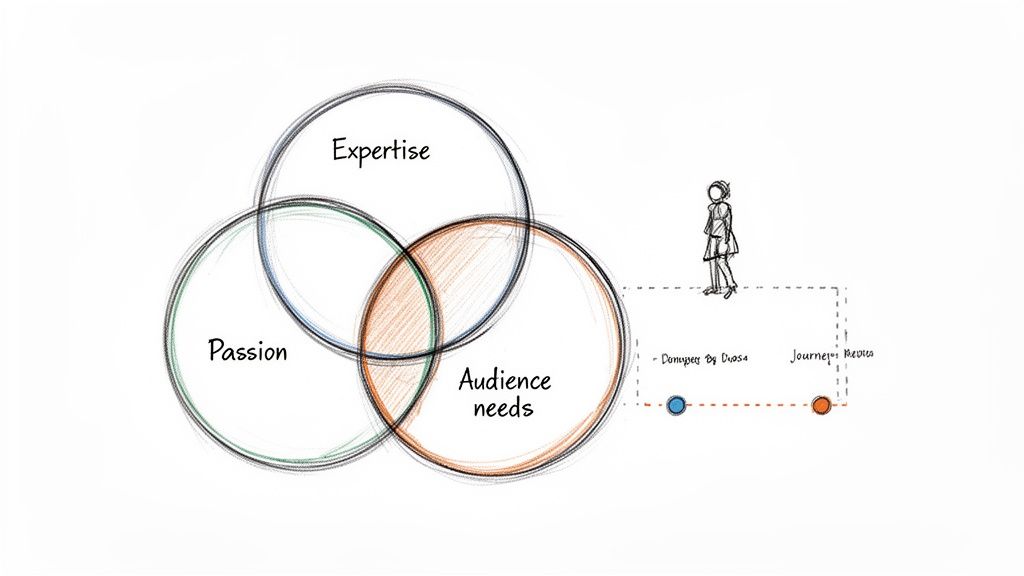
Think of it like this: your expertise is what you know. Your passion is why you care. And your audience’s need is who you help. If one is missing, the whole thing falls apart. Expertise without passion is boring, and passion without expertise is just fluff.
Your POV is your contrarian take. It's the battle-tested framework you've developed that flies in the face of so-called "best practices." This is the core belief that will anchor every piece of content you create.
To dig it out, ask yourself some honest questions:
A huge part of this is also developing a voice that's instantly recognizable. Your tone and style are just as important as your ideas. To get this right, you need to understand what is voice in writing and how to discover your unique style.
Your point of view is not just what you think; it’s how you think. It’s the lens through which you interpret your industry, and it’s the most valuable asset you have in building authority. Don't just report the news—interpret it for your audience.
Once you’ve got a lock on your POV, it’s time to get crystal clear on who you're actually talking to. Generic avatars are useless. You need to know this person inside and out.
Forget targeting "mid-level managers in tech." That's a recipe for creating bland, forgettable content. You need to build a persona so detailed it feels like you're talking to a real person.
Let me show you what I mean.
Scenario: A Fintech Founder's Audience Persona
Imagine you run a fintech company that helps bootstrapped SaaS founders manage their money. Your generic audience is "SaaS founders." That's not good enough.
Let’s get specific and create "Alex, the Bootstrapped Founder."
Here’s Alex’s real-world profile:
See the difference? Now you aren't guessing what to write. You know Alex's exact pain points. You can create content that hits them right between the eyes, like "A 5-Step Framework to Forecast Your Next Six Months of SaaS Payroll" or "The Three Financial Metrics Every Bootstrapper Ignores."
This is how you stop creating content for everyone and start creating it for someone. When you understand your audience this deeply, every post has a purpose, solves a real problem, and actually gets you noticed.
Once you've nailed your unique angle and know exactly who you're talking to, it's time to build the actual framework. This is where we stop chasing one-off viral posts and start creating a system that will generate high-value content for the long haul.
This system is built on what I call content pillars.
Think of your content pillars as the 3-5 core topics you want to completely own. These aren't random subjects you feel like writing about. They are the strategic territories that sit at the intersection of your deepest expertise and your audience's biggest problems. Every single piece of content you create should tie back to one of these pillars, reinforcing your authority over and over again.
Here’s where most people get it wrong. They choose pillars that are way too generic. "Marketing." "Leadership." "Sales." That’s not a pillar; that’s an entire industry.
You have to get specific. It’s the only way to cut through.
Let's go back to Alex, our bootstrapped SaaS founder. If I were a consultant trying to get on Alex's radar, my pillars might look like this:
See the difference? These aren't just vague topics. They are specific domains of expertise that speak directly to Alex's sleepless nights—managing cash flow without a huge safety net, hiring the right people on a tight budget, and finding ways to grow that don't involve giving up equity.
This level of focus makes creating genuinely helpful content a hell of a lot easier.
If a pillar is the "what," your signature themes are the "how." These are your repeatable formats, unique angles, and go-to narratives that make your content instantly recognizable. They’re your spin.
Signature themes are the DNA of your content. They turn a generic topic into something only you could have created, building a powerful sense of consistency and recognition with your audience.
Let's stick with the "Bootstrapped Financial Modeling" pillar. You could create a few signature themes to return to again and again:
When you map these out ahead of time, you’ll have a bank of powerful content generation ideas ready to go. With pillars and themes, you're never staring at a blank page again. You have a blueprint.
And you need that blueprint. Data shows that while 54% of senior leaders spend over an hour a week consuming thought leadership, a massive 82% say most of what they see is mediocre at best. A pillar system is your ticket to being part of the fraction that actually captures their attention.
I worked with a management consultant who was completely lost in the content game. Her expertise was broad, but her posts were all over the place—one day it was productivity hacks, the next it was corporate strategy. She was an expert, but online, she was invisible.
We got to work and defined three hyper-specific pillars:
She committed. She launched a "First 90 Days" series for new managers. She created a "Meeting Autopsy" template that went viral in her niche.
The results? Within six months, her LinkedIn engagement tripled. She got invited onto three industry podcasts. Best of all, she landed two five-figure consulting projects directly from people who reached out saying, "I've been following your posts on meeting culture, and we need your help."
That’s the power of pillars.
Great ideas are worthless without consistency. I’ve seen countless founders with brilliant insights fail to gain traction for one simple reason: they burn out.
They post randomly, get frustrated by the lack of results, and give up.
The goal isn't just to create more content. It's to build a system that lets you show up every single day with high-value insights without wanting to pull your hair out. It's about turning your expertise into a reliable engine for growth.
And the stakes are high. Globally, 70% of C-suite executives have switched vendors because a competitor simply had better thought leadership. With 62% of B2C leaders now using AI in their workflows, a solid, human-driven system is your biggest advantage. You can find more data on how thought leadership influences major business decisions if you're curious.
The secret to posting consistently without starting from scratch every single day is a model I swear by: Content Atomization.
This isn't about working harder; it's about working smarter.
You start with one big, valuable piece of content—a webinar, a keynote speech, a detailed guide. This is your "pillar." Then, you slice it and dice it into dozens of smaller, "atomic" pieces for all your different channels.
A few hours of deep work can literally fuel your content calendar for weeks.
Content Atomization is more than just repurposing. It’s about strategically deconstructing a single core idea and reframing it for the specific audience and context of each platform. You maximize your reach without reinventing the wheel.
Let’s say you record a 45-minute webinar on "Bootstrapped Financial Modeling." Here’s how you atomize it:
This simple workflow—defining pillars, creating themes, and choosing formats—is how you build a content engine that actually lasts.
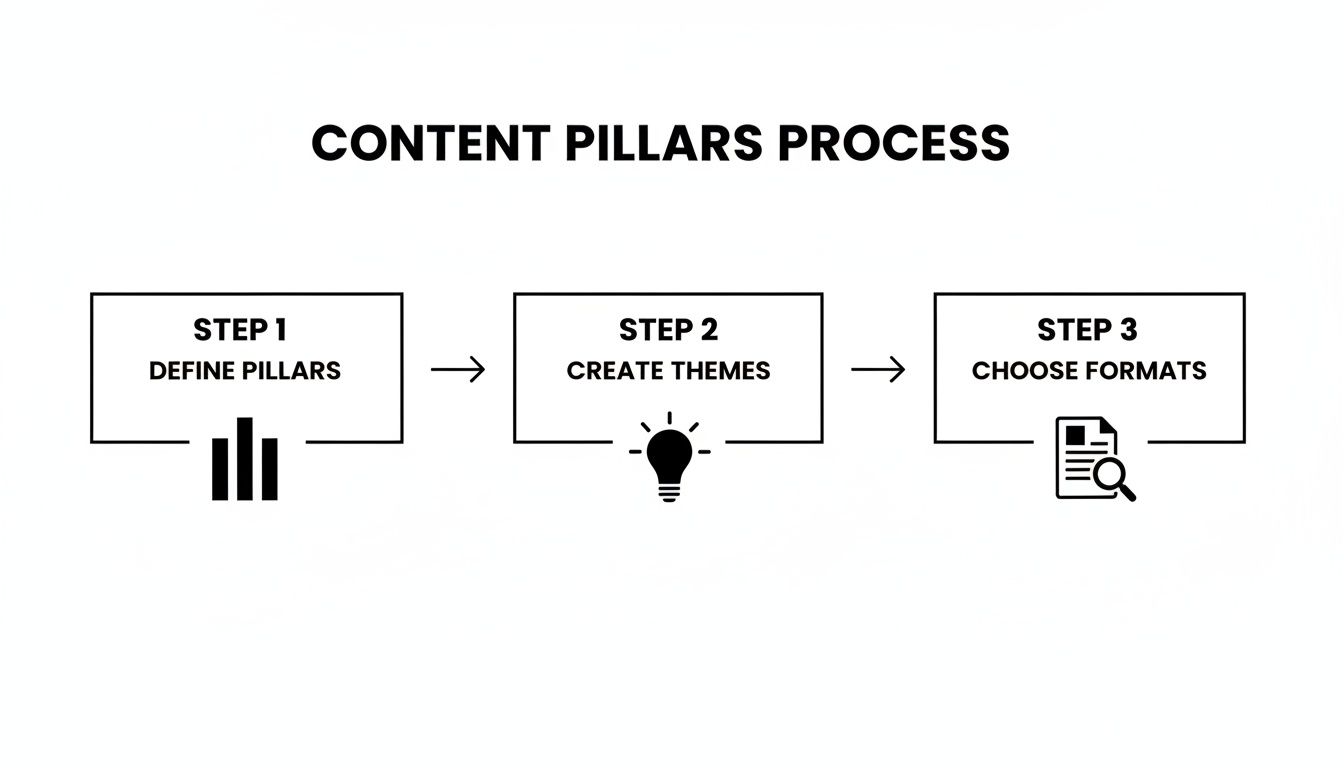
When you follow this flow, every single post ties back to your core expertise. You’re not just posting; you’re building authority.
Even with a system, the blank page can be intimidating. Waiting for inspiration is a losing game. Instead, use proven models to pull ideas directly from your expertise.
Here are a few I give to my clients:
These aren't just content ideas; they are frameworks for turning your daily work into content that gets noticed. If you want to dive deeper, check out our guide on how to scale content creation for your personal brand.
Your editorial calendar is your roadmap. It’s where your strategy gets real. Don't overcomplicate it—a simple spreadsheet is all you need.
Make sure your calendar tracks these key things:
This isn’t about being rigid. It's about having a structure that frees you from the daily "what should I post?" panic. It lets you be strategic and creative, ensuring your thought leadership efforts pay off in the long run.
Let's get one thing straight: hitting "publish" is the easy part.
If your game plan is to "post and pray," you’re going to be disappointed. I've seen too many experts with brilliant ideas talk to an empty room because they completely skip the most critical part of the process: distribution.
This isn’t about just blasting links everywhere. It’s about being smart and intentional. Your goal is to get your content in front of the right people and start real conversations—the kind that build your authority and lead to opportunities.
For just about every B2B founder, executive, or consultant I work with, the distribution strategy starts and ends with LinkedIn. This is where your audience—the decision-makers with buying power—is already spending their time.
But just dropping a link to your latest article won't move the needle. You have to get in the trenches and engage.
The real win isn’t getting a hundred passive likes. It's sparking a single, thoughtful comment that leads to a back-and-forth conversation. That's where relationships are built.
This is how you turn your content from a monologue into a dialogue. It’s how you start building a real community around your ideas.
Want to know one of the most effective, yet overlooked, distribution tactics? Strategic commenting. I’m not talking about dropping a "Great post!" and moving on. I mean adding real, tangible value to other people's conversations.
Here's the playbook:
Find 5-10 influential leaders in your niche whose audience overlaps with yours. Every day, spend 15 minutes scanning their posts and find one or two where you can make a meaningful contribution.
This does two things at once. It puts your name and expertise directly in front of a highly engaged, relevant audience. It also gets you on the radar of other industry players, which is how collaborations and partnerships start.
When you get distribution right, something powerful happens. People don't just see your content—they act on it.
In fact, after reading high-quality thought leadership, 72% of people are motivated to do more research on the topic or author, and 67% end up discussing the ideas with their colleagues. You can learn more about how readers engage with thought leadership from a recent study. This proves your content isn't just noise; it's making a real impact.
Every thoughtful comment, every DM, and every new follower is an opportunity. Acknowledge them. Send a personalized voice note to someone who leaves a great comment. Send a connection request to people who consistently show up.
These small, personal touches are what turn passive followers into a loyal community—people who trust you, value your insights, and look forward to what you have to say next. That's the real end game.
So, you’ve got your content engine fired up and running. Now what? You need to know if it's actually working.
This is exactly where most founders and experts go wrong. They get addicted to the vanity metrics—the likes, the views, the follower counts. Sure, those numbers give you a quick ego boost, but they tell you next to nothing about your actual business impact.
Let's be clear: True influence isn't measured in likes. It’s measured in the quality of attention you command and the real-world actions it drives. You have to shift your focus from vanity metrics to the ones that actually move the needle.
The metrics that really matter are the ones that prove your content is hitting home with the right people—your future clients, partners, and collaborators.
Instead of chasing empty engagement, start tracking these signals:
These aren't passive scrolls; they are indicators of deep engagement. They show your thought leadership is making people think and act.
At the end of the day, your content has to tie back to tangible business results. It’s not just a nice-to-have.
The data backs this up. A crucial 58% of buyers check out a company’s thought leadership before ever talking to a salesperson. For 42%, it directly sways their final decision. Better yet, 47% of C-suite executives have shared their contact information after reading valuable content. You can see more stats on how thought leadership drives buying decisions on nytlicensing.com.
The most powerful metrics are often qualitative, not quantitative. A single prospect saying, "I read your article on financial modeling, and it's exactly the problem we're facing," is worth more than a thousand likes.
You need a simple system to capture this. A basic dashboard or even a spreadsheet can work wonders. Start tracking when prospects mention your content on sales calls. Note how many inbound leads come directly from a specific article or post and, more importantly, the quality of those leads.
This is how you prove the ROI of your efforts. For a deeper look at this process, check out our guide on how to measure content performance for your personal brand.
When you focus on these meaningful metrics, you can stop guessing. You'll know exactly what’s working so you can double down on it and turn your expertise into a predictable growth engine for your business.
Starting out in thought leadership brings up a lot of questions. I hear them all the time from founders who are ready to build but aren't sure where to begin.
Let's clear up a few of the biggest ones I get asked.
Everyone is posting content. Your unique angle is what makes people stop scrolling and actually listen to you. It’s not about just reporting on industry news—it’s about having a real point of view.
It comes from the intersection of your experience, your story, and your convictions.
Ask yourself these questions:
Your real, unfiltered perspective is the one thing no one can copy. That's your edge. It's what separates genuine influence from just adding to the noise.
This is a big one. People use them interchangeably, but they aren't the same.
Content marketing is the broad game of creating content to attract and engage an audience. It might be a blog post explaining a "how-to" or a case study.
Thought leadership is a specific play within that game. The goal isn't just to attract an audience, but to establish yourself as an authority who is shaping the future of your industry.
Think of it this way: Content marketing joins the conversation. Thought leadership starts it.
Look, consistency beats cramming every single time. When you're just starting, block out 3-5 hours a week. That’s enough to build your core strategy and create your first major pieces of content.
The secret to making this work long-term isn't about grinding 24/7. It's about having a smart system.
When you use a framework like Content Atomization, you can turn one big idea into a week's worth of content. This allows you to show up daily with just a few focused hours of work. It’s about being strategic, not just busy.
Ready to stop guessing and start building a real personal brand? Legacy Builder specializes in transforming your expertise into a consistent stream of high-impact content. Learn how we can build your legacy, together.


You could – but most in-house teams struggle with the nuance of growing on specific platforms.
We partner with in-house teams all the time to help them grow on X, LI, and Email.
Consider us the special forces unit you call in to get the job done without anyone knowing (for a fraction of what you would pay).
Short answer – yes.
Long answer – yes because of our process.
We start with an in-depth interview that gives us the opportunity to learn more about you, your stories, and your vision.
We take that and craft your content then we ship it to you. You are then able to give us the final sign-off (and any adjustments to nail it 100%) before we schedule for posting.
No problem.
We have helped clients for years or for just a season.
All the content we create is yours and yours alone.
If you want to take it over or work on transitioning we will help ensure you are set up for success.
We want this to be a living breathing brand. We will give you best practices for posting and make sure you are set up to win – so post away.
Subscribe to our newsletter and get insights on how to grow your personal brand.
