.svg)
Subscribe to our newsletter and get insights on how to grow your personal brand.
Thank you! Your submission has been received!
Oops! Something went wrong while submitting the form.
.svg)


If your LinkedIn strategy feels like you're shouting into an empty room, you're not wrong. The platform has changed. Big time.
What worked a few years ago—firing off occasional updates, listing your job duties, sending out a bunch of generic connection requests—is dead. The days of easy organic reach are long gone, but for those who know how to play the new game, the rewards are bigger than ever.
The core of the problem? LinkedIn's algorithm got a lot smarter. It's no longer about just being active; it's about being relevant and building real connections. Generic posts about "hustle culture" or updates drowning in corporate jargon just don't cut it anymore. They get buried.

It's a tough pill to swallow, I get it. But you have to face the new reality of LinkedIn.
The competition on LinkedIn has exploded. We've analyzed the recent algorithm shifts, and the numbers are brutal for anyone still stuck in the past. People using outdated strategies have seen their views drop by 50% and engagement crater by 25%. Even worse, their follower growth has tanked by an incredible 59%.
You can dig into these LinkedIn algorithm changes yourself, but the message is clear.
This data isn't a reason to panic. It’s a sign that the platform is finally filtering out the noise and bland, lazy content. This is your opening.
Think about it: your competitors are probably still posting boring company news and lifeless job descriptions. While they're losing attention, you have a massive opportunity to step in and capture it by being real, intentional, and valuable.
The old LinkedIn was a megaphone. You'd shout something and just hope someone, somewhere, heard it.
The new LinkedIn is a conversation. It's a two-way street. This requires a complete shift in how you think about the platform.
Standing out on LinkedIn in 2026 isn't about gaming the algorithm. It's about building a real personal brand that delivers undeniable value. The founders and professionals who get this are the ones turning their profiles from dusty digital resumes into powerful machines for opportunity and influence.
This guide is your wake-up call. It's time to stop broadcasting and start building.
Let’s be honest. Most LinkedIn profiles are nothing more than dusty digital resumes. They’re a boring list of past jobs that sit there collecting virtual cobwebs.
But what if your profile could be your personal digital storefront? The front door to your brand, where ideal clients, partners, or even employers land and instantly get what you're all about.
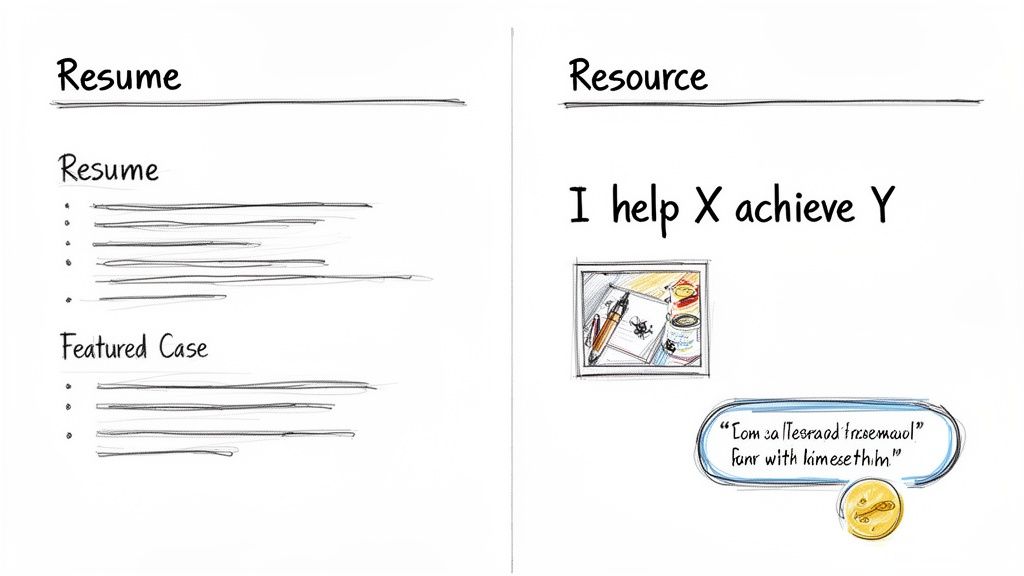
This shift—from a resume to a resource—is the secret sauce to standing out. It’s about positioning yourself as a problem-solver, not just another person looking for a job.
Let's break down exactly how to make this happen, piece by piece.
Your headline is the most valuable real estate on your entire profile. It shows up everywhere—in search results, next to your comments, and on connection requests.
Wasting it on a generic job title like "Senior Marketing Executive" is a massive missed opportunity.
Instead, your headline has one job: to answer the question, "What's in it for me?" for anyone who sees it. It needs to scream the problem you solve and who you solve it for.
See the difference? The "After" version calls out the audience (B2B companies), promises a hard result (cut churn by 30%), and hints at the method (AI strategies). It's not a title; it's a magnet for the right people.
The 'About' section is where you get to be human. Way too many people just copy-paste their resume summary here, and I can tell you, it's a surefire way to be completely forgettable.
This is your chance to hook people with your story. What gets you out of bed in the morning? What problems are you obsessed with solving? You want to guide the reader through your "why" and build genuine trust.
Your profile might have the same job title as 80,000 other people, but your unique perspective and story are what separate you from the crowd. Your 'About' section is where you prove it.
For instance, a marketing exec could ditch the dry list of campaigns they ran. Instead, they could tell the story of how they turned a struggling brand around by truly understanding its audience. That’s how you become memorable.
The 'Featured' section is your personal portfolio. Leaving it empty is like having a storefront with boarded-up windows. It's a huge red flag.
This is where you stop telling people you're an expert and start showing them. You need to provide tangible proof that you know your stuff and give visitors a reason to stick around.
What to Feature on Your Profile:
This curated collection of content transforms your profile into a resource hub. It educates your audience and gives prospects the confidence they need to reach out.
Looking for ideas on what kind of content really moves the needle? Check out our guide on how to write LinkedIn articles that build real authority.
When you nail these elements, your profile stops being a static document. It becomes an active, lead-generating machine that works for you 24/7.
Posting on LinkedIn without a clear plan is like shouting into the void. To actually make an impact, you have to move beyond random updates and develop a signature content strategy. This isn't just about churning out posts; it’s about becoming the go-to, trusted resource for your specific audience.
Your strategy is what separates you from the noise. It’s the game plan that turns you from just another connection into a recognized authority. Let's start building it.
Your content pillars are the 2-4 foundational topics you'll own. These aren't just subjects you find interesting; they are the strategic intersection of what you know, what your audience needs, and what you want to achieve.
Think of it as a Venn diagram of:
A SaaS founder targeting sales leaders, for instance, might focus on these pillars:
Nailing these pillars brings focus and consistency. Your network quickly learns what you stand for, which is how you build trust and establish authority. This intentional approach is a cornerstone of an effective thought leadership content strategy that gets real results.
Not all content formats are created equal on LinkedIn. The platform has evolved, and with average engagement rates climbing a massive 44% year-over-year to 3.85% in 2026, you need to know what captures attention right now.
Your profile might have the same job title as 80,000 other people, but only you think the way you do. Your content is how you prove it, and the format you choose determines how many people will see that proof.
Simple text posts still have their place, but their 0.5-2% engagement rates are completely overshadowed by more dynamic formats.
To give you a clearer picture, here’s how different formats are performing in 2026.
This table breaks down the average engagement rates for popular LinkedIn content formats. It’s a quick guide to help you decide where to focus your creative energy for maximum audience interaction.
As you can see, the data is pretty clear. Visual and in-depth formats like carousels and native documents are dominating. People on LinkedIn are craving more than just a quick text update; they want value they can see and use.
Once you’ve got your pillars and formats locked in, it's all about execution. Consistency is the engine of momentum on LinkedIn. Aiming for 3-5 high-quality posts a week is the sweet spot.
This is where a content calendar becomes your best friend. It doesn’t have to be fancy—a simple spreadsheet works just fine. It’s about mapping out your plan to ensure you’re hitting all your pillars with a good mix of formats.
Using a dedicated social media content planning template can be a game-changer for staying organized and strategic.
Here’s what a solid weekly mix could look like:
This is how you stop being a passive observer and start becoming an active, influential voice. It's a structured approach that ensures you're consistently delivering value and moving closer to your goals with every post.
Look, creating killer content is a huge win, but it’s only half the battle. If you just post and walk away, you’re leaving all the real value on the table.
True influence—the kind that actually gets you noticed and opens doors—is built in the comments and DMs. This is where you stop being a broadcaster and start becoming a community builder. It’s the active, human touch that shows you’re here to talk with people, not just at them. This is how you truly stand out.
What’s the fastest way to kill a potential relationship? Ask for something right away. We all get those generic, self-serving connection requests, and we all ignore them. The real secret is to provide value first.
I live by the “Give, Give, Give, Ask” model. It’s a dead-simple but powerful framework. For every one “ask” you make, you should be delivering at least three moments of pure, no-strings-attached value.
So, what does “giving” actually look like in the wild?
When you consistently show up to help, people start to recognize you as a trusted, valuable presence. So when you finally do have an ask—like connecting or hopping on a quick call—it feels like a natural next step, not a cold pitch.
Your comment section is a goldmine. Seriously. When someone takes the time to comment on your post, they're raising their hand and showing interest. Don’t just reply with a lazy "thanks!"
Use every single comment as a launchpad for a real conversation. Acknowledge their point and then ask an open-ended question to keep the dialogue going. This not only tells the algorithm your post is valuable, but it also strengthens your one-on-one connection with that person.
Your content is the invitation to the party. The comments section is where the real party happens. Your job is to be an active host—sparking conversations and making everyone feel welcome.
This proactive approach shows you actually care about what your audience has to say. That’s a rare quality that makes people remember you. While engagement rates can vary, the quality of your interaction is always 100% in your control.
This chart shows which formats are best at getting those initial comments, giving you more chances to work your magic.

As you can see, visual formats like carousels and documents are crushing it, creating more opportunities to start these valuable conversations.
When it’s time to connect with high-value prospects or peers, you have to ditch the templates that scream "SALES PITCH." The key to outreach that works is personalization and relevance.
Your connection request or first DM needs to immediately answer their unspoken question: "Why me?"
A non-spammy outreach message that gets replies has three things:
Here’s what that looks like: "Hi [Name], I really enjoyed your recent article on scaling customer support teams. Your point about proactive outreach was spot-on. As someone also focused on B2B SaaS growth, I'd love to connect and follow your insights."
This approach is respectful, relevant, and human. It’s the polar opposite of the automated spam flooding everyone’s inbox.
If you want more firepower for your outreach, we've put together some proven LinkedIn connection message examples you can adapt. Building a real community happens one authentic interaction at a time.
So you're creating great content and starting real conversations. That's the foundation. But if you aren't tracking what's actually happening, you're essentially flying blind. To really make an impact on LinkedIn, you have to know what’s working, what’s not, and where to double down.
This is about moving past the metrics that just make you feel good. Likes and views are nice, but they don’t pay the bills. They’re clues, not results. The real mission is to use data to sharpen your strategy so your time on LinkedIn generates a real, measurable return.
It’s way too easy to get hooked on chasing high impression numbers. But a post with a ton of views means very little if those views aren't from the right people. The whole game changes when you start focusing on metrics that tie directly back to your business goals.
Instead of just celebrating views, you need to be asking a much sharper question: "Who are these people viewing my stuff?" Luckily, LinkedIn’s analytics gives you the answer.
Core Metrics That Actually Drive Growth:
When you shift your focus to these metrics, your entire perspective changes. You stop trying to create content for everyone and start crafting it for the exact people you want to attract.
You don’t need a complicated, expensive tool to track your progress. A simple spreadsheet is all you need to get started. The key is to make it a weekly habit—just spend a few minutes logging your key data points. Over time, you’ll be able to spot trends and make much smarter decisions.
Think of your dashboard as a quick, at-a-glance summary of how you’re doing on LinkedIn. Tracking this weekly helps you connect a specific post or a new engagement tactic to a tangible outcome.
Data isn't for your ego; it's for insight. Use your analytics to listen to what your audience is telling you. Their clicks and comments are a roadmap showing you exactly what they find valuable.
Here’s a dead-simple dashboard you can build in a spreadsheet right now:
After just a few weeks of this, clear patterns will start jumping out at you. You might see that your personal story videos consistently spark more inbound messages, or that carousels breaking down a specific framework drive the most followers from your target industry.
This is where the magic really happens. Your data is the feedback loop you need to get better and better. It helps you answer the critical questions that will sharpen your entire content and engagement plan.
Iterate Based on What You Learn:
This cycle of measuring, analyzing, and iterating is what separates the pros who get real results from those who are just shouting into the void. It transforms your LinkedIn activity from a guessing game into a calculated strategy for building real influence and standing out.
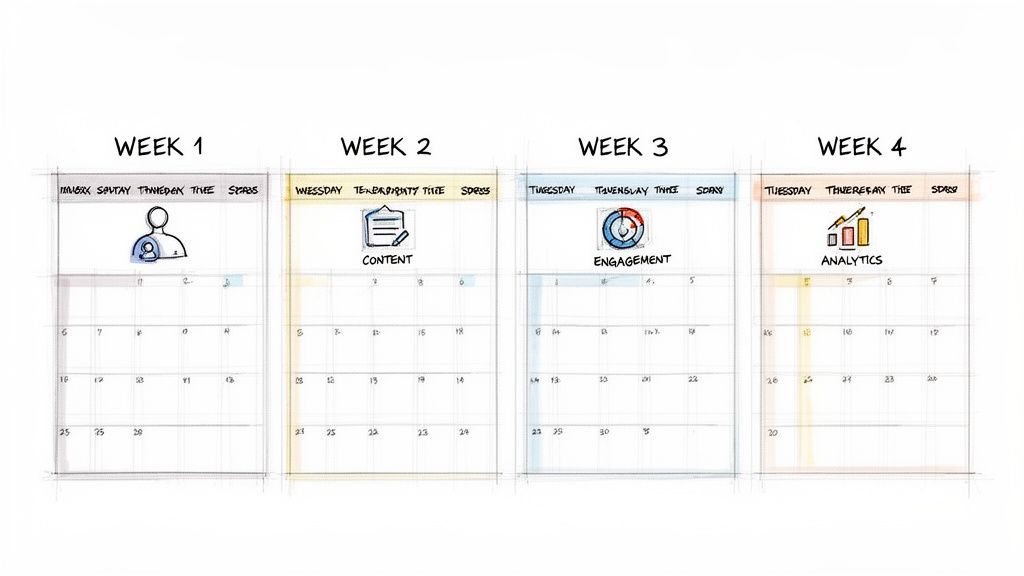
Knowing the strategies to stand out on LinkedIn is one thing. Actually putting them into practice consistently is what separates the talkers from the doers.
This isn't just theory. This is a practical, 30-day roadmap to build momentum and turn these habits into second nature. Let’s get to work.
Your entire focus this first week is to stop looking like a resume and start looking like a resource. By the end of this week, your profile should be a magnet for your ideal audience.
Your profile is your digital storefront. This first week is all about making sure that when people show up, they instantly get what you’re about and why they should stick around. Don't rush this; it makes everything else you do 10x more effective.
Alright, foundation's set. Now it’s time to activate your brand by creating content and, just as importantly, engaging with others. This is where you go from having a static profile to being an active voice in your industry.
The final week is about looking at the data so you can stop guessing and start knowing what works. What you learn this week will make your next 30 days even more powerful.
Dive into your LinkedIn analytics. Which posts got the most comments? Which ones drove the most profile views or sparked conversations in your DMs?
Find the patterns. If a certain topic or format blew up, that’s your audience telling you what they want. Double down on that. This isn't about being perfect; it's about getting a little smarter every single week.
Even with the best playbook, you're going to have questions. It’s just part of the process. I get asked the same things time and time again by founders, so let's tackle the most common ones head-on.
Look, consistency beats frequency every single time. A good target to aim for is 3-5 times per week. That’s enough to stay top-of-mind without completely flooding everyone's feed.
The real goal is to build a rhythm. You want your network to know they can count on you for solid insights regularly. If you're slammed, don't sweat it. Two genuinely great posts a week are far better than five rushed, low-effort ones. Start there and build your momentum.
You’ll see a ton of "gurus" say midweek mornings are the golden hours. But the truth? The real best time is whenever your specific audience is actually online.
Stop guessing and start using the data LinkedIn gives you. Pop over to your "Follower analytics" tab and see when your followers are most active. Test out different days and times, watch your engagement in those first few hours, and let the numbers tell you what’s working. If you're targeting people in another time zone, obviously, you'll need to adjust for that.
Your most popular post might have the same job title as 80,000 other professionals, but only you think the way you do. The best time to share your unique thoughts is when your specific audience is actually online and ready to listen.
Absolutely. In fact, you should be doing this. It's one of the smartest ways to get more mileage out of the hard work you’ve already put into your long-form articles.
But don’t just drop a link and call it a day. That’s lazy, and it doesn't work.
Instead, pull out a powerful quote, a key takeaway, or a specific framework from the article. Turn that one single idea into its own native LinkedIn post—a carousel or a simple text-plus-image post works great. Then, at the end, you can link back to the full piece for anyone who wants to go deeper. This gives immediate value right there in the feed while still driving traffic back to your site.
Ready to stop blending in and start building a powerful personal brand on LinkedIn? The team at Legacy Builder transforms your expertise into high-impact content that gets you noticed. Discover how we can build your legacy, one post at a time.


You could – but most in-house teams struggle with the nuance of growing on specific platforms.
We partner with in-house teams all the time to help them grow on X, LI, and Email.
Consider us the special forces unit you call in to get the job done without anyone knowing (for a fraction of what you would pay).
Short answer – yes.
Long answer – yes because of our process.
We start with an in-depth interview that gives us the opportunity to learn more about you, your stories, and your vision.
We take that and craft your content then we ship it to you. You are then able to give us the final sign-off (and any adjustments to nail it 100%) before we schedule for posting.
No problem.
We have helped clients for years or for just a season.
All the content we create is yours and yours alone.
If you want to take it over or work on transitioning we will help ensure you are set up for success.
We want this to be a living breathing brand. We will give you best practices for posting and make sure you are set up to win – so post away.
Subscribe to our newsletter and get insights on how to grow your personal brand.
