.svg)
Subscribe to our newsletter and get insights on how to grow your personal brand.
Thank you! Your submission has been received!
Oops! Something went wrong while submitting the form.
.svg)


Most advice on professional service marketing is backwards. It tells founders, partners, and principals to become full-time content creators. Post every day. Comment for an hour. Write your own newsletter. Show up everywhere.
That sounds disciplined. In practice, it breaks fast.
The people clients want to hire are usually the same people with the least spare time. They're leading delivery, selling complex work, managing teams, and making decisions clients pay for. If your marketing plan depends on that person personally drafting every post, writing every article, and manually nurturing every lead, you don't have a strategy. You have a bottleneck.
The better approach is simpler. Build a system that captures expertise once, turns it into assets many times, and distributes it consistently through a small internal team or an external partner. That's how you market expertise without flattening it into generic agency copy.
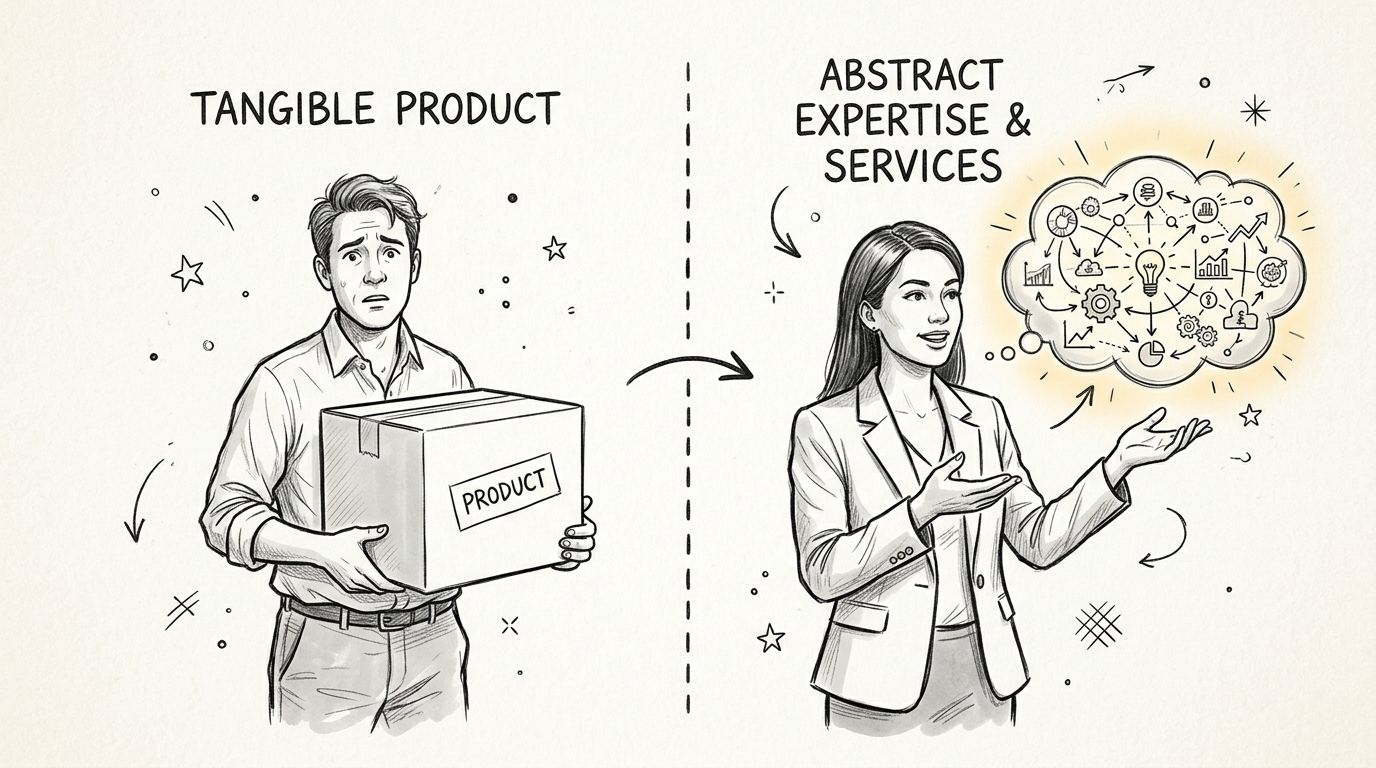
A product can be photographed, demoed, compared, and priced like an object. A professional service can't. You're not selling a box on a shelf. You're selling judgment, pattern recognition, and the ability to solve a hard problem without making the client pay tuition through mistakes.
That changes everything.
When someone buys software, they can evaluate features. When someone hires a consultant, advisor, lawyer, strategist, or agency, they're evaluating the quality of your thinking. They want to know whether you understand their situation, whether you've seen this problem before, and whether they can trust you in a room where critical decisions are made.
A lot of marketing guidance still assumes the expert should also be the primary author, speaker, and social voice. That assumption ignores reality. According to Hinge's overview of professional services marketing techniques, 60–70% of B2B decision-makers still see senior practitioner visibility as a key differentiator, yet only about 30% of firms report that partners consistently produce content or speak externally.
That gap matters. Clients still want visible expertise. Firms just haven't built a reliable way to produce it.
Practical rule: The expert should own the ideas, not every keystroke.
Think of it this way. In product marketing, you can sell the meal. In professional service marketing, you're selling confidence in the chef. People don't just want to know what's on the menu. They want proof that the person in charge won't ruin dinner.
If you're the founder, your job isn't to become a content machine. Your job is to create a voice-capture system.
That means:
The firms that win don't ask busy experts to “just post more.” They build a repeatable process around the expert's thinking and keep it moving without requiring daily heroics.
Trust isn't vague. It's built from signals buyers can observe before they ever reply to you. In professional service marketing, every asset, conversation, and touchpoint should strengthen one of three things: credibility, empathy, or reliability.
If those signals are weak, your marketing feels expensive and ineffective. If they're strong, buyers show up pre-sold on the idea that you understand their world.
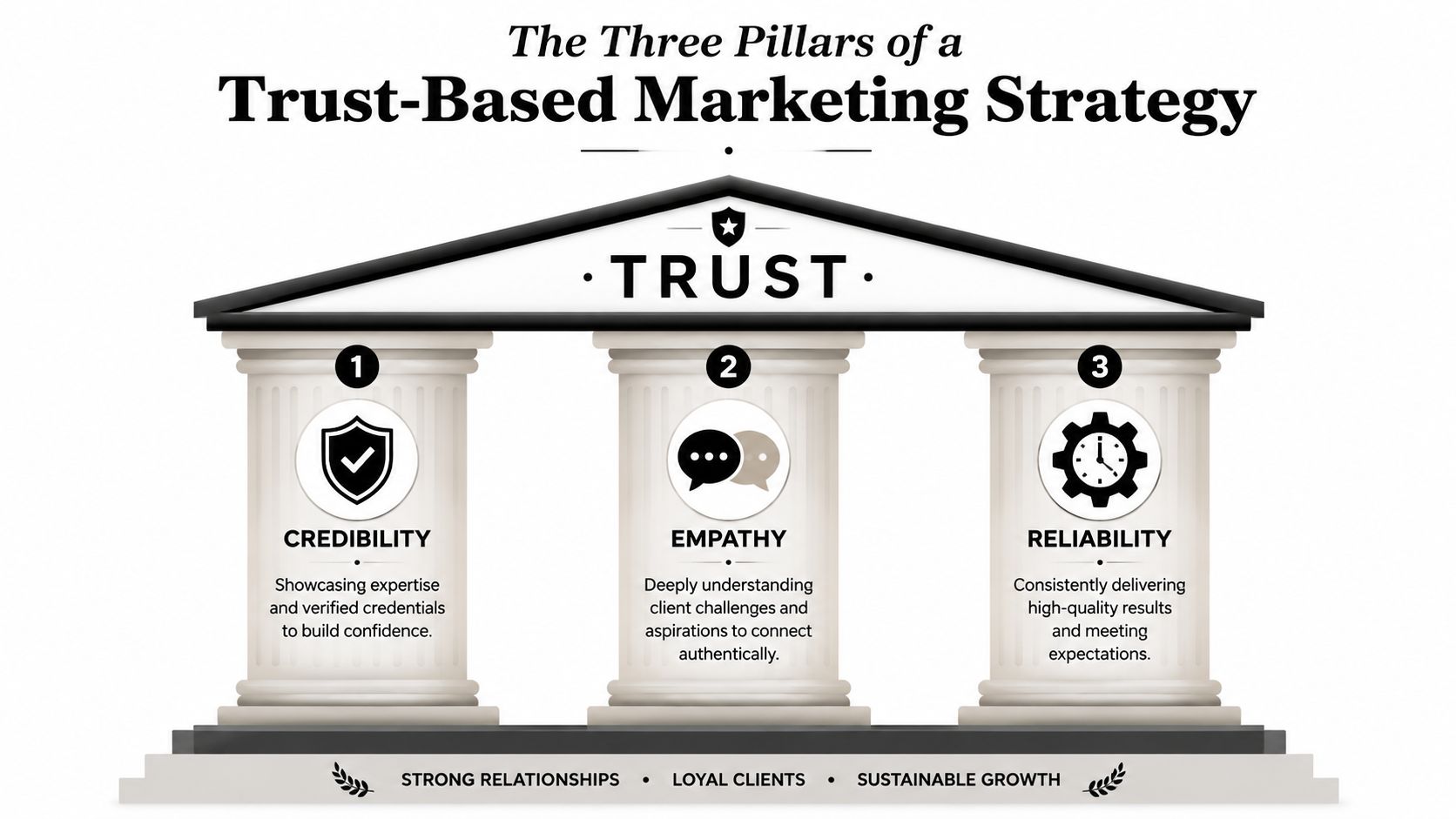
Credibility is the foundation. It answers the first silent question every buyer asks: “Do these people know what they're doing?”
You build credibility through specifics. Sharp positioning. Clear problem diagnosis. Useful articles. Strong case studies. Concrete language. Original insights that sound earned, not assembled from ten other blogs.
This is also where social proof in marketing builds trust. Not because logos impress people on their own, but because credible evidence lowers perceived risk.
A lot of firms sound smart and still lose. They describe the service well, but they don't make the buyer feel understood.
Empathy in marketing doesn't mean being soft. It means naming the actual friction your client lives with. Delayed decisions. Internal politics. Risk exposure. Capacity gaps. Bad previous hires. Pressure from leadership. If your content talks only about your method, buyers won't feel seen.
A useful test is simple. Read your homepage or your latest article and ask, “Does this sound like a firm describing itself, or a firm describing the client's problem?”
Reliability is the least glamorous pillar and often the deciding one. Buyers want signs that you'll follow through. Clean follow-up. Consistent publishing. Clear process. Organized proposals. A calm sales experience.
Buyers rarely separate marketing quality from delivery quality. If your marketing feels chaotic, they assume your work will too.
Here's the bridge metaphor I use with clients:
| Pillar | What the buyer sees | Why it matters |
|---|---|---|
| Credibility | Expertise, proof, point of view | “They know this space.” |
| Empathy | Accurate problem framing | “They understand my situation.” |
| Reliability | Consistency and process | “They'll be safe to work with.” |
Professional service marketing works when all three are present. If you only build credibility, you can look cold. If you only signal empathy, you can sound vague. If you only signal reliability, you can feel commoditized.
Clients don't move through a neat funnel. They move through trust checkpoints. They notice a problem, gather options, compare providers, test fit, and then decide whether your expertise feels safe enough to buy.
That journey is messy. It's also predictable.
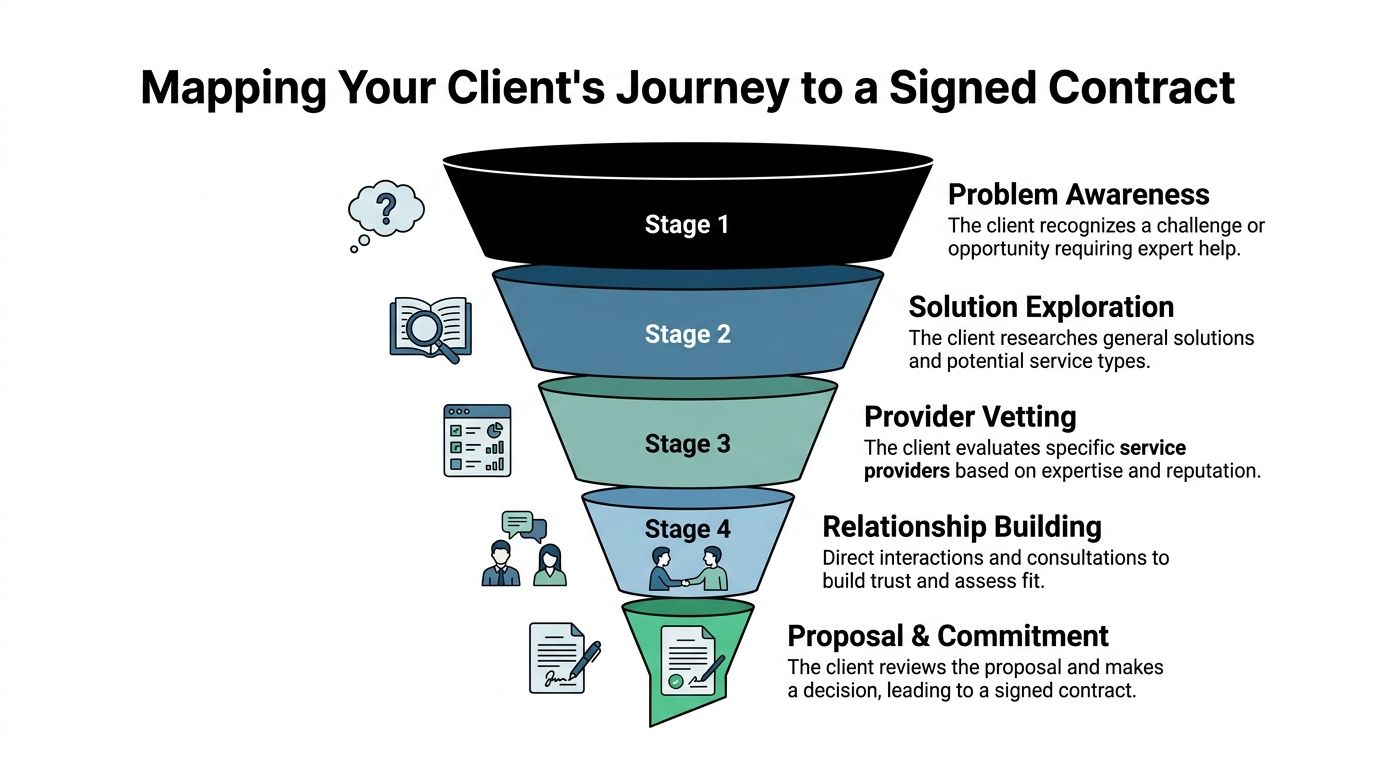
A prospect usually starts with discomfort, not vendor research. Something's off. Growth has stalled. Messaging is muddy. The team can't execute. A launch missed. Revenue quality slipped. At this stage, they're not looking for your service package. They're trying to understand the problem clearly.
That's where educational content earns attention. A sharp article, webinar, or diagnostic post can help them put language to the issue. If your content names the problem better than they can, you've already moved ahead of competitors.
Then comes vetting. They compare providers. They scan your site, your profile, your body of work, and your examples. During this process, many firms get exposed. They have a decent service, but weak evidence. If you need a clean format for gathering proof and insights before you write, Typist's resource for custom templates is useful because it helps structure research and reporting inputs before they become public-facing content.
Once a prospect reaches out, they're assessing fit as much as expertise. They want to know whether you can simplify complexity, whether you listen well, and whether your process feels steady under pressure.
For this, case studies do heavy lifting. Not fluffy testimonials. Real narratives that show the client problem, your approach, and the outcome in a way a skeptical buyer can believe. If your examples are weak, fix that first. This guide on writing business case studies that actually convert is worth reviewing because case studies often become the bridge between interest and proposal.
The proposal rarely creates trust. It confirms trust that was built earlier.
By the time the prospect reads your scope, they've already formed a view of your judgment. The contract stage isn't where professional service marketing wins. It's where prior signals get tested one last time.
A practical way to map the journey is this:
If you market with these checkpoints in mind, you stop chasing leads and start reducing buyer hesitation.
Most firms spread themselves too thin. They try to be active on every platform, attend every event, launch a podcast, run paid campaigns, and publish generic blog posts that nobody remembers.
That's not strategy. That's channel anxiety.
In professional service marketing, a few channels do most of the serious work because they create the right kind of intent. According to Ruler Analytics' professional services marketing statistics, direct traffic converts at 16.8% and organic search converts at 12.3%, both far above the 1.7% sector-wide average. That matters because those channels capture people who already trust your name or are actively searching for a problem-specific solution.
Organic search is where expert positioning compounds. If someone searches for a painful, specific problem and finds your article, they don't experience that as advertising. They experience it as discovery.
That's why generic content underperforms. “Top marketing tips for businesses” won't do much. A tightly framed piece that addresses a specific operational or strategic problem has a better shot at attracting the right buyer.
Use search to answer the questions a qualified prospect types when the problem becomes expensive enough to solve.
Direct traffic is the brand test. People already know you, have heard of you, or got referred to you and typed your name into the browser. That's why it converts so well. Direct traffic is what happens when your reputation moves ahead of your outreach.
You don't build direct traffic with louder promotion. You build it through repeated exposure to useful thinking, clear positioning, and a memorable point of view.
These aren't interchangeable. Each has a specific job.
The mistake is treating these as content dumping grounds. Don't publish one article and spray it everywhere unchanged. Adapt the same core idea for the channel's role.
A practical channel mix for a small team looks like this:
| Channel | Primary job | What to publish |
|---|---|---|
| Organic search | Capture active demand | Problem-specific articles and landing pages |
| Direct traffic | Convert reputation into inquiry | Clear homepage, service pages, proof assets |
| Build authority in public | Short opinion posts, clips, carousels, comments | |
| Referral network | Trigger introductions | Case studies, insight emails, check-in messages |
| Nurture trust over time | Tight newsletters, invitations, useful breakdowns |
If your bandwidth is limited, prioritize the channels that reward intent and trust, not the ones that reward volume for its own sake.
Thought leadership isn't a creative hobby. It's an operating system. If it depends on inspiration, your publishing cadence will collapse the first time client work gets busy.
A better model is an engine. The expert supplies raw insight. A team shapes it. The system turns one conversation into multiple assets. That's how you create authentic visibility without asking the founder to disappear into Canva, Google Docs, and scheduling tools every night.

Most firms publish too wide. They talk about leadership one day, hiring the next, then trends, culture, AI, productivity, and random commentary. Buyers can't tell what the firm is known for.
The stronger approach is tighter. According to Content Marketing Institute's guidance for professional services marketers, focusing content on 3–5 core client problems, with 1–2 high-value gated assets and 4–6 lighter blog or social pieces for each pillar, can sustain lead quality more reliably than a fragmented approach. The same source notes that this problem-first structure can increase email engagement by 20–30% and lift organic search conversions by 2–3× compared with generic content.
That's the blueprint. Pick the few problems clients repeatedly pay you to solve, then build the content architecture around those problems.
Most “ghostwritten” content sounds fake because the process starts with the asset. It should start with the expert.
Use:
Working rule: Don't ask the expert to write. Ask them to react, explain, and decide.
After you capture insight, turn it into a sequence. One call can become a flagship article, several LinkedIn posts, a short email, a webinar topic, and a gated playbook.
A useful companion framework is this strategy to become an industry expert, especially if you need help sharpening the difference between broad publishing and actual authority building.
Here's the embedded walkthrough if you want a visual primer before building the process:
Use a weekly production rhythm:
That's authentic thought leadership. Not because the founder typed every word, but because the ideas are theirs, the perspective is theirs, and the system protects that signal.
Most marketing dashboards are built for businesses with short sales cycles and obvious transactions. That model breaks in professional services.
If you judge your marketing mainly by likes, impressions, follower count, or even raw traffic, you'll miss what matters. Those numbers can move while your pipeline stays flat. They can also stay modest while high-quality conversations increase.
The better question is simple. Are you creating more trust-filled buying situations?
Measure leading indicators that sit closer to relationship formation and buyer intent.
Then pair those with lagging business metrics like proposals sent, proposals won, and revenue closed.
If a metric doesn't help you decide what to publish, where to distribute, or who to follow up with, it probably belongs lower on your dashboard.
| Metric Type | KPI Example | What It Measures |
|---|---|---|
| Leading | Email replies from qualified prospects | Whether your ideas are starting real conversations |
| Leading | Referral introductions received | Whether trust is spreading through your network |
| Leading | Consultation requests | Whether your positioning creates buying intent |
| Leading | Case study downloads or gated asset signups | Whether your proof assets attract serious interest |
| Lagging | Proposals sent | Whether conversations are maturing into opportunities |
| Lagging | Signed contracts | Whether trust converted into revenue |
| Lagging | Revenue by source | Which channels produce actual business |
| Lagging | Client expansion | Whether your positioning supports deeper engagements |
A good dashboard should help you answer three things quickly: what's attracting attention from the right people, what's turning that attention into conversations, and what's turning conversations into contracts.
That's the scorecard. Everything else is support data.
You don't need a huge team to get this moving. You need focus, a cadence, and a refusal to overcomplicate the first quarter.
Start with positioning and source material.
This month is about clarity. Don't publish heavily yet if your message is still muddy.
Now build the engine.
Create one cornerstone asset tied to a real client problem. That might be a strong article, webinar, playbook, or case study. Then break that asset into smaller pieces for LinkedIn and email.
Set a weekly rhythm:
Also decide how you'll track progress. A simple CRM, spreadsheet, or notion board is enough if you use it consistently.
Shift from production to engagement.
Publish less than your competitors if you need to. Just make every piece sharper, more useful, and more closely tied to a real buying problem.
By the end of the first ninety days, you should have clear positioning, a repeatable content workflow, at least one strong proof asset, and a better sense of which ideas create qualified demand. That's enough to build momentum without turning the founder into a full-time marketer.
If you're a busy founder or expert who knows your insights are valuable but doesn't have the time to turn them into consistent, high-quality content, Legacy Builder can help. They build authentic personal brand systems around your real voice, real experience, and real goals, so your marketing keeps moving even when your calendar is full.


You could – but most in-house teams struggle with the nuance of growing on specific platforms.
We partner with in-house teams all the time to help them grow on X, LI, and Email.
Consider us the special forces unit you call in to get the job done without anyone knowing (for a fraction of what you would pay).
Short answer – yes.
Long answer – yes because of our process.
We start with an in-depth interview that gives us the opportunity to learn more about you, your stories, and your vision.
We take that and craft your content then we ship it to you. You are then able to give us the final sign-off (and any adjustments to nail it 100%) before we schedule for posting.
No problem.
We have helped clients for years or for just a season.
All the content we create is yours and yours alone.
If you want to take it over or work on transitioning we will help ensure you are set up for success.
We want this to be a living breathing brand. We will give you best practices for posting and make sure you are set up to win – so post away.
Subscribe to our newsletter and get insights on how to grow your personal brand.
