.svg)
Subscribe to our newsletter and get insights on how to grow your personal brand.
Thank you! Your submission has been received!
Oops! Something went wrong while submitting the form.
.svg)


Before you ever write a single word of a case study, the real work begins. It’s all about laying the right foundation.
You need to find the perfect customer success story, lock in a single, clear objective for the piece, and then pitch it to your client in a way that makes it a no-brainer for them. Nail these three things, and you’re setting yourself up for a story that’s focused, persuasive, and actually moves the needle.
Let's be real—before you can tell a great story, you have to find one worth telling. This is probably the most critical part of the whole process. It’s not about just finding a happy customer. It's about finding the right happy customer whose journey will hit home with the exact people you want to attract.
Your best candidates are usually right under your nose. They aren’t just satisfied; they’re true fans who have seen a real, measurable change thanks to you.
Look for clients who:
Don’t just ask your account managers who they think is happy. Get your hands dirty. Dig into your CRM, look through support tickets, and check product usage data to find the power users who crushed a major challenge with your help. These are the heroes your prospects are waiting to read about.
Building a solid process for this is key to establishing your brand's authority. We dive deeper into this in our guide on building an authoritative online presence.
A case study that tries to do everything ends up doing nothing. You have to decide on its primary goal before you even think about reaching out to the client. Is this thing supposed to shorten your sales cycle? Justify a higher price point? Or are you trying to shine a light on a specific feature nobody's using?
By defining a single, sharp objective upfront, you ensure every interview question, data point, and sentence works towards a specific business outcome. This focus turns a simple success story into a precision sales tool.
For example, if you’re trying to get over pricing objections, the entire story needs to scream ROI. But if the goal is to show off a new feature, then the narrative has to revolve around how that one thing was the key to their success. You absolutely cannot skip this strategic step.
This simple flow shows you how to get your prep work done right.
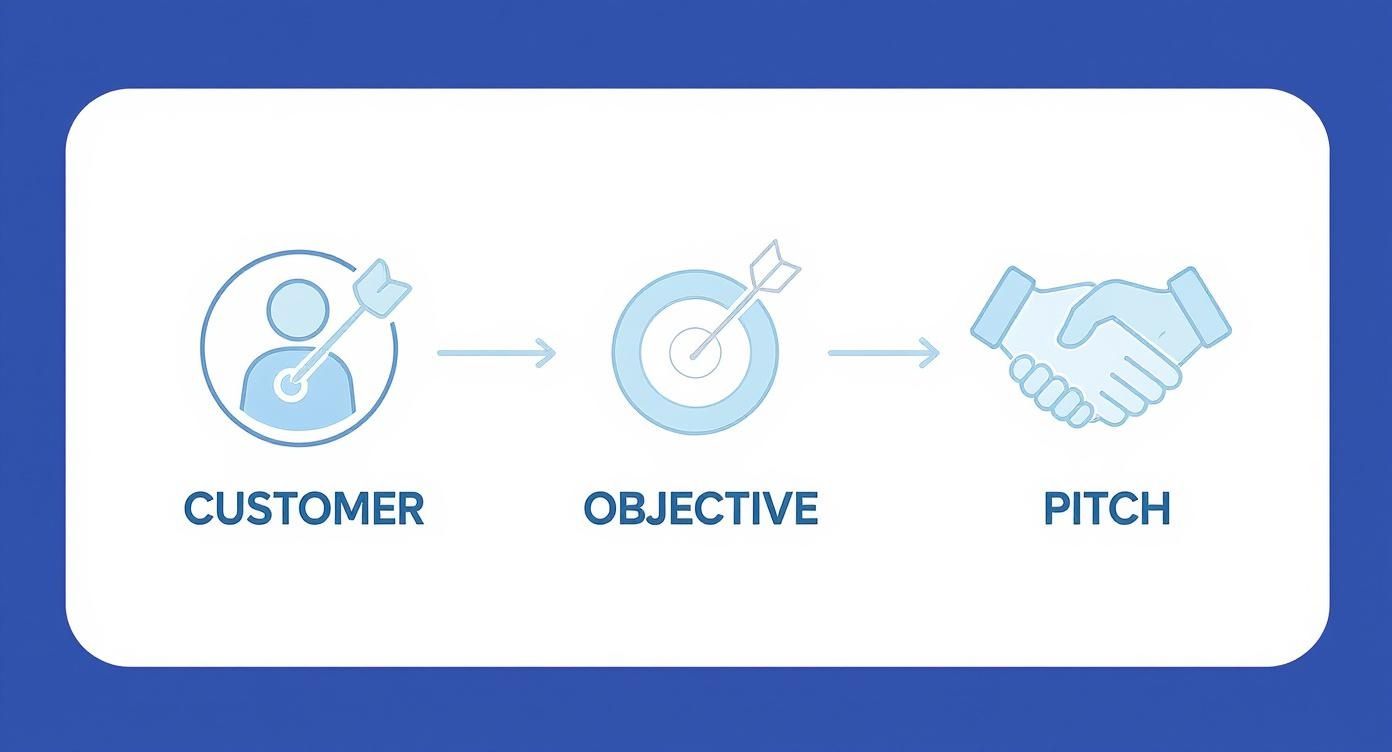
Get this process down, and you'll move from finding the right story to framing the perfect pitch with total clarity.
Okay, you've got your customer and your objective. Time to make the ask.
Just remember: your client is busy. Your pitch can't sound like you're asking for a favor. You have to frame this as a co-marketing opportunity that helps them.
Focus on the "what's in it for them":
Make it clear you'll do all the heavy lifting. Tell them the whole process is painless—just a quick 30-45 minute interview is all you need from them. To make things even easier on both of you, a case study generator tool can help structure your first draft and pull the info together, which is a great way to streamline the process.
Alright, you've done the strategic groundwork. Now it's time for the most human part of writing a killer case study: the client interview.
This conversation is where a good story becomes a great one. It’s your chance to dig past the numbers and find the genuine emotion and specific details that make a story resonate with your prospects. Data alone can't do that.
Anyone can get a generic testimonial. The real magic happens when you guide your client to share their journey—the frustrating "before," the pivotal "aha!" moment, and the triumphant "after." Your job isn't just to ask questions; it's to be a journalist uncovering the heart of the story.

Walking into an interview unprepared is the fastest way to get vague, useless answers. A little prep shows you respect their time and guarantees you walk away with the gold you need.
Before the call, send a brief agenda and the main questions you'll be asking. This isn't to script their answers—it's to give them a heads-up so they can think and gather any data they need. This simple step can turn a decent interview into a goldmine of specific metrics and powerful quotes.
Most importantly, always get permission to record the conversation. You’ll never capture that perfect, word-for-word quote while you're scrambling to take notes. A simple, "Do you mind if I record this call just for my notes?" is all it takes.
The quality of your case study comes down to the quality of your questions. Ditch the simple yes/no stuff and use open-ended prompts that encourage storytelling. You want to paint a vivid picture of their transformation.
These questions set the stage. They establish the problem and the pain it caused, creating an emotional anchor for the entire story.
Here, you're looking for that turning point when they knew your solution was the right one.
This is where you dig for the hard numbers. The metrics that prove your value and build a logical, undeniable case for your product or service.
Pro Tip: Don’t be afraid to ask simple follow-ups like, "Can you tell me more about that?" or "How did that feel?" These little nudges often lead to the most authentic and compelling quotes you'll get.
Once the interview is over, the real work begins. The best storytellers know that a great interview goes hand-in-hand with knowing how to efficiently transcribe an interview like a pro. A clean transcript is your raw material for pulling out those perfect, punchy quotes that bring your case study to life.
As you read through it, look for phrases packed with emotion and personality. These are the soundbites that will connect with your readers on a human level, making the results you present feel both credible and inspiring.
This isn't just about good marketing; it's about reflecting what's happening in the real world. For example, a recent Deloitte survey from over 30 countries showed a massive shift toward using tech to improve customer experience. The big takeaway? Successful companies are the ones that adapt. A well-crafted case study is the perfect way to show exactly how you help companies do just that.
You’ve done the hard part—you found an amazing customer story. Now, you’ve got to tell it in a way that cuts through the noise. Even the most mind-blowing success story will fall flat if it’s buried in a wall of text.
Let's be real: decision-makers don't read, they skim. Your first job is to build this case study so someone can get the gist—and the big win—in under 30 seconds. That means your layout has to be scannable and your key points have to jump off the page.
The trick is to reward both the skimmer and the deep reader. The person scanning gets the impressive highlight reel, while the person who sticks around gets the juicy, credible details that actually close deals.
At the end of the day, a great case study is just a great story. It follows a simple, timeless structure that just works because it’s how we’re wired to understand tales of transformation.
This isn't about being robotic. It's about giving your reader a familiar path to follow so the information goes down smooth.
Framing your story this way—problem, solution, result—makes it incredibly compelling and dead simple to follow.
To really drive home how these pieces fit together, let's break down the essential components of a case study that truly performs.
This table isn't just a checklist; it's a strategic map for creating a persuasive asset from top to bottom.
The top of your case study is prime real estate. You have seconds, maybe less, to convince a busy person this is worth their time. Don't be vague.
Your headline should be a miniature case study all on its own. It needs to scream the most impressive result right away. A simple formula that crushes it is: [Client Name] Gets [Specific, Measurable Result] Using [Your Product/Service].
So instead of a snoozer like "Tech Company Improves Marketing," you go with "Acme Corp Boosts Lead Conversion by 47% with Our CRM Platform." See the difference? One is fluff, the other is a powerful value proposition.
Right under that killer headline, drop in a quick executive summary or a "snapshot" section. This is for the TL;DR crowd and should feature your absolute best numbers.
Your goal is to deliver the main message and the biggest win immediately. If someone only reads the headline and this quick summary, they should still walk away knowing you delivered incredible results.
How your case study looks is just as important as the words you use. Smart formatting is your secret weapon for guiding the reader’s eye to the good stuff, making the whole thing feel less like a chore and more like an engaging read.
You're not just writing a document; you're designing a piece of marketing. A clean, scannable structure is also a core part of a strong overall content strategy, making sure your hard work actually gets consumed.
Here are a few must-have formatting tactics:
A good story about your client's journey is great. But a story backed by hard numbers? That’s an undeniable sales tool.
This is where your case study pivots from an emotional story to logical, undeniable proof. Your prospect needs to see the real, tangible return on investment. It's your job to present that data not as a boring spreadsheet, but as the triumphant final act of the story.
Think of it this way: the data is the evidence that makes the entire story stick. It's the "happily ever after," but told in the language every business understands—dollars saved, efficiency boosted, and real growth.
First things first, you need to dig for the metrics that tell the most powerful story. When you're interviewing your client, don't just ask, "So, what were the results?" That’s too generic.
Instead, guide the conversation toward specific, quantifiable outcomes that tie directly back to the problem you solved.
Try probing for numbers related to:
These are the numbers that give your case study its backbone. They turn a feel-good story into a factual account of the value you delivered.
Just dropping a list of stats into a paragraph is the fastest way to get your reader to tune out. The goal is to make the data pop. You want your best results to literally jump off the page and get stuck in your prospect's head.
So, how do you do it? Think visually. Don't bury your best numbers in a dense block of text—give them the spotlight they deserve.
Pro Tip: Your single most impressive metric should show up more than once. Put it in the headline. Call it out in the summary. Then, break it down in the results section. This repetition ensures that even the fastest skimmers can't possibly miss it.
This approach makes sure your data lands as the powerful conclusion it’s meant to be.
Smart formatting is your secret weapon here. It breaks up the wall of text, guides the reader’s eye, and makes even complex info easy to digest at a glance. You want the ROI to be instantly obvious.
Here are a few simple but incredibly effective techniques I use all the time:
When you integrate data this way, you connect the emotional journey with the cold, hard proof that every decision-maker craves.
This isn’t just a case study trick; it's a reflection of how modern businesses operate. Time and again, studies show that companies that embrace data analytics drive more productivity and growth. We see it everywhere—from Walmart using predictive analytics to slash inventory waste, to Johns Hopkins Hospital cutting patient readmissions by 10% with data modeling. These real-world examples, much like the ones you're creating, serve as powerful blueprints for success, a topic you can dive into with these data analytics case study examples for businesses.
Look, creating a killer case study is a huge win. Pat yourself on the back. But your work isn't done the second you hit "publish."
A brilliant story collecting dust on some forgotten corner of your website does nothing for your bottom line. The final, and maybe most important, step is mastering distribution.
Think of your finished case study not as a static document, but as a content goldmine. It's the raw material for a dozen smaller, snackable assets that can fuel your marketing and sales for months. You just have to get it in front of the right people.
A single case study has everything: compelling quotes, hard-hitting data, and a powerful narrative. Don’t let that value stay trapped in a PDF.
You need to atomize it—break it down for different platforms and audiences. This is how you meet people where they are, whether they have two minutes to scroll LinkedIn or twenty minutes to read a full-on blog post.
Here are a few ways to give your story new life:
This multi-channel approach is how you build a real online presence. For more on this, check out our guide on creating a modern B2B social media strategy that works.
Your sales team is on the front lines. A well-crafted case study is one of the most effective weapons you can arm them with. This isn't marketing fluff; it's tangible proof that you deliver on your promises.
Train your sales reps to use it. They should be sending it after a discovery call to build credibility or using it to crush specific objections. If a prospect is hung up on price, a case study that screams ROI is the perfect counter.
Your case study is third-party validation. It changes the conversation from "trust us, we're great" to "look at the incredible, documented results we achieved for a company just like yours."
This is especially true when you can show how you're tackling modern challenges like AI and data. By 2025, 35% of companies had AI integrated into their business, and the AI market hit $184 billion in 2024. Success stories showing real-world AI impact—like how Amazon’s AI-driven supply chain cut costs and delivery times—provide the tangible proof needed to justify ROI. You can find more insights on how business analytics case studies show real impact.
Last but not least, make your new asset easy to find. Don't bury it.
Your goal is to weave it seamlessly into the buyer's journey. Drop links to your case studies on key service or product pages where prospects are actively evaluating what you do.
And please, have a dedicated "Customer Stories" or "Results" section in your main navigation. This builds massive social proof and makes your wins a central part of your brand. When you amplify your story this way, you turn a single success into a continuous engine for growth.
Even with the best game plan, you're going to hit a few snags when you're deep in the trenches of writing a case study. I've been there. Getting past these common hurdles is what separates a case study that sits on a hard drive from one that actually closes deals.
Let's break down some of the most common questions I get asked.
Forget the idea of a "perfect" word count. The real sweet spot is between 500 and 1,500 words, which usually fits nicely into a one or two-page PDF.
But here’s what really matters: can a busy exec get the gist in 60 seconds? Your goal isn't to write a novel; it's to make an impact, fast.
That's why you have to lead with your biggest, most impressive results right at the top. Even if they only read the first paragraph, they'll walk away knowing the value you delivered. That's the win.
This happens all the time. Don't sweat it. While a big revenue number is great, it's not the only way to tell a powerful story. Sometimes, qualitative results hit even harder.
If they can't share exact percentages or dollar figures, pivot. Focus on the operational wins and the real-world changes. Get direct quotes that paint a vivid picture of the "before and after."
Think about framing the results like this:
These kinds of statements are pure gold. They speak directly to the headaches your prospects are likely dealing with right now, making the story incredibly relatable.
A powerful, direct quote describing a real-world improvement can be more persuasive than a statistic without context. You're not just showing data; you're showing a human success story.
You don't ask for a favor—you present an opportunity. Your client is slammed, so you need to frame this as a win-win that requires almost zero effort on their part.
Lead by highlighting the co-marketing value. You're not just writing a story for yourself; you're putting a spotlight on their company and positioning them as an industry leader. And you need to make it clear that you're doing all the heavy lifting—the writing, the design, the promotion.
Make it sound ridiculously easy for them:
Your best bet is to start with your biggest fans—the clients who are already singing your praises. They're usually more than happy to share their story, especially when you make it this simple and beneficial for them.
If you can't prove a case study is working, it's just a pretty document. You have to track its influence on your sales pipeline.
First, put the case study behind a simple form on your website. This isn't about being difficult; it's about tracking who's interested enough to download it. These are warm leads.
Next, get your sales team on board. Have them log every single time they send that case study to a prospect and note how it impacted the conversation. Over time, you'll start to see a clear line connecting that case study to closed deals and real revenue. That's how you prove its worth.
At Legacy Builder, we turn your client wins into powerful stories that build authority and drive growth. If you're ready to stop letting your best work go unnoticed, we can help you craft the narratives that get you noticed. Discover how we build legacies, one story at a time.


You could – but most in-house teams struggle with the nuance of growing on specific platforms.
We partner with in-house teams all the time to help them grow on X, LI, and Email.
Consider us the special forces unit you call in to get the job done without anyone knowing (for a fraction of what you would pay).
Short answer – yes.
Long answer – yes because of our process.
We start with an in-depth interview that gives us the opportunity to learn more about you, your stories, and your vision.
We take that and craft your content then we ship it to you. You are then able to give us the final sign-off (and any adjustments to nail it 100%) before we schedule for posting.
No problem.
We have helped clients for years or for just a season.
All the content we create is yours and yours alone.
If you want to take it over or work on transitioning we will help ensure you are set up for success.
We want this to be a living breathing brand. We will give you best practices for posting and make sure you are set up to win – so post away.
Subscribe to our newsletter and get insights on how to grow your personal brand.
