.svg)
Subscribe to our newsletter and get insights on how to grow your personal brand.
Thank you! Your submission has been received!
Oops! Something went wrong while submitting the form.
.svg)


Ever heard the term social proof? It's a fancy way of describing a simple human truth: we tend to follow the crowd.
Think of it as digital word-of-mouth. When potential customers see that other people already trust and value your brand, they’re far more likely to jump on board. It’s the secret sauce for building credibility and knocking down that all-too-common buyer hesitation.

Let me paint a picture. You’re walking down an unfamiliar street, hungry. You spot two cafes. One is buzzing with people chatting and sipping coffee; the other is dead silent, completely empty.
Which one do you pick? I’d bet you’d head straight for the busy one.
That gut instinct—assuming the crowd knows something you don't—is social proof in its purest form. This isn't some new-age marketing trick; it's a hardwired human behavior that’s just as powerful online as it is on a busy street. When we can't physically touch a product or shake a founder's hand, we look for clues that others have gone before us and had a great experience.
At its heart, social proof taps into our basic need for validation. We're wired to believe that if a lot of people are doing something, it must be the right, safe, or smart thing to do. This is especially true when we’re feeling uncertain, like when we're about to pull out a credit card for a new software or service.
For founders, entrepreneurs, and executives, learning to use this isn't just a good idea—it's essential. It’s how you take your personal brand from "who's that?" to "I've heard great things." Instead of just telling everyone you’re the expert, you let the voices and actions of others do the talking for you.
Social proof isn't about bragging. It's about building a case for your value using credible, third-party evidence. It shifts the narrative from "trust me" to "trust them."
This evidence comes in a lot of different forms, and each plays a specific role in your content strategy. We'll get into the details, but first, let's break down the main concepts you need to know.
To help you get a quick handle on these ideas, here’s a simple table outlining the fundamental types of social proof we'll be exploring.
Think of this table as your cheat sheet. Each of these concepts is a powerful tool in its own right, and when combined, they create a nearly unstoppable force for building trust.
Let's be honest, we're all drowning in marketing messages. In this kind of environment, trust is the ultimate currency. People trust other people way more than they trust slick advertisements from a faceless brand.
The numbers don't lie. A staggering 97% of consumers now read online reviews before making a purchase. If that doesn't scream "social proof is king," I don't know what does. You can dig into more social proof stats on SMB Guide if you want to go deeper.
Getting a handle on this is the first real step toward turning a skeptical audience into a loyal following. By strategically weaving positive feedback, client results, and community engagement into your content, you build an ecosystem of credibility that works for you 24/7. Your goal is to make choosing you feel like the safest, smartest, and most obvious decision.
Let's be clear: social proof isn't just another marketing buzzword. It's the bedrock of trust in today's world. Think of it as the ultimate shortcut to credibility, letting you cut through the noise and connect with high-value clients who are already sold on you before you even have a conversation.
Here’s a simple way to look at it: when you make a claim about your brand, it's just that—a claim. It’s you, tooting your own horn. But when a happy client, an industry peer, or a crowd of engaged followers makes that same claim for you, it becomes something else entirely. It becomes a verifiable fact.
That shift—from self-promotion to community-backed authority—is how you stop being just another option and become the only choice.
Every single prospect you talk to shows up with a healthy dose of skepticism. They’ve heard lofty promises before, and their default setting is "prove it to me." Social proof is your best weapon for dismantling that friction before it hardens into a firm "no."
When a founder stumbles upon a detailed case study showing how you helped a similar company double its revenue, that skepticism starts to melt. When an executive scrolls through LinkedIn and sees a glowing testimonial from a peer they respect, their guard comes down.
These aren't just nice little endorsements. They are powerful signals telling your audience, "It's safe to trust this person."
This whole process dramatically shortens your sales cycle. Instead of spending weeks trying to convince a lead you're the real deal, you walk into the conversation with your credibility already baked in. The entire dynamic shifts from, "So, why should I choose you?" to "This is great. How do we get started?"
In a world filled with fleeting trends and here-today-gone-tomorrow tactics, authentic social proof builds something that lasts: brand equity. It's the kind of reputational capital that works for you 24/7, attracting opportunities and talent without you having to chase them.
Your brand's authority isn't built by what you say about yourself; it's forged by what others are willing to say about you publicly. This external validation is the bedrock of a resilient personal brand.
And this is exactly where authenticity becomes non-negotiable. Faked testimonials or vague praise don't just fall flat—they can actually destroy the very trust you're trying to build. If you want to dive deeper into this, check out our guide on what brand authenticity is and why it matters for leaders.
When your social proof is the real deal, it becomes an asset that compounds over time.
Every genuine piece you add layers onto your reputation, making your brand stronger and more resistant to market shifts. It’s the difference between a brand that has to constantly scream for attention and one whose community does the shouting for it. This is often part of a broader strategy. To get the bigger picture, you can explore the power of social influence marketing and see how these pieces fit together.
At the end of the day, social proof is your ultimate strategic differentiator. While your competitors are busy polishing the perfect sales pitch, you can be building a fortress of credibility that makes their claims feel hollow.
Your library of success stories, endorsements, and community shout-outs becomes an asset that no one else can copy.
For founders, executives, and leaders, this is the real key to sustainable growth. It's how you go from being just another name in a crowded market to becoming the trusted authority everyone turns to and recommends. By consistently gathering and showcasing real proof of your value, you create a powerful flywheel of trust that keeps attracting your ideal clients and solidifies your legacy for years to come.
Social proof isn't some one-size-fits-all marketing trick. Think of it more like a toolkit—you wouldn't use a hammer to saw a board, right? A glowing testimonial from a happy customer serves a totally different purpose than a viral TikTok video of someone using your product.
Understanding the five main types of social proof helps you get strategic. It lets you pick the right tool for the job, whether you're a founder trying to land your next big client or an executive building unshakeable industry authority.
This is the classic, the OG of social proof. It’s the digital version of a friend leaning in and saying, "Seriously, you have to try this." We're talking about direct quotes, star ratings, and reviews from real customers who've paid you their hard-earned money.
Customer testimonials are absolute gold because they’re personal, relatable, and cut right through the marketing fluff. A powerful quote from a happy client sitting on your homepage will do more heavy lifting than ten pages of your own sales copy ever could. To get a better feel for what makes them work, check out some effective testimonial features.
The numbers don't lie. A staggering 93% of consumers say online reviews directly influence what they buy. Even more telling? 91% of people aged 18-34 trust online reviews as much as a recommendation from a friend. This isn't just a nice-to-have; it's foundational.
If a testimonial is the punchy soundbite, a case study is the full story. This is mission-critical for B2B companies, consultants, or anyone selling a complex, high-ticket service. You have to prove you can deliver the goods.
A case study digs deeper than a simple quote. It lays out the client's problem, details the exact solution you brought to the table, and—this is the most important part—shows off the measurable, tangible results you got for them.
A great case study stops you from making vague promises and starts providing concrete proof. It shifts the conversation from, "We can help you grow," to, "Here's the exact blueprint of how we helped a company just like yours increase revenue by 47%."
This storytelling format lets potential clients see themselves in the success. It answers their internal questions and quiets their anxieties by giving them a clear, data-backed roadmap of your work in action. It's one of the most powerful trust-builders you have.
This is all about borrowing credibility. When a respected industry expert, a well-known thought leader, or a public figure gives you their stamp of approval, their hard-earned trust gets transferred directly to your brand.
And no, you don't need a movie star. For most founders and executives, an endorsement from a key leader within your specific niche is way more powerful.
Think about it like this:
The secret here is relevance. The endorsement has to come from someone your audience already knows, respects, and trusts. The closer the expert is to your field, the more their recommendation means.
User-Generated Content (UGC) is today’s word-of-mouth, but on steroids. It's any content—photos, videos, social media posts, blog reviews—created by your audience, not you.
UGC is a game-changer because it feels completely organic and unbiased. It’s real-world proof that people aren't just using your product; they’re so fired up about it they’re willing to create and share content on their own time.
This bucket also includes social signals—the quick, at-a-glance metrics of public approval. These are your follower counts, likes, shares, and comments. A huge, engaged following on LinkedIn or Instagram instantly signals to newcomers that you're relevant and that a community values what you have to say. Seeing a post with thousands of likes is a fast, subconscious nod of approval.
This is a more targeted play, sitting somewhere between expert endorsements and UGC. It’s about partnering with creators who have already built a loyal, engaged community in your specific niche.
Unlike a big-name celebrity endorsement, influencer marketing is about precision. You find creators whose audience is a mirror image of your ideal customer. When that influencer recommends your product or service, it’s delivered with a layer of trust and authenticity that a traditional ad can only dream of.
A fintech startup, for example, could team up with a popular finance YouTuber to review their app. The influencer's credibility and down-to-earth explanation act as powerful social proof for an audience that’s already there to listen to them. It’s the perfect blend of an expert’s authority and a peer’s recommendation.
Knowing what social proof is doesn't do you much good. The real trick is weaving it into your content so it feels authentic, not forced. This isn't about slapping a testimonial on a page and calling it a day. It's about storytelling.
You want to frame this proof as a celebration of your clients' wins, not a hard sales pitch from you. When you embed these trust signals naturally, you create a powerful loop. Every piece of content reinforces your credibility, which in turn draws in more of the right people.
You can't showcase social proof you don't have. So, the first step is building a system to collect it. Don't sit back and wait for compliments to land in your inbox—go out and ask for them when a client is happiest.
A simple, automated email sent a couple of weeks after wrapping up a successful project can work wonders. Just ask for a quick quote about their experience. Make it dead simple for them by linking to a form or just telling them to reply to the email.
Here’s a quick-start guide to get you going:
This map breaks down the key types of social proof you should be collecting and using.
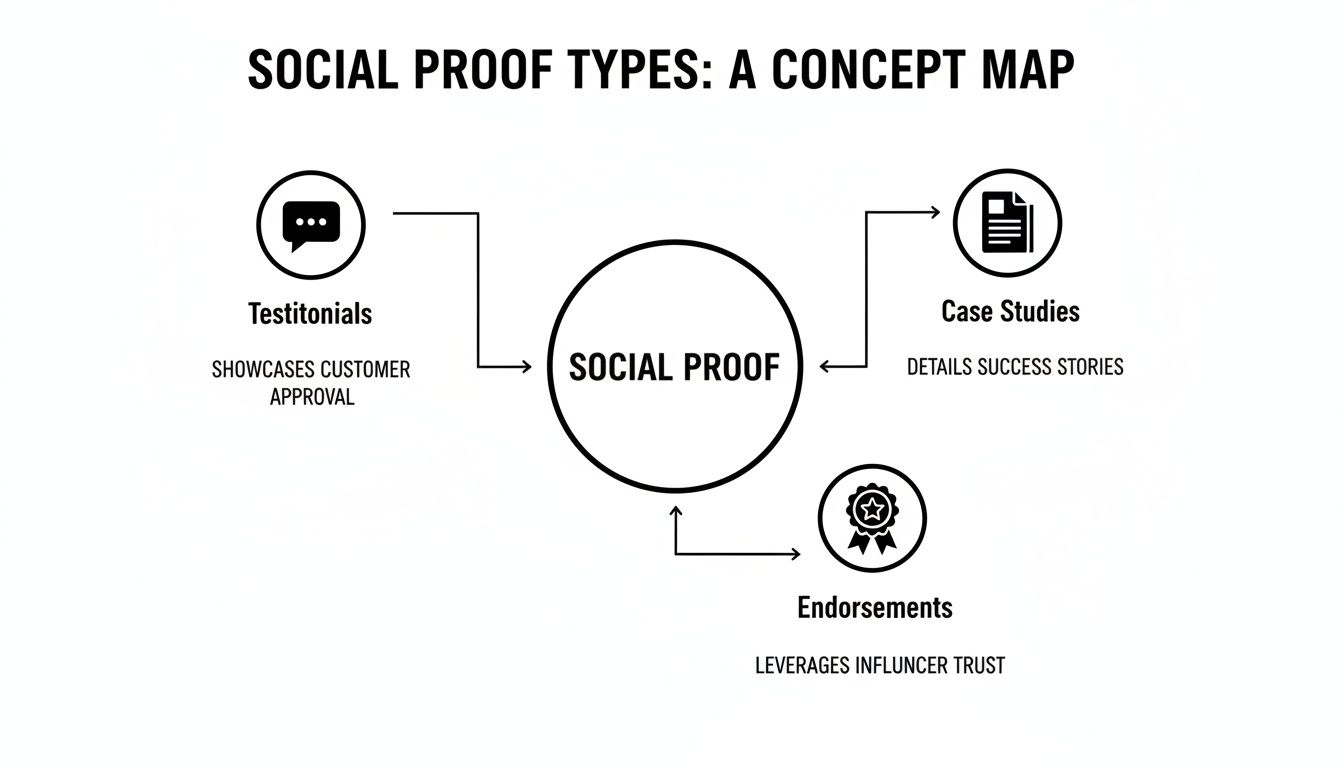
Think of testimonials, case studies, and endorsements as three distinct but connected pillars holding up your brand's reputation.
Your website is your digital storefront. It’s often the very first impression someone has of you, making it prime real estate for social proof. Visitors should see evidence of your value within seconds of landing on your page.
Whatever you do, don't bury your best testimonials on some hidden page nobody will ever find. Sprinkle them throughout your site where they'll have the biggest impact.
Key Takeaway: Put your most powerful social proof right next to your main calls-to-action. Seeing a glowing review right beside a "Book a Call" button can be the final push someone needs to take action.
Here’s how to nail this:
Your content strategy isn’t just your blog. Every single platform you're on is another chance to build credibility. The key is to adapt your social proof to fit the channel.
A deep-dive case study might be perfect for your blog, but for LinkedIn, you’d want to break that down into a punchy carousel post with key stats and a great client quote. A full-length video testimonial can live on YouTube, while a 15-second clip from it becomes a killer Instagram Reel.
Here are some tactics for different channels:
When you consistently integrate these elements, social proof stops being a tactic and starts becoming an organic part of your brand's voice. It's an always-on strategy that proves you know what you're doing. This way, no matter where someone finds you, they’re met with undeniable proof that you deliver on your promises.
Great social proof isn’t just about making your brand feel popular; it’s about fueling real growth. But if you can't measure it, you can't prove it's working.
It’s easy to get caught up in vanity metrics like likes and shares. The real challenge is moving past those and understanding what truly connects with your audience and drives bottom-line results. You have to draw a straight line from a client testimonial to a new lead, or from a killer user-generated content campaign to a spike in sales. That's how you prove the ROI.
To see what’s actually working, you need to look at numbers that reflect action and impact. These metrics tell you a story about how your social proof is influencing people at make-or-break moments.
Start tracking these:
Tracking these numbers is just one piece of the puzzle. To really see the big picture, you need to understand how to measure brand awareness and see how all these efforts connect.
Stop guessing what works. Start testing. A/B testing is your secret weapon for figuring out exactly which types of social proof resonate with your specific audience. The idea is simple: create two versions of a page, change just one thing, and see which one performs better.
A/B testing takes the guesswork out of your strategy. It turns marketing from an art based on gut feelings into a science driven by data, making sure every move is optimized for impact.
Here’s a quick example. Let's say you want to improve your main services page.
Let the test run for a couple of weeks and see which version gets more clicks on your "Book a Call" button. The data doesn't lie. This kind of insight helps you double down on the formats that actually get people to act. When you consistently measure and test, you turn social proof from a hopeful tactic into a predictable engine for growth.
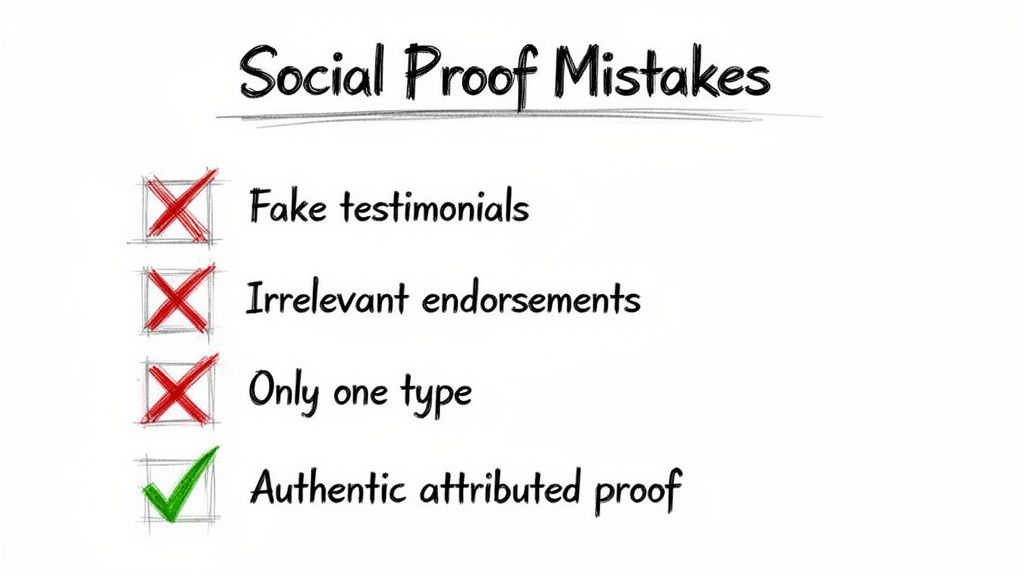
Social proof is powerful, but when you get it wrong, it can absolutely tank your credibility. The whole point is to build real trust. But if you take shortcuts, you can end up looking desperate or, even worse, dishonest.
For any founder or executive building their personal brand, steering clear of these pitfalls is non-negotiable. Your reputation is everything, and that means every piece of social proof you share has to be built on a foundation of total integrity.
One of the most common mistakes I see is featuring testimonials that just don't hold up. Vague praise with no name or face attached feels anonymous, and let's be honest, it's just not believable. A quote that says "Great service!" from "A happy customer" does absolutely nothing to build confidence.
To fix this, you have to get specific and make it attributable. A truly powerful testimonial needs to be:
This kind of detail is what turns a generic compliment into a rock-solid piece of evidence.
Another massive misstep is using social proof that just doesn't connect with your target audience. An endorsement from a big-name celebrity is totally useless if your ideal client has no clue who they are or doesn't care about their opinion on the subject.
Social proof is only powerful when it comes from a source your audience recognizes and trusts. The relevance of the endorser is often more important than their raw popularity.
Think about it. If you're a B2B software company trying to sell to CIOs, a rave review from a popular lifestyle influencer is going to fall completely flat. But a detailed recommendation from a respected tech analyst? Or a CIO from another company in their industry? That's pure gold.
Always ask yourself: "Will my ideal client see this person as a credible peer or an authority?" If the answer is no, that proof isn't going to move the needle. You have to make sure every endorsement speaks directly to your audience's world. That’s how you create proof that actually resonates and builds the kind of trust that closes deals.
Even the best strategy comes with a few questions. I get these all the time from founders, so let's clear up the most common ones right now.
If you're new to the game, you can't just sit back and wait. You have to be proactive.
Offer your service for free or at a steep discount to a handful of ideal clients. The only catch? They have to give you honest, detailed feedback in return. Document everything—their experience, your process, and any early wins, no matter how small. Even a quote about your professionalism is powerful currency when you're starting from zero.
My go-to tip: Don't forget your existing network. Ask a respected mentor or a former colleague who can speak to your work ethic for an endorsement. Their credibility can give you that initial boost you need to get the ball rolling.
Not at all. In fact, it can be the opposite. A page full of flawless, 5-star reviews can feel fake to anyone who's spent more than five minutes on the internet.
A few balanced or even slightly critical reviews make you look more authentic. The real magic is in how you handle it. When you respond publicly with a thoughtful, professional solution, you show everyone that you listen, you care, and you’re committed to getting it right. That kind of transparency builds way more trust than a perfect record ever could.
This really depends on your industry, but if I had to pick, user-generated content (UGC) and in-depth case studies deliver the biggest punch. UGC feels raw and real—it’s a genuine recommendation from a peer that cuts right through the marketing fluff.
But for B2B founders and executives, nothing beats a solid case study. It tells a story. It breaks down a specific client problem, details your solution, and—most importantly—shows the measurable results you delivered. It's the ultimate proof that you don't just talk the talk; you get things done.
Ready to stop telling people you're an expert and start showing them?
Legacy Builder is the content engine that turns your expertise into undeniable social proof. We help you package your client wins into high-impact content that becomes your greatest marketing asset.


You could – but most in-house teams struggle with the nuance of growing on specific platforms.
We partner with in-house teams all the time to help them grow on X, LI, and Email.
Consider us the special forces unit you call in to get the job done without anyone knowing (for a fraction of what you would pay).
Short answer – yes.
Long answer – yes because of our process.
We start with an in-depth interview that gives us the opportunity to learn more about you, your stories, and your vision.
We take that and craft your content then we ship it to you. You are then able to give us the final sign-off (and any adjustments to nail it 100%) before we schedule for posting.
No problem.
We have helped clients for years or for just a season.
All the content we create is yours and yours alone.
If you want to take it over or work on transitioning we will help ensure you are set up for success.
We want this to be a living breathing brand. We will give you best practices for posting and make sure you are set up to win – so post away.
Subscribe to our newsletter and get insights on how to grow your personal brand.
