.svg)
Subscribe to our newsletter and get insights on how to grow your personal brand.
Thank you! Your submission has been received!
Oops! Something went wrong while submitting the form.
.svg)


Figuring out how to price your consulting services boils down to four core actions. You need to calculate your real business costs, define your personal income goals, pick a pricing model that actually ties to client results, and anchor your price to the value you deliver.
This isn't about selling hours. It's about selling outcomes.
Too many consultants start with the wrong question: "What should my hourly rate be?"
Right away, you've put a ceiling on your income and turned your expertise into a commodity.
A much better question to ask is, "What is this specific result worth to my client?" This single shift in perspective is the foundation of any premium consulting business and the key to pricing your services with confidence.
Before you can even think about putting a number out there, you need to build a solid financial and strategic base. This isn't about pulling a price out of thin air. It’s about making a smart decision based on your data, your goals, and the unique value you bring to the table.
Think of your pricing strategy like a structure held up by three pillars. If one of them is weak, the whole thing gets shaky.
Getting a handle on financial terms, like the difference between margin vs markup, is also non-negotiable for pricing with confidence. These concepts are what you'll use to calculate profitability and make sure your business model can actually last.
Ultimately, your pricing says everything about your business's health and your positioning in the market. You might want to dig deeper into https://www.legacybuilder.co/blog/what-is-strategic-positioning-and-how-to-find-your-market-edge to really sharpen your pricing power.
Your price is more than a number—it’s a statement about the value you create. When you get this foundation right, you stop trading time for money and start pricing the transformation you deliver. It's the difference between being a temporary helper and a respected strategic partner.
Picking your pricing model is one of the most critical decisions you'll make. It’s the engine that powers your entire consulting business, and getting it wrong can stall you out before you even get started.
Don't just pull a number out of thin air. Let’s walk through how to price your services in a way that aligns with the results you deliver and actually lets you build a profitable business.
There are four main ways to price yourself. We’ll break them down and I’ll give you the real story on how they play out.
Let's get this one out of the way. Charging by the hour is where almost everyone starts. It feels safe and simple. You work an hour, you bill an hour. Easy, right?
Wrong. This is a trap.
The harsh reality is that billing by the hour punishes you for being good at your job. The faster and more efficient you get, the less you earn for the exact same result. It puts you in a position where your incentive (more hours) is the opposite of your client's (fewer hours). This creates friction and a hard cap on your income. You can only work so many hours in a day. Even the big consulting firms only shoot for a 75% utilization rate, so you're never billing 100% of your time.
This is a huge step up. With project-based pricing, you charge one flat fee for a specific, well-defined outcome. The entire conversation shifts from "how many hours will this take?" to "what is the result we're getting?"
For example, a marketing consultant could charge a $15,000 flat fee to build and launch a new brand identity. The client loves this because their cost is predictable. You love this because you’re rewarded for efficiency. If you knock it out of the park faster than you estimated, your effective hourly rate skyrockets.
The catch? You absolutely need an iron-clad scope of work. Without one, you'll fall victim to "scope creep"—that endless cycle of "just one more thing" that kills your profitability.
My Take: Project fees force you to get crystal clear on deliverables from day one. That clarity is gold. It protects you and makes the client feel confident because they know exactly what they're paying for.
Want predictable, recurring revenue? The retainer model is your best friend. A retainer is a fixed monthly fee your client pays for ongoing access to your expertise.
This is perfect for long-term, strategic work where the scope isn't a single, one-off project. Think of it as having a consultant "on call."
Imagine you're a leadership coach for a startup CEO. A $5,000 monthly retainer might get them two strategy calls per month, unlimited email support, and a quarterly team workshop. They get consistent guidance, and you get stable income you can count on.
Retainers are a perfect fit when:
This chart gives you a simple way to think about the fundamental choice you're making—are you pricing your time, or are you pricing the outcome?
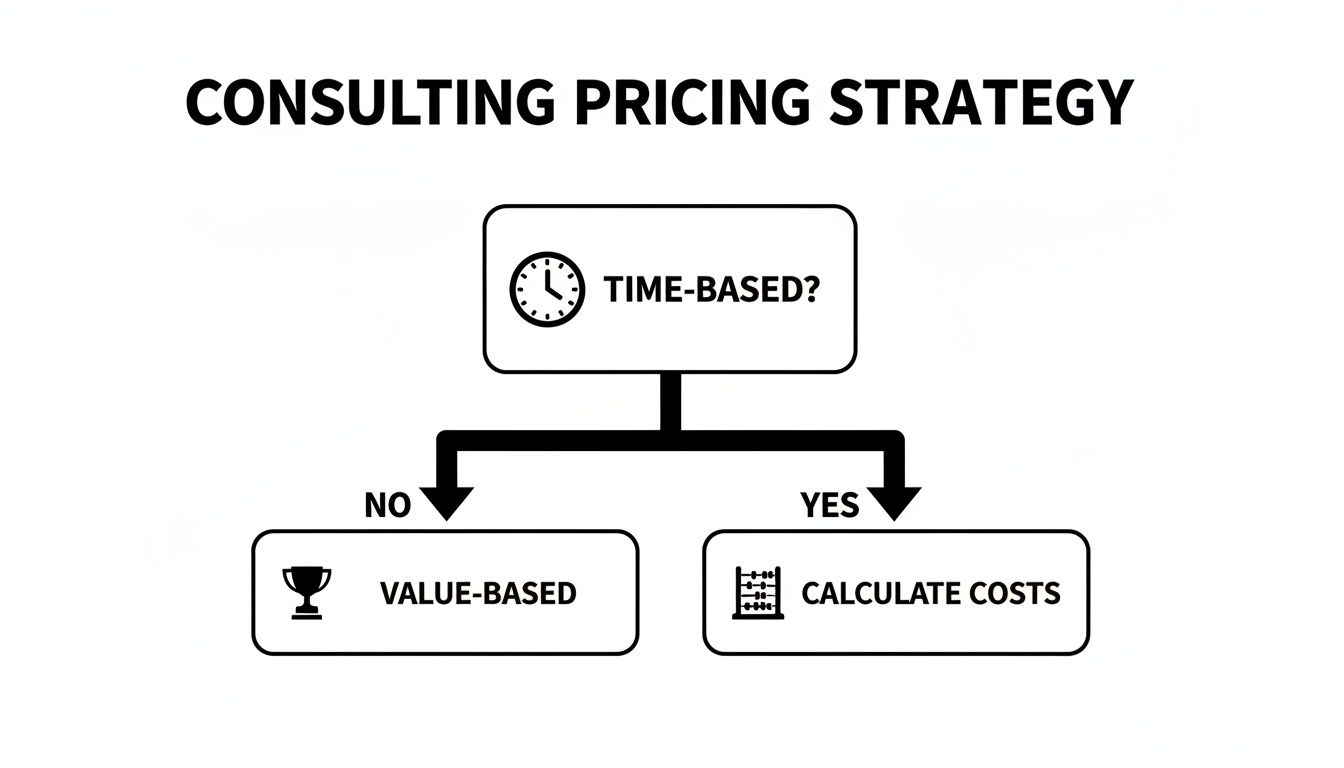
As you can see, while time-based models feel safe, the real money and freedom come from decoupling your income from the hours you put in.
This is the holy grail. With value-based pricing, your fee is a percentage of the tangible, monetary value you create for your client. It has nothing to do with your time and everything to do with their ROI.
Let's say your sales consulting will help a software company increase customer lifetime value by $500,000 in the next year. Suddenly, a $50,000 fee (10% of the value you create) doesn't just sound reasonable—it sounds like a brilliant investment.
To pull this off, you have to be confident and able to clearly forecast and measure the business impact of your work. Sure, some general coaching might go for $70-$90 per hour, but when you apply that same expertise to a massive problem and price on value, you can command five or even six-figure fees for a single project. This is where top-tier consultants play.
Before you even think about quoting a project or talking value-based fees, you need to know your floor. This isn't the price you'll necessarily charge, but it's the absolute rock-bottom number you must earn to keep your business running and, you know, actually eat.
Figuring out this baseline rate is a non-negotiable first step. It takes the mystery out of your finances and makes sure you never accidentally work for less than minimum wage. Let’s break down the numbers you need to know cold.
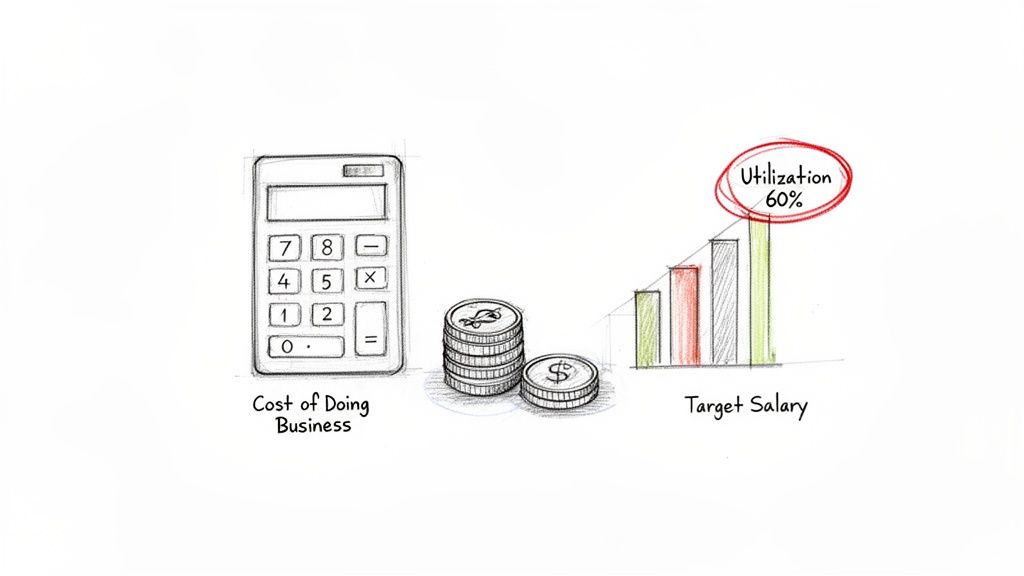
First, it’s time for some brutal honesty. What does it really cost to run your life and your business for an entire year? Too many consultants just think about their software subscriptions, but that's just the tip of the iceberg.
Your true costs are a mix of what you need to live and what you need to operate.
Your life costs money. Think rent/mortgage, groceries, health insurance, and retirement savings. Don't forget a budget for vacations and fun—you’re not a robot. Be realistic about the lifestyle you want to maintain.
Your business costs money. This includes software, website hosting, marketing spend, professional development, insurance, and maybe a coworking space. It all adds up.
Add it all together. This final number is your Total Annual Cost of Doing Business. It’s the absolute minimum your business has to bring in just to break even.
Let’s be clear: breaking even isn’t a business. It’s a very stressful hobby. A real business makes a profit.
A healthy profit margin of 20-30% is a solid target. This isn’t about being greedy; it’s the cash you'll use to survive slow months, reinvest in growth, and build personal wealth.
Then comes Uncle Sam. As a consultant, you’re on the hook for self-employment taxes (around 15.3% in the US) on top of your regular income taxes. To be safe, plan on setting aside 30-40% of every dollar you earn for taxes.
Your real revenue goal isn't just your costs. It’s your costs plus profit, with taxes accounted for. If your total costs are $100,000, you’re not shooting for $100,000 in revenue. After taxes and a 20% profit margin, your actual revenue target is closer to $163,000.
This is your new North Star. Every pricing decision you make has to get you closer to this number.
Now we get to the part everyone messes up: your utilization rate. This is simply the percentage of your work time that you can actually bill to a client.
I'll tell you right now, no one bills 40 hours a week, 52 weeks a year. Chasing that is a one-way ticket to burnout and a failing business.
You have to account for all the unbillable work that’s essential to running your business:
For most solo consultants, a realistic utilization rate is somewhere between 60% and 75%. Out of a standard 2,080-hour work year, you’re realistically only billing for 1,248 to 1,560 of those hours. Knowing how to calculate billable hours properly is the key to not accidentally undercharging.
Okay, let's put it all together to find your baseline hourly rate. This is the absolute minimum you need to charge when you’re doing client work to hit that big annual revenue goal we figured out earlier.
The math is simple: Baseline Hourly Rate = Target Annual Revenue / Total Annual Billable Hours.
To give you a concrete look at how this works, here’s a sample calculation. This walks you through the inputs we've been discussing to arrive at a final baseline rate.
Based on this math, your baseline rate is $127 per hour.
Remember, this is your floor, not your ceiling. This is the number that tells you if a project is even worth considering. Pricing below this means you are literally paying to work for someone.
Now you can walk into any negotiation with the confidence of knowing exactly what you need to earn. That’s the real foundation of pricing your consulting services.
Let's get one thing straight: clients don't buy your time. They couldn't care less about your hours. They buy solutions. They're looking for a clear, direct path from their current headache to their desired outcome.
The best way I've found to do this is by packaging your expertise into offers that are so compelling and easy to understand, it makes saying 'yes' a no-brainer. This single shift moves you away from a confusing, à la carte menu where clients get decision fatigue. Instead, you present clear, tiered solutions designed for specific results, instantly changing the conversation from "How much does this cost?" to "Which investment is right for me?"

Stop selling "one hour of coaching" or "five blog posts." It commoditizes your expertise. Start selling a complete solution that gets a client from A to Z.
A powerful way to structure this is with tiered packages. Think Bronze, Silver, Gold, or even better, descriptive names that sell the result, like Foundation, Growth, and Scale. Each tier solves the same core problem, just at different levels of depth, speed, or hands-on support.
Here’s why this works so well:
This approach is foundational for building a service business that can actually grow. If you're serious about this, you should also check out our guide on how to scale a service business with proven systems.
Don't sleep on this—the names you choose for your packages are half the battle. They need to communicate a clear benefit. Ditch the generic labels and go for names that tap into your client's biggest goals.
Let's say you're a content marketing consultant. Instead of a random list of services, you could create a "Thought Leadership Accelerator" program with three tiers.
Tier 1: Foundation Package ($5,000)
Tier 2: Growth Package ($10,000)
Tier 3: Scale Package ($20,000)
See the difference? Now your offer feels tangible and professional. The client isn't just buying articles; they're buying a system to build authority. It's an investment, not an expense.
The goal of packaging is to make your highest-value offer feel like the most logical choice. By clearly defining what a client gets at each level, you anchor the price to a specific, desirable outcome.
This tiered model has a secret weapon built right in: price anchoring.
When you put a $5,000, $10,000, and $20,000 option side-by-side, something magic happens. That middle "Growth" package suddenly looks incredibly reasonable. The high-end tier makes the mid-tier option feel like a fantastic deal, while the low-end tier provides an accessible entry point for clients who aren't ready to go all-in just yet.
This simple psychological principle guides clients right where you want them—usually to that middle tier, which should be priced for your ideal profitability and workload. You're framing the decision, not forcing it. This strategy alone can dramatically boost your average deal size without any sleazy sales tactics. It's how you stop being just another service provider and start being a strategic partner.
You’ve done the math, crunched the numbers, and packaged your services. Now comes the moment of truth: presenting your price. This is where so many consultants stumble. But if you handle it right, this isn't a tense standoff; it's the natural, logical next step in your conversation with the client.
The secret? Stop thinking of your fee as a cost. It’s an investment, and you need to frame it that way.

Never, ever just drop a number and go silent. That’s a rookie mistake. You need to present your price in the context of the return they're getting. Your sales calls should have already uncovered their pain points and what it's worth to them to solve them—whether that's in hard revenue, cost savings, or a competitive edge.
Before you say a single number, remind them of their goals and the outcome you're delivering.
Instead of just saying, "My fee is $15,000," try this.
"We agreed your goal is to generate 200 qualified leads a month, which you've said is worth over $100,000 in new business each year. Our 'Lead Generation Engine' package is built to deliver exactly that. The total investment for this is $15,000."
See the difference? You’ve completely reframed the conversation. $15,000 is no longer a scary expense; it’s the key to unlocking $100,000 in value. Suddenly, your price feels small.
No matter how well you frame your value, someone will push back on price. Don’t get defensive. An objection isn't a "no"—it's a request for more information. How you handle these moments defines you as a pro.
Here are the usual suspects and how to handle them:
The best defense is a good offense. Have your answers ready. Another killer tool is social proof. Having solid case studies that show you’ve delivered real results for other clients can shut down objections before they even start. If you need help with that, check out our guide on how to write business case studies that actually convert.
If you're talking to a great-fit client who has a real budget constraint, your go-to move isn't discounting. It's adjusting the scope. This reinforces that your rate is firm and the price is tied directly to the work you deliver.
Let's say your full package is $10,000, but their budget is maxed out at $7,000.
Don't say: "Fine, I'll do it for $7,000."
Instead, say: "I can definitely work within a $7,000 budget. To make that work, we'd remove the video script component and reduce the number of articles from eight to five. That will still give you a strong foundation to build on, and we can always add the other pieces back in later."
You've held your value, respected their budget, and kept the door open for more work down the road.
Let's be clear: some clients just aren't a good fit. If a prospect is constantly trying to lowball you, haggles over every dollar, and doesn't seem to respect your expertise, those are giant red flags.
Think of your pricing as a filter. Premium prices attract premium clients who get it. Taking on a bad-fit client for a discounted rate almost always leads to scope creep, endless revisions, and a project that kills your profitability and your spirit.
Learning to say "no" to the wrong clients is one of the most powerful things you can do for your business. It frees you up to find the right ones who will happily pay what you're worth.
Getting your consulting price right often comes down to knowing what not to do. I’ve seen far too many sharp consultants shoot themselves in the foot by making the same predictable mistakes.
Think of this as your final check-up—a way to make sure your pricing isn’t just a guess, but a strategy built to last.
One of the biggest blunders I see? Just copying what your competitor is charging. It feels safe, like a shortcut, but it's a massive strategic error.
You have no clue what their costs are, what they need to make, or who they're even trying to attract. Their pricing could be totally outdated or, even worse, a race to the bottom just to land any client.
Don't anchor your value to someone else's business. Your pricing has to be a direct reflection of your unique skills, your costs, and the specific results you deliver. Anything else is just throwing darts in the dark.
Another trap that sinks consultants is forgetting about all the work you do outside of client-facing projects. So many people calculate their rates assuming a 40-hour billable week, totally ignoring the time spent on essential, non-billable work.
This is all the stuff that keeps the lights on:
If you ignore this time, you’re dramatically under-pricing your services from the start.
And don’t even get me started on taxes. Forgetting to bake in a serious chunk for taxes—often 30-40% for self-employed folks—will give you a nasty shock at the end of the year. Your price has to cover your client work, your business admin, and your tax bill.
When a potential client pushes back on your price, it's tempting to immediately offer a discount. This is almost always a mistake.
Caving on price screams a lack of confidence and instantly devalues your expertise. Instead of slashing your rate, offer to reduce the project scope to fit their budget. Protect your value.
Finally, a surprisingly common error is just... never raising your rates. Your expertise isn't a fixed asset. It grows with every project you nail, every certification you earn, and every great result you deliver for a client.
If you’re still charging the same rates you were two years ago, you’re not just leaving cash on the table—you're telling the market you haven’t gotten any better. Look at your pricing every year and definitely after any major win or professional milestone.
Even when you have a solid pricing framework, a few tricky questions always pop up. Let's get straight to them—here are the answers I give consultants when they ask me about pricing.
You should be looking at your rates every single year, at a minimum.
But don’t be afraid to raise them sooner. The perfect time is right after you land a big-name client, get a new certification, or when your calendar is booked solid for more than three months out.
Don't wait until you're feeling burned out to make a move. When you do bump them up, give your current clients at least 60 days' notice. You want to frame it as a positive, explaining that the new rate ensures you can keep delivering the high-level service they expect while you invest in your skills.
Your rates have to grow with your expertise. If you're better than you were last year, but your prices are the same, you're leaving money on the table. Stagnant rates signal a stagnant business.
This one really depends on what you're selling.
If you offer productized services, putting your prices out there is a great move. It weeds out the tire-kickers and saves you from pointless sales calls. A "Brand Audit for $2,500" is crystal clear and attracts buyers who are ready to go.
But for custom, value-based projects, it’s usually better to keep your pricing private. This forces a conversation where you can establish the massive ROI you're going to deliver before you ever talk numbers.
A smart play is to use a "starting at" price. This gives prospects a ballpark figure without boxing you in. For example: "Monthly Marketing Retainers start at $4,000."
First off, don't panic. And definitely don't offer a discount.
Get curious. Your first move is to understand where they're coming from. Ask something like, "When you say it's high, what did you have in mind for solving this problem?" This immediately pivots the conversation from cost back to value and the outcome they want.
If it's a genuine budget issue, the solution isn't to lower your price—it's to lower the scope. Offer to scale back the project to fit what they can afford. This protects your rate and shows them that your price is directly tied to the work and results, not some number you pulled out of thin air.
At Legacy Builder, we turn your expertise into a premium brand that commands top-tier rates. We handle the content strategy and creation so you can focus on delivering high-value work for high-value clients. Start building your legacy today.


You could – but most in-house teams struggle with the nuance of growing on specific platforms.
We partner with in-house teams all the time to help them grow on X, LI, and Email.
Consider us the special forces unit you call in to get the job done without anyone knowing (for a fraction of what you would pay).
Short answer – yes.
Long answer – yes because of our process.
We start with an in-depth interview that gives us the opportunity to learn more about you, your stories, and your vision.
We take that and craft your content then we ship it to you. You are then able to give us the final sign-off (and any adjustments to nail it 100%) before we schedule for posting.
No problem.
We have helped clients for years or for just a season.
All the content we create is yours and yours alone.
If you want to take it over or work on transitioning we will help ensure you are set up for success.
We want this to be a living breathing brand. We will give you best practices for posting and make sure you are set up to win – so post away.
Subscribe to our newsletter and get insights on how to grow your personal brand.
