.svg)
Subscribe to our newsletter and get insights on how to grow your personal brand.
Thank you! Your submission has been received!
Oops! Something went wrong while submitting the form.
.svg)



You've done the hard part in real life. You built the company, led the team, closed the deals, survived the messy middle, and earned the title people now introduce you with. Then a prospective client, investor, podcast host, or hiring committee searches your name, and the internet gives them almost nothing useful.
That gap costs more than most founders realize.
A weak digital presence doesn't just look unfinished. It creates doubt. If your public footprint is thin, outdated, or inconsistent, people assume your relevance is thin, outdated, or inconsistent too. That's unfair, but it's how modern credibility works. Your reputation now gets filtered through search results, social profiles, review signals, and increasingly through AI summaries that compress you into a few lines.
Professional reputation management isn't about vanity. It's about making sure your visible reputation matches your actual value. Done well, it attracts better opportunities, shortens trust-building, and gives people a reason to choose you before the first call. Done poorly, it turns accomplished people into digital ghosts.
A founder lands a major introduction to a strategic partner. On paper, the fit is obvious. Strong business, real traction, sharp point of view. Before the meeting, the partner does what everyone does. They search the founder's name.
What shows up? An old conference bio. A half-filled LinkedIn profile. A dormant X account. A company website with no real founder story, no recent thinking, no visible proof of expertise. The search doesn't reveal a problem. It reveals an absence.
That absence becomes the story.
People don't judge you only by what they find. They judge you by what should have been easy to find and wasn't. If your digital presence doesn't confirm your credibility, people fill in the blanks themselves. They assume you're less active, less trusted, less established, or less relevant than you are.
Your reputation online is like the lobby of a high-end office. If it's clean, clear, and intentional, people expect competence before the meeting starts.
Founders often think reputation management begins when something goes wrong. That's backwards. By the time you're cleaning up a visible mess, you're already operating from a disadvantage. The smarter approach is to build enough credible surface area that opportunity finds a strong signal immediately.
First impressions now happen before introductions. A referral no longer carries the full weight. People validate the referral online. They scan your content, your reviews, your interviews, your mentions, your social presence, and the consistency of your message. If those signals line up, trust accelerates. If they don't, momentum stalls.
Professional reputation management should be treated like pipeline infrastructure. It shapes who takes your call, how much confidence they bring into the conversation, and whether your expertise feels obvious or merely claimed.
A founder can have strong referrals, real results, and a solid track record, then lose momentum because their online presence feels generic, thin, or inconsistent. That is the core function of professional reputation management. It is not a cleanup crew. It is the discipline of making your credibility visible, credible, and easy to verify at scale.
The work is structural.
You are building a body of proof around your name. That includes your profiles, search results, reviews, interviews, articles, social posts, podcast appearances, and the language that connects them. If those pieces sound like they came from five different people, trust drops. If they sound polished but hollow, trust drops again. A strong reputation is not manufactured polish. It is a clear public record of what you know, how you think, and what you consistently deliver.
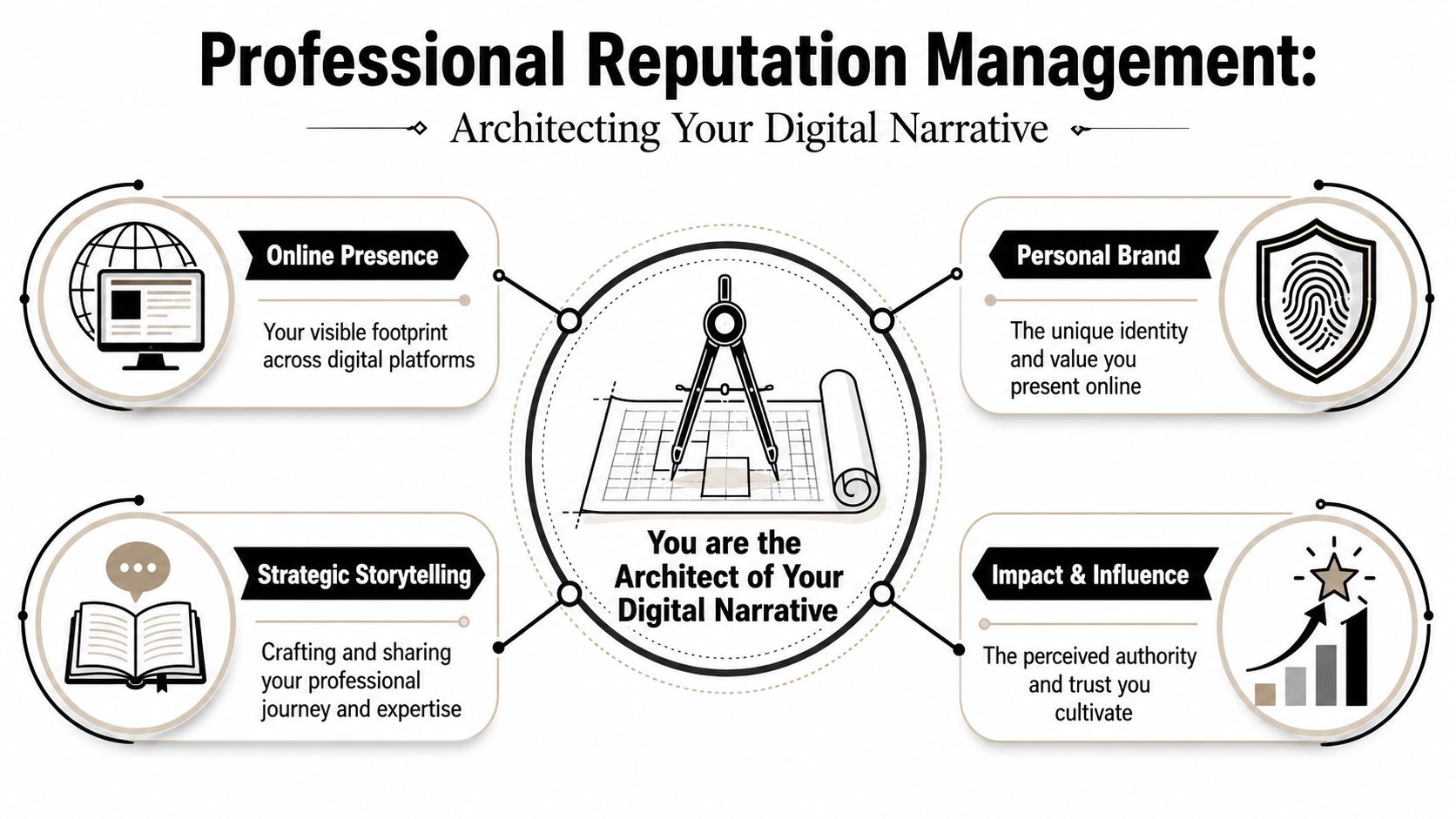
Professional reputation management has two jobs. It creates demand by publishing proof and perspective. It protects demand by correcting errors, responding to public feedback, and addressing misleading content before it shapes perception.
The first job matters more than many founders admit. Reviews influence buying behavior, and a strong reputation can drive materially more inbound interest, as noted in these reputation management statistics. That is why this field keeps growing. Companies do not spend on reputation because it feels nice. They spend on it because trust changes conversion rates, deal velocity, and pricing power.
But raw output is not enough. A lot of executives damage their reputation by scaling content faster than they can keep it honest. Their team posts every day, yet none of it sounds like them. The market notices. Authenticity is not a soft concept here. It is a performance advantage. When your voice is distinct and your message stays consistent across channels, people remember you, refer you, and trust your judgment faster.
That is why professional reputation management should operate like an editorial system with standards, not a panic button. You need clear themes, proof-backed messaging, and a process that keeps your public presence accurate as your company grows. The right support helps you scale without flattening your voice into bland corporate filler.
For a practical benchmark, review these actionable reputation tips for 2025. Use them to pressure-test whether your current presence reflects your actual authority or just fills space.
Reputation doesn't improve because you posted for two weeks and felt productive. It improves when you run a repeatable system. The right model is a loop, not a campaign.
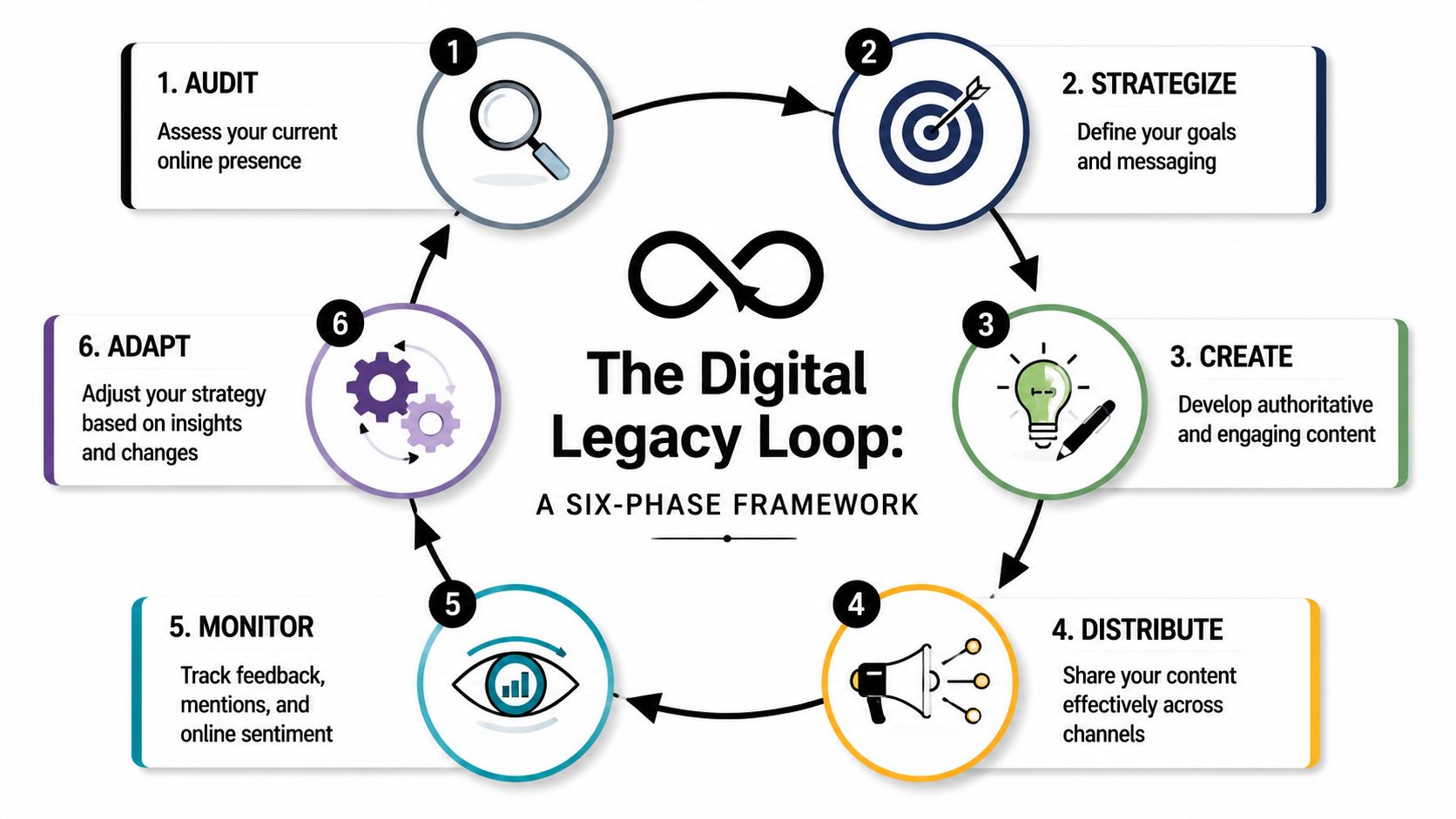
A solid system starts with a baseline, tracks what changes, and routes issues into a response process. That closed-loop approach is the backbone of effective reputation work, as explained in this overview of baseline audits, monitoring, and response workflows.
Audit
Look at reality, not assumptions. Search your name, review your profiles, inspect your search footprint, and note what a stranger would conclude.
Strategize
Decide what you want to be known for. Most founders skip this and end up sounding broad, reactive, and forgettable.
Create
Turn your experience into assets. Articles, founder posts, videos, interviews, profile copy, and viewpoint pieces should all support the same narrative.
A quick walkthrough helps frame the loop in motion.
Distribute
Good content buried on one platform won't shape perception. You need strategic placement across the channels your audience uses.
Monitor
Watch mentions, reviews, branded search results, and audience feedback. If you're not monitoring, you're flying blind.
Adapt
Update the message, the formats, and the platform mix based on what's landing and what's changing around you.
This framework works because each phase feeds the next. Audit reveals the gaps. Strategy gives the gaps meaning. Creation fills them. Distribution gives them reach. Monitoring reveals what needs attention. Adaptation prevents stagnation.
Operational rule: Treat reputation like a revenue system. If there's no owner, no cadence, and no feedback loop, it will drift.
Busy professionals often struggle at the execution layer, not the awareness layer. They know they should do this. They don't have the time or process to do it consistently. That's where a structured service can help. For example, Legacy Builder offers a model built around monthly interviews, ghostwritten content in the client's voice, and consistent publishing, which can support founders who need execution without handing over their identity.
Most founders don't need more motivation. They need a clean diagnosis. If you don't know how your reputation currently appears, strategy turns into guesswork.
Start with the search experience. Open an incognito window and search your name, your company name, and combinations of both. Search the version of your name people use, including shortened forms and common misspellings. Then stop thinking like the subject and start thinking like a stranger with limited patience.
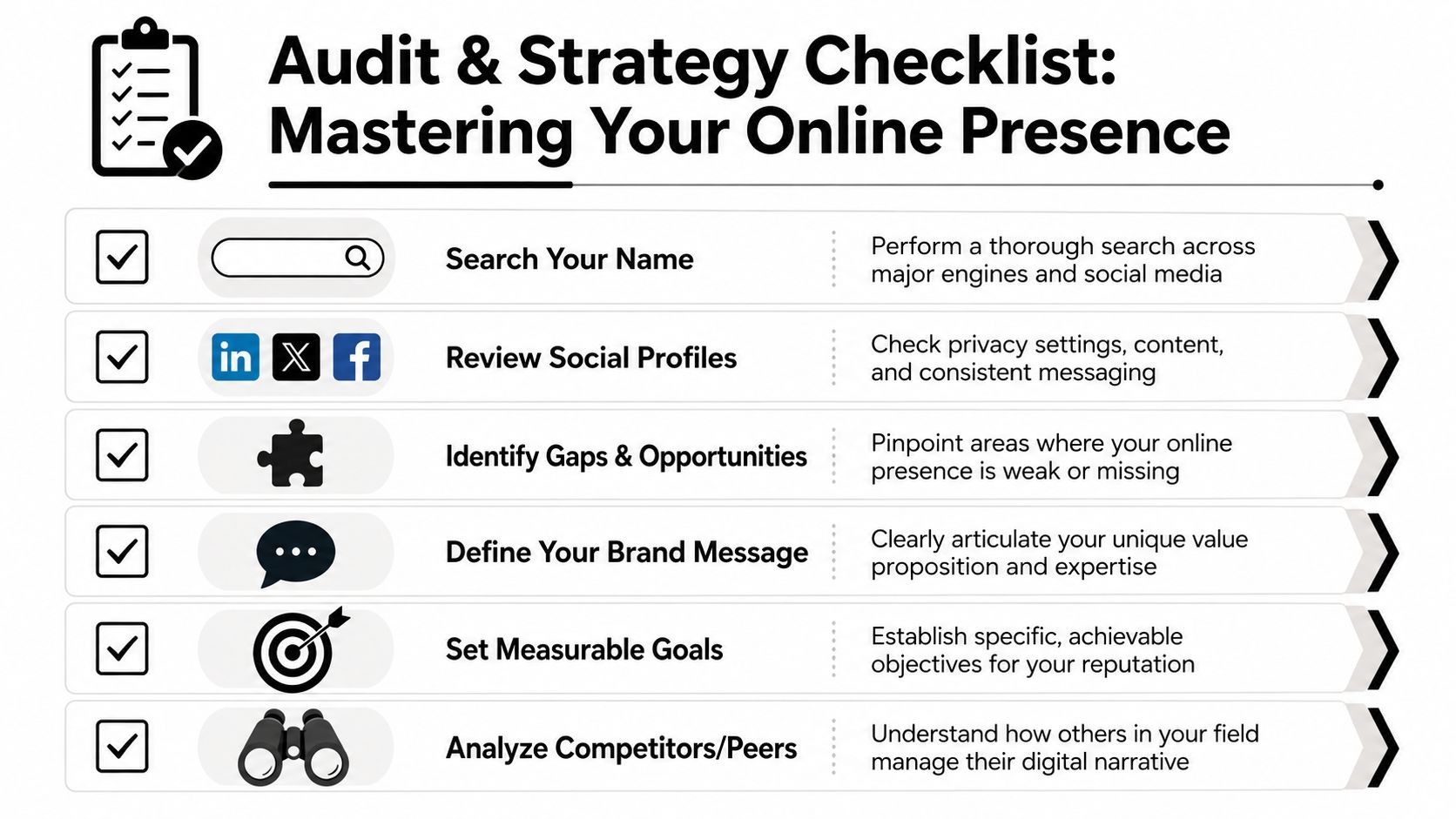
Use this checklist and write down what appears, what's missing, and what feels off.
Search result quality
Are the first results accurate, current, and favorable? Or are they random directories, stale bios, and irrelevant pages?
Profile consistency
Compare LinkedIn, company bio, speaker profile, and social platforms. If each one tells a different story, you don't have a brand. You have fragments.
Authority signals
Do you have visible proof of expertise such as interviews, essays, media mentions, event appearances, or thoughtful posts?
Visual credibility
Check headshots, banners, bios, featured links, and pinned content. People decide quickly whether your presence looks current or neglected.
This is the part many professionals still miss. Search engines aren't the only gatekeepers anymore. AI assistants increasingly summarize people and companies before someone clicks through to a website. That's why modern reputation work now includes an AI Engine Optimization Audit, as outlined in this guidance on how AI platforms shape first impressions.
Ask AI tools to describe you, your business, and your area of expertise. Then inspect the answer. Is it accurate? Is it thin? Does it over-index on old material? If an AI summary sounds generic or confused, your digital footprint is giving it weak ingredients.
If AI tools are summarizing you poorly, the fix usually isn't arguing with the output. The fix is improving the underlying public evidence.
Once the audit is done, decide three things.
First, what you want to be known for. Pick a small set of themes. Not everything. If you try to be known for operations, fundraising, growth, hiring, leadership, product, brand, culture, and AI all at once, you will sound like everyone else.
Second, who needs to trust you. Prospective clients, investors, media, recruits, and peers all look for different signals. A founder raising capital needs a different footprint than a founder selling enterprise services.
Third, where your narrative should live. You don't need to dominate every platform. You need to own the right ones. For many professionals, that means a strong website presence, a polished LinkedIn profile, and one active public channel where ideas are shared consistently.
If you need a practical starting point for tightening those basics, this guide on how to build online presence for beginners is useful because it forces you to get the foundation right before chasing reach.
Founders usually have more authority than their content suggests. The problem isn't lack of insight. The problem is translation. Their best thinking is trapped in meetings, voice notes, client calls, internal memos, and off-the-cuff conversations.
Your job is to convert that raw material into public proof.
Authoritative content doesn't sound polished first. It sounds specific first. Start with the decisions you've made, the mistakes you've corrected, the assumptions you've changed, and the patterns you keep seeing in your market.
That means your content should include things like:
If your content could have been written by any agency for any executive, it won't build reputation. It will only fill a calendar.
Many smart people sabotage themselves. They finally commit to publishing, outsource too aggressively, and start sounding like a corporate ghost. Clean grammar won't save content that feels emotionally fake.
Use this simple filter before publishing:
| Check | Question |
|---|---|
| Voice | Would you actually say this out loud in a meeting? |
| Specificity | Does it include a real point, not just posture? |
| Point of view | Is there a stance, or just safe agreement? |
| Relevance | Does this matter to the audience you want to attract? |
For a useful framework on turning expertise into stronger assets, review this guide to thought leadership content creation.
Content creation gets attention. Distribution builds reputation.
A founder with one excellent article and no supporting footprint is still vulnerable. A founder with aligned content across a website, LinkedIn, social profiles, speaker bios, podcasts, and third-party mentions creates coverage density. That's what helps shape branded search results and reinforces trust across the digital footprint, as explained in this breakdown of coverage density and first-page narrative control.
As with political campaigning, one speech doesn't win; repetition across channels does. Your message needs to appear in different formats, on different surfaces, for different scanning behaviors.
Publish like a human, distribute like a system.
A practical distribution stack often looks like this:
That's how professional reputation management shifts from content marketing into reputation architecture.
A reputation isn't built by broadcasting alone. People trust what they can observe in motion. They watch how you respond, how you disagree, how you handle criticism, and whether your public behavior matches your polished messaging.
That's why engagement matters. Not fake engagement. Not “Thanks for sharing” filler. Real participation.
If you want your reputation to generate opportunities, show up where your audience already pays attention and contribute something useful. Comment on industry posts with an actual argument. Reply to thoughtful questions with specifics. Join discussions where your expertise can clarify, not where your ego can perform.
Here's the simplest test. After someone reads your comment or reply, do they learn something about how you think? If not, you're adding noise, not reputation.
Three habits work well:
Negative feedback is uncomfortable, but it's also revealing. It shows your judgment in public. That's why robotic legalese and defensive non-apologies usually make things worse.
Current guidance on authenticity makes this point clearly. Reputation can be damaged by content that feels overly managed or inauthentic, and some agencies can even “ruin your reputation” if they aren't transparent and client-specific, as noted in this article on reputation management and authentic communication.
When criticism hits, use a simple response sequence:
The goal in a public response isn't to win the argument. It's to show observers that you're credible under pressure.
If you need a more detailed playbook for handling hard moments well, this guide on turning criticism into growth and reputation is a strong operational reference.
Crisis management in professional reputation management is less about spin and more about composure. The founders who come out stronger are usually the ones who respond like adults. Quickly. Clearly. Without theater.
Your reputation already exists. The only question is whether you're shaping it or leaving it to chance.
That's the core shift. Professional reputation management isn't a defensive exercise for people in trouble. It's a forward operating system for people with ambition. It turns your experience into visible authority, your values into trust signals, and your public footprint into something that works while you sleep.
If you're a founder, your reputation does several jobs at once. It pre-sells your credibility. It affects who replies to your outreach. It influences who wants to hire you, partner with you, feature you, or invest in you. It also determines whether your name carries weight beyond the rooms where people already know you.
The strongest reputations don't feel manufactured. They feel coherent. The same person shows up across the website, the profile, the interview, the post, the comment, and the response under pressure. That consistency is what people trust.
Start there. Audit what exists. Tighten your message. Publish what you know. Distribute it with intent. Respond like a human. Then keep going long enough for the internet to catch up with who you already are.
If you want help doing that without outsourcing your voice, Legacy Builder offers a practical model for founders and professionals who need structured content creation, profile optimization, and consistent publishing built around their real story and expertise.


You could – but most in-house teams struggle with the nuance of growing on specific platforms.
We partner with in-house teams all the time to help them grow on X, LI, and Email.
Consider us the special forces unit you call in to get the job done without anyone knowing (for a fraction of what you would pay).
Short answer – yes.
Long answer – yes because of our process.
We start with an in-depth interview that gives us the opportunity to learn more about you, your stories, and your vision.
We take that and craft your content then we ship it to you. You are then able to give us the final sign-off (and any adjustments to nail it 100%) before we schedule for posting.
No problem.
We have helped clients for years or for just a season.
All the content we create is yours and yours alone.
If you want to take it over or work on transitioning we will help ensure you are set up for success.
We want this to be a living breathing brand. We will give you best practices for posting and make sure you are set up to win – so post away.
Subscribe to our newsletter and get insights on how to grow your personal brand.
