.svg)
Subscribe to our newsletter and get insights on how to grow your personal brand.
Thank you! Your submission has been received!
Oops! Something went wrong while submitting the form.
.svg)



Getting hit with negative feedback feels like a punch to the gut. I get it. But learning to handle it the right way is a skill that separates the pros from the amateurs.
The secret isn't a magic script. It’s what you do in the moments before you respond. It's about taking a breath, stepping back, and treating that criticism as raw data—not a judgment on who you are.
That mental flip is everything. It turns a moment of pain into a chance to get smarter.
The real work starts before your fingers ever hit the keyboard. Handling a harsh comment isn't about finding the perfect comeback. It's about building the mental armor to see criticism as unfiltered information, not a personal attack.
Your brain’s first instinct is to see criticism as a threat. That immediate jolt of anger or the urge to fire back a defensive reply? That’s your fight-or-flight response kicking in. It's completely normal.
The key is to not let that instinct drive. Acknowledge the feeling, then deliberately pause.
Here's the most powerful mindset shift you can make: separate your identity from your work.
A critique of your content, your product, or your service is not a critique of you. You are not your business. This simple distinction creates the space you need to look at the feedback without emotion clouding your judgment.
Try this: imagine that comment was left on a competitor's post. What would you tell them to do? Suddenly, the personal sting is gone, and you can see it for what it is—information.
"Negative feedback isn’t a report card on your worth as a professional. It’s a compass pointing you toward areas where you can grow. The feedback that stings the most often holds the biggest opportunities."
This is so critical, especially when you're wrestling with self-doubt. Learning to detach is a core skill that helps you overcome imposter syndrome and build your brand with real confidence. See it as data, and you'll start spotting patterns and fixing blind spots you never knew you had.
Now, let's be real. Just because you need to be open to criticism doesn't mean all of it is valid. Sometimes, the feedback says more about the other person’s own issues or biases than it does about your work.
This is a well-documented problem. For instance, a 2024 report in Fortune showed a huge gap in how feedback is delivered. It found that a shocking 76% of high-performing women get hit with negative, personality-focused feedback. The same was true for just 2% of their male peers.
That kind of vague, biased feedback isn't just unfair; it's useless. Knowing this helps you filter what comes in. It empowers you to recognize when a comment is less about your performance and more about someone else's subjective lens. That awareness lets you decide what's worth your energy and what you can dismiss without a second thought.
So, before you do anything, run through this mental checklist:
Building these habits creates a shield. It protects your confidence but keeps you open to the insights that will actually help you grow. This is the first, and most important, step in mastering feedback.
Okay, you've got the right mindset to handle criticism. But what happens when the comments start pouring in?
Let's be real: responding to every single comment is a one-way ticket to burnout. Not every piece of feedback deserves your time or emotional energy. If you react to everything, you’ll spend your days putting out fires instead of building your brand.
The solution is a triage system. Just like an ER, you need a quick way to sort and prioritize what's coming at you. This isn't about ignoring criticism—it's about learning how to handle negative feedback by filtering the truth from the trolls.
This decision tree is a great place to start. It walks you through a simple process to decide whether to tune out the noise or lean in and learn from what's being said.
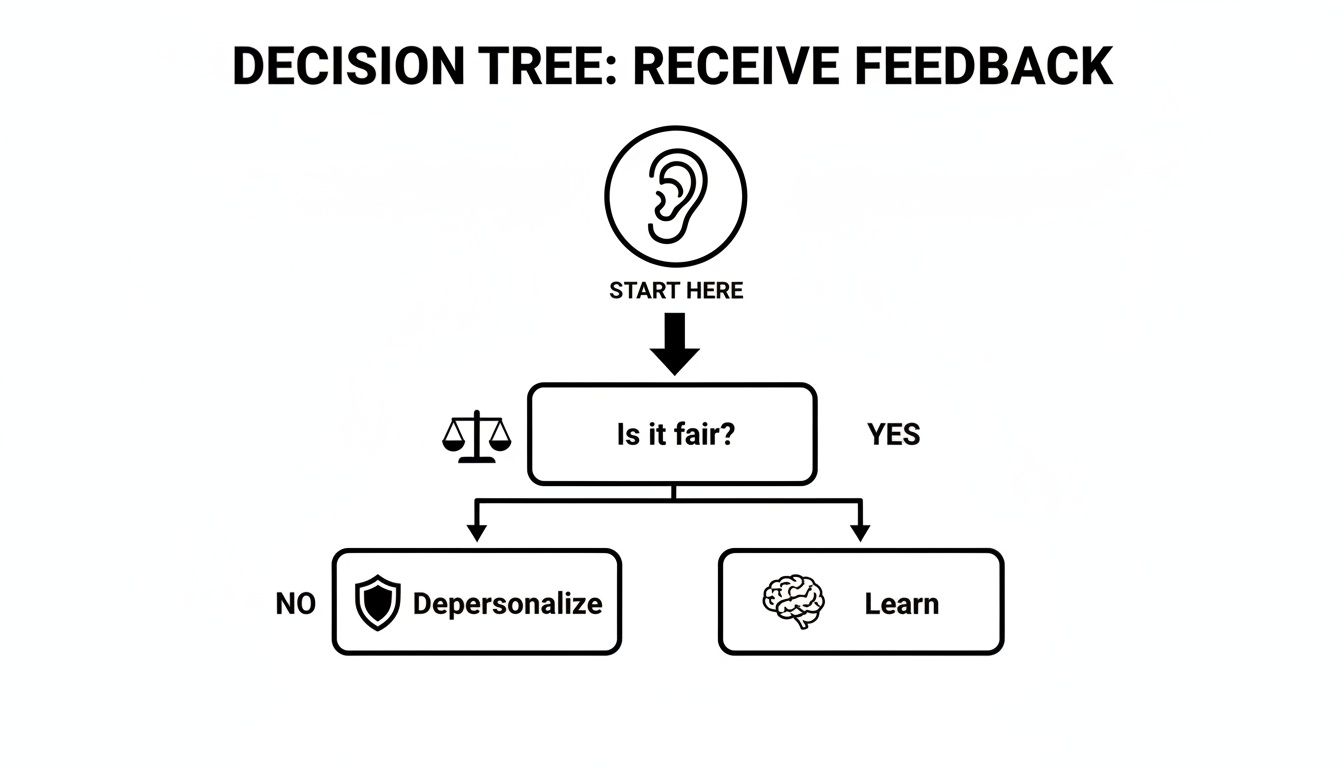
The first question is always: is this fair? If it’s baseless, protect your energy. If it’s fair, your job is to learn from it.
Your first move is to categorize. Every negative comment you get will fall into one of three buckets. Knowing which bucket a comment belongs in tells you exactly how to respond—or if you should respond at all.
This sorting process is your first line of defense. It stops you from wasting an hour arguing with a troll when you could be strengthening a relationship with a real customer.
Once you know the what, figure out the who. The source of the feedback adds critical context.
A complaint from a long-time customer who just had a bad experience carries far more weight than an angry comment from an anonymous profile with no followers.
What’s their intent? Are they genuinely trying to get help, or are they just trying to start a fight? A customer with a product issue is looking for a solution. Someone slinging insults is looking for attention.
This is especially true for internal feedback. Unhappy employees often take their grievances public—in fact, 33% of employees admit to posting negative comments about their company online. Those comments can do serious damage to your reputation and your ability to hire good people. As you can read more about how employee feedback trends are shaping workplaces, you'll see why it's so important to get this right.
To make this dead simple, I use a matrix to quickly categorize feedback and decide on the next step. It removes the emotion and gives you a clear, logical path forward.
Use this matrix to quickly categorize incoming negative feedback and determine the appropriate course of action.
| Feedback Type | Characteristics | Recommended Action |
|---|---|---|
| Constructive | Specific and actionable feedback from a legitimate user or customer. They point out a real flaw or area for improvement. | Engage & Learn. Prioritize this. Respond publicly to acknowledge, then take it to DMs or email to solve it. |
| Misguided | Based on a misunderstanding or incomplete information. Not malicious, just incorrect. | Educate & Clarify. Respond publicly with helpful information. Turn their question into a teachable moment. |
| Trolling | Vague, personal attacks from anonymous or hostile accounts. No substance, just designed to provoke. | Ignore & Monitor. Do not engage. Block or mute freely. Giving them attention is like throwing fuel on a fire. |
By applying a simple framework like this, you shift from reacting emotionally to responding strategically. You’ll know exactly what to do, ensuring your energy goes where it matters most: turning valuable criticism into real growth.
Alright, you’ve sorted through the feedback. Now comes the moment of truth: crafting a response that protects your reputation and actually shows you’re listening. Where the comment lands—publicly on social media or privately in your inbox—changes everything.
This isn’t just damage control. It's a massive opportunity to show what your brand is really made of. Think about it: research shows a staggering 94% of consumers admit a bad review has scared them away from a business. But a solid, thoughtful response can flip that script entirely, turning a critic into a fan.
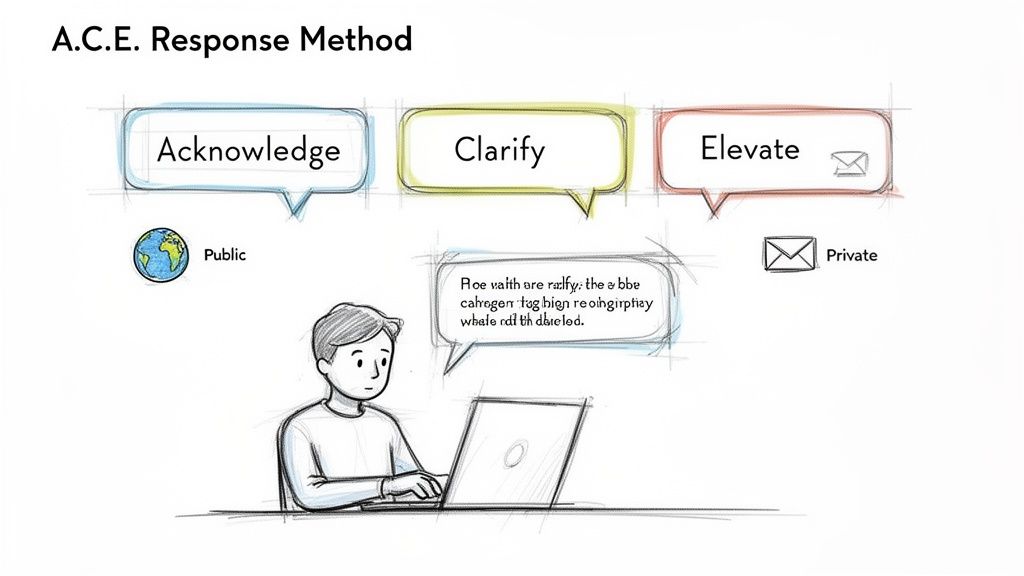
When criticism hits a public feed, your audience is everyone, not just the person who left the comment. The game plan is simple: de-escalate the tension and get the conversation offline. Fast.
For this, I swear by the A.C.E. method: Acknowledge, Clarify, and Elevate.
This simple three-step process shuts down a public back-and-forth, which almost never ends well. It shows everyone watching that you're accountable, but lets you solve the real problem one-on-one. Mastering how to handle an upset customer in public is a non-negotiable skill for brand survival.
Once you're in the DMs or email, the tone shifts. Now it's personal and all about finding a solution. Empathy is your superpower here. The person on the other side is just frustrated and wants to be heard.
Start by repeating their problem back to them in your own words. This is a game-changer. It proves you actually read and understood their message. "I understand you're frustrated that the report was late and was missing the specific data you needed." See? You get it.
Next, tell them exactly what you’re doing to fix it. Get specific. "We'll look into it" is weak. Try this instead: "I've already talked to the project manager about the delay, and I'll have an updated report with the correct data in your inbox by 3 PM today."
Expert Tip: Never, ever make a promise you can't keep. It's always better to under-promise and over-deliver. If you think a fix will take 48 hours, ask for 72. Delivering early builds massive trust; delivering late shatters it.
Finish by thanking them again for the feedback and letting them know it helps you improve. This closes the loop on a positive note and turns a complaint into a genuinely constructive moment. Honestly, a lot of these same ideas are crucial for effective workplace conflict resolution, which is all about listening to find a path forward. https://www.legacybuilder.co/blog/10-effective-workplace-conflict-resolution-strategies-for-leaders-in-2025
Let's put this into practice.
Scenario 1: A Vague Public Complaint
Scenario 2: A Specific Private Complaint
This playbook gives you a way to handle negative feedback that's both structured and authentic, protecting your brand while making customer relationships even stronger.
Most people see a negative comment and their first instinct is to panic. Delete. Block. Ignore.
I see free market research.
Instead of treating a complaint like a fire you need to put out, you should see it for what it is: a signpost pointing directly to your audience’s real problems. This is the moment you stop playing defense and start using feedback as a powerful engine for your brand.
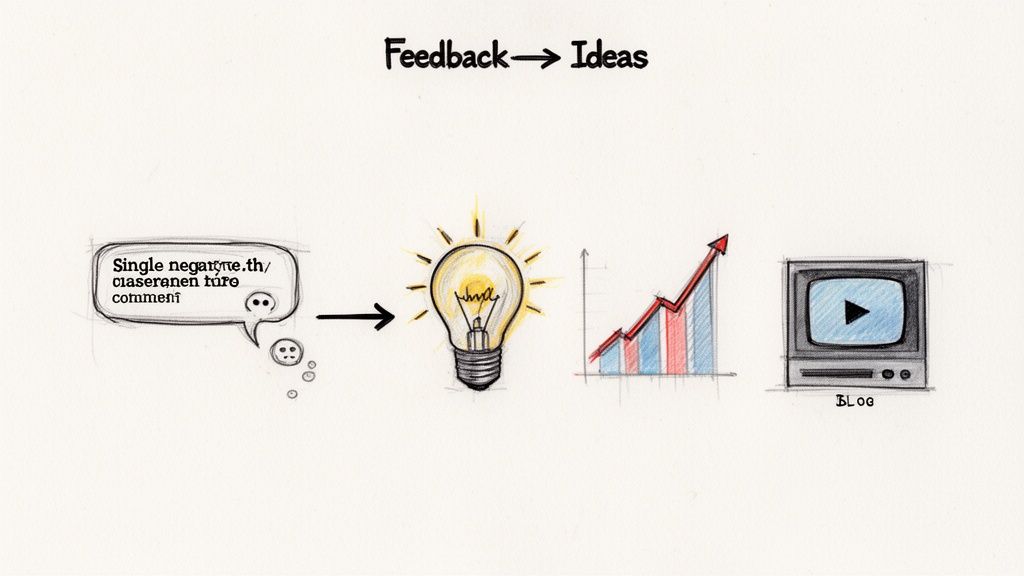
When you actually start listening, one unhappy DM can spark your next viral video or a game-changing update to your offer. It's how you go from just fixing problems to building a brand that people trust because you’re constantly getting better.
Your audience is telling you exactly what content to create. You just have to pay attention. Look for the patterns in your DMs, email replies, and comments. Every bit of feedback is a content idea in disguise.
Let's get practical. Think about these scenarios:
When you build a system for this, you create a direct pipeline from customer problems to business solutions. You stop guessing what your audience wants and start giving them what they've already asked for.
This isn't just about PR. It's about knowing how to handle customer complaints and turn negative feedback into loyal customers, turning your biggest critics into your most vocal fans.
Don't let valuable feedback vanish into the ether after you've replied. The real magic happens when you collect and analyze it over time. One comment might just be an outlier. Five comments about the exact same thing? That’s not a problem—it’s an opportunity.
This applies to your team, too. When your employees don't feel heard, they check out. A Gallup poll found that a staggering 80% of employees who feel their negative feedback is ignored start looking for another job. Only 10% stay engaged. Think about the cost of not listening.
You need a simple system to turn all this feedback into fuel. Here’s what we do:
When you’re just getting started, a few DMs and comments are easy to handle. But as you grow, that small trickle of feedback can turn into a firehose overnight.
If you’re just winging it, you’re going to burn out. Worse, you'll miss the gold hidden inside that feedback.
An ad-hoc approach just doesn't work at scale. You need a system. A real, repeatable workflow ensures every comment gets handled the right way, protecting your brand while giving you the insights you need to get better.
First thing's first: you need to assign roles. When everyone on the team knows exactly what they're responsible for, nothing slips through the cracks. For most brands, this breaks down into three core jobs.
The Monitor: This is your eyes and ears. This person is on the front lines, actively tracking mentions of your brand everywhere—social media, forums, review sites, you name it. Their one job is to catch feedback the moment it appears.
The Responder: Once the Monitor flags something, the Responder takes over. This person is your voice. They know your brand inside and out and are trained on your response playbook (like the A.C.E. method we talked about). They handle all the direct communication, public or private.
The Analyst: This is the strategist. The Analyst takes all the feedback logged by the Monitor and Responder and starts connecting the dots. Their job is to find the patterns and turn raw complaints into powerful business intelligence.
This isn't just about managing how to handle negative feedback more efficiently. It's about turning a defensive task into an offensive strategy. You’re not just putting out fires—you’re using the smoke signals to find and fix the weak points in your business.
Feedback is worthless if it's scattered across ten different platforms and a dozen private inboxes. You need a single source of truth—one central place where every important piece of feedback lives.
This doesn't have to be some complex, expensive software. A simple shared spreadsheet, a Trello board, or even a dedicated channel in Slack can do the trick. The point is to have one spot where your Analyst can see everything at a glance.
For every piece of feedback you log, make sure you capture:
This central hub is what lets you graduate from reacting to individual comments to solving systemic problems. It transforms a bunch of isolated complaints into a dataset you can use to make real, long-term improvements.
Let's be clear: you need a non-negotiable policy for what you will not tolerate.
A block-and-delete policy isn't about silencing valid criticism. It’s about protecting your community and your team from spam, hate speech, and genuine abuse. This isn't censorship; it's basic moderation.
Your policy needs to be dead simple, public, and enforced 100% of the time. This gives your team the clarity and confidence to act fast when someone crosses the line.
Put up a "Community Guidelines" page on your website or a pinned comment on your social profiles. State that you encourage constructive feedback but will immediately remove anything that contains spam, personal attacks, hate speech, or illegal content.
This is what empowers your team to keep the space safe and productive. They can delete the garbage without getting dragged into pointless arguments, keeping the conversation focused on what actually matters.
Even with the best playbook, you're going to hit some tricky situations. Negative feedback is messy, and when you're in the hot seat, the right move isn't always obvious. Let's cut through the theory and get straight to what you should actually do.
Let me be clear: you should absolutely delete comments that are blatant hate speech, spam, personal attacks (like doxxing), or completely off-topic rants. You need to protect your space.
But—and this is a big but—never delete a comment just because it’s critical of you or your work. That’s a fast track to losing all trust. People will call you out for censorship, and the situation will blow up. I've seen it happen time and time again.
Your best move is to have a simple, public comment policy. That way, when you remove something, you can point to a specific rule it broke. You're not deleting it because you're mad; you're deleting it because they broke the house rules.
Ah, the classic "your service is terrible" comment. It's frustrating because you can't do anything with it.
Your gut reaction might be to get defensive or ignore it. Don't. Instead, meet it with a calm, public request for more info.
Something like: "Sorry to hear you had a bad experience. To help me understand what went wrong, could you share a few more details? Feel free to reply here or shoot me a private message."
This does three things at once:
If they ghost you, you still look like the professional. If they reply with details, you just got free, valuable insight. It’s a win-win.
The channel you use depends on your goal. It’s a strategic choice, not an emotional one.
Public responses are for damage control and accountability. When you reply on a social media thread, you’re not just talking to one person—you’re talking to everyone who will ever see that comment. A good public reply de-escalates the tension and shows your entire audience you’re on top of things. You're controlling the narrative.
Private responses are for actually solving the problem, especially when it involves sensitive information like an order number, email, or account details.
The real pro move is a hybrid approach. Start public, then move it to private. It looks like this: "So sorry you're running into trouble with your order. I just sent you a DM to get your details so we can get this sorted out for you right away."
You’ve shown public accountability, but you’ve taken the messy back-and-forth out of the spotlight.
If you want better feedback, you have to ask for it. Don’t just wait for people to drop comments. You need to build dedicated channels and guide them.
Here are a few ways to get proactive:
And don't just ask, "What do you think?" That's too broad. Ask pointed questions like, "What's one thing we could add that would make this indispensable for you?"
When someone gives you a great idea, shout them out. Feature their suggestion. Show people you’re not just listening—you’re acting on what they say. This trains your audience to give you the gold.
Managing feedback is a core part of building a resilient personal brand that people trust. At Legacy Builder, we turn your expertise into content that builds that trust and makes you the go-to authority in your space.
If you're ready to stop guessing and start building a powerful online presence, we should talk.
Discover how Legacy Builder can amplify your voice and grow your influence.


You could – but most in-house teams struggle with the nuance of growing on specific platforms.
We partner with in-house teams all the time to help them grow on X, LI, and Email.
Consider us the special forces unit you call in to get the job done without anyone knowing (for a fraction of what you would pay).
Short answer – yes.
Long answer – yes because of our process.
We start with an in-depth interview that gives us the opportunity to learn more about you, your stories, and your vision.
We take that and craft your content then we ship it to you. You are then able to give us the final sign-off (and any adjustments to nail it 100%) before we schedule for posting.
No problem.
We have helped clients for years or for just a season.
All the content we create is yours and yours alone.
If you want to take it over or work on transitioning we will help ensure you are set up for success.
We want this to be a living breathing brand. We will give you best practices for posting and make sure you are set up to win – so post away.
Subscribe to our newsletter and get insights on how to grow your personal brand.
