.svg)
Subscribe to our newsletter and get insights on how to grow your personal brand.
Thank you! Your submission has been received!
Oops! Something went wrong while submitting the form.
.svg)


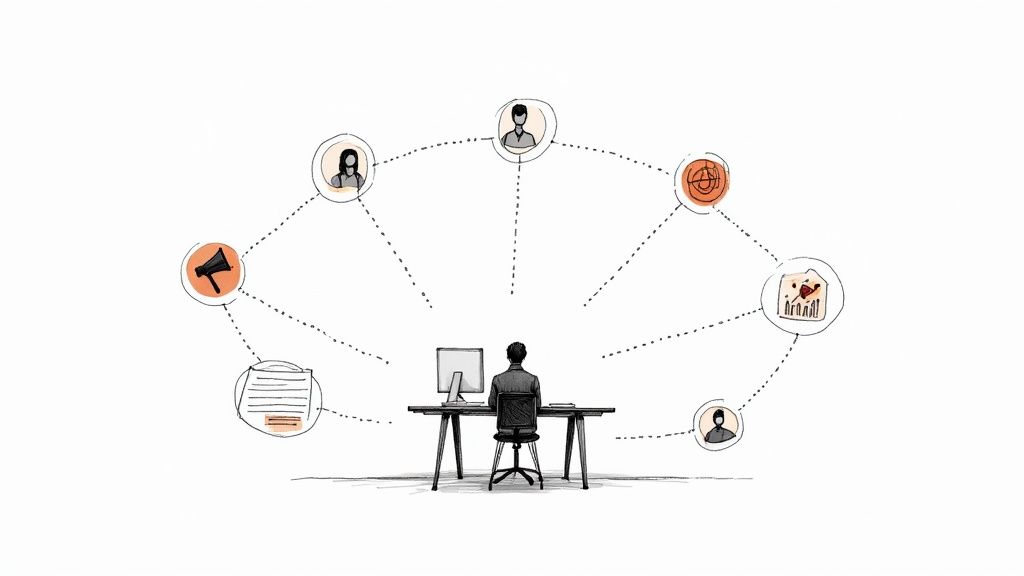
So you want to build a powerful online presence? Let's get one thing straight: it's not about just posting more often or shouting into the digital void and hoping someone listens.
It’s about strategically building a digital identity that actually connects with the right people. This whole process is about defining what makes you different, getting crystal clear on who you're talking to, and then showing up on the right platforms to build real relationships.
Think of this as your personal roadmap to building a presence that’s not just visible, but valuable and completely authentic to you.
Most people get this wrong. They think building an online presence just means posting on social media every day. While consistency is definitely part of the puzzle, a real strategy goes way deeper.
It's about building a cohesive digital ecosystem. Every single piece—from your LinkedIn bio to your website's homepage—should work together to tell a clear, compelling story about who you are and the value you bring to the table.
I like to think of it like building a house. You wouldn't just start throwing up walls without a blueprint, right? The same goes for your online brand. You need a plan that outlines your goals, defines your audience, and details the specific moves you'll make to win.
This is what separates random acts of content from intentional, effective brand-building.
To get you started, let's break down the foundational pillars of any online presence that actually gets results. Nail these, and you'll have a focused, sustainable strategy that drives real growth over time.
A strong online presence is a direct reflection of your visibility, credibility, and reputation. Without it, you’re just another faceless name in an incredibly crowded space. The real goal is to build authority and become the go-to resource in your niche.
This guide is built to turn these big ideas into small, actionable steps. We're going to forget about vanity metrics like follower counts and focus on what actually moves the needle: building real connections and establishing yourself as a credible authority.
If you want to go even deeper on this, the next logical step is understanding exactly how to build authority online. You can learn more about that here: https://www.legacybuilder.co/authority
To create a truly holistic presence, you need to think about every single interaction someone could have with your brand. Seriously, every single one. Exploring these 50 essential brand touchpoints is a great way to make sure you're not leaving any opportunities on the table.
This table breaks down the core pillars into a simple, at-a-glance framework.
Think of this as the foundation. With these pillars in place, you’re ready to build a presence that not only gets attention but also commands respect.
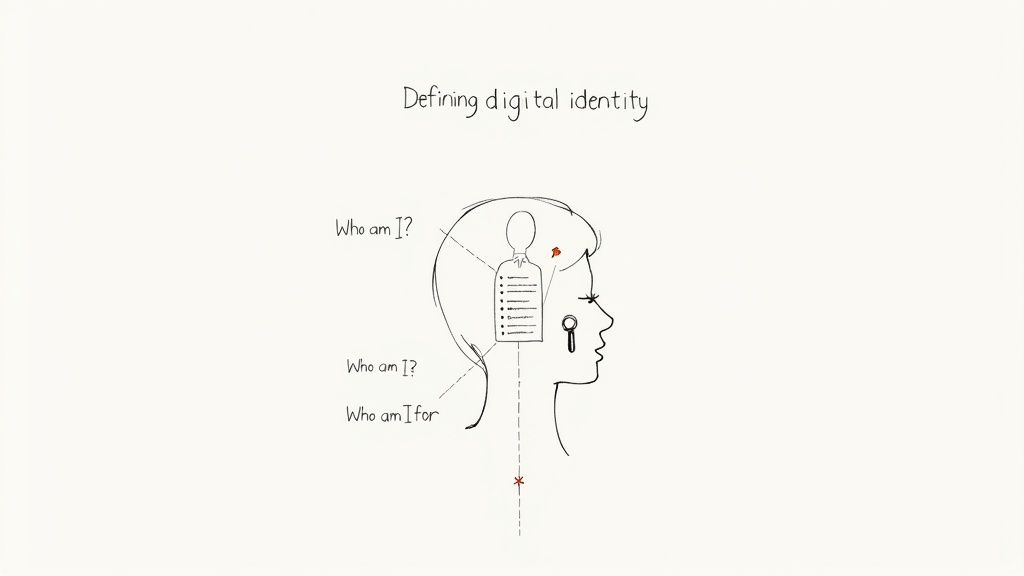
Before you ever write a post or tweak your bio, you have to nail down the answers to two simple but critical questions: “Who am I online?” and “Who am I speaking to?”
This isn't some fluffy branding exercise—it's the strategic bedrock for everything you're about to do. Get this wrong, and every effort to build a presence will feel disconnected and ultimately fall flat.
Your digital identity is where your expertise, personality, and the value you provide all meet. It’s what makes your voice stand out in a ridiculously crowded room. It’s the reason someone follows you instead of the thousand other people in your space.
This isn’t about inventing a persona. It’s about amplifying the most compelling parts of who you already are. It's about deciding on the one or two things you want to be known for and then weaving a consistent story around them.
Think of your core message as your North Star. It’s the central theme that guides every single piece of content you create. To find it, you have to get real about your unique value.
Put it this way: what specific problem do you solve? When someone lands on your profile, they need to get it in seconds. A vague mission like "helping people succeed" just won't cut it. It’s noise.
Get specific. Are you helping SaaS founders slash churn with killer email campaigns? Or are you coaching new managers on how to lead their first team without faking it? The sharper your focus, the more magnetic your presence becomes.
To get this locked in, ask yourself:
Defining your digital identity isn't about being perfect; it's about being specific. A sharp, focused identity attracts the right people and repels the wrong ones—which is exactly what you want.
Once you know who you are, it’s time to get crystal clear on who you're talking to. The classic mistake is trying to appeal to everyone. When you talk to everybody, you end up connecting with nobody. The real key is to build a detailed persona of your one ideal follower.
And I’m talking about more than just demographics. You need to get inside their head—their hopes, fears, motivations, and what frustrates them day-to-day. What’s keeping them up at night? What are the "stupid questions" they're too embarrassed to ask anyone else? Your content needs to be the answer to those unspoken needs.
Research shows that a whopping 97% of consumers go online to research local businesses and services. That same behavior applies to personal brands; people are actively looking for experts to solve their exact problems.
Let’s say you’re an expert in project management for creative agencies. Your ideal audience persona might be "Creative Director Chloe":
Boom. Now, every single thing you create is for Chloe. You’re not guessing what to post anymore. You’re building a library of resources to solve her specific problems, making your content feel personal and hyper-relevant.
The cornerstone of building a resonant online presence is truly understanding who you're trying to reach. For a deep dive on this crucial step, check out this guide on how to identify your target audience. This process turns your strategy from a shot in the dark to a well-aimed arrow, ensuring your message hits the people who need to hear it most.
Alright, you've done the hard work of figuring out who you are and what you stand for. Now it's time to make sure the rest of the world sees it.
Think of your online profiles and website as your digital storefronts. They're open 24/7, and when someone new stumbles upon you, they’re making a snap judgment in seconds.
This is where the rubber meets the road. Every single element—your bio, your profile picture, your cover photo—needs to be laser-focused on grabbing the attention of your ideal audience and telling them exactly what you're about. If your message is all over the place, you're creating confusion. Confusion kills trust, and you've lost before you even hit "publish" on your first post.
Your social media bio is your elevator pitch. You have about three seconds to convince a complete stranger that you're worth their time.
Vague fluff like "passionate marketer" or "business enthusiast"? It's a total waste of digital real estate. Get specific. Get sharp. Your bio needs to answer three questions, instantly:
Let's break it down. A generic bio says, "Helping businesses grow." An optimized one says, "I help early-stage SaaS founders slash churn by 20% using battle-tested email strategies." See the difference? The second one is a magnet for the right people and a filter for the wrong ones. That's the goal.
Your social media profile isn't a resume; it's a billboard. Its one job is to attract the right people by screaming, "I solve this problem for you."
The opportunity here is massive. By 2025, there will be an estimated 5.42 billion people on social media, and the average person is active on 6.83 different networks each month. It's no wonder that 86% of marketers still count on platforms like Facebook for visibility. If you want to dig into the numbers, these social media statistics show just how big the playground is.
Social media is great for getting discovered, but your personal website is the only piece of online real estate you actually own.
It's your home base. Here, you control the story, build authority without fighting an algorithm, and turn casual followers into dedicated clients or subscribers. It’s your turf, your rules.
Stop thinking of your website as a static online resume. It needs to be a dynamic resource that works for you.
Last but not least, make sure your brand looks and feels the same everywhere. A consistent, professional look makes you instantly recognizable and reinforces that you're the real deal.
This isn't just about looking pretty. This level of detail shows you're intentional and serious. It’s the final polish that transforms a random collection of profiles into a powerful, unified digital presence that gets results.
Content is the engine that drives your online presence. Simple as that. Without it, even the most polished profiles just sit there collecting digital dust.
The problem is, most people’s “strategy” is just scrambling for an idea and posting on the fly. That’s a one-way ticket to burnout and getting zero results. A powerful online presence isn’t built on random bursts of creativity—it’s built on a sustainable system.
The goal here is to stop being a reactive content creator and become a strategic one. It's about building a simple, repeatable process so you always know what to post, when to post, and how to squeeze every last drop of value out of each idea. You’ll end up working smarter, not harder.
This is how you keep your entire digital footprint—from social media to your website—active, cohesive, and actually working for you.
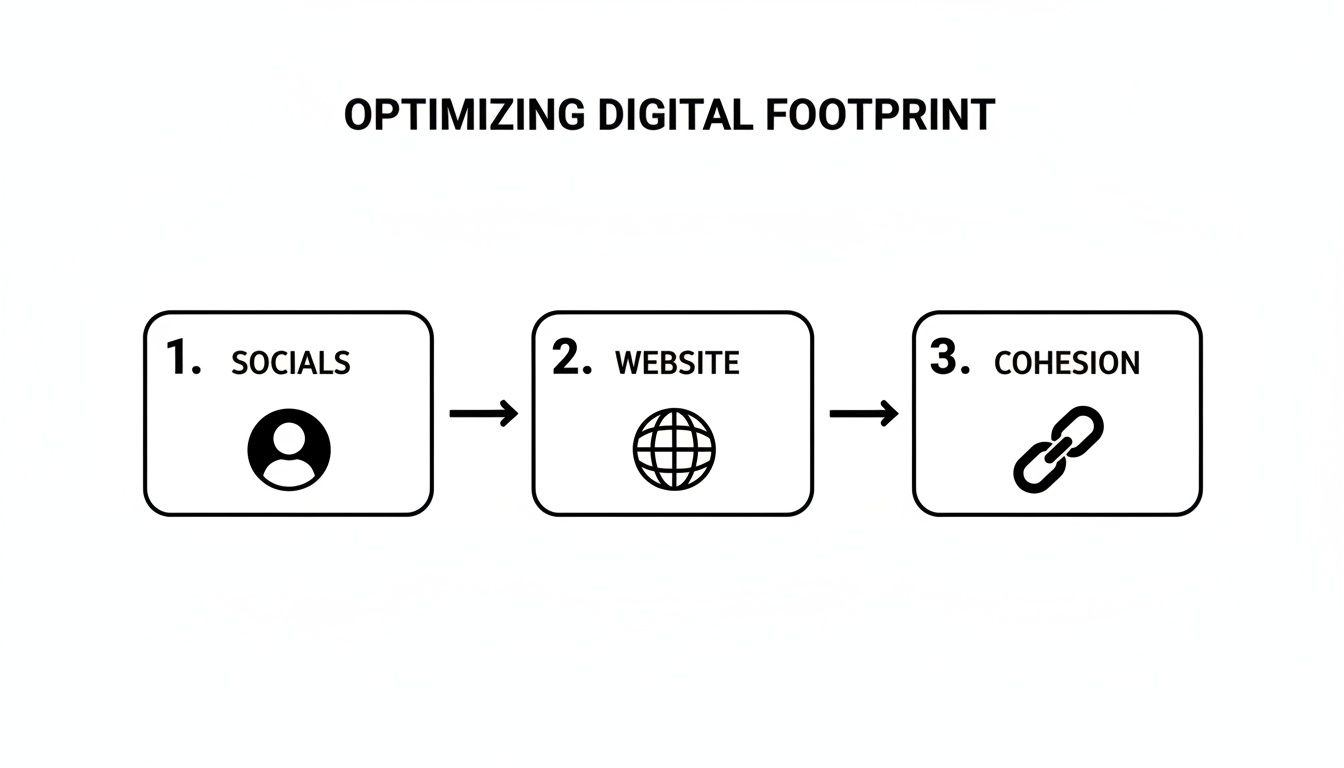
The image above nails the flow: start with your social profiles, drive traffic to your website, and make sure the message is consistent everywhere. You can only pull that off with a solid content system in place.
You should never have to stare at a blank page wondering what to write about. Ever.
The fix? Establish 3-5 core content pillars. These are the big-picture themes you’ll talk about over and over again. They should come directly from your expertise and the burning questions your audience has.
Think of these as the main support columns for your entire content strategy. For a marketing consultant focused on e-commerce, the pillars might be:
Every single piece of content you create should tie back to one of these pillars. This makes creating content a breeze, but more importantly, it trains your audience on what you’re all about. It’s how you become the go-to expert in your niche.
A sustainable content system isn't about having endless new ideas. It's about having a framework that turns a few great ideas into a consistent stream of valuable content.
Content batching is a total game-changer. It’s the simple idea of creating a bunch of content in one dedicated session.
Instead of the daily grind of writing, designing, and scheduling a post, you block out a few hours once a week or even once a month and knock it all out. This lets you get into a deep creative flow without the constant context-switching that absolutely kills productivity and drains your mental energy.
A simple batching day could look like this:
Boom. In a single focused day, you’ve got a month of content ready to roll. This frees you up to spend the rest of your time actually engaging with people and building your community—which is where the real growth happens.
Here’s the biggest mistake I see people make: they treat their content like it’s a disposable, one-and-done asset.
The best creators operate with a "create once, distribute forever" mindset. They understand that a single great idea can be sliced, diced, and repurposed into dozens of different pieces of content for different platforms. If you want a deep dive on how to build out a full-blown content machine, you should check out our guide on developing your content strategy.
This is how you multiply your output without multiplying your effort. Here’s exactly how it works:
This is the system that lets you stay present and valuable across multiple platforms without having to reinvent the wheel every single day. It’s the key to maintaining a high-quality, high-frequency posting schedule that builds unstoppable momentum.
Look, just pumping out content is only half the job. Honestly, it's the easier half. The real work—and where the magic happens—is turning that content into a conversation.
A killer online presence is built with your community, not just broadcasted at them. It’s a two-way street. You have to give as much as you get.
This is where you need to shift your mindset from being a publisher to a community builder. Your goal isn't just to post and ghost. It's to spark discussions, ask good questions, and actually respond to people in a way that makes them feel heard. That’s the line between having followers and building a loyal tribe.
Engagement isn't just dropping a quick "thanks!" on a comment and calling it a day. It's about adding real value to the conversation.
When someone takes the time to comment, see it as an opportunity. Ask them a follow-up question. Share a resource you think they'd find helpful. Offer a new angle on the topic.
Think of it like hosting a dinner party. You wouldn't just serve the food and then disappear into the kitchen, right? Of course not. You'd mingle, make sure everyone's talking, and connect people. Your online space should feel just like that—a place where people want to hang out.
Here are a few simple ways to get the ball rolling:
Meaningful engagement is the currency of trust online. Every thoughtful reply and genuine interaction is a deposit into your brand's reputation, building loyalty that algorithms can't measure.
If you're not tracking your efforts, you're flying blind. But it's easy to get lost in a sea of numbers and analytics.
Vanity metrics—like your raw follower count—might give you a nice ego boost, but they don't tell you if what you're doing is actually working. They don't pay the bills.
You need to lock in on the metrics that signal a real connection with your audience. These are the numbers that tell you what's hitting the mark and what's falling flat, so you can double down on your winners.
Key Metrics to Track:
This data-backed approach is non-negotiable. Why? Because SEO is still the heavyweight champion, driving 93% of all website traffic. And get this—an incredible 97% of people check out a company's online presence before ever stepping foot in their physical location. With the digital marketing space expected to blow past $786.2 billion by 2026, you can't afford to just guess. If you're not convinced, check out these digital marketing statistics to see the full picture.
The ultimate goal here is to build a powerful feedback loop. It goes like this: You post content, you measure the engagement, and you use those insights to decide what you'll create next.
Suddenly, your audience becomes a co-creator in your content strategy.
For instance, you post about a specific software tool and the comments and DMs blow up with questions. That's not an accident; it's a signal. Your audience is literally telling you what they want more of.
This is how you get out of the content guessing game and start creating things you know will land.
And for those of you ready to turn all this engagement into real business, our guide on generating high-quality leads is the perfect next step.
Jumping into building an online presence can feel like you’re staring at a blank map. You hear conflicting advice everywhere, see people who seem to blow up overnight, and it's easy to feel stuck before you even start.
Let’s cut through the noise. I'm going to tackle the questions I hear most often and give you straight answers—no fluff. This is about setting you up with the right expectations so you can move forward with confidence.
This is the million-dollar question, isn't it? The honest answer: building something that lasts is a marathon, not a sprint. You can definitely start seeing some real traction within 30-90 days if you're consistent, but creating a strong, authoritative presence that actually works for you? Plan on 6 to 12 months.
Your timeline depends on a few things: how crowded your niche is, the quality of your content, and most importantly, how consistently you show up. Don't let a slow start get you down. The people who win are the ones who build sustainable habits, not the ones who burn out after a few weeks of intense effort.
Building a real online presence is about consistency over intensity. The goal isn't a one-week sprint you can't sustain; it's a system you can run for a year. That "overnight success" you see is almost always the result of years of quiet, consistent work behind the scenes.
Here’s a realistic breakdown of what that journey looks like:
Absolutely not. Please don't do this. It's one of the fastest ways to burn out and get zero results for your effort. Trying to be everywhere means you'll end up being mediocre on all of them.
The smart move? Pick one or two platforms where your target audience actually hangs out and pour all your energy there.
Are you a B2B consultant trying to connect with executives? LinkedIn is your world. A visual artist or a chef? Instagram and Pinterest are where you need to be.
Get really good at one platform first. Learn its quirks, build a real community, and create a content system you can actually stick with. Once you've got that dialed in, then you can think about expanding somewhere else. Depth on one or two key channels will always crush a shallow presence across ten.
I get this one a lot. It feels like a trick question, but the real answer is a balance between the two, with one rule that you can never, ever break: consistency.
You can’t just shovel out low-value, generic posts and expect to win. That’s a surefire way to damage your reputation and teach people to ignore you.
But on the flip side, spending a month creating one "perfect" masterpiece isn't going to work either. The algorithms will forget you exist, and your audience will find someone else to listen to.
The key is to define what "high quality" means for you and then deliver it on a reliable schedule. High quality doesn't mean a Hollywood-produced video every time. It could be a simple, well-researched post that gives your audience one clear, actionable takeaway.
Aim for a steady stream of that kind of valuable content. That powerful combo—great insights delivered on a predictable schedule—is what builds trust, establishes you as an authority, and creates an online presence that people actually rely on.
At Legacy Builder, we turn your expertise into a powerful, consistent online presence—without the burnout. We handle the content and the strategy, so you can focus on what you do best. Discover how we can build your legacy online.


You could – but most in-house teams struggle with the nuance of growing on specific platforms.
We partner with in-house teams all the time to help them grow on X, LI, and Email.
Consider us the special forces unit you call in to get the job done without anyone knowing (for a fraction of what you would pay).
Short answer – yes.
Long answer – yes because of our process.
We start with an in-depth interview that gives us the opportunity to learn more about you, your stories, and your vision.
We take that and craft your content then we ship it to you. You are then able to give us the final sign-off (and any adjustments to nail it 100%) before we schedule for posting.
No problem.
We have helped clients for years or for just a season.
All the content we create is yours and yours alone.
If you want to take it over or work on transitioning we will help ensure you are set up for success.
We want this to be a living breathing brand. We will give you best practices for posting and make sure you are set up to win – so post away.
Subscribe to our newsletter and get insights on how to grow your personal brand.
