.svg)
Subscribe to our newsletter and get insights on how to grow your personal brand.
Thank you! Your submission has been received!
Oops! Something went wrong while submitting the form.
.svg)



Most personal branding advice is wrong because it treats visibility as the finish line. “Post consistently” sounds practical, but consistency without positioning, audience interaction, and a path to conversion only creates a busier feed. A strong personal branding strategy for social media should make the right people understand what you do, trust your judgment, and take the next step.
I've seen founders spend months collecting likes from people who would never buy, refer, or partner with them. The problem wasn't effort. It was measurement. Your profile, content, comments, and direct messages should work as a connected business-development system, not as a public scrapbook of professional activity.
Your social profile probably resembles a digital resume. It lists your title, experience, services, and accomplishments, then waits for the right person to notice. That approach made sense when online reputation depended mainly on being discoverable. It fails now because social platforms distribute active participation, not static credentials.
Personal branding moved through three major phases: a static phase from 1995 to 2005, a social phase from 2005 to 2015, and an algorithmic phase from 2015 to the present, as documented in this history of personal branding and social media. LinkedIn launched in 2003, followed by Facebook, Twitter, and Instagram, creating public infrastructure for broadcasting expertise, building networks, and managing reputation at scale.
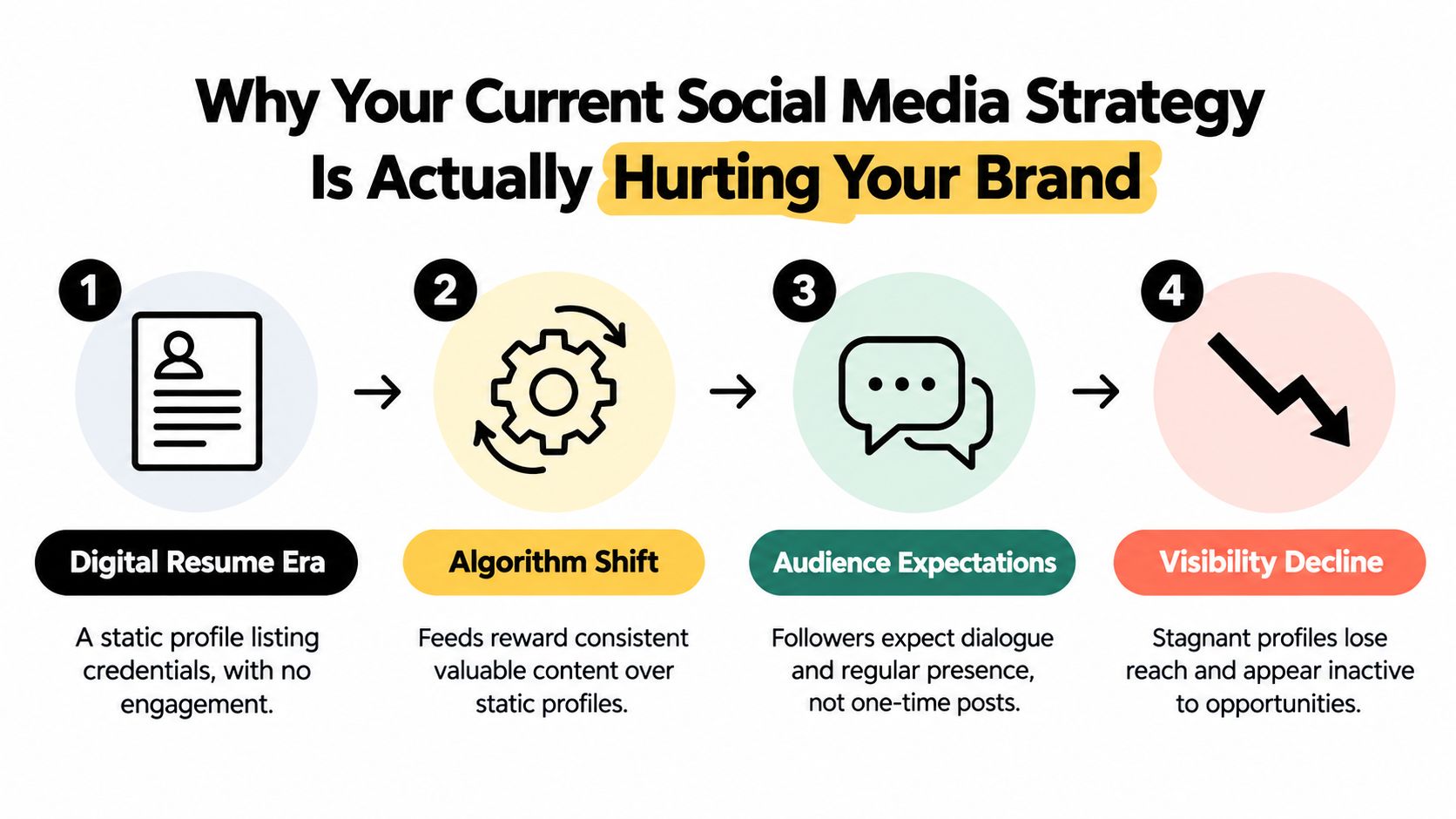
A static profile tells people what you've done. It doesn't show how you think, how you solve problems, or how you respond when someone challenges your viewpoint. Buyers, partners, and potential employers need those signals before they trust you with a meaningful opportunity.
The modern feed also gives your profile a job beyond identification. It must help distribute ideas, invite conversation, and reinforce a recognizable point of view. A polished biography can support that work, but it can't replace repeated proof of expertise.
Strategic rule: Your profile explains your positioning. Your content proves it. Your engagement makes it believable.
The “post and pray” mindset creates another weakness. You publish an announcement, a polished insight, or a company update, then measure success by impressions. But visibility without the right audience, meaningful responses, or downstream action is an expensive distraction.
A personal brand now behaves more like a small media operation. You need an editorial point of view, recurring themes, a distribution rhythm, and a feedback loop. That doesn't mean turning yourself into a content machine. It means accepting that trust grows through repeated participation rather than one-time self-presentation.
Your strategy should answer four questions:
If your current presence only lists credentials, it isn't neutral. It actively makes you look inactive, interchangeable, and difficult to evaluate. Replace the static resume with a living body of evidence.
A vague title is not positioning. “Thought leader,” “business strategist,” and “growth expert” describe aspiration, not a problem you solve. Your niche should give a relevant visitor an immediate reason to follow you.
Start with this sentence:
I help [specific audience] solve [specific problem] through [distinct approach].
Keep the audience and problem narrow enough to guide your editorial decisions. “I help B2B founders turn technical expertise into trusted content” gives you a stronger lane than “I help businesses grow.” The first statement suggests subjects, examples, and buyers. The second creates no useful boundary.
Your expertise lane should sit at the intersection of three things:
Don't choose a niche only because it sounds marketable. Choose one you can support with original observations. If you've built sales teams, write about the decisions that make sales hiring work. If you've led product launches, explain the trade-offs executives rarely discuss. Specific experience creates stronger content than generic motivation.
Your headline should state the outcome or problem, not merely your job title. Your banner should reinforce the same promise with a short phrase, visual cue, or proof point. Your About section should move from the audience's problem to your perspective, then to a clear next step.
A profile visitor is asking, “Why should I pay attention to this person?” Make the answer visible without forcing them to inspect every section.
Review these elements together:
Searchability matters, but keyword stuffing weakens trust. Use the phrases your audience actually uses in your headline, About section, and experience descriptions. Then make the surrounding copy sound like a human speaking to a buyer, not a profile assembled for a database.
A well-optimized profile doesn't promise everything. It makes a focused promise and gives your content a clear home.
Content pillars work when they connect what your audience needs with what you can explain better than most others. They fail when they become a list of topics you happen to enjoy. Your audience doesn't owe you attention because a subject interests you. Earn it by making the subject useful, surprising, or personally relevant.
Choose three to five recurring themes, then assign each theme a distinct job in the buyer's decision process. One pillar can establish expertise. Another can reveal your judgment. A third can reduce uncertainty. A fourth can show the human experience behind your work.
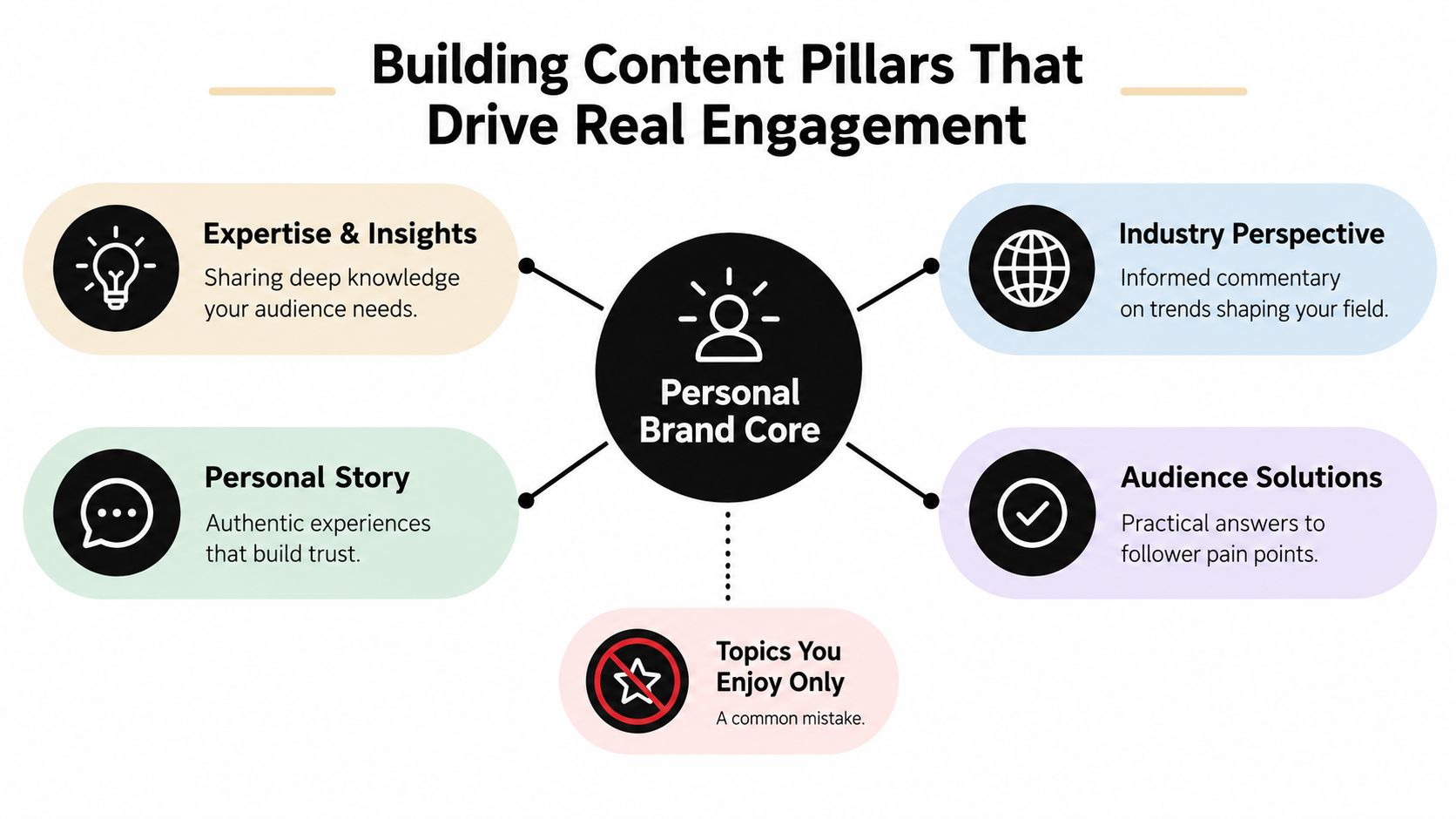
Expertise and insights should teach a method, explain a trade-off, or challenge a familiar assumption. Don't summarize a book your audience could find themselves. Show how you applied an idea and what changed in practice.
Industry perspective gives people a reason to return to you for interpretation. Respond to a product shift, regulatory development, market pattern, or common executive mistake. Your value comes from the filter you apply, not from repeating the headline.
Personal story supplies context and emotional credibility. Share a difficult decision, a failed experiment, or a lesson that changed your operating style. Keep the story connected to a professional point. Vulnerability without relevance becomes self-disclosure, not authority.
Audience solutions answer questions your ideal clients ask repeatedly. Turn objections, onboarding issues, failed processes, and misunderstood concepts into practical posts. This pillar often produces the strongest conversations because it starts with an existing problem.
The crossed-out category is topics you enjoy only. You can still write about them, but they shouldn't dominate the strategy unless they connect to your audience and positioning.
Use different formats inside the same pillar. A single idea can become a short opinion, a step-by-step explanation, a story, a response to a common objection, and a conversation prompt. This gives your audience variety without forcing you into unrelated subjects.
For example, a founder who helps SaaS teams improve onboarding could publish:
Store ideas by pillar, audience problem, format, and intended action. That system makes planning easier and reveals gaps. If every idea is educational, add perspective and lived experience. If every post is personal, add proof and instruction.
When one strong idea deserves a longer life, use a build a repurposing workflow that adapts the insight to several native formats instead of copying the same post everywhere. You can also use this guide to creating content pillars that build your personal brand to pressure-test whether each theme supports a coherent reputation.
Consistency matters because an inactive profile cannot build familiarity. But the right cadence is the one you can sustain while preserving a point of view. Publishing frequently with weak ideas teaches your audience to ignore you. Publishing excellent ideas sporadically makes it difficult for them to remember you.
A widely cited 2026 analysis reported that 91% of LinkedIn creators posted at least once every three days, which suggests that regular output has become a baseline for visible growth, not a clever advantage. The same LinkedIn analysis of personal profiles and company pages found that personal profiles accounted for about 62% of what users saw in feeds, compared with roughly 5% for company pages, while matched-content studies showed personal-profile posts generating 2.75 times more impressions and 5 times more engagement than equivalent company-page posts.
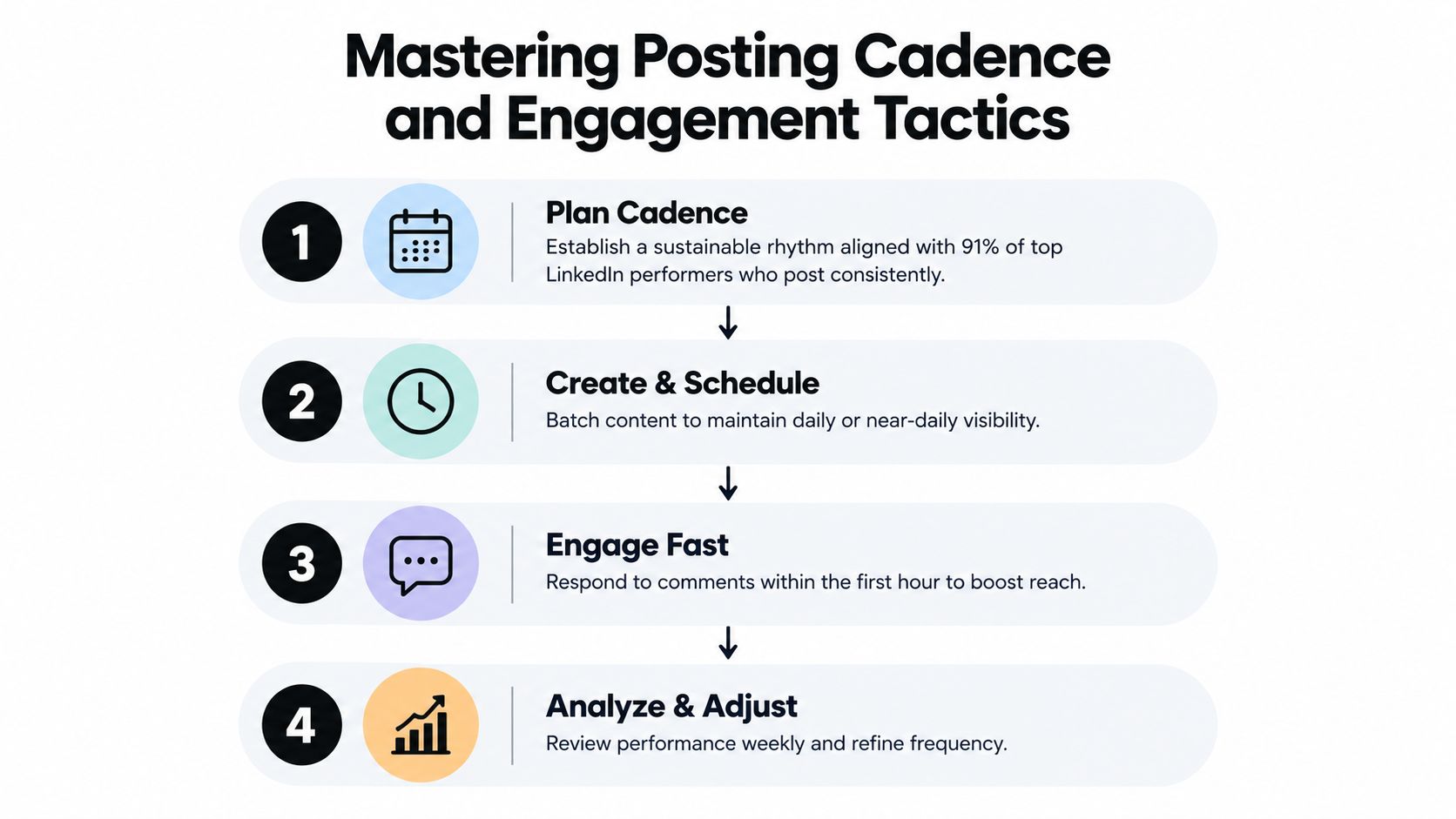
Build your cadence around production capacity, not anxiety. A practical schedule might include a teaching post, an opinion post, a personal operating lesson, and a response to a current industry issue. The exact mix matters less than keeping each post connected to your positioning.
Batching helps, but don't remove spontaneity. Prepare several durable ideas in advance, then leave room to respond to events, audience questions, and conversations that emerge during the week. A content calendar should reduce decision fatigue, not turn your voice into a broadcast script.
Your profile also benefits from the difference between publishing and participating. People may discover you through a post, but they often decide whether to trust you by reading your comments and observing how you handle disagreement.
Set aside time to:
Ask questions that invite experience rather than empty agreement. A useful collection of 10 social media question ideas can help when you need conversation starters, but adapt every prompt to your expertise and audience.
Measure the quality of engagement. A thoughtful reply from a potential buyer is worth more than a large volume of passive reactions. For a practical operating system, use this resource on how to master your social media posting schedule in 2026, then adjust your rhythm based on the conversations and business actions it creates.
Likes and follower counts are convenient because platforms display them prominently. They're poor substitutes for business outcomes. A large audience can still produce no qualified conversations, while a smaller group of relevant professionals can create referrals, introductions, and demand.
Treat your personal brand as a conversion system with stages:
Reach tells you whether distribution is working. Track impressions and the sources of discovery, but don't stop there.
Engagement reveals whether the idea earned attention. Track meaningful comments, shares, saves, and engagement rate. A reaction alone tells you very little about intent.
Consideration shows whether people want more from you. Watch profile clicks, follows from relevant people, newsletter subscriptions, resource requests, and direct messages.
Conversion connects activity to revenue. Record qualified conversations, booked calls, proposals, referrals, and closed opportunities that began through social content or interaction.
A 2026 analysis of 673,658 posts across 63,108 accounts found that personal accounts generated 63% more engagement even when average impressions per post were similar, according to the Metricool and Favikon LinkedIn analysis. The implication is straightforward: interaction quality matters more than reach alone.
Create a simple record for every meaningful lead. Note the first content interaction, the conversation that followed, the problem discussed, and the eventual outcome. Social platforms won't always provide complete attribution, so ask new prospects how they found you and keep the answer in your customer relationship system.
Review performance on a regular cycle. Compare themes, formats, audience quality, profile actions, and lead outcomes. Don't ask only, “Which post got the most reach?” Ask, “Which topic attracted people I can help?”
Use the complete guide to audience engagement metrics to build a more disciplined dashboard. Your goal isn't to eliminate broad awareness. It's to distinguish awareness that supports your commercial objectives from attention that merely flatters your analytics.
The fastest way to weaken a personal brand is to sound like a company that has removed every human detail. Generic posts use polished language, broad claims, and safe observations. They may look professional, but they give readers no reason to remember the person behind them.

The alternative isn't oversharing. It's recognizable specificity. State what you believe, explain why you believe it, and connect the point to an experience your audience can evaluate. “Leadership matters” is forgettable. “I stopped asking my team for weekly status updates after realizing the meetings were hiding decision delays” gives readers a perspective, a situation, and a question worth discussing.
Company-style messaging tends to emphasize:
Human-led messaging does the opposite. It names the decision-maker, acknowledges constraints, and makes the reasoning visible. Readers can disagree with a clear opinion. They can't engage with a sentence designed to offend nobody.
This matters commercially. 72% of U.S. adults use at least one social media platform, and 70% of consumers feel a stronger connection to brands whose leaders are active on social media, according to reported personal branding data from Tenet. The same source reports that 57% say visible, authentic leadership affects purchasing decisions, while 72% of B2B salespeople say social media improves performance and more than 50% of B2B respondents report closing deals directly through social channels.
Show the person making the judgment. Share the standard you use, the mistake you corrected, or the customer tension you had to resolve. Keep confidential details private, but don't remove every trace of lived experience.
A useful voice test is simple: could someone identify the author if the name and logo disappeared? If the answer is no, rewrite the post until the sentence structure, examples, and point of view belong unmistakably to you.
This video offers another way to think about building a visible identity without hiding behind generic brand language:
AI can increase production capacity, but it can't supply a credible life, considered judgment, or earned point of view. Use it to remove repetitive work. Don't use it to outsource the parts of your brand that make people trust you.
Current 2026 trend coverage identifies AI integration as a leading personal-branding focus while authenticity remains the top priority, creating a direct tension between scale and trust, as described in this analysis of personal branding trends. The same source reports that only 15% of respondents have a clearly defined personal-branding strategy and only 20% regularly receive leads from it. More content won't solve an unclear strategy.
AI is useful for:
You should personally own the positioning, examples, claims, final edits, and calls to action. Record your ideas in your natural speaking voice before asking a tool to structure them. Add the detail that only you know. Remove phrases you'd never say aloud.
Proof-based content protects authenticity. Refer to a decision you made, a pattern you've observed, a customer problem you understand, or a process you've tested. Recognizable voice comes from vocabulary, rhythm, standards, and recurring opinions. Analytics then tells you which subjects create useful interaction, but it shouldn't dictate your entire identity.
For teams that need visual output without putting a person on camera, faceless video creation tools can support format experimentation. They're appropriate for explaining frameworks, presenting research, or illustrating processes. They shouldn't replace the personal stories and judgments that distinguish a founder or expert from a content template.
Use AI as an assistant with a brief, not as an author with authority. Give it your audience, positioning, source material, banned claims, tone, and desired action. Then review every sentence for accuracy and ownership. The scalable advantage isn't publishing generic content faster. It's preserving your distinct perspective while reducing the mechanical work around it.
Legacy Builder helps professionals turn their stories, expertise, and operating perspective into consistent content across social platforms, with profile optimization, strategic distribution, and audience interaction in the workflow. If your personal brand is generating activity but not enough qualified conversations, visit Legacy Builder to discuss a content system built around your voice and business goals.


You could – but most in-house teams struggle with the nuance of growing on specific platforms.
We partner with in-house teams all the time to help them grow on X, LI, and Email.
Consider us the special forces unit you call in to get the job done without anyone knowing (for a fraction of what you would pay).
Short answer – yes.
Long answer – yes because of our process.
We start with an in-depth interview that gives us the opportunity to learn more about you, your stories, and your vision.
We take that and craft your content then we ship it to you. You are then able to give us the final sign-off (and any adjustments to nail it 100%) before we schedule for posting.
No problem.
We have helped clients for years or for just a season.
All the content we create is yours and yours alone.
If you want to take it over or work on transitioning we will help ensure you are set up for success.
We want this to be a living breathing brand. We will give you best practices for posting and make sure you are set up to win – so post away.
Subscribe to our newsletter and get insights on how to grow your personal brand.
