.svg)
Subscribe to our newsletter and get insights on how to grow your personal brand.
Thank you! Your submission has been received!
Oops! Something went wrong while submitting the form.
.svg)



You publish consistently, but your audience still can't explain what you're known for. One post teaches a tactic, the next shares a personal story, and the third promotes an offer. Each piece may be useful on its own, yet the overall brand feels scattered, engagement appears unpredictable, and creating the next post gets harder than it should.
That problem usually isn't a lack of effort. It's a lack of architecture. Content pillars give your personal brand a small set of recurring ideas, perspectives, and proof formats, so your publishing becomes recognizable without becoming repetitive. The strongest approach treats those pillars as a dynamic portfolio, with one pillar attracting new people, another building trust, and another helping qualified prospects take action.
You finish a week of publishing and still cannot explain which posts created demand. One idea attracts attention, another earns thoughtful replies, and a third produces a sales conversation, yet the differences remain unclear. Without a system, you spend time generating topics, rewriting captions, switching audiences, and interpreting isolated reactions.
The problem is not a lack of activity. It is the absence of a portfolio with defined jobs. A growth pillar should bring the right people into your audience. A trust pillar should demonstrate judgment and experience. A conversion pillar should help qualified prospects understand why your offer fits. Each theme earns a place by serving a business function, not by sounding broad or impressive.
A documented strategy remains less common than the number of active content calendars suggests. The Content Marketing Institute reported that 35% of businesses had a documented content strategy in 2025, while 42% published new content at least weekly and 55% planned to increase content marketing spend in the next year. The figures show how easily regular publishing can exist without a clear operating model. The Content Marketing Institute's overview of content marketing pillars offers useful context for moving from activity to governance. For a more evidence-led approach to personal brand planning, review this data-driven content strategy for personal brands.

Weak strategies often begin with categories that sound professional but cannot guide a decision. “Leadership,” “marketing,” and “mindset” do not tell you what to publish, whom the post serves, or what action should follow. They also make your perspective difficult to distinguish from familiar advice across the market.
A useful pillar names a recurring audience tension. “Leading without a team” gives you a sharper direction than “leadership.” “Marketing when you hate selling” creates a clearer editorial lane than “marketing.” The first option identifies a problem, a person, and a conversation. The second supplies only a label.
Practical rule: A pillar should make it easier to reject an idea than to approve one.
A content pillar is a decision filter, not just a topic bucket. It connects an audience need to a business outcome, then helps you choose the right format, angle, and call to action. Once every pillar has a defined role, daily publishing becomes easier to plan and performance becomes easier to interpret.
The commercial case for structure has grown alongside the industry. The global content marketing industry was projected to grow from about $72 billion in 2023 to over $107 billion by 2026, a 33% increase, according to Salesgenie's content marketing statistics. The same source reports that content marketing can generate 3x more leads than outbound marketing while costing 62% less per lead, and that 97% of marketers said they have a content strategy for 2026, with 61% saying it significantly or moderately improved results and ROI.
For a personal brand, the takeaway is disciplined allocation rather than higher volume. Give each pillar a job, then let the portfolio balance reach, trust, and conversion. That structure keeps daily output recognizable without making every post sound identical.
A founder publishes polished advice on positioning, then receives repeated questions about explaining their offer. A creator posts consistently, yet the strongest responses arrive on an imperfect story about credibility. These gaps are audience truths. They show where your content can become useful, trusted, and commercially relevant.
Gather recent posts, client conversations, sales calls, direct messages, comments, and questions people ask after consuming your work. Put them in one working document. For each item, record the central topic, audience, format, platform, meaningful response, and business result when available.
Look for patterns across the portfolio:
Recurring tensions usually point toward stronger pillars. Founders may struggle with positioning, consistency, or credibility. Senior professionals may need to communicate expertise without sounding self-important. Creators may want a recognizable voice without turning every post into a polished performance.
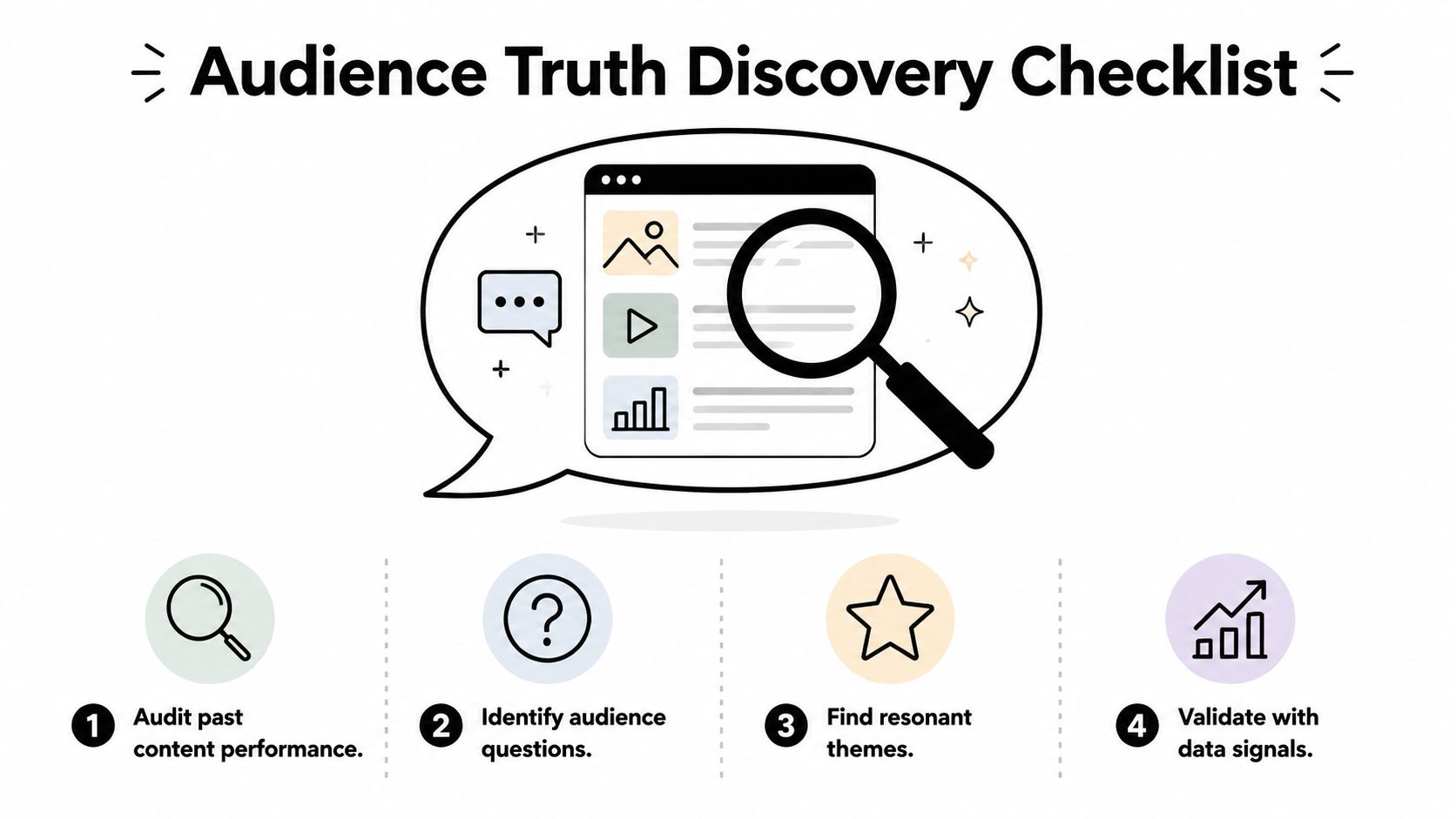
Write each tension as a sentence:
Group similar tensions, then name the editorial promise beneath them. A pillar should set a clear expectation while remaining broad enough to support sustained work. It should also serve a distinct role in your portfolio, such as audience growth, trust, or conversion. That role prevents every topic from competing for the same outcome.
Choose 3–5 core themes, a range recommended in the practical methodology from Content Technologist's guidance on measuring content pillars. Assign each pillar an owner and review its results regularly. The owner may be you, a team member, or a collaborator, but one person must maintain quality and decide whether the pillar still deserves attention.
Test every candidate:
A theme that fails several tests is probably a category, not a pillar. For deeper research, connect the audit to this personal brand guide to audience segmentation.
Use the video below to examine how audience signals can shape your content decisions.
A pillar tells you what conversation you own. It doesn't automatically tell you where that conversation belongs. Format and distribution should follow the audience's level of awareness and the job each piece needs to perform.
Compare a broad-reach awareness post with a trust-building tutorial. The first should be easy to understand and share. The second needs more room for nuance, evidence, and application. A conversion asset should answer objections and make the next step obvious.
| Pillar Goal | Best Format | Primary Platform |
|---|---|---|
| Audience growth | Short educational posts, carousels, or X threads | LinkedIn or X |
| Trust building | Deep-dive newsletter, podcast, or short video | Email, YouTube, or LinkedIn |
| Conversion support | Case-study narrative, FAQ, or email sequence | Email, website, or direct messages |
| Community connection | Personal story, response post, or audience prompt | LinkedIn, Instagram, or community space |
An audience-growth pillar might address a common misconception in a concise LinkedIn post, then expand the idea into an X thread. A trust pillar could show your decision-making process through a newsletter or video. A conversion pillar should handle the questions that stop a qualified prospect from moving forward, such as fit, process, timing, or expected experience.
Broad topics become stronger when you frame them around a specific tension. “Personal branding” is a category. “How technical founders can become visible without becoming influencers” is a point of view with a clear audience. “Leadership” is broad. “How to lead when your authority comes from expertise rather than hierarchy” gives you a more distinctive lane.
Don't distribute every pillar everywhere. Choose the platforms where your audience already pays attention and where you can maintain a recognizable presence. This guide to posting across social media at once can help with distribution mechanics, but automation shouldn't replace platform judgment. A post may need a different opening, length, visual treatment, or call to action on each channel.
The efficient system isn't the one that duplicates every asset perfectly. It's the one that preserves the central insight while respecting how people consume each platform.
Use long-form content for depth when the idea needs context, and short-form content for reach when a single observation can stand alone. The trade-off is clear: short-form versus long-form content strategy should be decided by the job of the pillar, not by whichever format feels easiest to produce that week.
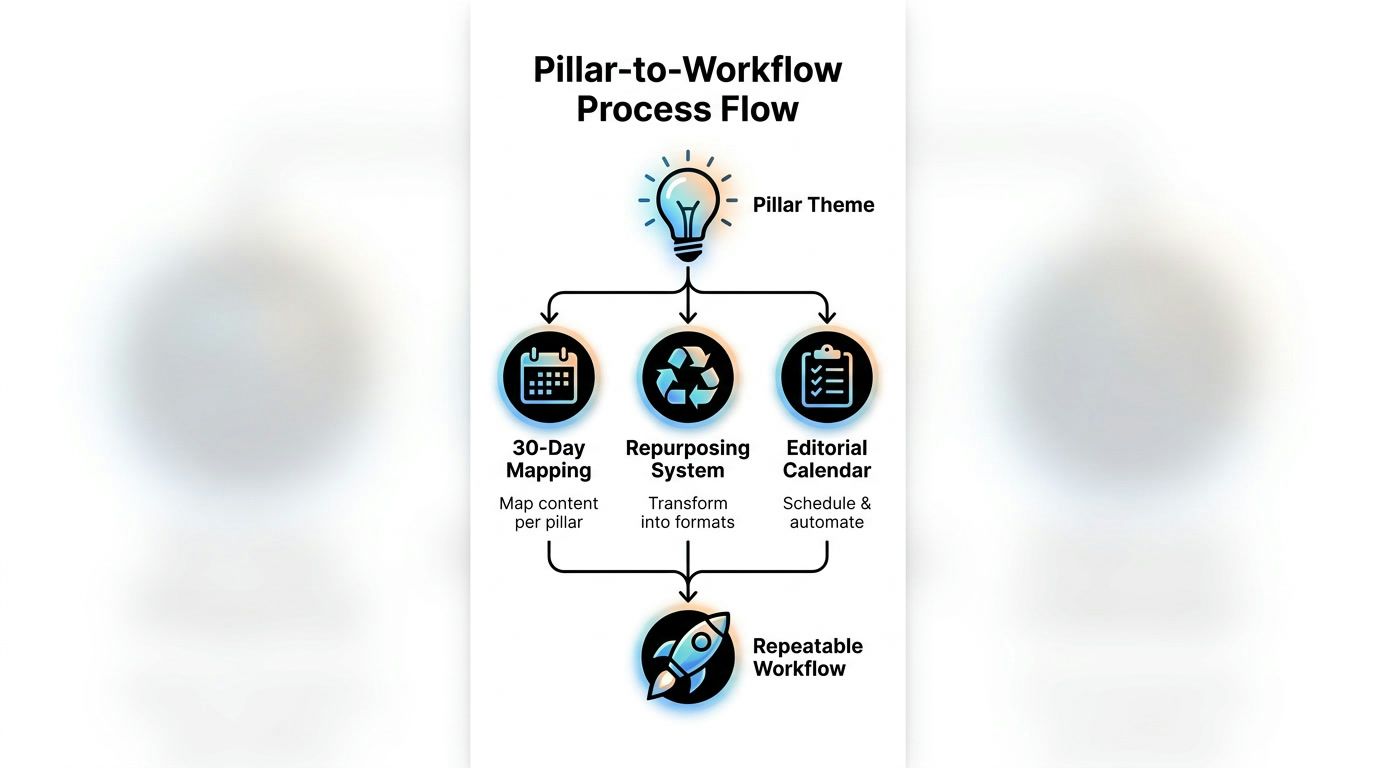
A pillar without a schedule remains an intention. A schedule without a repurposing system becomes a production burden. You need both: a calendar that protects consistency and a workflow that lets one strong idea travel without making every output feel copied.
Create a working calendar that shows four fields at minimum: pillar, format, platform, and status. Add the publication date only if it helps you make decisions. If updating the calendar takes more than a short daily check, simplify it.
For a 3–5 pillar system, assign each week a primary theme while allowing smaller posts from other pillars when a timely opportunity appears. This keeps research and drafting focused. It also reduces the mental switching that makes personal-brand content feel exhausting.
A practical sequence looks like this:
One source asset can become a thread, three quote cards, a short video clip, and two email tips. That doesn't mean you should mechanically paste the same paragraph into every channel. Each derivative should have its own entry point and audience action.
For example, a newsletter about positioning can produce a short post identifying the common mistake, a video showing how to fix it, a carousel comparing weak and strong positioning, and an email prompt that asks readers to rewrite their own description. The underlying idea stays consistent, while the format changes the experience.
For more approaches to adapting a source asset across channels, review these best ways to reuse content in 2026. The useful principle is editorial, not technical: preserve your perspective, change the packaging, and remove anything that only made sense in the original format.
Authenticity depends on keeping the source material real. Use your actual decisions, client questions, lessons, and disagreements as raw material. A repurposing system should reduce repetitive production, not manufacture a personality.
A post can earn attention and still fail commercially. Likes show that someone noticed it, but they do not show whether the right audience understood your positioning, trusted your judgment, or took a useful next step.
Measure each pillar according to its business role. A growth pillar should bring relevant people into your profile, email audience, or wider content ecosystem. A trust pillar should create stronger evidence of attention, such as sustained reading, repeat visits, or subscriber activity. A conversion pillar should connect to inquiries, calls, signups, purchases, or another defined action.

Choose one primary KPI for every pillar, then add a small supporting set that explains changes in performance. Tracking every available number makes review slower and decisions less clear.
A practical measurement record might include:
Review the numbers alongside evidence from real conversations. Tools such as LinkedIn analytics tools can simplify platform-level review, but a dashboard cannot decide whether a theme still fits your offer. Read comments, review direct messages, ask new clients what they remember, and note the language prospects use to describe their problem.
The goal is a balanced portfolio, not a leaderboard. A growth pillar may produce reach while a trust pillar creates fewer but stronger interactions. Cutting the latter because its surface metrics look smaller can weaken the conversion path.
Review the portfolio on a regular cycle, as recommended in Brandwatch on content pillars. Replace a pillar when it repeatedly attracts the wrong audience, produces shallow interaction, lacks a credible point of view, or fails to connect with a business outcome.
Before retiring it, check the execution. The theme may be sound while the hooks are unclear, distribution is weak, or the proof format does not suit the idea.
Your portfolio should change as your offer, audience, and authority develop. One pillar can attract attention, another can build confidence, and a third can help prospects decide. Invest more effort in the themes that create useful momentum, and let weak themes earn their place through evidence.
Treat the next quarter as a controlled operating cycle, not a permanent rebrand. You're testing whether your themes can attract the right audience, express your expertise, and support the actions your business needs.
Audit existing posts, conversations, and audience questions. Group recurring tensions, remove broad categories, and select 3–5 pillars. Give every pillar a clear owner, audience promise, proof format, and success metric.
Write one sentence for each theme:
“This pillar helps [specific audience] solve [recurring tension] through [your point of view].”
That sentence should guide both ideation and editing. If an idea doesn't serve the audience or the promise, place it in a holding file instead of forcing it into the calendar.
Map each pillar to its strongest formats and distribution channels. Build a simple 30-day calendar with the pillar, source asset, derivative formats, platform, and status. Choose a manageable publishing rhythm that you can sustain when client work becomes busy.
Avoid creating a separate strategy for every channel. Build a central idea, then adapt its opening, length, visual structure, and call to action for the platform.
Publish and repurpose consistently. Record engagement quality, audience questions, profile behavior, email activity, and conversion signals against the relevant pillar. Keep a running note of phrases prospects use, because those phrases often become stronger hooks than abstract marketing language.
Review the portfolio. Keep the pillars that attract relevant attention and support trust or action. Refine themes that show potential but need sharper positioning. Retire pillars that repeatedly consume resources without producing a useful signal, then redirect that capacity toward the strongest opportunities.
Content pillars should evolve with your audience and business. Build the system, use it long enough to learn from it, and let evidence shape the next quarter rather than treating your initial choices as permanent identity.
Legacy Builder helps professionals turn their stories, expertise, and positioning into authentic content pillars, then supports writing, design, distribution, and audience engagement around that strategy. If you want a practical partner for building a consistent personal-brand publishing system, visit Legacy Builder and explore how the process can fit your goals.


You could – but most in-house teams struggle with the nuance of growing on specific platforms.
We partner with in-house teams all the time to help them grow on X, LI, and Email.
Consider us the special forces unit you call in to get the job done without anyone knowing (for a fraction of what you would pay).
Short answer – yes.
Long answer – yes because of our process.
We start with an in-depth interview that gives us the opportunity to learn more about you, your stories, and your vision.
We take that and craft your content then we ship it to you. You are then able to give us the final sign-off (and any adjustments to nail it 100%) before we schedule for posting.
No problem.
We have helped clients for years or for just a season.
All the content we create is yours and yours alone.
If you want to take it over or work on transitioning we will help ensure you are set up for success.
We want this to be a living breathing brand. We will give you best practices for posting and make sure you are set up to win – so post away.
Subscribe to our newsletter and get insights on how to grow your personal brand.
