.svg)
Subscribe to our newsletter and get insights on how to grow your personal brand.
Thank you! Your submission has been received!
Oops! Something went wrong while submitting the form.
.svg)


Ever feel like you’re just throwing content at the wall, hoping something sticks? You’re not alone.
If your social media feels like a constant, draining treadmill of random posts, you’re missing the single most important asset for growth: a plan. This isn't about posting more. It’s about posting with a clear purpose and a rhythm that builds trust.
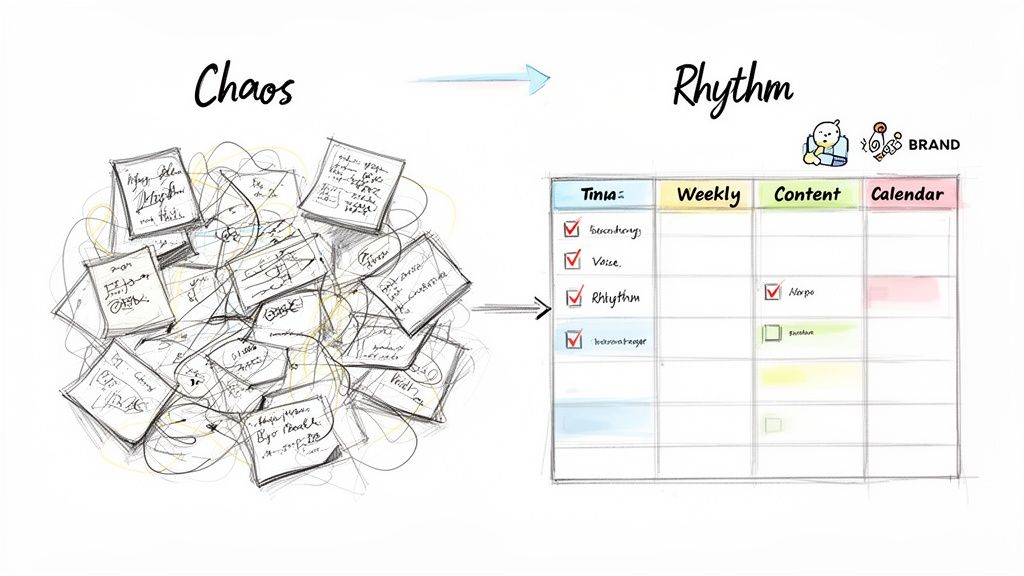
Let's be honest. The pressure to come up with fresh ideas every single day is enough to burn anyone out. I've seen it happen to hundreds of founders and creators. They get stuck in "content chaos"—posting reactively, stressing daily, and seeing almost no return for their effort.
The fix is a strategic social media posting schedule. It flips the script from a source of stress to your most powerful growth tool. You stop reacting and start building with intention.
A great schedule is so much more than just a calendar with dates. It's your entire content strategy, mapped out. It forces you to get crystal clear on your brand's story and makes sure every single post is a deliberate step forward.
Before we get into the nitty-gritty of building your own, this table breaks down the core pieces of a schedule that actually works.
| Component | What It Is | Why It's Critical for Your Brand |
|---|---|---|
| Audience Insights | Knowing exactly when and where your ideal clients are active. | You post when they’re listening, maximizing reach and engagement. |
| Platform Strategy | Defining the unique role each social channel plays for your brand. | You stop posting the same thing everywhere and start tailoring content. |
| Content Pillars | The 3-5 core topics your brand owns and talks about consistently. | This creates brand authority and makes content creation 10x easier. |
| Posting Cadence | The specific frequency and timing of your posts on each platform. | Consistency builds trust with your audience and favor with the algorithms. |
| Content Formats | The mix of video, text, images, and carousels you’ll use. | Variety keeps your feed fresh and caters to different audience preferences. |
| Measurement | Tracking key metrics to see what’s working and what’s not. | You stop guessing and start making data-backed decisions to improve. |
This framework is the key to creating a manageable, impactful rhythm that feels authentic to you and your brand.
A great social media posting schedule isn't just a calendar; it's a strategic document that aligns your daily actions with your long-term legacy.
This is a fundamental shift in thinking. You’re no longer just filling empty slots on a calendar—you're architecting a journey for your audience.
If you need a head start on organizing these ideas, our guide on creating a content calendar template for social media that actually works is the perfect next step.
A schedule gives you the structure to share your vision with intention. It’s the difference between shouting into the void and building a real community that trusts your voice.
Time to ditch the content chaos for good.
A solid social media schedule isn't about guesswork. Not even a little bit.
It's built on a rock-solid understanding of who you're actually talking to and where they hang out online. Jumping straight to a calendar without doing this foundational work is like trying to build a house without a blueprint. It’s just not going to work.
Before you even think about when to post, you have to nail down who you’re posting for. This means getting way more specific than just "entrepreneurs." You need to create detailed audience personas.
These personas aren't just make-believe characters. They're built from real data and insights about your ideal audience, making them feel like actual people with real goals and very real problems.
Your job is to get inside their head. What's keeping them up at night? What are their biggest career goals? Where do they actually go for advice or a dose of inspiration?
A great persona goes way beyond a job title and an age range. You need to dig in and define:
When you get this detailed, your content starts to connect on a much deeper level. And if you're managing multiple brands or personas, focusing on their core needs is the key. We break down how to do this strategically in our guide on how to manage multiple social media accounts without burnout.
Once you know your people, the next move is figuring out where they are. Let me be clear: not every platform is right for every audience. Spreading your efforts too thin is a fast track to burnout and zero results.
A B2B SaaS founder looking for investors is going to get massive value from a strong, thought-leadership-focused LinkedIn presence. A visual artist building a brand? They’re going to live on the image-first platforms like Instagram and Pinterest.
It’s not about being everywhere. It's about being on the right one or two platforms where your audience is already active. A focused strategy on a couple of channels will always crush a scattered presence across five or six.
To keep it all straight, grabbing a social media posting schedule template is a smart move. It helps you visually map out which persona you're hitting on which platform with every single post.
Let’s make this real. Imagine you have two primary personas: "Startup Steve" and "Creative Carla."
Startup Steve (SaaS Founder):
Creative Carla (Freelance Designer):
By creating this simple map, you’ve just laid the entire foundation for an effective social media posting schedule. You know who you're talking to, where to find them, and what they actually want to see from you.
Now, every post has a purpose. Your efforts are strategic from day one. This is how you turn your schedule from a simple to-do list into a powerful engine for brand growth.
Trying to be everywhere on social media is the fastest way to get nowhere.
Spreading yourself thin across every trending platform leads to burnout, not a bigger brand. You'll get far better results by dominating one or two channels than by showing up inconsistently across five or six.
The goal isn't to be everywhere. It’s to be where your audience actually is. This means taking a hard look at where your ideal clients spend their time and which platforms fit the brand you're trying to build.
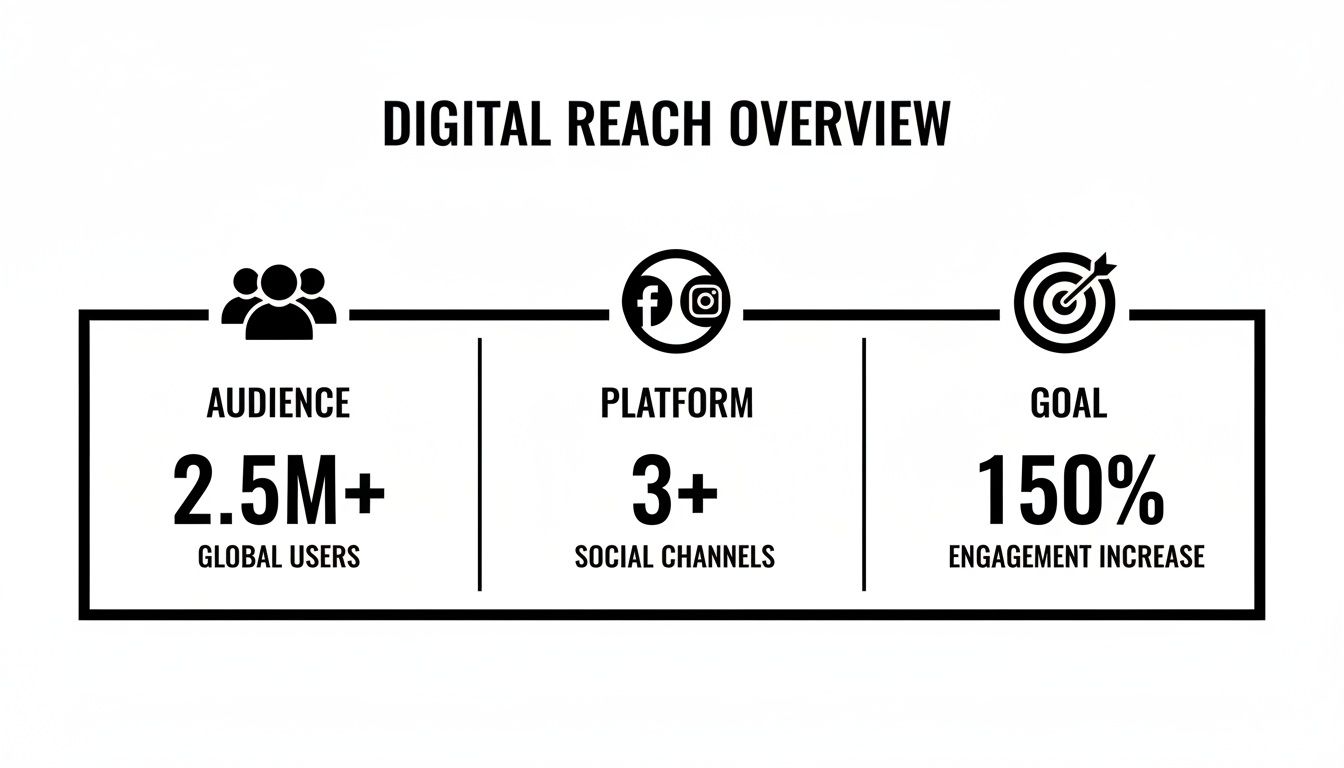
Think of it like this: your platform choice is where who you're reaching meets what you're trying to accomplish.
Your audience personas are your roadmap here. Don't guess. Every platform has its own vibe and attracts a different crowd. Your job is to find the right fit.
Let’s break down the big players:
LinkedIn: This is the home of B2B. It’s for founders, professionals, and anyone building a brand on industry expertise. The audience is here for career growth and expects in-depth content like articles, case studies, and sharp professional insights.
Instagram: A purely visual game. Instagram is a goldmine for brands with a strong aesthetic—think designers, coaches, and lifestyle businesses. It’s all about high-quality images, Reels, and authentic Stories that build a real connection.
TikTok: Don't dismiss it as a platform for kids. TikTok has become a massive cultural engine for all ages. Its algorithm is incredibly powerful and can give massive reach to short, sharp videos that entertain or teach something valuable.
A founder looking for investors should be crafting thought leadership on LinkedIn, not filming dance challenges on TikTok. A wellness coach, on the other hand, will find a much hungrier audience for their daily routine videos on Instagram or TikTok than on a text-heavy platform like LinkedIn.
It’s just common sense.
Beyond gut feelings, you need to look at the numbers.
In 2026, TikTok is the undisputed engagement king, with an average engagement rate of 3.70%. That’s a massive 49% jump from the previous year. It absolutely dwarfs Instagram (0.48%) and Facebook (0.15%).
This tells us that for brands building a legacy, a posting schedule built for TikTok’s algorithm pays off. Consistency is everything. The data shows brands posting around 5 times a week on TikTok and Instagram see the best results.
But here’s a twist: average comments per post have dropped 24% on TikTok and 16% on Instagram. This points to a shift toward more passive engagement—people are watching and sharing more than they are commenting. You can find more 2026 social media benchmarks here to dig deeper.
Choosing your platforms is an exercise in focus. It's about saying 'no' to the channels that don't serve your primary audience so you can say a resounding 'yes' to the ones that do.
This data doesn't mean you have to be on TikTok. It just means the potential for explosive engagement is there if your audience is. If your audience is made up of C-suite executives who live on LinkedIn, then that’s where you need to be, period.
Ready to make a choice? Run every platform you’re considering through these three simple questions:
Answer those honestly. You'll quickly narrow your list to the one or two platforms that will give you the best return on your time. This is how you build a posting schedule that drives real results, not just more noise.
Let's clear the air on one of the biggest myths in social media: you have to post every single day to get results.
I've seen this pressure lead to total burnout. Worse, it clogs your feed with rushed, low-quality posts that actually hurt your brand more than they help.
The truth is, posting more doesn't automatically mean more engagement. Your goal isn't to be the loudest person in the room—it's to be the most valuable and consistent. It's about finding a sustainable rhythm that doesn't sacrifice quality for the sake of just "being there."
Think about your own social media habits. Do you follow the account that spams you with ten mediocre updates a day? Or the one that drops three genuinely insightful posts a week?
It's a no-brainer. Your audience feels the exact same way.
When you commit to a less frequent schedule, every single post carries more weight. You give yourself the time to research, create, and polish your content so it truly serves your audience. That’s how you build a reputation for being the go-to expert and get people excited to see your name pop up on their feed.
A huge piece of this is figuring out the right posting cadence. To stop guessing and start making strategic moves, you need to understand how often to post on social media for real impact. This is what separates a guessing game from a data-backed social media posting schedule.
While your perfect cadence will be unique to your brand, industry data gives us a fantastic starting point. The key is to remember that what works on Instagram will probably bomb on LinkedIn. Each platform has its own culture.
Here are some solid, data-backed guidelines for 2026:
Instagram: Aim for 3-5 times per week. This is the sweet spot to stay top-of-mind with the algorithm without annoying your followers. Mix it up with high-quality Reels, carousels, and interactive Stories.
LinkedIn: This is where quality is king. Posting 2-3 times per week with thoughtful, high-value content will crush daily fluff posts every time. Think deep-dive insights, professional stories, and real-world case studies.
Facebook: A frequency of 3-5 posts per week is where most brands see success. The algorithm loves meaningful interaction, so post things that get people talking—questions, polls, and community-focused updates work wonders.
X (formerly Twitter): It's a faster-paced world here. While some brands go hard with multiple posts a day, you can still build serious authority with 3-5 high-value posts per week, especially if you’re actively engaging in conversations.
Recent data backs this up. For most brands on Instagram and Facebook, the sweet spot is 3-5 times per week, balancing visibility without causing "scroll-past" fatigue. With over 5.2 billion people on social media, a consistent, measured approach is how you stand out.
The ultimate goal isn't to hit a magic number. It's to establish a rhythm that you can maintain consistently over the long term without sacrificing the quality of your content.
Remember, these are just starting points. The real work begins when you start testing these frequencies and paying close attention to your own analytics. Your data is the only source of truth that really matters.
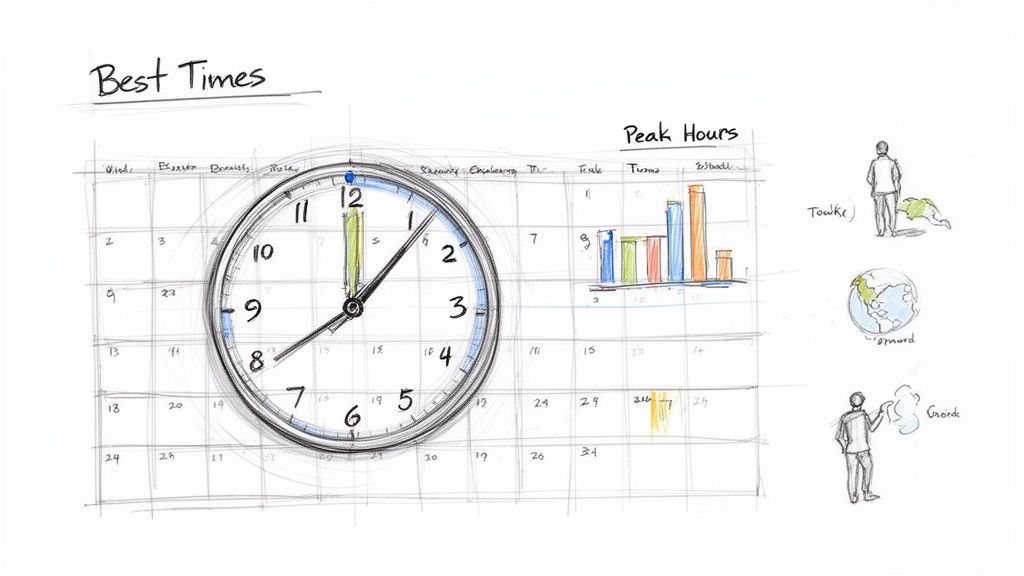
Let’s be real. You can create the best piece of content in the world, but if you post it when your audience is asleep, you might as well have shouted it into the void.
You’ve seen the generic lists of "best times to post" all over the internet. They’re a decent starting point, but they are not a strategy. Following them blindly is a surefire way to get mediocre results.
The real gold is hidden in your own analytics. Your audience has specific habits, and figuring them out is the key to getting your content seen by the right people at the right time.
Before you start digging into your own data, it helps to know the broad strokes. Think of these as the industry’s best guess—a foundation you can test and build on.
Most people hop on social media during the natural lulls in their day: the morning commute, their lunch break, and when they’re unwinding in the evening.
For 2026, the data points to weekday mornings from 9 AM to 11 AM and the lunch hour (12 PM to 1 PM) as prime time. Wednesday, for whatever reason, seems to be a powerhouse day for engagement across the board. But this isn't a one-size-fits-all rule. LinkedIn engagement predictably spikes during business hours, while TikTok tends to come alive at night.
With 93% of internet users hitting social media every month, you can't afford to guess. You can check out the latest platform-specific timing data from eClincher’s 2026 research to get a baseline for your first few weeks.
For our clients here at Legacy Builder, we often use Wednesday’s peak engagement to schedule more personal, authentic stories—it helps cut through the noise when people are most receptive.
Alright, now it’s time to stop guessing and start knowing. Your social media accounts are sitting on a treasure trove of data about your specific followers. You just need to know where to look.
Here’s your treasure map:
The goal isn't just finding when most people are online. It's about finding when your ideal audience—the people who will actually become leads and clients—are most likely to see and engage with your content.
Once you’ve identified these peak times, test them. Schedule your posts for those specific windows for a couple of weeks. Track the results. See what happens.
The "best" time to post is completely dependent on who you're trying to reach. A schedule for a CEO targeting other execs will look nothing like one for a creator with a global Gen Z audience.
Your schedule has to mirror the life of your ideal client persona.
Once you've analyzed this data, the next move is to get even more specific by learning how to measure your content performance for your personal brand. This will show you which topics hit hardest and at which times.
Ultimately, your posting schedule is a living, breathing thing. Start with the industry data, confirm it with your own analytics, and never stop testing. That’s how you find your rhythm and turn your personal brand into a consistent source of opportunities.
Even with the perfect plan, you're going to have questions. That's normal. Building a social media schedule that actually works isn't a one-and-done task.
Let’s cut through the noise and tackle the questions I hear most often from founders trying to get this right.
This is a balancing act, but I’ve found a sweet spot.
Plan your big-picture themes or content pillars one month in advance. This gives you a clear roadmap and makes sure your social media is actually pushing your business forward.
But for the actual posts? Write and schedule those only one to two weeks out.
Why? This hybrid approach keeps you strategic without being rigid. It leaves you room to jump on a trend, share a spontaneous thought, or react to something happening right now without blowing up your whole plan.
It's a game-changer. You get the direction of a long-term plan with the agility of being in the moment.
First, breathe. One missed post is not going to tank your brand.
Seriously. Your audience will not notice or care. The goal here is consistency over perfection.
If the post was evergreen (meaning, not time-sensitive), just slot it into the next open spot on your calendar. If it was tied to a specific day or event, just let it go. Move on.
The worst thing you can do is let one small slip-up convince you to abandon your social media posting schedule altogether. Get back on track with the next post. That's it.
Your schedule is a living document, not a stone tablet. It needs to adapt.
Here's the review cadence I give my clients:
You use the deep dive to make real, strategic shifts. This cycle of posting, measuring, and optimizing is what separates the pros from the amateurs.
Use a tool. This shouldn't even be a question.
Using a platform like Buffer, Later, or SocialPilot is a massive unlock. It’s how you stay consistent without being chained to your desk.
These tools let you batch-create your content and get it all lined up to go out at the perfect times. We've seen clients save over six hours a week just by automating their posting.
But there’s a catch.
The best founders use a hybrid approach. They automate the posting, then use the time they saved to do what actually builds a brand: replying to every single comment, engaging with people in their DMs, and having real conversations.
You get the efficiency of automation and the real connection that only a human can provide. It's the best of both worlds.
At Legacy Builder, we help you turn your expertise into a powerful online presence that drives real growth. If you’re ready to build a personal brand that goes beyond just scheduling posts, let's talk.
Learn more about how our team can help you build your legacy at https://www.legacybuilder.co.


You could – but most in-house teams struggle with the nuance of growing on specific platforms.
We partner with in-house teams all the time to help them grow on X, LI, and Email.
Consider us the special forces unit you call in to get the job done without anyone knowing (for a fraction of what you would pay).
Short answer – yes.
Long answer – yes because of our process.
We start with an in-depth interview that gives us the opportunity to learn more about you, your stories, and your vision.
We take that and craft your content then we ship it to you. You are then able to give us the final sign-off (and any adjustments to nail it 100%) before we schedule for posting.
No problem.
We have helped clients for years or for just a season.
All the content we create is yours and yours alone.
If you want to take it over or work on transitioning we will help ensure you are set up for success.
We want this to be a living breathing brand. We will give you best practices for posting and make sure you are set up to win – so post away.
Subscribe to our newsletter and get insights on how to grow your personal brand.
