.svg)
Subscribe to our newsletter and get insights on how to grow your personal brand.
Thank you! Your submission has been received!
Oops! Something went wrong while submitting the form.
.svg)


Most advice on personal branding for financial advisors is too soft to be useful. It tells you to “be authentic,” “share your story,” and “post consistently.” Fine. None of that helps if your positioning is vague, your message sounds like every other advisor, and your content creates compliance headaches.
A strong advisor brand isn't the loudest brand. It's the clearest one. It tells the right clients exactly who you help, what you help them solve, and why your approach is credible. Then it repeats that message across every public touchpoint without drifting into promises, hype, or sloppy claims.
That's the standard. Distinctive and defensible.
“Just be authentic” is weak branding advice. Clients don't hire you because you seem genuine on LinkedIn. They hire you because your public presence makes you look credible, relevant, and consistent before they ever speak with you.
That's why personal branding for financial advisors has to be treated like a business asset, not a side project. Tenet reports that financial audiences trust leaders with visible personal brands 6× more than those without, and executives estimate 44% of a company's market value comes from reputation and brand-related perception, according to Tenet's personal branding statistics roundup. If you're still treating your name, online presence, and point of view as optional, you're misreading how trust gets built.
Prospects check your name before they book a call. They look at your LinkedIn profile, website bio, firm page, and whatever content appears in search. They're not only asking, “Is this advisor qualified?” They're asking, “Does this person sound like they understand people like me?”
That answer comes from brand clarity.
If your public presence is inconsistent, generic, or overly corporate, people assume your advice may be the same. If your positioning is sharp and repeated clearly, people start the relationship with context. That shortens the trust gap.
Practical rule: Your brand should do the first round of filtering before you ever enter the room.
A lot of advisors underestimate how much this matters because they still think branding is visual polish. It's not. A polished headshot won't save a weak message. A logo won't fix unclear positioning. Your real brand is the market's memory of you.
Your credentials matter. Your experience matters. But neither creates demand on its own. Buyers remember a specialist with a clear point of view. They forget the advisor who “works with individuals, families, and business owners to help achieve their financial goals.”
That sentence is invisible.
A useful way to pressure-test your own presence is to review outside client feedback on brand coaching. You'll notice the same pattern. The strongest brands aren't built on clever slogans. They're built on clarity, consistency, and a point of view people can repeat.
If you want a broader framework for how visible authority compounds over time, this guide on developing your personal brand for influence is a solid companion read.
Most advisors don't have a brand problem. They have a positioning problem.
They say they serve “professionals,” “families,” or “pre-retirees.” That's not a niche. That's a market category. A defensible niche is narrower. It connects a specific type of client, a specific set of financial problems, and a specific planning perspective.

One useful benchmark comes from advisor-focused branding guidance summarized by The Advisor Coach on financial advisor branding, which notes that 68% of advisors are positioned as not offering integrated planning. That creates a clear opening for advisors who can credibly show a more integrated planning model inside a defined niche.
Don't begin with what sounds profitable. Start with evidence from your existing work.
Use these questions:
That last point matters more than most advisors admit. If your tone is calm, educational, and planning-heavy, you probably shouldn't market yourself like an aggressive growth strategist. Positioning breaks when your message fights your nature.
Take a broad audience and keep narrowing.
Example:
That's getting closer.
Now make it market-facing: “I help owner-operators with uneven income and overlapping personal-business finances build coordinated planning systems.”
That works because it names the audience, the challenge, and the method.
Generic positioning attracts generic attention.
A defensible brand isn't only technical. It also needs a values layer.
Your specialty says what you solve. Your values narrative explains why your approach feels different. Maybe you focus on holistic planning, plain-English communication, tax-aware coordination, family decision-making, or calm guidance during transition periods. Those aren't slogans. They're decision filters.
Use this simple structure for your brand statement:
| Element | Question to answer | Example |
|---|---|---|
| Audience | Who do you serve | Mid-career physicians |
| Problem | What are they trying to solve | Complex income, benefits, and time constraints |
| Method | How do you approach it | Coordinated, holistic planning with clear decision frameworks |
Put it together in one sentence. Then compare it to your current headline. If your current version sounds broader, flatter, or more corporate, replace it.
If you need a sharper framework for narrowing your market position, this article on strategic positioning and finding your market edge is worth reviewing.
Often, most advisor branding falls apart. The message is either bland enough to say nothing, or bold enough to create compliance risk.
You need a third option. Clear, specific language that communicates expertise without drifting into implied guarantees, unapproved testimonials, exaggerated outcomes, or promissory wording.

SmartAsset highlights a major gap in the market around personal branding for financial advisors. Most advice stays generic and doesn't explain what claims, testimonials, or social content are safe in a regulated environment. That gap matters because your brand only works if you can use it repeatedly without compliance friction.
Your message should emphasize scope, process, specialty, and perspective. It should avoid guarantees, superlatives, and language that sounds like an outcome commitment.
Here's the difference.
Weak and risky
Stronger and safer
The second set is still persuasive. It's just anchored in positioning instead of promises.
Your brand message needs three working versions.
LinkedIn headline
Keep it specific. Name the audience and your specialty.
Short bio
Use two to three sentences. Cover who you help, what problems you address, and how you approach planning.
Website About copy
Go one level deeper. Explain your background, why you chose this niche, and what clients can expect from your planning style.
Here's a simple before-and-after:
| Asset | Before | After |
|---|---|---|
| Headline | Financial Advisor helping clients reach goals | Financial Advisor for physicians navigating complex income and planning decisions |
| Bio | Passionate about helping people build wealth and retire comfortably | I work with physicians who want organized, coordinated financial planning around income, benefits, and long-term decisions |
| About | We provide customized strategies for every stage of life | My work centers on helping time-constrained medical professionals make confident planning decisions with a clear, holistic framework |
If a sentence could describe half the advisors in your city, cut it.
Don't rely on instinct. Create a simple compliance-safe workflow:
If you want examples from another regulated, credibility-driven category, this B2B SaaS marketing playbook offers useful thinking on building trust through education rather than hype. For a deeper messaging framework, review this guide to brand messaging and how to create it.
A weak digital presence makes a strong advisor look second-tier. That's the blunt truth.
The Financial Planning Association notes that a modern advisor brand depends on a professional website, active social presence, and consistent branding across channels, built from your experiences, skills, and values in its article on creating a personal brand that sets you apart. Prospects don't experience your brand in one place. They piece it together across search results, your website, LinkedIn, and whatever content appears under your name.
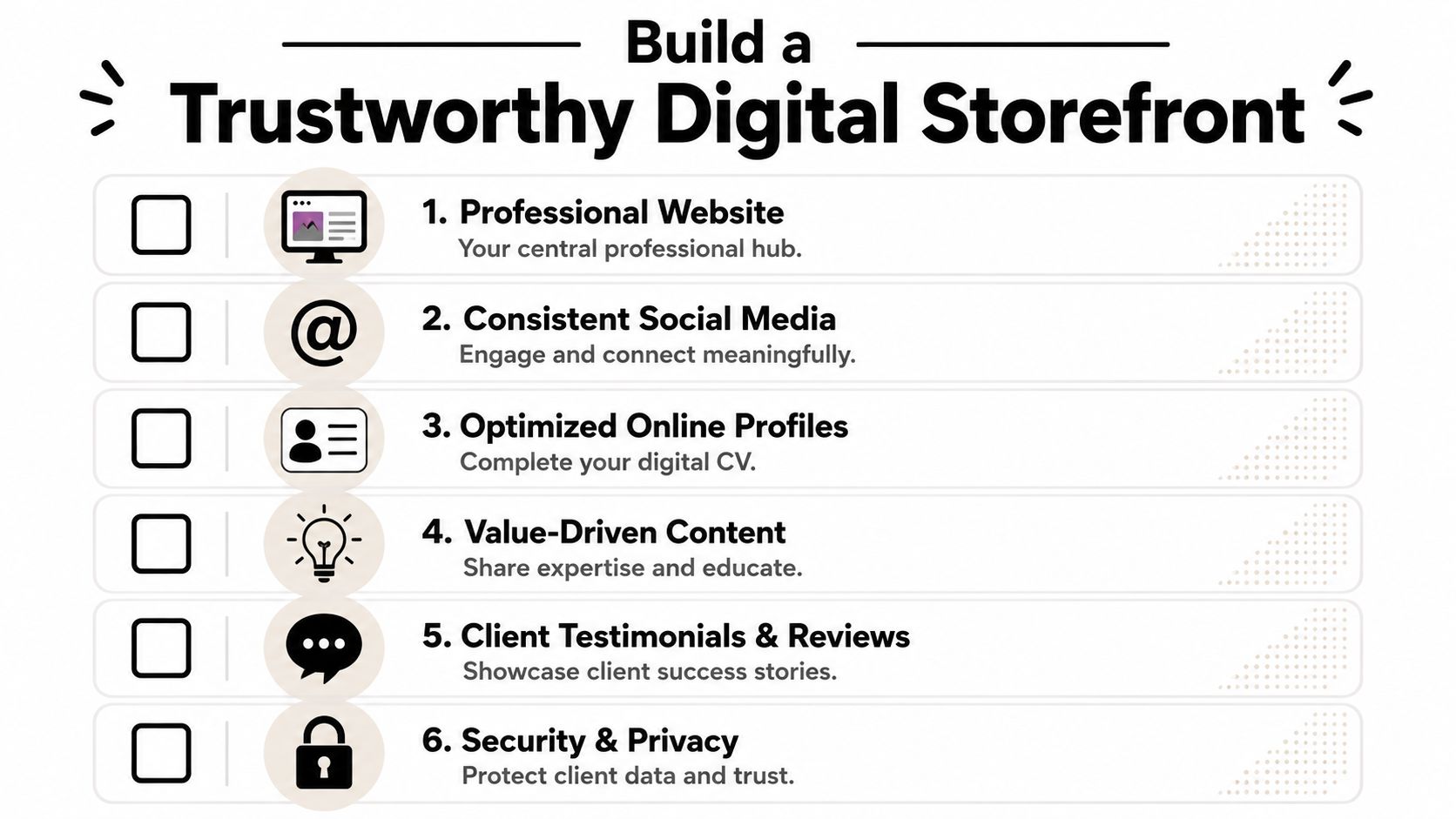
If you only improve one platform, start with LinkedIn. It's usually the first place a prospect, referral partner, recruit, or journalist checks.
Use this checklist:
Most advisor websites try to cover every detail. That's a mistake. Your site doesn't need to say everything. It needs to make the right prospect feel like they found the right advisor.
Your About page should answer four questions fast:
A generic About page reads like firm boilerplate. A useful one sounds like a capable professional speaking clearly to a defined audience.
Here's a practical benchmark to use: if your LinkedIn summary and your About page describe different audiences or different priorities, your brand is fractured.
A quick explainer can help your team align on what a credible online presence looks like:
If you serve clients in a geographic market, your Google Business Profile matters. Keep your description, categories, business details, and imagery aligned with the same brand language you use elsewhere.
Your digital presence is your pre-meeting reputation.
This is also where operational help can make sense. Some advisors handle this internally with a marketing coordinator. Others use a content and positioning partner such as Legacy Builder, which works on profile optimization, content development, and audience-facing brand consistency for professionals building authority online.
Content fails when advisors treat it like inspiration instead of infrastructure.
You don't need to post constantly. You need a small system that keeps your message consistent. Advisor branding guidance from FIG Marketing on the rise of personal branding for financial advisors reports that firms combining a defined personal brand with disciplined content execution saw a 45% average lift in lead-to-client conversion. The same guidance points to the main failure point. Inconsistent messaging across channels.
Most advisors create random content because they haven't defined pillars. Fix that first.
Use three pillars:
Planning insight
Explain the kinds of issues your niche faces. Keep it educational and practical.
Decision framework
Show how you think. Walk through tradeoffs, timing questions, and planning considerations.
Values and philosophy
Explain your approach to communication, coordination, and the advisor-client relationship.
That's enough. You don't need ten themes. You need a narrow set you can repeat without sounding repetitive.
Don't build your content engine around high-effort formats if you won't maintain them. Start with formats that are simple to produce and easy to approve.
Three reliable options:
Myth-busting text post
Example opening: “A common mistake I see among equity-compensated employees is assuming tax withholding equals tax planning.”
Client question post
Use a real question in generalized form. Example: “A question I hear from business owners is whether they should prioritize liquidity, tax efficiency, or retirement contributions first.”
Short article or video note
Take one issue and explain your perspective in plain English. One topic. One argument. One takeaway.
Consistency beats variety when you're building recognition.
A basic weekly plan is enough if it's tied to your niche and message.
| Day | Pillar | Format | Example Topic |
|---|---|---|---|
| Monday | Planning insight | Text post | Common planning blind spots for physicians with changing compensation |
| Tuesday | Decision framework | Short article | How to evaluate competing financial priorities during peak earning years |
| Wednesday | Values and philosophy | Text post | Why I use a coordinated planning approach instead of isolated product conversations |
| Thursday | Planning insight | Q&A post | What business owners should organize before a planning review |
| Friday | Decision framework | Short video | Three factors I look at before recommending a major planning change |
Keep this practical. Draft in batches. Review in one block. Publish on a set cadence. Measure response patterns monthly, not emotionally after every post.
If your message starts drifting, don't create more content. Tighten the pillars.
If you judge your brand by likes, you'll make bad decisions.
Likes are weak signals. They can indicate resonance, but they don't prove business impact. Personal branding for financial advisors should be measured the same way you'd measure any serious growth initiative. Track whether visibility leads to trust signals, conversations, qualified opportunities, and stronger client relationships.

Lead indicators tell you whether the market is noticing your brand. Lag indicators tell you whether the brand is changing commercial outcomes.
Use this split:
| Type | What to track | Why it matters |
|---|---|---|
| Lead indicator | Profile views | Shows whether visibility is increasing |
| Lead indicator | Inbound connection requests with context | Signals relevance, not just reach |
| Lead indicator | Direct messages tied to content | Shows your content is starting conversations |
| Lag indicator | Qualified discovery calls | Connects brand activity to pipeline |
| Lag indicator | New clients who mention content or online presence | Confirms brand influence in the sales process |
| Lag indicator | Retention trends and referral quality | Shows whether brand trust is compounding |
You don't need a complex dashboard to start. A spreadsheet works. What matters is discipline.
Brand measurement breaks when advisors react too fast. One post underperforms and they change the message. One topic gets more comments and they abandon their niche. That's how brands get noisy.
A better approach is to review monthly against a short list of questions:
For a broader view of how marketers think about outcome tracking, this article from PressBeat on marketing effectiveness is a useful outside perspective.
The point is simple. Your brand is working when it improves the quality of attention you receive, the quality of conversations you have, and the quality of clients you attract and retain.
If you want help building a financial advisor brand that's clear, credible, and usable across content, profiles, and client-facing touchpoints, Legacy Builder offers support around positioning, messaging, profile optimization, and consistent authority-building content.


You could – but most in-house teams struggle with the nuance of growing on specific platforms.
We partner with in-house teams all the time to help them grow on X, LI, and Email.
Consider us the special forces unit you call in to get the job done without anyone knowing (for a fraction of what you would pay).
Short answer – yes.
Long answer – yes because of our process.
We start with an in-depth interview that gives us the opportunity to learn more about you, your stories, and your vision.
We take that and craft your content then we ship it to you. You are then able to give us the final sign-off (and any adjustments to nail it 100%) before we schedule for posting.
No problem.
We have helped clients for years or for just a season.
All the content we create is yours and yours alone.
If you want to take it over or work on transitioning we will help ensure you are set up for success.
We want this to be a living breathing brand. We will give you best practices for posting and make sure you are set up to win – so post away.
Subscribe to our newsletter and get insights on how to grow your personal brand.
