.svg)
Subscribe to our newsletter and get insights on how to grow your personal brand.
Thank you! Your submission has been received!
Oops! Something went wrong while submitting the form.
.svg)



Before you write a single post, we need to lay the foundation. This isn't the flashy part, but it's the most important. Getting this right is the difference between a brand that connects and converts, and one that just adds to the noise.
It all boils down to defining your expertise and values, nailing down who you're talking to, and then packaging it all into 3-5 core content pillars. This is the framework that will guide every single thing you create from here on out. It’s how you build real authority and stay consistent.
Let's be real: the hard work of building a personal brand happens long before you hit "publish." It starts with some serious introspection.
You have to get crystal clear on who you are, what you're an expert in, and why anyone should care. This isn't about creating some fake online persona. It's about digging deep and clearly articulating the value you already bring to the table. Skipping this step is like building a house with no blueprint—it’s going to be a mess, and it won't stand for long.
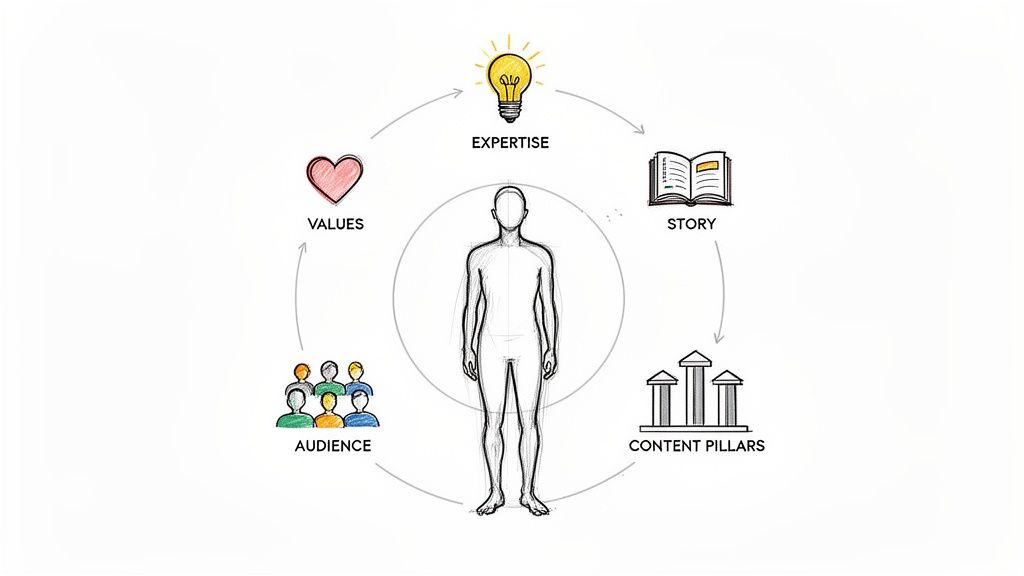
I see so many founders and professionals get stuck here because they think they need to be an expert in everything. The opposite is true. A powerful brand is specific. It owns a distinct niche in the minds of your audience. In a world full of noise, that kind of clarity is your superpower.
First, let's map out your "Zone of Genius." This is where your passions, skills, and the problems you solve for others all overlap. Forget your job title for a second and think bigger.
What do people constantly ask you for help with? What skills are so second-nature to you that you don't even realize they're valuable?
Ask yourself these questions to get the ball rolling:
This isn't an ego trip; it's an inventory check. The goal is to lock in on the one or two areas where you deliver undeniable value. That specificity is the bedrock of your authority.
Your expertise explains what you do. Your values and story explain why you do it. This is how you stop being just another expert and start being a human people want to connect with.
Your values are your non-negotiables. They guide how you act, how you communicate, and how you do business. Are you all about relentless innovation? Unshakeable integrity? Building a strong community? Nail them down.
Your personal story is the emotional glue for your brand. It’s what turns dry facts about your expertise into a relatable narrative that builds trust and makes people want to follow your journey.
Your story doesn’t have to be some epic tale. It could be about what got you into your field, a massive failure that taught you a critical lesson, or the mission that gets you out of bed every morning. Weaving bits and pieces of this into your content is what makes you memorable and real.
For a deeper look at the whole process from start to finish, check out this practical guide to building your personal brand.
You can't be everything to everyone. Trying to is the fastest way to be nothing to anyone.
A huge part of developing your personal brand is knowing exactly who you're trying to reach. I'm not talking about vague demographics. I mean building a crystal-clear picture of your ideal client or follower. You can check out our full guide on how to find your target audience for a personal brand to really dig into this.
What keeps them up at night? What are their biggest career goals? What questions are they secretly Googling? The better you understand their world, the more your content will hit home, making you the obvious person they turn to for help.
Think about this: while 70% of professionals know personal branding is critical for their career, a tiny 15% actually have a defined strategy. That massive gap usually comes from one thing: a failure to connect what they know with what a specific audience needs.
Use this worksheet to move from abstract ideas about your brand to concrete, actionable pillars that will guide your content.
Once you've filled this out, look for the recurring themes and connections. These are the building blocks of your brand and the source of endless content ideas.
Okay, you've figured out your core pillars. Now it's time to stop strategizing and start storytelling.
This is where you take everything you stand for and bake it into your online presence. Your profiles on LinkedIn, X, and elsewhere are your digital handshake. They’re often the very first impression a potential client or partner has of you, and you've got seconds to make it count.
This isn’t about just listing your past jobs. It’s about crafting a clear, compelling narrative that connects your expertise, your values, and your story. A solid narrative doesn't just tell people what you do; it shows them who you are and exactly why they should listen to you.
Let's be real: your social media bio is your digital elevator pitch. On a platform like LinkedIn or X, you have a tiny window to grab someone's attention. Most people screw this up with a boring, passive bio that reads like a line from their resume.
Don't do that. Think of your bio as a magnet—it should pull in your ideal audience and push away everyone else.
A killer bio answers three questions almost instantly:
A generic bio says: "Marketing Manager at ABC Corp." A brand-focused bio says: "I help B2B tech startups build demand generation engines that drive predictable pipeline." See the difference? The second one hits hard, establishing expertise and speaking directly to a specific audience's problem.
If your bio is the hook, your "About" section is where you seal the deal. This is your chance to go deeper and explain the "why" behind what you do, which is absolutely critical for building a brand that feels real.
The biggest mistake I see is people writing a dry, third-person summary of their career. No one wants to read that. Use this space to tell a story that makes your expertise come alive.
Stop listing your skills—start demonstrating them with a story. Talk about a challenge you crushed, a failure that taught you a hard lesson, or the moment you knew this was your passion. That kind of vulnerability builds trust way faster than a list of certifications ever will.
Think about a founder whose first company crashed and burned. They could hide it. Or, they could own it: "My first startup taught me more about product-market fit than any MBA ever could. Now, I use those hard-won lessons to help other founders avoid the same mistakes."
That’s a story. It's powerful, it's relatable, and it makes you credible in an instant.
Having a great story is only half the battle. People actually have to find you. This means you need to optimize your profiles for both human connection and search engines. A professional headshot is non-negotiable. Get a good one that matches your brand's vibe—whether that's approachable and creative or polished and corporate.
Beyond the visuals, you need to think about keywords. What terms would your ideal client type into Google or LinkedIn to find someone like you? Sprinkle those terms naturally into:
The goal here is simple: consistency. When someone Googles your name, everything they find—your LinkedIn, your website, your X profile—should tell the same clear, compelling story. That consistency is what makes a personal brand memorable and, most importantly, trusted.
A powerful personal brand isn’t built overnight. It’s built brick by brick, post by post. That consistency is what separates the brands that gain real momentum from the ones that just fizzle out. But the secret isn't about hustling harder—it’s about building a smart, sustainable system that lets you show up every day without hitting a wall.
Think of it as your content engine. It's a simple process for coming up with endless ideas, creating content in efficient sprints, and keeping a rhythm that makes you a familiar face to your audience. Intensity is fleeting, but a well-oiled system keeps you going, compounding your authority over the long haul.
One of the biggest things that trips people up is the daily pressure to come up with something brilliant right now. The fix? Stop the daily grind and shift to a weekly or bi-weekly creative sprint. We call this content batching.
Instead of trying to think, write, and post every single day, you carve out a few hours once a week to do all the heavy lifting. This lets you get into a state of flow, tackling one thing at a time. A solid workflow is everything, and you can learn how to plan social media content with a surprisingly simple framework.
Here’s what a typical batching session could look like:
This whole approach turns content creation from a daily chore into a focused, manageable task. It frees up your mental space during the week to focus on what really moves the needle: engagement and building relationships.
Listen, you don't need to be everywhere. You don't need to do everything. The real key is to pick content formats that play to your natural strengths and match where your audience actually hangs out. Trying to launch a podcast, a video series, and a newsletter all at once is just a fast track to burnout.
Think about how you communicate best:
Don’t get distracted by every shiny new trend. Pick one primary format and one secondary format to absolutely master first. Once that engine is humming, then you can think about adding another. Consistency in two formats crushes inconsistency across five.
For example, a founder who's a strong writer might make detailed LinkedIn posts their primary thing, and then use X for shorter, punchier thoughts as their secondary channel. Simple and effective.
The most prolific creators aren't coming up with hundreds of new ideas every month. They're masters of repurposing. They take one great idea and slice and dice it into multiple pieces of content. This is the ultimate efficiency hack for your content engine.
This all starts with a core narrative, which is the foundation of your entire digital footprint.
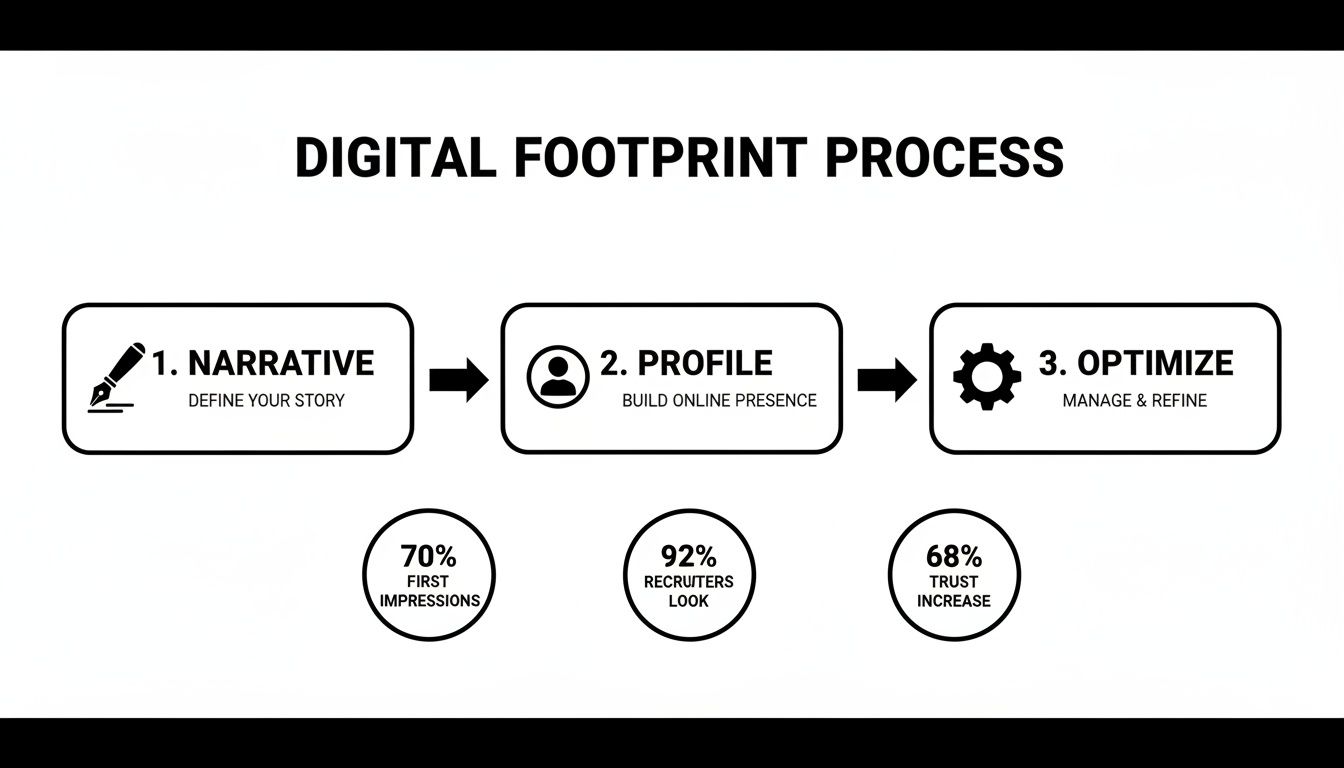
As you can see, a single, powerful narrative can be adapted to build out and optimize your entire presence, making sure every piece of content has maximum impact.
Let’s say you write a killer LinkedIn post about a common mistake people make in your industry. That single piece can become:
When you start thinking of every core idea as a content "asset," you multiply your output without multiplying your effort. For founders and professionals, learning how to write LinkedIn posts that build your personal brand is a great place to start creating these core assets. This system ensures you’re always delivering value on different platforms, meeting your audience where they are, and reinforcing your expertise at every single turn.
Look, putting out consistent content is the engine of your personal brand. I won't argue with that. But engagement? That’s the high-octane fuel that actually makes the whole thing move.
It’s not enough to just broadcast your ideas into the void. Real authority, the kind that gets you noticed and paid, is built in the back-and-forth. It’s built in the trenches of the comments section and the DMs. This is where you stop being a content creator and start being a community leader.
This is how you turn passive scrollers into a loyal crew that trusts you, champions your work, and actually looks forward to what you have to say.
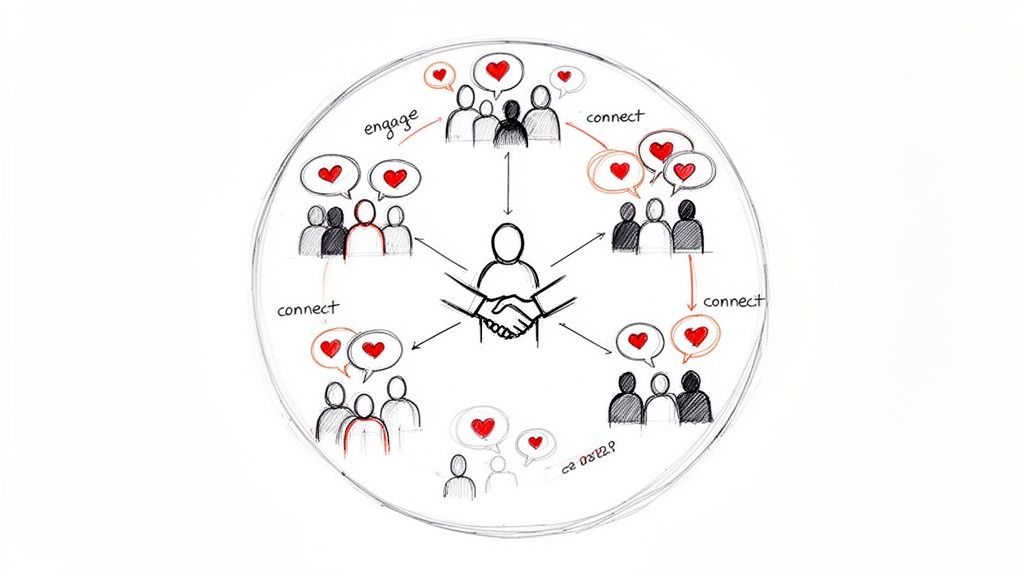
Responding to comments is the most basic form of engagement, but most people get it wrong. A thumbs-up emoji or a quick "Thanks!" is better than crickets, but it’s a dead end. It kills the conversation.
To really build something, you have to be more thoughtful.
Instead of a generic reply, try one of these:
This small shift from just acknowledging to actively conversing makes a world of difference.
Building a community isn't a passive activity. You can't just post and pray. You have to go on offense by adding value to conversations that are already happening. This is how you network without being sleazy and get noticed by the people you want to work with.
Block out 15-20 minutes every single day for this. Find posts from leaders in your industry or your ideal clients and drop a genuinely thoughtful comment. Don't just write "Great insight!" Add to the conversation. Offer a unique perspective or build on their point.
The goal isn't to plug your services in someone else's comments. It's to become known as the person who consistently shows up with smart, valuable ideas. When you do that, people get curious. They click on your profile. They follow you.
This trust-first approach works. The data is clear: an incredible 92% of consumers trust recommendations from individuals over corporate ads. And according to some studies, posts from employee accounts can get 5-10 times more engagement than when the same content comes from a corporate page. It proves that a real human connection is an economic powerhouse. You can dig into more stats on personal branding over at Wifitalents.com.
Finally, you can design your content to spark conversation from the get-go. Don't just lecture your audience; pull them into the discussion. This not only juices the algorithm but makes your followers feel like they're a part of something.
Here are a few dead-simple ways to do it:
When you start using these strategies consistently, you graduate from being just another voice online. You become a community builder—the go-to person people seek out not just for information, but for genuine connection. That’s how you build a personal brand that lasts.
Throwing content out there without measuring what happens next is like driving blind. You're moving, sure, but are you even on the right road? If you want to build a personal brand that actually generates results, you have to stop guessing and start tracking what really moves the needle.
And let's get one thing straight: follower count is not it.
That number might feel good, but it's a classic vanity metric. It tells you almost nothing about your actual influence or whether you're building a brand that can drive business. True impact is measured in connection, not just reach.
The real vital signs of a healthy personal brand are found much deeper than surface-level numbers. Instead of obsessing over how many people follow you, you need to track how many people are actually listening, engaging, and taking action.
Your focus should be on the numbers that tell a story.
These are the metrics that truly matter:
Tracking these metrics is the difference between being popular and being influential. Popularity gets you likes; influence gets you opportunities.
To keep your strategy sharp, you need a regular check-in. Think of it as a quick, honest look in the mirror for your brand—something you can do monthly or quarterly to see what's working, what's not, and where you should double down.
This doesn't need to be complicated. Just use this simple framework:
This regular feedback loop is what turns your personal brand from a static project into a dynamic asset that constantly improves. For a deeper dive, you can learn more about how to measure brand awareness and use that data to fuel your strategy.
To really get a handle on this, it helps to see the metrics laid out and understand what they really mean for your brand.
This table breaks down the essential KPIs to monitor, helping you focus on metrics that reflect genuine impact rather than just vanity.
By zeroing in on these numbers, you start to see a much clearer picture of what's actually working.
Each platform offers its own unique data points, and learning to read them gives you a serious edge.
Take LinkedIn's Social Selling Index (SSI). It’s a surprisingly useful tool that scores your effectiveness in four key areas: establishing your professional brand, finding the right people, engaging with insights, and building relationships.
A low score in one area, like "Engage with insights," gives you a clear, actionable goal for the next month. Similarly, looking at the job titles of people viewing your profile on LinkedIn tells you point-blank if you're reaching your target audience.
When you consistently measure the right things, you stop treating your personal brand like an art project and start running it like a business. You make data-informed decisions, refine your strategy, and build a brand that becomes a predictable engine for growth.
Look, I get it. Stepping out and building a personal brand feels like walking into a minefield of questions. Even with a solid plan, the doubts creep in.
Let’s tackle the most common roadblocks I see founders and professionals run into. No fluff, just straight answers to get you moving.
This is the big one. The fear that by getting super specific, you’re cutting off a massive audience.
It’s completely backward. If you try to be everything to everyone, you’ll be nothing to anyone. A watered-down brand has zero authority.
Think about it. If you need serious heart surgery, are you looking for a general family doctor or the top cardiac surgeon in the state? The specialist wins, every single time. Your brand is no different.
Specificity is what makes you credible. It’s what draws in the right people—the ones who desperately need what you know.
Your sweet spot is where these three things collide:
Don’t just be a “marketer.” Be the marketer who helps B2B SaaS founders with under $5M in ARR build their first repeatable demand-gen pipeline. That’s not a niche; that’s a competitive advantage.
That’s just imposter syndrome talking, and it has killed more great personal brands than anything else.
Here’s the truth: you don’t need to be the #1 guru in the world. You just need to be a few steps ahead of the person you’re trying to help.
Your journey is your expertise. People don't want another unrelatable guru on a pedestal. They connect with the climb. Documenting what you're learning, the mistakes you’re making, and the wins you’re getting right now is gold.
Forget waiting until you "arrive." Frame yourself as a guide. Share the experiments, the results (good and bad), and the process. This builds trust faster than any polished resume ever could. It’s real.
It’s not if you'll get criticism online, it's when. The second you put a real opinion out into the world, someone will disagree. How you handle it says everything about your brand.
First, don’t fire back emotionally. Take a beat and figure out what you’re dealing with. Is it actual feedback or just a troll trying to get a rise out of you?
One hater doesn’t invalidate your message. In fact, it usually means you’re making enough noise to get noticed.
Authenticity is everything, but it's not a license to overshare. Nobody needs to know what you had for breakfast.
The goal is to be relatable, not to turn your LinkedIn profile into a reality TV show. The key is strategic vulnerability.
Share personal stories, struggles, or hobbies only when they tie back to your core message or teach a lesson that helps your audience. A leadership coach sharing a story about botching a team project and what they learned? That's powerful and relevant.
Before you post something personal, ask yourself this one question: "Does sharing this help my audience, build trust, or teach them something useful?" If the answer is yes, you're on the right track. You are always in control of the narrative.
Building a brand that actually moves the needle is a marathon, not a sprint. It takes a clear strategy and relentless consistency—things most busy founders just don't have time for.
At Legacy Builder, we turn your expertise into a magnetic digital presence. We handle the entire system, from content strategy to audience growth, so you can stay focused on running your business.
Ready to build a brand that opens doors you never knew existed? See how Legacy Builder can amplify your impact.


You could – but most in-house teams struggle with the nuance of growing on specific platforms.
We partner with in-house teams all the time to help them grow on X, LI, and Email.
Consider us the special forces unit you call in to get the job done without anyone knowing (for a fraction of what you would pay).
Short answer – yes.
Long answer – yes because of our process.
We start with an in-depth interview that gives us the opportunity to learn more about you, your stories, and your vision.
We take that and craft your content then we ship it to you. You are then able to give us the final sign-off (and any adjustments to nail it 100%) before we schedule for posting.
No problem.
We have helped clients for years or for just a season.
All the content we create is yours and yours alone.
If you want to take it over or work on transitioning we will help ensure you are set up for success.
We want this to be a living breathing brand. We will give you best practices for posting and make sure you are set up to win – so post away.
Subscribe to our newsletter and get insights on how to grow your personal brand.
