.svg)
Subscribe to our newsletter and get insights on how to grow your personal brand.
Thank you! Your submission has been received!
Oops! Something went wrong while submitting the form.
.svg)



Most personal branding advice for consultants starts with the wrong promise: post consistently and the leads will follow. That advice confuses visibility with trust. A buyer may see your content, visit your profile, and still decide you're too broad, too polished, too generic, or too difficult to evaluate.
I've helped founders build brands that convert, and the pattern is consistent. The consultants who generate better commercial conversations don't just publish more. They create alignment between their niche, message, proof, profile, content, and interactions. Their audience knows who they help, how they think, and why a conversation with them is worth having.
Personal branding for consultants works when it reduces buyer uncertainty. This guide shows you how to close the gap between being noticed and being trusted enough to hire.
Consistent posting doesn't guarantee consistent leads. It only guarantees that you're producing more opportunities for people to notice you. If your positioning is vague or your proof is missing, increased visibility can expose the problem rather than solve it.
Consultants often spend money on ghostwriters, design, profile rewrites, scheduling tools, and engagement support before answering a more basic question: what exactly should a buyer trust you to do? A polished profile that says “strategic advisor, growth consultant, and transformation expert” may sound senior, but it gives a buyer no clear reason to choose you over dozens of similar professionals.
The commercial case for personal branding is real. The global personal branding services market was estimated at USD 720 million in 2025 and is projected to reach USD 1.4 billion by 2034, with a projected compound annual growth rate of 7.7%, according to the 2025 personal branding services market estimate. The category's growth suggests that visibility, credibility, content, and profile management have become formal business services rather than casual self-promotion.
A buyer evaluates your brand through several connected signals:
If one signal contradicts the others, trust weakens. A consultant may publish sharp operational advice but maintain a profile that describes unrelated services. Another may have strong testimonials but publish only generic motivational content. A third may have a narrow niche but never explain the method behind the offer.
Practical rule: Don't measure your brand by how often people see you. Measure it by how quickly the right buyer understands your value.
Search your name as if you were a prospective client. Review your LinkedIn headline, About section, featured content, website, and recent posts. Then ask whether each asset supports the same answer to three questions:
If the answers change from channel to channel, your branding budget is paying for disconnected activity. Fix the message architecture before increasing publishing volume.
Most consultants don't have a content problem. They have a positioning problem. They address too many audiences, describe too many capabilities, and use language that makes their experience sound interchangeable.
A benchmark report covering more than 200 business leaders identified persistent gaps in digital presence, networking, and positioning, as discussed in the 2025 personal branding benchmark report. The important lesson isn't that professionals lack effort. It's that activity doesn't compensate for an unclear commercial identity.
A niche isn't a prison. It's a buying signal. You can still accept work outside your public specialty, but your brand needs a clear center of gravity.
Start with four inputs:
Suppose you advise companies on operations. “I help businesses improve efficiency” is too broad. “I help growing software companies replace founder-dependent delivery processes with repeatable operating systems” gives the buyer a situation, an audience, and a meaningful problem.
That statement also creates content territory. You can discuss process bottlenecks, decision rights, documentation, delivery quality, and the trade-offs leaders face when formalizing operations.
A niche such as “leadership consultant” describes a category. A useful niche describes a buyer, situation, and outcome. “Leadership consultant for executives” remains broad because it doesn't identify the moment when a buyer needs help.
Use this positioning formula:
I help [specific buyer] solve [specific problem] so they can [commercially relevant outcome], using [distinctive method or perspective].
Keep the language plain. Buyers don't reward complexity. They reward recognition. If someone can read your positioning and immediately think, “That's my situation,” you've done more strategic work than another month of general thought leadership.
Review past proposals, discovery notes, testimonials, and referrals. Look for repeated words that clients use to describe their problem and the value they received. Your market language is usually more useful than the language you invent in a branding workshop.
For an example of how sharper thought leadership and business development can reinforce each other, review Prime Origin's business development results. It's a useful reference point for connecting visibility with commercial positioning rather than treating content as an isolated activity.
You can also use this guide to finding an authentic and profitable niche to pressure-test your audience, expertise, and differentiation. The aim isn't to find the smallest possible market. It's to find the clearest credible market where your experience gives you an advantage.
Consultants often say they have nothing to post because they can't disclose client details. That's usually a process failure, not a lack of expertise. Your client work contains patterns, questions, trade-offs, and decisions that can become valuable content without revealing confidential information.
The safest approach is to remove identity and preserve the reasoning. Don't tell the story of a client. Explain the type of decision that appears repeatedly in your work.
After discovery calls, workshops, and project reviews, capture four categories:
A question such as “Should we hire before fixing the process?” can become a diagnostic post. A trade-off such as “speed versus control” can become a decision framework. A recurring pattern such as “every approval still returns to the founder” can become an observation about organizational design.
The content becomes useful because it reflects real judgment. It doesn't need a client logo to feel credible.
A practical monthly rhythm can include:
This structure gives your audience different ways to evaluate you. The diagnostic post demonstrates recognition. The method post demonstrates competence. The case-pattern post demonstrates experience. The opinion post demonstrates judgment.
Never include names, exact timelines, internal documents, identifiable business details, or results that could reveal a client. Ask permission when a story requires specifics. If permission isn't available, write from the pattern:
“Several leadership teams I've worked with had the same approval bottleneck.”
That sentence is safer than describing a recognizable company, but it still creates a useful teaching moment. Add the decision logic, not invented drama. Explain what you noticed, what options existed, and why one route made more sense.
Client work becomes persuasive content when you teach the reasoning, not when you advertise the engagement.
Keep a private content bank with three fields: the original question, the generalized lesson, and the safest format for publishing. When a client asks something twice, treat it as a content signal. When several projects reveal the same obstacle, treat it as a point of view.
A consultant's content system needs more than topics. It needs controls that keep the brand recognizable while allowing the format to fit the audience and the platform.
A cross-cultural branding study found positive effects for customized content format, a clearly characterized personal theme, and personal interaction frequency. The reported standardized effects were β = 0.232 for customized content format, β = 0.278 for characterized personal theme, and β = 0.237 for personal interaction frequency, with the reported significance values below the study's stated threshold. The study also reported a positive relationship between audience engagement and cross-cultural branding effectiveness, with β = 0.155 and p = 0.021. Review the cross-cultural branding study for the full research framework.
The practical conclusion is simple: your format, theme, and interaction habits need to work together.
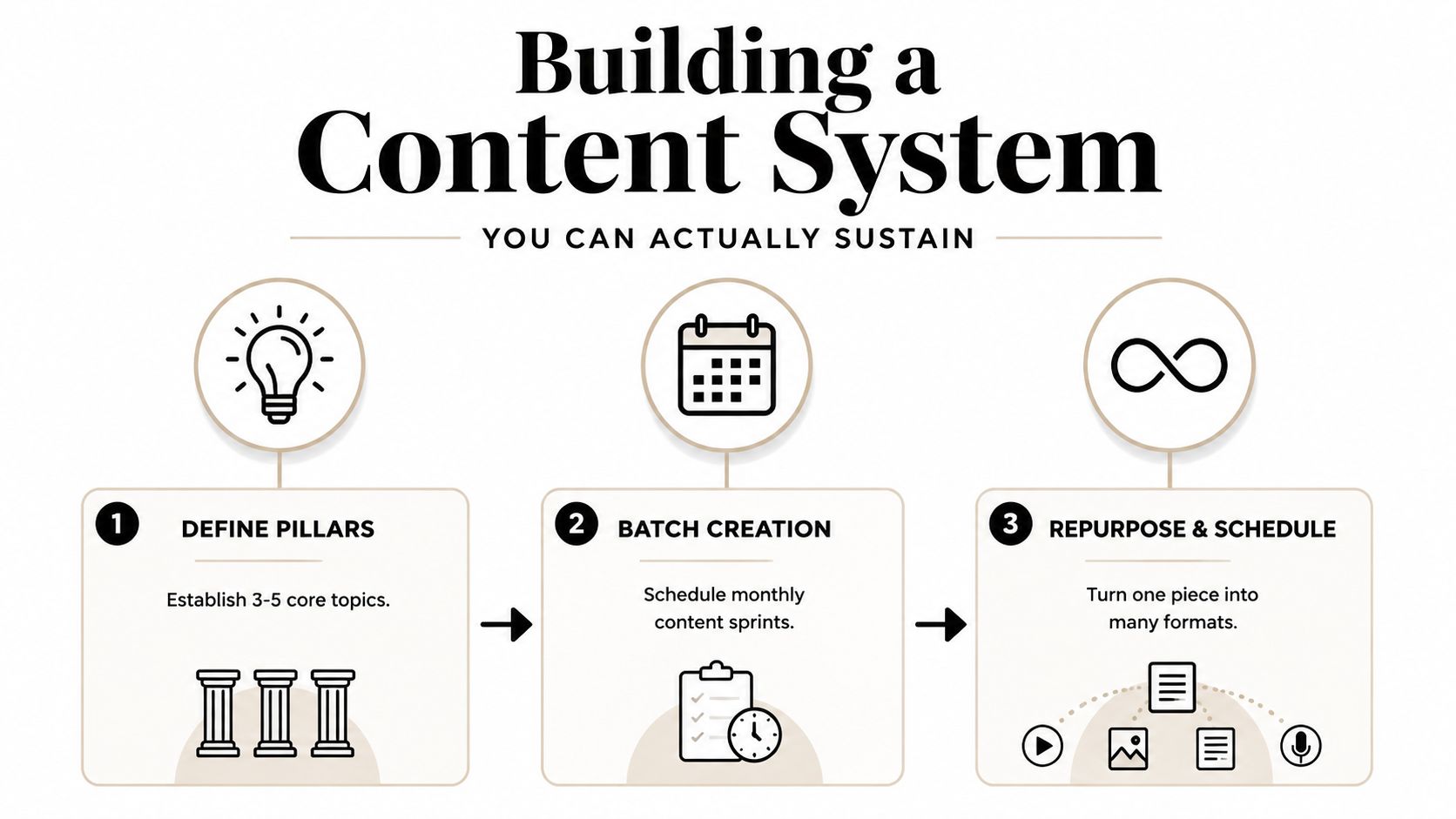
Choose three to five core themes that your ideal buyers already care about. For an operations consultant, those might include decision-making, founder dependency, delivery systems, and organizational clarity. Your personal theme is the lens that makes those subjects feel connected.
Then decide how each theme appears. A complex framework may work as a LinkedIn text post or newsletter. A visual process may work as a document post. A short explanation may work as native video. Customized format doesn't mean chasing every platform trend. It means matching the form to the idea.
Consistency depends on reducing decisions. Create a repeatable template for your opening, argument, example, and closing question. Keep visual choices recognizable, and reserve time to respond to comments while the subject is still active.
A 2026 panel study of 460 Instagram creators found posting consistency was positively associated with average monthly likes, reported at β = 0.326, and comments, reported at β = 0.234, with both relationships reported as statistically significant at the study's stated level. Those findings come from the 2026 study of creator posting consistency. The platform differs from consulting-led LinkedIn publishing, but the operational lesson transfers: a stable cadence supports repeat audience interaction.
| Control | Effect Size | Why It Matters |
|---|---|---|
| Customized content format | β = 0.232 | The idea reaches people in a form they can use |
| Characterized personal theme | β = 0.278 | A clear perspective makes expertise recognizable |
| Personal interaction frequency | β = 0.237 | Two-way participation builds familiarity and trust |
Use a monthly creation sprint to turn one substantial idea into several assets. A client question can become a diagnostic post, a short video, a newsletter section, and a conversation prompt. The guide to repurposing content offers a useful view of adapting one source idea across formats without repeating the same message mechanically.
For a deeper operating model, see this content repurposing framework. Tools such as Buffer, Notion, and native LinkedIn scheduling can support the workflow. A done-for-you option such as Legacy Builder can also combine positioning, content creation, publishing, and audience interaction when execution is the constraint.
Your LinkedIn profile isn't a résumé pasted onto the internet. It's a buyer's first evaluation of your expertise, relevance, and communication style.
LinkedIn launched in 2003, and Microsoft acquired the platform in 2016 for USD 26.2 billion, according to the historical and platform context summarized in LinkedIn's consultant branding guidance. LinkedIn has also reported more than 1 billion members globally, giving consultants a large professional environment in which to demonstrate expertise and develop relationships.
Reach matters, but profile clarity determines what visitors do with that reach.
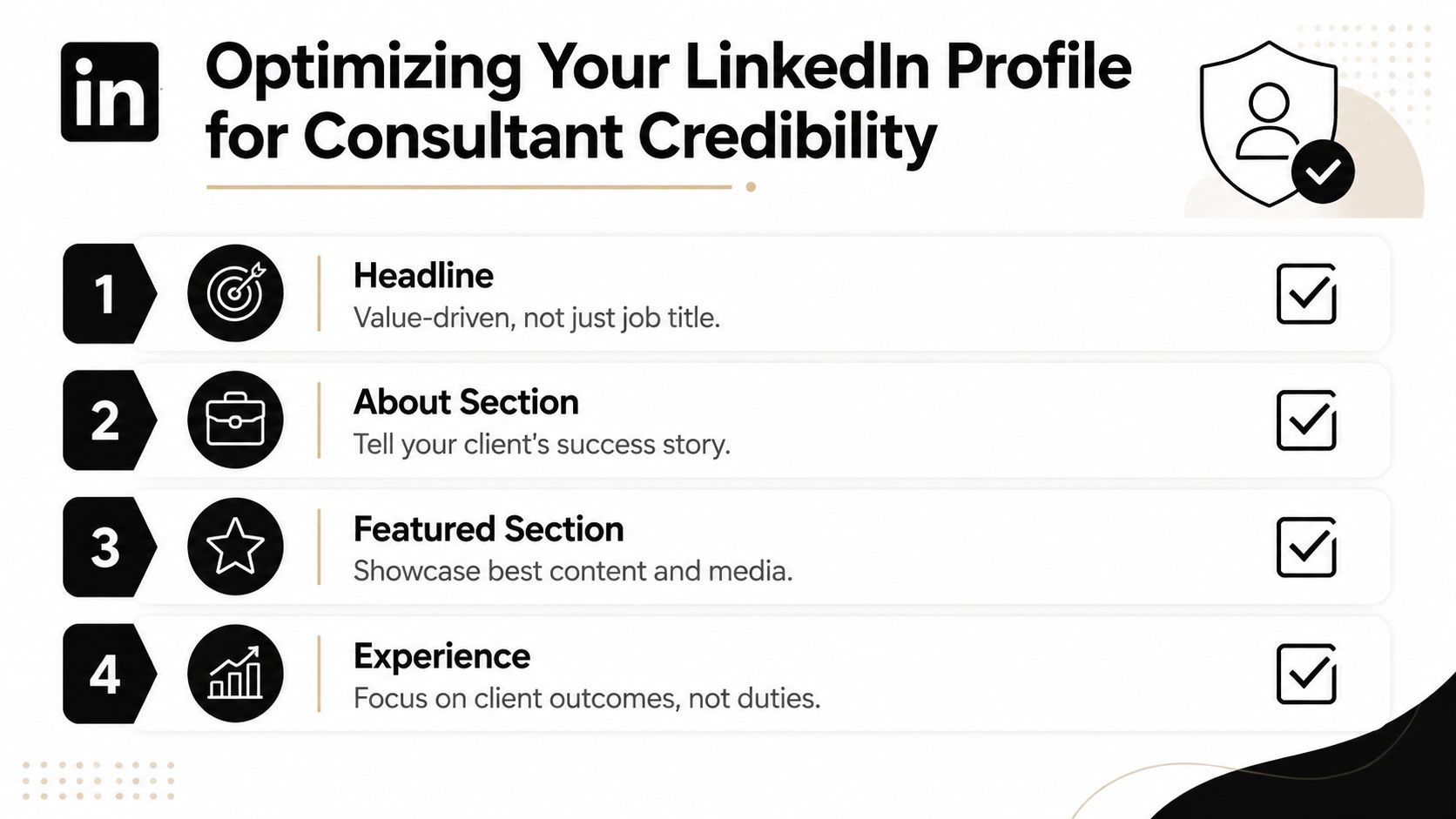
Your headline should describe value, not status. Replace a title such as “Independent Business Consultant” with a clear statement about the buyer, problem, and approach you support. Use the terms a prospective client would search for.
Your About section should make the problem recognizable. Open with the situation your clients face, then explain how you think about it, what you do, and who should contact you. Avoid a chronological autobiography. Buyers want to understand whether your experience applies to their problem.
Your Experience section should focus on decisions and outcomes. Don't list responsibilities that sound like a job description. Explain the types of problems you handled, the choices you made, and the conditions in which your method works.
Your Featured section should provide proof quickly. Add your strongest framework, relevant article, client-approved testimonial, interview, or case-pattern post. Every item should answer a buyer's silent question: “How does this person think?”
For practical guidance on writing the most important profile copy, use these LinkedIn About section best practices.
Your posts and profile must make the same promise. If your headline says you help SaaS leaders improve delivery operations, your recent content shouldn't primarily discuss unrelated productivity habits. Variety is fine. Confusion is expensive.
Use a consistent profile image and professional visual identity, but don't let aesthetics carry the strategy. If video supports your communication style, review these LinkedIn video marketing tips before adding it to your publishing mix. Native demonstrations can make your thinking easier to evaluate, especially when your work depends on explanation and judgment.
A consultant who publishes useful ideas but ignores relevant conversations is using LinkedIn as a broadcast channel. Buyers rarely trust a profile because of one post. They build familiarity through repeated exposure, useful comments, and direct interactions that don't feel like disguised pitches.

Consider two consultants targeting the same audience. The first comments “Great insights” beneath popular posts, sends connection requests with a service pitch, and measures success by reactions. The second adds a specific counterpoint, shares a relevant operating example, and asks thoughtful questions in private only after a real exchange has started.
The second consultant is building commercial familiarity. They're showing how they think before asking anyone to buy.
Create a private list of people who matter to your practice:
Follow their work. Read before responding. Comment when you have a useful observation, not because you need to maintain an arbitrary activity streak.
A strong comment adds one of four things: a relevant example, a distinction, a challenge, or a practical question. “This is right” contributes little. “The hidden issue is often decision ownership, because teams can document a process and still send every exception back to the founder” demonstrates a perspective a buyer can remember.
The platform research cited earlier also identified personal interaction frequency as a positive engagement control. That doesn't mean automated replies or empty activity. It means showing up in a way that reinforces your chosen theme.
Don't open with an offer. Reference the conversation, answer a question, or share a relevant resource. A useful message might say that you noticed someone discussing a problem you work on, then offer one observation without forcing a call.
If they respond with a real challenge, continue the conversation. If they don't, leave the relationship alone. Trust declines when every interaction becomes a sales sequence.
Track quality rather than volume. A meaningful signal is an ideal buyer asking a follow-up question, referring someone to your post, accepting a conversation, or describing your niche accurately to another person. Those actions tell you more than broad engagement from people who will never buy or refer your work.
Follower counts and likes are easy to see, but they don't tell you whether your brand is helping buyers choose you. A consultant needs a measurement system that connects attention to commercial trust.
Track three layers.
Review who engages with your posts and profile. Are they potential buyers, referral partners, peers, or unrelated audiences? A smaller audience with strong relevance can be more useful than broad attention that never reaches a buying environment.
Look for repeated themes in profile visits, comments, and connection requests. If people respond to your operational frameworks but ignore broad leadership commentary, your audience is giving you positioning feedback.
Record whether people:
These signals show whether your message is becoming memorable and credible.
Maintain a simple monthly record of brand-influenced opportunities. Note the source of each inquiry, the topic that created recognition, the buyer's stated problem, and whether your profile or content contributed to the conversation.
Don't change your entire strategy after one quiet week. Review patterns over a meaningful operating period, then adjust one variable at a time. If relevant people engage but don't start conversations, improve your call to action or offer clarity. If people visit but don't engage, strengthen your point of view. If conversations start but don't progress, examine your proof and sales process.
The goal isn't to turn every post into a lead. It's to build a coherent body of evidence that makes the right buyer more confident about contacting you.
Legacy Builder can help consultants turn positioning, client insight, and professional expertise into consistent content, profile optimization, and strategic audience interaction. If your brand is clear but execution keeps slipping, visit Legacy Builder to explore a done-for-you system built around authentic personal branding.


You could – but most in-house teams struggle with the nuance of growing on specific platforms.
We partner with in-house teams all the time to help them grow on X, LI, and Email.
Consider us the special forces unit you call in to get the job done without anyone knowing (for a fraction of what you would pay).
Short answer – yes.
Long answer – yes because of our process.
We start with an in-depth interview that gives us the opportunity to learn more about you, your stories, and your vision.
We take that and craft your content then we ship it to you. You are then able to give us the final sign-off (and any adjustments to nail it 100%) before we schedule for posting.
No problem.
We have helped clients for years or for just a season.
All the content we create is yours and yours alone.
If you want to take it over or work on transitioning we will help ensure you are set up for success.
We want this to be a living breathing brand. We will give you best practices for posting and make sure you are set up to win – so post away.
Subscribe to our newsletter and get insights on how to grow your personal brand.
