.svg)
Subscribe to our newsletter and get insights on how to grow your personal brand.
Thank you! Your submission has been received!
Oops! Something went wrong while submitting the form.
.svg)


Most content repurposing advice starts with the wrong question: How many posts can we squeeze from this asset? That volume-first mindset turns a useful article, podcast, or founder interview into a pile of near-duplicates. Platforms notice when the new version offers no new reason to read, watch, save, or reply, and audience fatigue arrives before reach does.
A stronger content repurposing framework starts with selection. You decide which source assets still contain useful thinking, which themes support your positioning, and which formats can carry the idea without flattening it. The widely cited 2026 summary data reflects why this matters: 94% of marketers say they repurpose content in some form, while 60% say repurposed content generates more leads than original-only content. The same research cluster identifies repurposing as the single best-performing content marketing strategy for 46% of marketers, and reports that one blog post can become 8-12 content pieces while extending content lifespan by 300% on average (content repurposing ROI statistics).
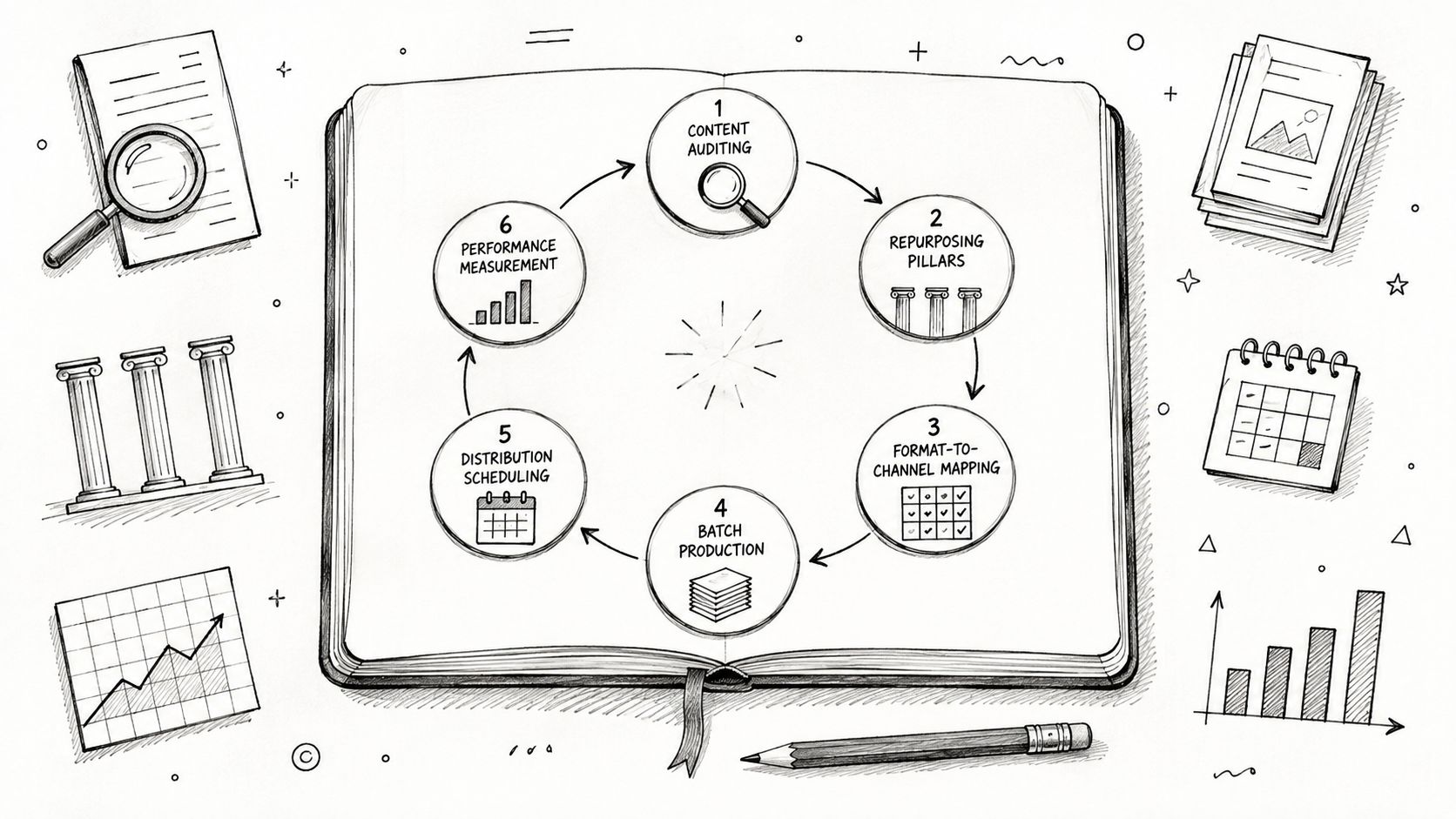
That doesn't mean every post deserves another life. A founder with 40-80 existing posts can still feel invisible if the archive is unmanaged, the themes are scattered, and every derivative piece sounds like a transcript excerpt. The framework below uses six moves, audit, pillars, mapping, batching, distribution, and measurement, to turn old content into a controlled publishing system rather than a recycling bin. For a broader menu of tactical approaches, Trendy's guide to 7 ways to grow fast with repurposing is useful, but the critical discipline comes first: select before you multiply.
The common plan is simple. Find a long article, cut it into short posts, publish the pieces everywhere, and call the work done. It feels efficient because the source already exists. It fails because format conversion isn't the same as editorial adaptation.
A blog paragraph has room for context, transitions, and search intent. A LinkedIn post needs a reason to stop scrolling. An X thread needs sequence and tension. A short video needs a visual or spoken hook that works immediately. Copying the same language across those environments preserves the words while losing the purpose.
Modern platforms give creators feedback through signals such as retention and average view duration. If a video clip starts slowly because it inherits the introduction from a podcast, viewers leave. If a social post repeats an article without a sharper angle, readers have little reason to continue. Recent guidance on repurposing specifically warns against copy-pasting and recommends checking retention or average view duration before deciding whether an asset deserves reuse.
Academic work on reuse in knowledge work makes the distinction more precise. Adopting content means carrying it into a new setting largely as-is. Adapting means changing the content for its new context, including the way its material qualities affect what can be reused effectively (research on generative AI and content reuse). That distinction should govern every decision in this framework.
Practical rule: If the source idea needs a different hook, structure, example, or level of explanation, you're repurposing. If you're only changing line breaks, you're reposting.
A scalable system follows a deliberate sequence:
The first move is one frequently overlooked. They start atomizing before deciding whether the original material is strong enough to carry a second life. That multiplies weakness, not authority.
Most content archives are not repurposing libraries. They are storage rooms. A successful post can contain a weak argument, outdated examples, or attention caused by controversy that has nothing to do with your offer. Recycling every visible winner creates volume, not authority. Audit for selection first, then decide what deserves adaptation.
Set a focused review window and judge assets without rewriting them. The first pass should produce a short queue, not a polished database nobody maintains. For each meaningful asset, record its URL or file location, original platform, possible pillar, last touched date, and one useful signal. That signal might be saves, replies, watch retention, email responses, profile visits, or a pipeline interaction. Use this guide to measuring content performance for your personal brand to refine the measurement model.
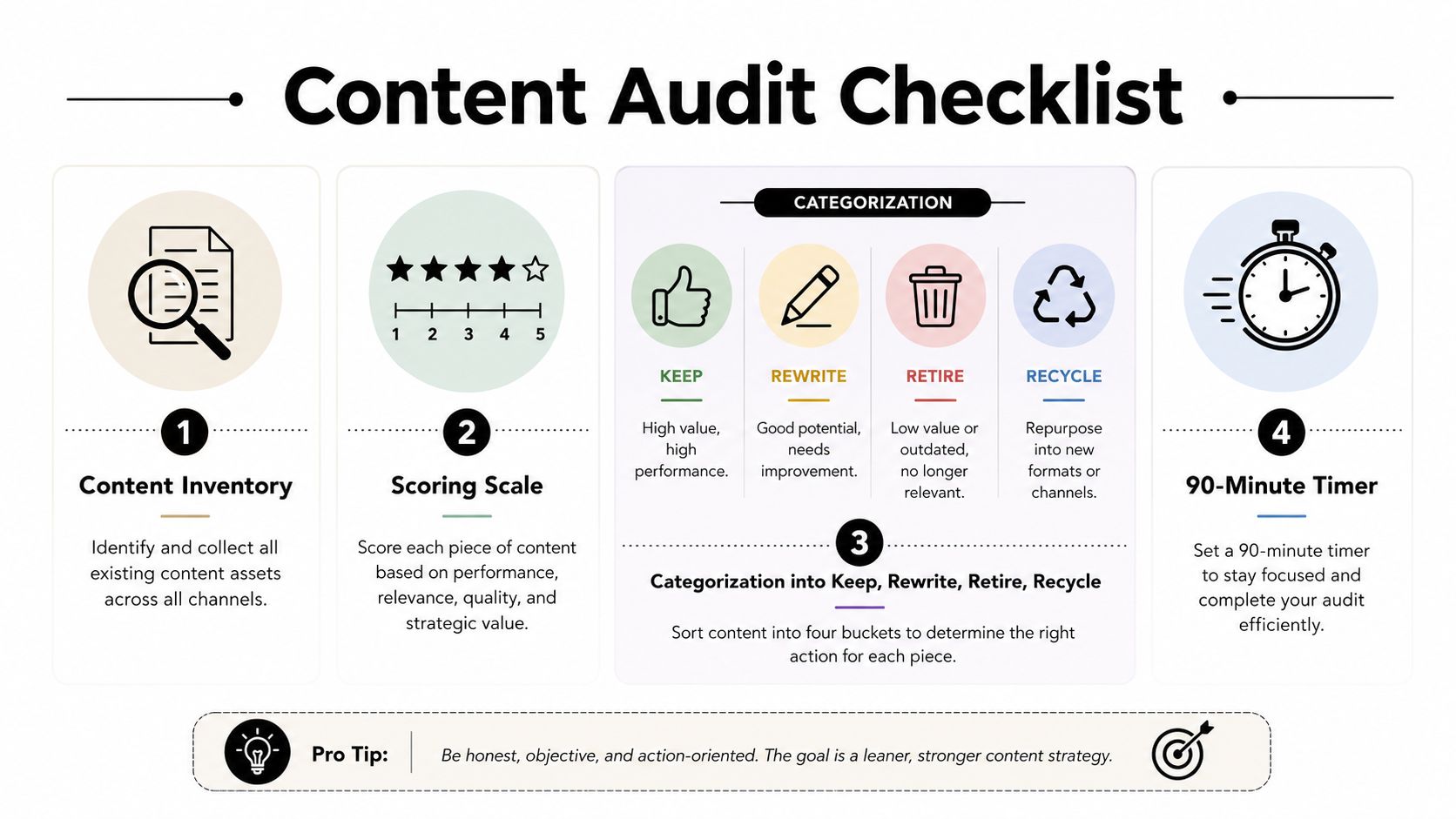
An asset belongs in the recycle queue only when its value is clear across these tests:
Public engagement is not the only evidence. A quiet post may answer a recurring buyer question or express a point of view you can own. A busy post may be a poor source if its attention came from an unrelated controversy. Separate audience activity from business usefulness.
| Verdict | What It Means | Next Move |
|---|---|---|
| Keep | The asset is clear, relevant, and still accurate. | Preserve the source and mark its strongest extractable ideas. |
| Rewrite | The idea is valuable, but the argument, examples, or positioning are weak. | Repair the source before creating derivatives. |
| Retire | The topic is stale, off-position, repetitive, or unsupported. | Remove it from the active repurposing queue. |
| Recycle | The source has useful evidence and can travel into new contexts. | Add it to the prioritized production map. |
Rewrite and recycle are different production decisions. Rewrite means the source itself needs work before you create anything from it. Recycle means the source already has a sound core and can be adapted for a new context. Treating both labels as permission to make more posts turns one mediocre article into several mediocre derivatives.
Interactive products, technical documentation, and app-related material need another check. Verify the underlying experience before turning product claims into public advice. A directory of app QA service providers can help identify suitable review support when product quality affects the source material.
Do not process the whole archive. Choose 6-10 source assets that combine audience evidence, commercial relevance, and durable insight. Tag each with its strongest pillar and add one reason for reuse, such as “strong objection handling” or “clear founder lesson.”
The selection rule is blunt: explain why the asset deserves another audience interaction. If the reason is only that it performed once, leave it out. Repurposing should preserve a useful idea while changing its context, not distribute a weak source more efficiently.
The following video can help teams visualize the audit process before they build their own worksheet.
An archive becomes useful when every surviving idea has somewhere to go. Repurposing pillars are recurring themes that connect your expertise, personal story, audience questions, and commercial offer. They stop the production team from treating every source asset as an isolated creative project.
Use 3-5 pillars. Fewer themes can make the brand feel repetitive, while too many dilute recognition and make routing difficult. A pillar isn't a format, channel, or product feature. “LinkedIn posts” isn't a pillar. “How founders build a reliable publishing habit” can be one.
Review replies, sales conversations, discovery call notes, customer emails, and comments. Group repeated questions into tensions your audience already understands. Then test each possible pillar against three filters:
A pillar that passes only the authority test becomes self-expression without demand. A pillar that passes demand but lacks relevance may generate attention that never reaches your business.
Suppose a founder sells strategic content services to B2B companies. Their pillars might look like this:
Story pillar: Lessons from building the company, including mistakes, decisions, and changes in direction. This creates personal context and gives abstract expertise a human source.
Contrarian pillar: Challenges to familiar marketing advice, such as the belief that more publishing automatically creates more authority. These posts attract discussion when the founder can defend the position with experience.
How-to pillar: Practical systems for interviews, editorial planning, content audits, and distribution. Readers can see the founder's operating method here.
Offer pillar: Explanations of what strategic support changes, who benefits, and which problems require a team rather than another template. It should clarify the buying decision, not become a stream of product announcements.
Customer proof pillar: Client lessons, anonymized patterns, and permitted testimonials. The emphasis belongs on the problem, decision, and learning, not on inflated praise.
Every asset from the recycle queue gets one primary pillar. It may support another theme, but one primary label keeps production decisions fast. If an article touches founder discipline, audience research, and content operations, choose the pillar that best supports the intended business conversation.
Selection beats extraction. A source asset should strengthen a recognizable idea, not merely fill an empty publishing slot.
Create a simple pillar brief for each theme. Include the audience question, the point of view you want to own, proof you can use, formats that suit it, and the offer it can lead toward. This brief becomes the filter for the mapping stage, where you decide how each idea should travel.
Repurposing fails when teams treat it as extraction. One blog post does not automatically deserve thirty derivatives. The map should first decide which source assets are worth recycling, which pillar they support, and where copying the original structure would weaken the idea or reduce reach.
Start by isolating the core asset in each source. It might be a process, story, objection, framework, opinion, customer question, or explanation. Assign it one primary pillar, then choose formats based on what the audience must understand on each channel. The idea can remain consistent, while its opening, evidence, pacing, and structure change.
A long-form podcast episode may contain several arguments, stories, and explanations. Select only the parts that can stand alone. A written breakdown can organize the reasoning, a carousel can make the sequence easy to scan, and short clips can isolate moments that work without the full conversation.
A strong LinkedIn post usually carries one observation and a compact argument. It may become a newsletter section or an X thread if the idea has enough depth to develop. Turning it into a YouTube video requires added examples, demonstrations, or a wider narrative. If the source does not provide that material, mark the video skip.
| Source Asset | Repurposed Formats | Skip If |
|---|---|---|
| Long-form podcast episode | Written analysis, carousel, short clips, email insight | The strongest moments depend on guest context or slow setup. |
| Evergreen blog post | LinkedIn posts, newsletter section, carousel, short video script | The article is thin, outdated, or built around search phrasing rather than a clear idea. |
| Founder story | Text post, email narrative, short video, quote graphic | The story has no decision, tension, lesson, or relevance to the audience. |
| Customer question | FAQ post, sales email, short explainer, webinar segment | The answer is too specific to one account or includes confidential details. |
| High-performing LinkedIn post | Newsletter section, X thread, follow-up post | The post is a single-line observation with no argument to develop. |
Platform-native adaptation changes more than the headline. A written breakdown can lead with the conclusion. A video can open with the costly mistake. An email can begin with a personal note to an owned audience. A carousel can turn the reasoning into a sequence of visual decisions.
Do not force every source into every channel. If the format does not translate naturally, mark it skip and record the reason. Retiring a derivative protects editorial quality and keeps production capacity for assets with a stronger chance of carrying the idea.
Research on reuse in knowledge work shows that the material qualities of content affect what can be adopted or adapted. That supports a selection-led system: choose the source and angle first, then decide how far the idea should travel (generative AI and reuse research).
Your one-page map should include the source, pillar, core idea, target format, channel, hook angle, adaptation reason, and skip decision where relevant. Add the intended business connection so a derivative earns attention without drifting away from the original purpose. The map turns repurposing from copy-pasting into a set of deliberate editorial choices.
A batch workflow should make the next action obvious to every person involved. The mistake is to batch by source alone, then hand a large undifferentiated folder to a writer or designer. Batch by stage and role so each handoff has a defined artifact.
A practical week uses three slots:
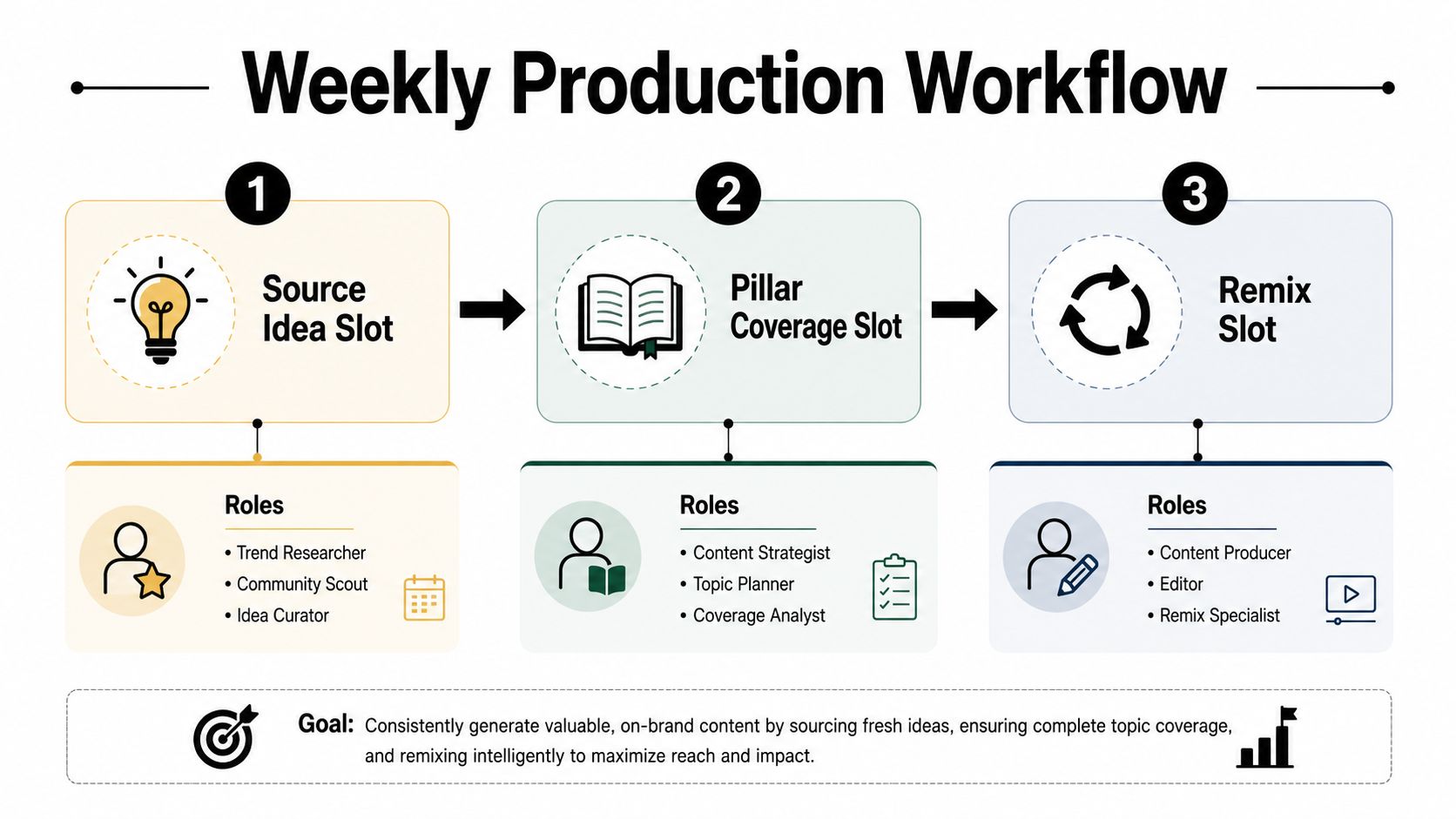
On Monday, the strategist reviews the selected source and confirms the pillar, audience problem, and intended business connection. On Tuesday, the founder records a 20-minute voice memo that expands the source idea with a story, objection, or example. The strategist turns that material into a brief rather than asking the founder to draft every derivative.
On Wednesday, the writer ships one long-form piece. The designer receives the approved concepts for visual assets, while the video editor marks usable moments for clips. By Friday, the team has pulled 6-8 derivative pieces from the source, each with its own hook and channel instruction. Those outputs might include text posts, a newsletter section, a carousel, and short videos, but only when the map supports those formats.
The production artifacts should be visible:
Teams that want to formalize this cadence can use a guide to content batching and workflow management as a reference point.
The founder should protect the source session. Their job is to supply judgment, experience, and voice. The production team should carry the repeatable work downstream.
The workflow works when each person edits the right layer. Strategists decide what deserves attention. Writers shape the argument. Designers make the idea legible. Editors make spoken content watchable. Schedulers deploy the finished work. Nobody should be asked to rescue a weak source at the final step.
Distribution begins after production, but it shouldn't be treated as a single publishing command. One batch needs a sequence that gives each channel a distinct entry point into the idea. LinkedIn can carry the professional argument, X can carry the compressed tension, email can add context for an owned audience, and short-form video can make the point audible and visual.
A useful spacing rule is 48-72 hours between closely related versions. This gives the first asset time to generate replies and objections before the next version appears, while keeping the core idea active across the week. The interval isn't a law. If the first post reveals a new objection, revise the next hook rather than publishing the original plan unchanged.
| Day | Channel | Native angle |
|---|---|---|
| Monday | Lead with the problem and the founder's point of view. Invite informed disagreement or examples. | |
| Tuesday | Short-form video | Open with the mistake, result, or surprising decision. Show one complete lesson rather than a teaser. |
| Wednesday | Add context, nuance, and a practical application. Link to the deeper source when useful. | |
| Thursday | X | Turn the argument into a sequence of concise claims, with one idea per post in the thread. |
| Friday | Use a customer question, objection, or behind-the-scenes lesson that extends the original point. | |
| Weekend | Reserve slot | Hold a strong reply, quote, or visual remix for a timely follow-up rather than filling the slot automatically. |
Write the hook for the environment. “We audited our content process” is a reasonable email opening but a weak social hook. “Your archive isn't a strategy” creates tension on LinkedIn. “The best content to repurpose is often not your newest content” can open a short video if the speaker follows it with a concrete selection rule.
A scheduler, including an AI-powered social media scheduler, can handle queue management, but automation doesn't replace approval. Check that every version fits the channel, preserves the intended meaning, and doesn't expose private customer details. A calendar guide on creating a content calendar that actually works can help translate the sequence into an operating document.
Replies and direct messages are research. Tag the objections, language, and follow-up questions that appear after publication. Those signals should shape the next source idea, a revised hook, or a new pillar angle. Distribution is complete only when audience response returns to the editorial system.
Measurement should answer a practical question: Which source assets and pillars deserve more production time? Channel-level reach alone won't tell you that. A post can attract attention without creating relevant conversations, while a quieter email or direct message can reveal strong commercial intent.
Separate the dashboard into leading and lagging indicators. Leading indicators show whether the content is earning useful attention:
Lagging indicators show whether that attention supports the business:
Don't average these signals across the whole brand. Read them by pillar, then by format and channel. If the how-to pillar earns saves but no conversations, add a stronger point of view or connect the lesson to a relevant offer. If the story pillar earns replies but attracts the wrong audience, sharpen the business context. If a format repeatedly requires heavy editing without producing useful signals, cut it.
Audit the archive. Define pillars that connect expertise to demand. Map each source to formats it can support. Batch production through clear roles. Distribute with native hooks and spacing. Measure the response by pillar and business outcome.
A practical 30-day kickoff starts with the first three moves. In the first week, inventory and score the archive. In the second, select the recycle queue and define the pillars. In the third, map sources to formats and prepare briefs. In the fourth, run the first production and distribution cycle, then document what the audience responded to.
The benchmark data suggests why disciplined reuse has become standard practice, with 94% adoption among marketers and 60% reporting stronger lead generation from repurposed content (content repurposing ROI statistics). The useful lesson isn't to publish more for its own sake. It's to build a feedback loop that increases the proportion of your output worth publishing.
Legacy Builder helps founders turn their stories, expertise, and existing source assets into pillar-led content, adapted formats, and consistent distribution. If you want this content repurposing framework managed by strategists, writers, designers, and success managers, visit Legacy Builder and start a conversation about your publishing system.


You could – but most in-house teams struggle with the nuance of growing on specific platforms.
We partner with in-house teams all the time to help them grow on X, LI, and Email.
Consider us the special forces unit you call in to get the job done without anyone knowing (for a fraction of what you would pay).
Short answer – yes.
Long answer – yes because of our process.
We start with an in-depth interview that gives us the opportunity to learn more about you, your stories, and your vision.
We take that and craft your content then we ship it to you. You are then able to give us the final sign-off (and any adjustments to nail it 100%) before we schedule for posting.
No problem.
We have helped clients for years or for just a season.
All the content we create is yours and yours alone.
If you want to take it over or work on transitioning we will help ensure you are set up for success.
We want this to be a living breathing brand. We will give you best practices for posting and make sure you are set up to win – so post away.
Subscribe to our newsletter and get insights on how to grow your personal brand.
