.svg)
Subscribe to our newsletter and get insights on how to grow your personal brand.
Thank you! Your submission has been received!
Oops! Something went wrong while submitting the form.
.svg)


Most advice about personal branding for coaches is lazy. “Be authentic” sounds good, but it doesn't tell you how to get discovered, trusted, and hired.
Authenticity matters. It just isn't a strategy.
I've seen too many coaches treat branding like self-expression with a Canva account. They post motivational thoughts, rotate through trendy hooks, and hope the right client magically appears in their inbox. That approach creates activity, not demand. If you want a brand that brings in clients, you need an operating system.
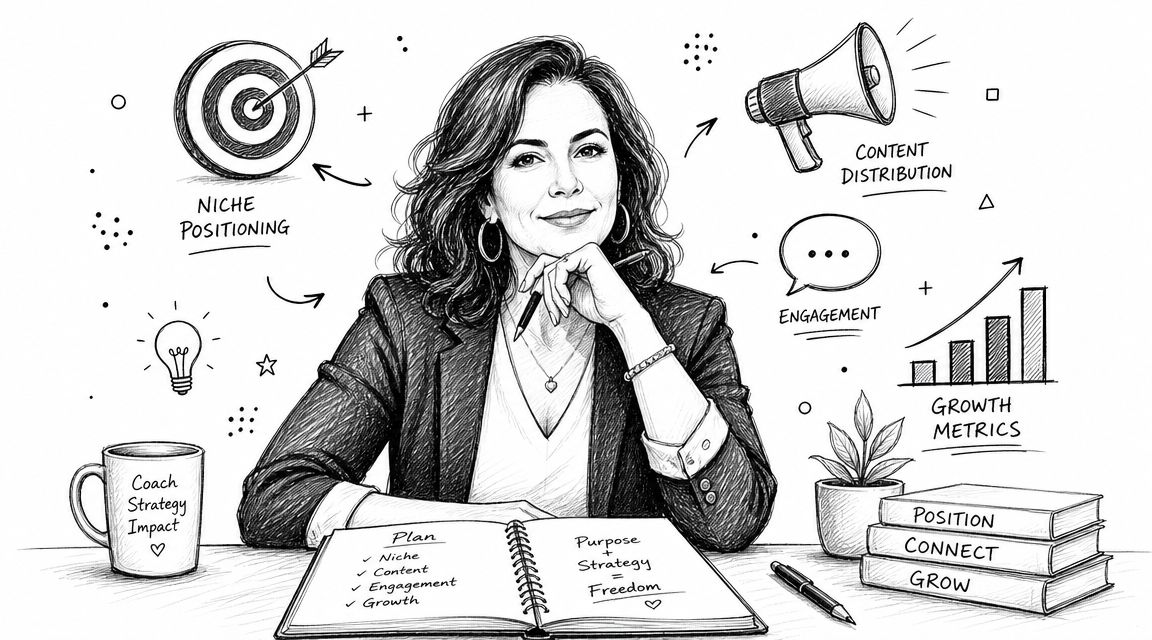
For coaches, personal branding works best when you treat it like a business system with four moving parts: positioning, content, engagement, and conversion. Positioning tells people what you're known for. Content scales that message. Engagement builds trust faster than broadcasting ever will. Conversion turns attention into calls, applications, and sales conversations.
That's the difference between a coach who is visible and a coach who is booked.
“Just be authentic” is incomplete advice because buyers don't hire coaches for honesty alone. They hire coaches whose expertise is clear, relevant, and low risk.
If your brand message is broad, your audience has to work too hard to understand you. And confused people don't inquire. They scroll.

I don't define personal branding for coaches as “showing up online.” I define it as building a repeatable path from stranger to buyer. That path needs structure.
Here's the flywheel I use:
If one of those four pieces is weak, the whole thing stalls. Most coaches overinvest in content and underinvest in position and conversion. That's why they feel busy and invisible at the same time.
Practical rule: If your audience can't describe what you do in one sentence, your brand isn't ready to scale.
Branding also isn't just a vanity exercise. A peer-reviewed study discussed by MentorCruise found that personal branding efforts are associated with greater career satisfaction because they improve perceived employability, which makes you appear more market-ready to potential clients, as noted in this review of personal branding outcomes.
Random content creates random results. A system beats inspiration every time.
That doesn't mean you need to become robotic. It means your content should serve a commercial purpose. Every post should do one of four jobs:
If you want a sharper playbook for channel-specific execution, this guide on how to master social media branding is useful because it pushes the conversation beyond generic posting advice.
The coaches who win aren't always the loudest. They're the clearest. Their brand gives prospects a simple answer to one question: “Why should I trust this person with my problem?”
Before you optimize a profile or write a post, fix your position. If your position is weak, your content has no spine.
The coaching market is crowded. The global coaching market has over 109,200 professionals and generates $4.5 billion annually, which is exactly why a niche isn't optional if you want to be seen and remembered, according to this coaching branding overview.
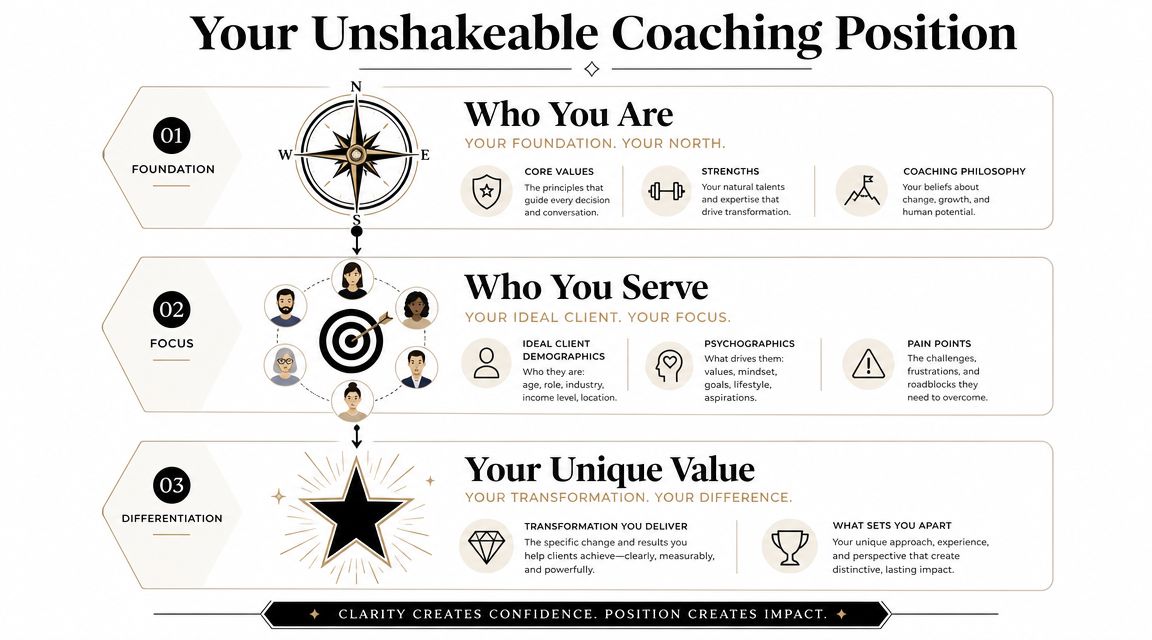
Most coaches try to pick a niche by guessing what sells. That's backward. Start with what you can credibly own.
Run a quick audit across three areas:
You're looking for overlap. The sweet spot is where your natural strengths, your preferred style, and a real market problem meet.
A strong brand position feels narrow from the inside and obvious from the outside.
“Life coach” isn't a position. “Leadership coach” usually isn't either. It's too broad, too crowded, and too forgettable.
A stronger niche combines audience, problem, and outcome. For example:
You don't need a niche that impresses your peers. You need one that instantly tells buyers, “This is for me.”
To pressure-test demand, look at real audience language in comments, search behavior, community questions, and video performance. If YouTube is one of your channels, tools that help you gain YouTube audience insights can help you spot patterns in what your audience responds to.
Here's a useful prompt: What kind of client would I gladly coach for years, and what problem do they urgently want solved?
A quick visual can help if you're still refining that answer:
Your positioning statement should be simple enough to say out loud without sounding rehearsed.
Use this structure:
I help [specific audience] achieve [specific outcome] by using [distinct method or perspective].
Examples:
If you need help shaping the wording, these brand positioning statement examples and templates are useful because they force specificity.
The test is brutal but fair. If ten ideal clients heard your statement, would they immediately know whether they should keep listening?
Content should document your position, not replace it. Once your positioning is clear, content gets easier because you're no longer asking, “What should I post?” You're asking, “Which part of my expertise should I package today?”
That shift matters.
I recommend building your system around a few content pillars. Each pillar should support your offer, reflect your method, and answer a buying question your audience already has. If your content can't do one of those jobs, cut it.
Most coaches need three or four pillars, not twelve. Keep them tight.
Common examples:
The mistake is making every pillar educational. Buyers also need to understand your judgment, your standards, and your approach to results.
Good coaching content teaches. Strong coaching content also qualifies.
The easiest way to burn out is to create from scratch every day. Don't do that. Start with one substantial idea and break it into smaller assets.
A single long-form piece can become a week of content:
That's not “recycling.” It's message reinforcement.
If you want a stronger editorial structure, this guide to a personal brand content strategy that works in 2026 is a useful planning reference.
| Content Pillar | Core Message / "Big Idea" | Primary Format (e.g., Video, Blog) | Repurposed Formats (e.g., X Thread, IG Reel, Quote Card, Newsletter Snippet) |
|---|---|---|---|
| Problem awareness | Your audience misdiagnoses the root issue | Blog post | LinkedIn post, short video, email opener, quote card |
| Method and philosophy | Your process solves the issue differently | Video | X thread, carousel, newsletter section, pinned post |
| Proof and credibility | Real client situations show your method in action | Case-based post | Testimonial graphic, Reel, email story, sales page snippet |
| Actionable guidance | A simple step helps the audience act now | Newsletter | LinkedIn text post, checklist, short clip, story sequence |
I prefer a simple weekly system over an ambitious monthly calendar that falls apart by day four.
A practical rhythm looks like this:
That's enough to stay visible without turning your business into a content factory.
If you don't want to run the system yourself, you can also use a done-with-you partner. For example, Legacy Builder works with clients by turning their story, expertise, and ideas into ongoing content and strategic distribution. That kind of support makes sense when your bottleneck is execution, not expertise.
Most coaching profiles read like mini resumes. That's a wasted asset.
Your profile isn't there to summarize your past. It's there to help the right person decide whether to trust you now. Every line should either clarify your position, prove credibility, or move someone toward action.
Your headline matters more than your bio because it's often the first line people see in search, comments, and profile previews.
A strong headline does three things:
Weak: Executive coach helping people thrive.
Better: I help first-time executives lead with more clarity, stronger communication, and more trust from their teams.
That's clearer, more useful, and easier to remember.
When I audit profiles, I look for friction. Most of it comes from missing context.
Use this checklist:
If a visitor has to guess what you do or what to click next, your profile is underperforming.
Coaches often hide their best evidence three clicks deep. Pull it forward.
Useful proof artifacts include:
For channel-specific ideas, this walkthrough on how to increase profile views on LinkedIn is worth reviewing because it ties visibility improvements back to profile structure.
A good profile doesn't chase everyone. It filters aggressively and converts selectively.
Content gets you noticed. Engagement gets you remembered.
Many coaches underperform in this aspect. They post solid content, then disappear. Meanwhile, buyers are deciding who feels credible, generous, and relevant by watching who participates in conversations well.
If you want stronger personal branding for coaches, stop acting like publishing is the whole job. It isn't. You also need a relationship engine.

Hearing “Dream 100” often brings to mind influencer networking. That's too narrow. Your list should include three groups:
Build a focused list. Follow them closely. Read what they post. Learn their language. Then contribute where you can add a real point of view.
Don't leave low-effort comments like “great post” or “needed this.” Those comments help the platform, not your brand.
Write comments that do one of these things:
That's how people start recognizing your thinking.
A direct message should never feel like an ambush. The point isn't to pitch. The point is to begin a relevant conversation.
A simple DM framework:
Example:
“Your point about new managers struggling with team trust was sharp. I see the same issue, especially when feedback is vague and infrequent. Curious if you've noticed that pattern too.”
That works because it feels human. It shows attention. It creates room for dialogue.
Buyers rarely trust the coach who appears only when it's time to sell.
You don't need a giant audience if you know how to show up in the right places.
Look for:
The point is simple. Instead of waiting for your audience to find you, spend time where attention already exists.
That strategy compounds because engagement improves every other part of the system. It sharpens your language, reveals objections, surfaces content ideas, and increases trust before someone ever books a call.
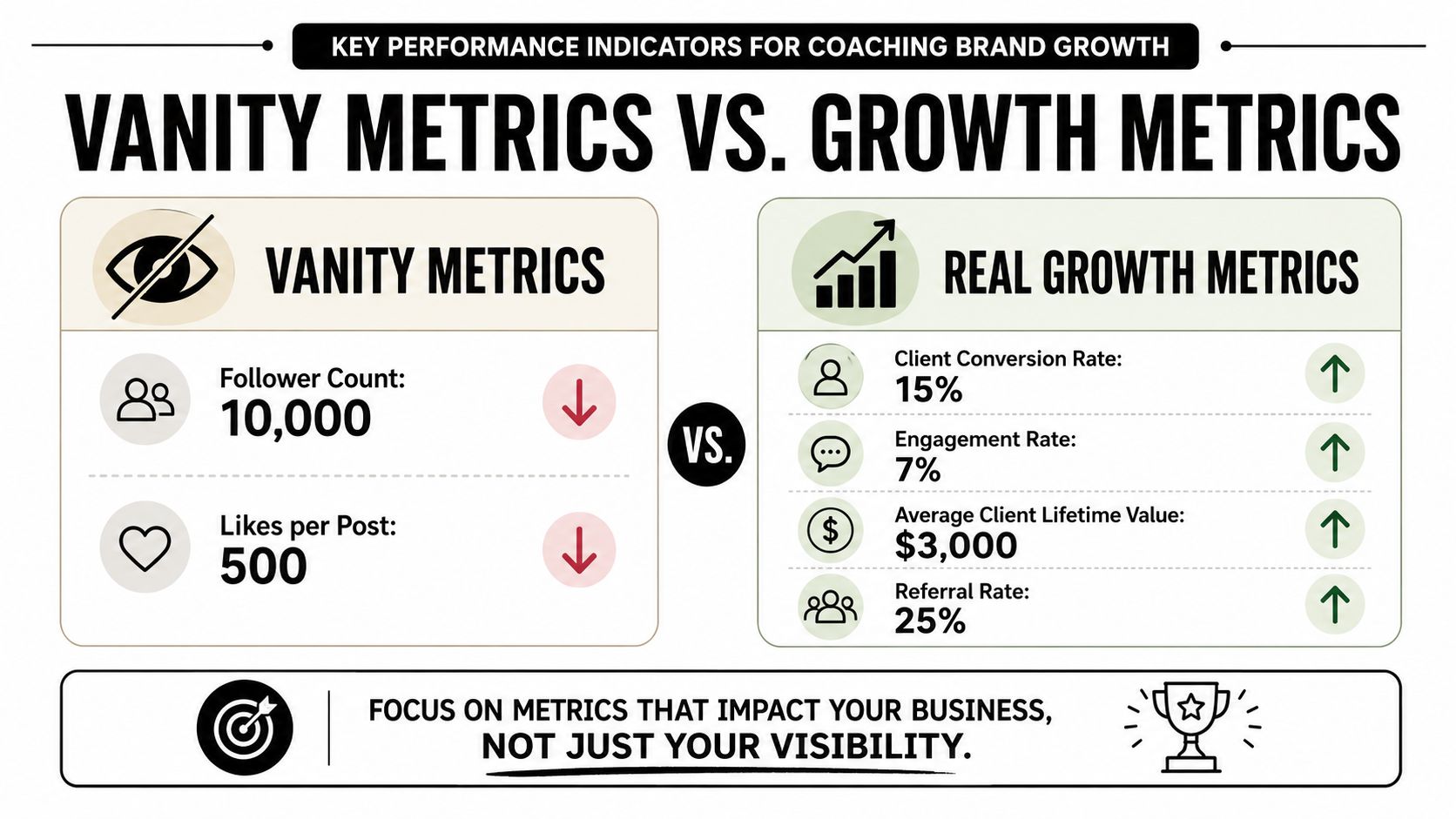
If you track only followers and likes, you'll misread your brand. Visibility matters, but visibility alone doesn't pay for coaching.
The primary task is to measure signs of buyer intent.
That distinction matters because the most common branding mistake is confusing visibility with positioning. Coaches get better insight by watching engagement rate on specific posts, inbound messages, and profile views, which are stronger signals of intent, according to this guide on branding metrics for coaches.
You do not need a complicated analytics setup. You need a small set of metrics you'll review.
I'd track these weekly:
A spike in followers means very little if none of those people move closer to a sales conversation.
Numbers only help if they change your decisions.
If profile views rise but inbound messages stay flat, your content may be interesting but your profile or CTA is weak. If connection acceptance is strong but conversations die in DMs, your outreach may be polite but vague. If one topic repeatedly generates direct questions, build more around that topic and tie it to your offer.
Use metrics to answer practical questions:
That's what real brand growth looks like. Better fit, stronger trust, and more buying signals.
If you want help turning your expertise into a consistent personal brand system, Legacy Builder works with professionals to shape positioning, create content, optimize profiles, and support strategic distribution so your brand does more than look polished. It does the job of attracting the right audience and starting better conversations.


You could – but most in-house teams struggle with the nuance of growing on specific platforms.
We partner with in-house teams all the time to help them grow on X, LI, and Email.
Consider us the special forces unit you call in to get the job done without anyone knowing (for a fraction of what you would pay).
Short answer – yes.
Long answer – yes because of our process.
We start with an in-depth interview that gives us the opportunity to learn more about you, your stories, and your vision.
We take that and craft your content then we ship it to you. You are then able to give us the final sign-off (and any adjustments to nail it 100%) before we schedule for posting.
No problem.
We have helped clients for years or for just a season.
All the content we create is yours and yours alone.
If you want to take it over or work on transitioning we will help ensure you are set up for success.
We want this to be a living breathing brand. We will give you best practices for posting and make sure you are set up to win – so post away.
Subscribe to our newsletter and get insights on how to grow your personal brand.
