.svg)
Subscribe to our newsletter and get insights on how to grow your personal brand.
Thank you! Your submission has been received!
Oops! Something went wrong while submitting the form.
.svg)



Personal brand strategy is often approached backward. Choosing a platform, copying a popular creator's posting rhythm, and measuring progress through impressions and follower growth feels productive, but it often produces a visible account with no clear reason for the right buyer, recruiter, partner, or peer to remember it.
A personal brand isn't built by posting more. It's built by making a sequence of correct decisions: what you stand for, whom you serve, what proof you can offer, where that message belongs, and which signals indicate real trust. Distribution matters, but distribution amplifies a weak position just as efficiently as a strong one.
The practical framework is simple to state and demanding to execute: narrative, audience, content pillars, profiles, distribution, and measurement. Treat those pieces in the right order, and your content starts working as an asset instead of becoming another weekly obligation.
The biggest lie is that posting frequency creates authority. It doesn't. Frequent publishing can increase exposure, but exposure isn't the same as trust, qualified demand, or career advantage.
The better question isn't, “How often should I post?” It's, “What should someone reliably understand about me after seeing my work repeatedly?” If the answer changes from post to post, your audience has to reconstruct your expertise every time. They won't.
Research on personal branding describes the discipline as a distinctive narrative and set of characteristics designed to create competitive advantage, not as a schedule of self-promotional updates (research on personal brand narrative and engagement). That distinction changes the work. You need a recognizable point of view before you need a larger audience.
Practical rule: Never scale distribution before you can explain your positioning in one sentence.
The six-part sequence I use is:
That sequence supports a disciplined 90-day build. The first month establishes meaning, the second creates a repeatable publishing system, and the third tests distribution and quality. The exact calendar matters less than respecting the order.
For consultants, the practical difference between visibility and demand is especially important. A useful guide to consultant branding for leads can help connect positioning with lead generation, but no profile tactic can rescue an unclear offer.
Vanity metrics feel like progress because they're immediate and public. Trust usually appears later, in a thoughtful direct message, a qualified introduction, a speaking invitation, or a buyer who arrives already convinced that you understand their problem.
Personal brand strategy did not begin with content calendars or platform tactics. It began as a response to a changing career structure. In 1997, Tom Peters published the Fast Company essay “The Brand Called You,” arguing that individuals should manage their careers like brands. He expanded the idea in his 1999 book The Brand You 50 (history of personal branding).
The discipline then passed through three recognizable eras, each revealing a limitation in the one before it.
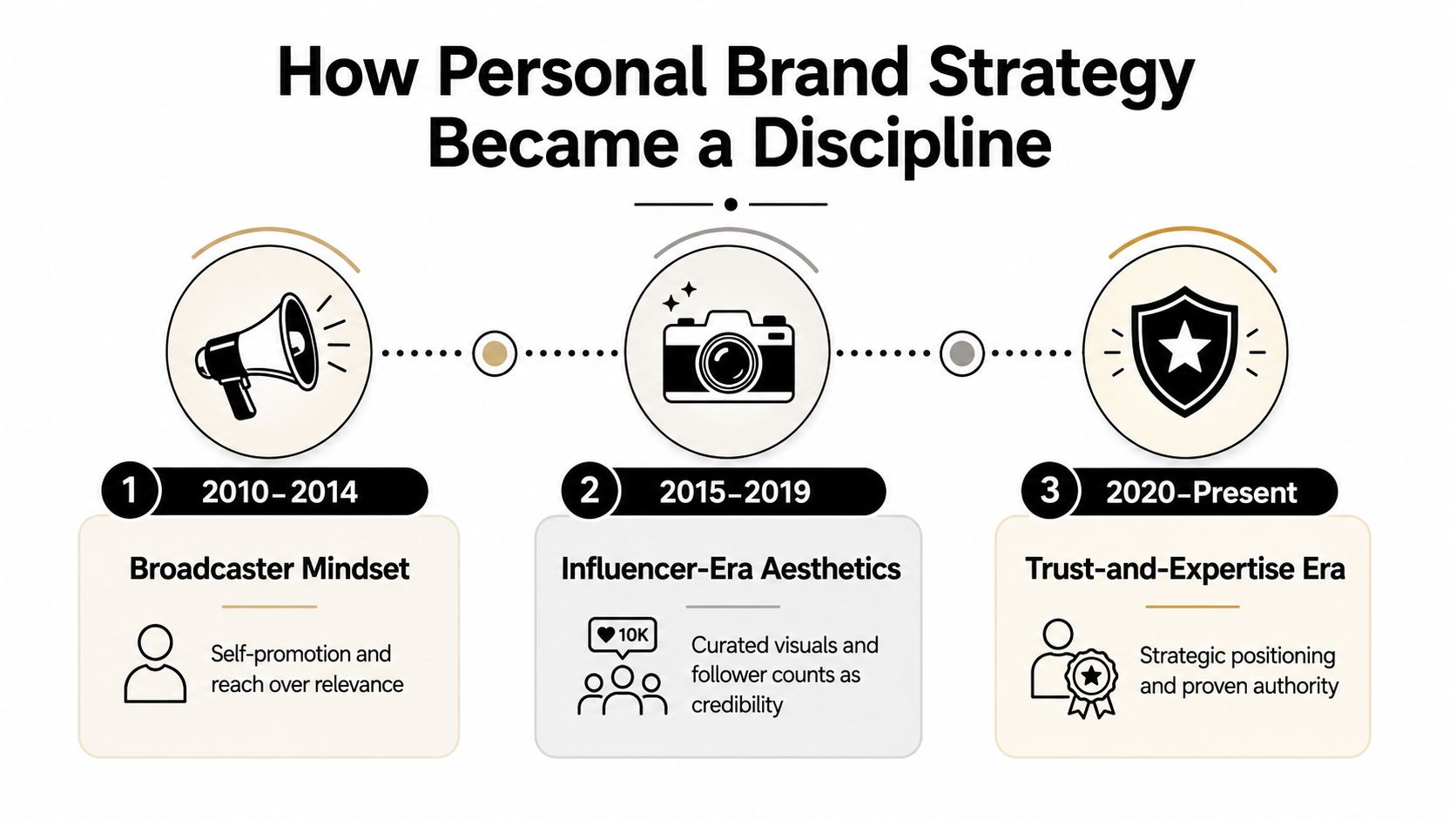
In the early social-media era, professionals treated platforms as broadcast channels. They pursued reach, visibility, and frequent self-promotion. A post went out, an audience received it, and success meant being seen by as many people as possible.
That approach worked when publishing consistently could distinguish someone from colleagues with no public presence. It also created a weak habit: listing achievements without giving the audience a practical reason to care.
The next era made presentation the main signal. Curated visuals, recognizable personal style, follower counts, and polished lifestyle cues became proxies for credibility. Professionals borrowed creator tactics without adapting them to B2B buying decisions or serious career choices.
Personal branding started to resemble performance. Consistent appearance could attract attention, but it could not prove judgment, competence, or the quality of someone's work.
The current standard is stricter. Buyers, employers, and partners can examine a person's ideas before starting a conversation. They look for evidence of thinking, useful explanations, coherent positions, and consistency across every place that person appears.
LinkedIn, launched in 2003, helped turn public professional identity into a platform-supported system for managing reputation and opportunity. The change also exposed the need for sequencing. Distribution cannot repair unclear positioning, a scattered narrative, or content published without a repeatable system.
Build the position first. Then create the narrative and content system that express it. Scale channels only after those foundations produce consistent signals of expertise. Visibility and presentation still matter, but they work best underneath a clear expert position, not in place of one.
Your first task isn't opening a content calendar. It's deciding what transformation you help create and for whom.
A strong positioning sentence gives your publishing system a filter. Use this structure:
I help [specific audience] achieve [specific transformation] through [distinct method or point of view].
“Helping businesses grow” is not positioning. “Helping early-stage B2B software founders turn complex product expertise into a clear category narrative” gives you an audience, an outcome, and a subject area that can guide decisions.
Clarify the transformation. What changes for the people you serve? Describe the before and after in practical language. The transformation might involve clearer pricing, better hiring decisions, stronger distribution, or a more credible executive presence.
Name the exact audience. Avoid “entrepreneurs” or “professionals.” Specify the buyer, role, business stage, or recurring problem. A narrow starting audience doesn't trap you. It gives your message somewhere to land.
Audit your proof. List the work you've done, decisions you've made, systems you've built, lessons you've learned, and patterns you've observed. Your brand should stretch your ambition, but it can't depend on expertise you haven't earned.
Pressure-test the sentence. Put the draft in front of three real prospects, peers, or former clients. Ask what they think you do, who they think it's for, and what part sounds most credible. Their confusion is useful evidence.
A deeper brand narrative development guide can help you connect the personal story to commercial relevance, but keep the first version short enough to use in conversation.
Write answers to these prompts without editing:
Then remove anything that describes your personality without connecting it to value. “Curious” and “passionate” are weak positioning ingredients unless your content demonstrates how those qualities improve an outcome.
Weak positioning is the most common reason downstream content underperforms. A writer can produce excellent posts, but if the audience, subject, and promise keep shifting, readers won't know why they should return.
Content pillars aren't a list of topics. They're recurring promises. Each pillar tells the audience what they'll gain whenever they encounter your work in that lane.
Choose three to five pillars from four inputs: recurring audience questions, your actual expertise, the process behind your work, and the point of view you want to own.
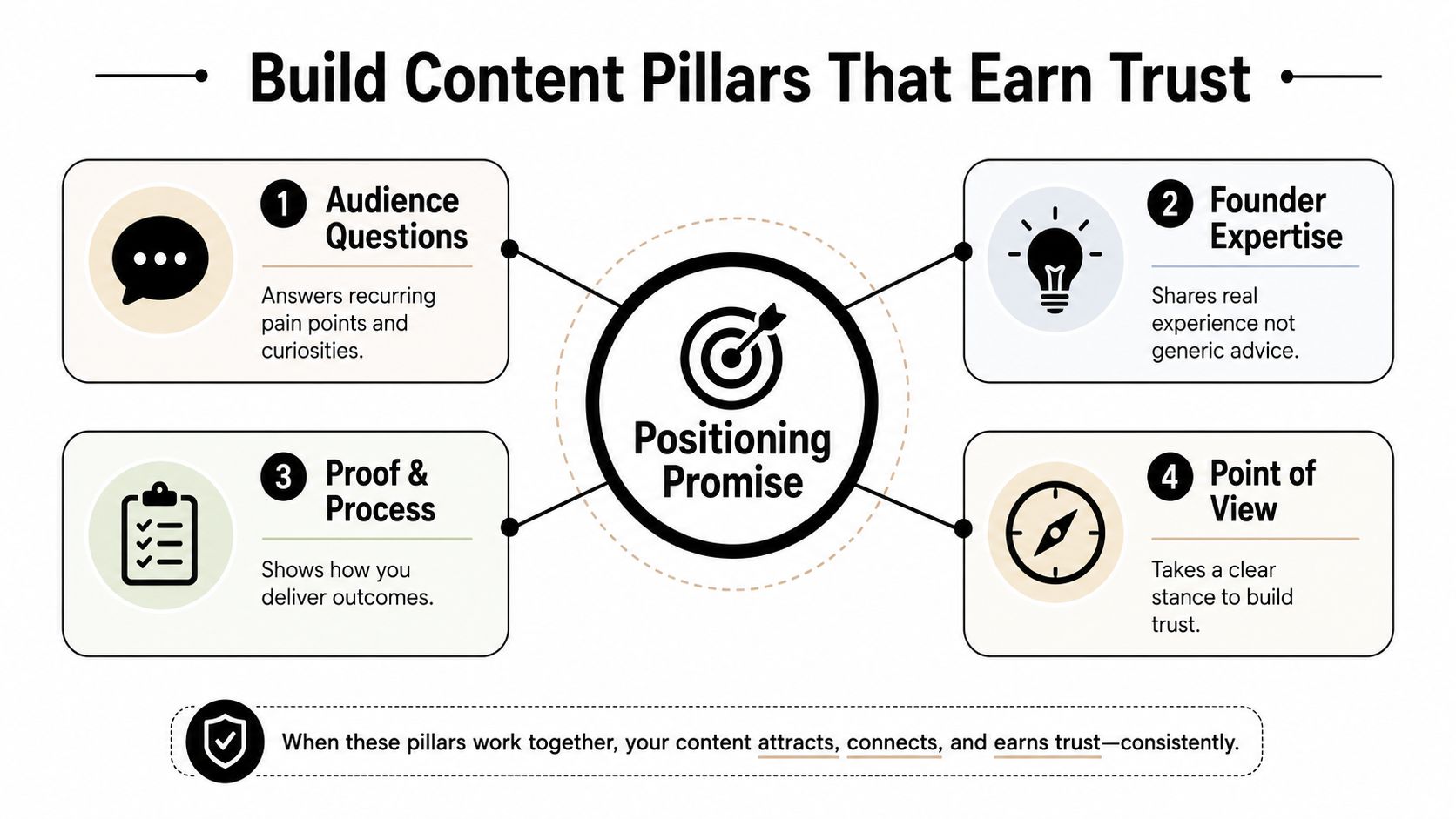
Take a B2B SaaS founder whose positioning centers on helping technical companies build durable growth systems. The pillars might be:
Each pillar should produce a distinct type of trust. Pricing demonstrates commercial judgment. Hiring demonstrates leadership. Behind the build demonstrates honesty and operating experience.
A content pillar guide such as what content pillars mean for authority growth is useful when your ideas feel scattered. For execution, a resource on how to build a viral content calendar can help organize production, but don't let a calendar turn your pillars into a rigid content factory.
Use a repeatable cadence of three to five posts per week, one flagship long-form piece per pillar per month, and a 70/20/10 mix:
The percentages are less important than the discipline of maintaining all three modes. Teaching creates utility, examples create credibility, and experience creates memorability.
Audit your last 12 posts. Tag each one by pillar, then mark whether it teaches, applies, or reveals. If most posts sit in one lane, your audience may associate you with a narrow fragment of your expertise. That's acceptable if it's deliberate. It's dangerous when it happens by accident.
Your LinkedIn profile, X profile, and speaker bio aren't biographies. They're conversion surfaces. A visitor is deciding quickly whether your expertise is relevant, credible, and worth exploring.
LinkedIn branding research identifies the headline and About or Summary areas as high-value elements, with experience, skills, education, achievements, goals, and unique qualities shaping visibility and reputation (LinkedIn personal branding research).
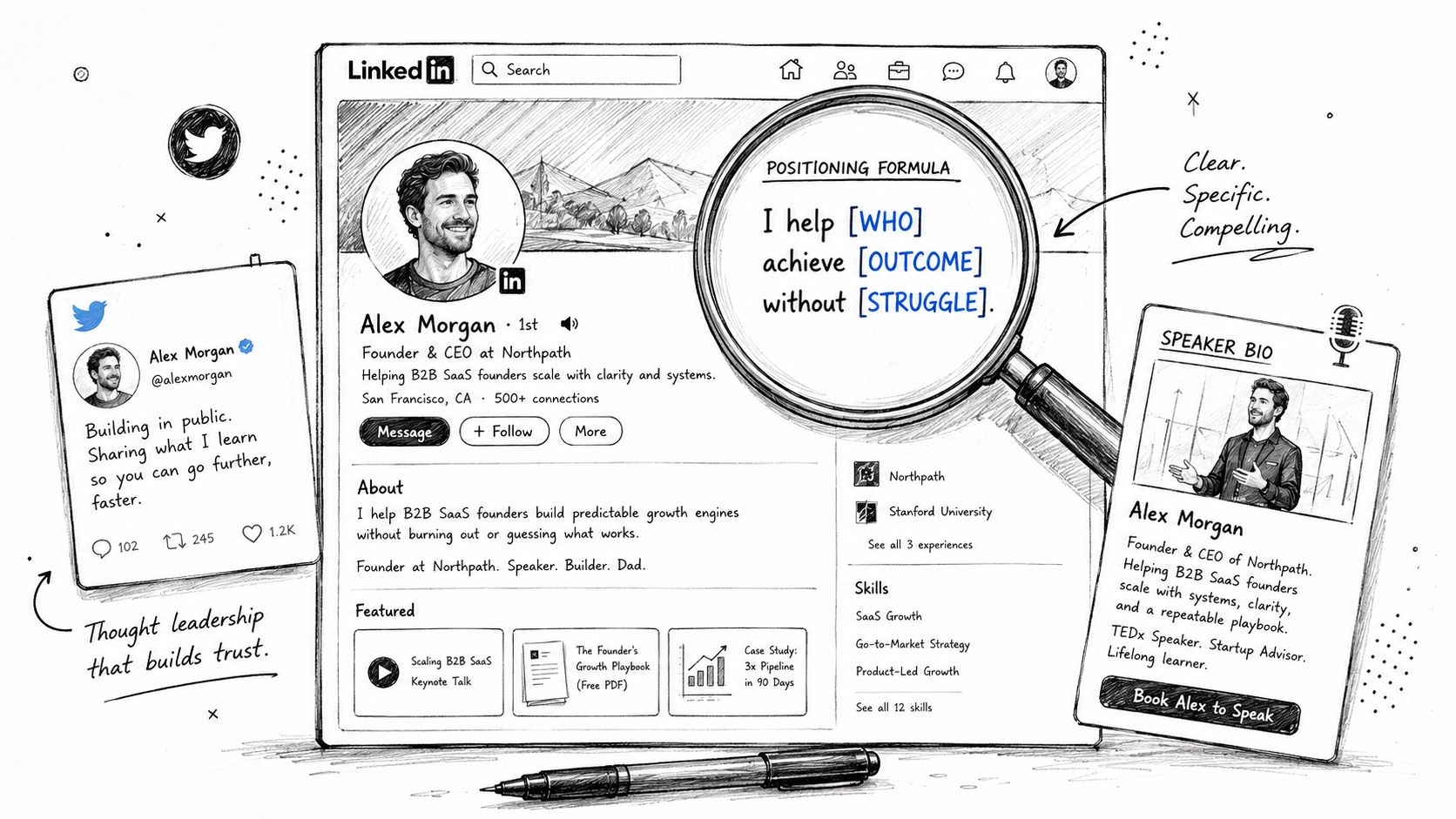
A positioning-led headline answers three questions:
Keep the headline under 220 characters so the mobile preview remains clean. Lead with meaning, not internal job language. “Founder at Acme” tells the reader where you work. “Helping B2B SaaS teams turn technical expertise into buyer-ready category narratives” tells them why the profile matters.
The credibility hook can be a relevant role, body of work, market perspective, or specialized experience. Don't pack the line with every credential. One strong proof signal beats a crowded string of titles.
Use three paragraphs:
The LinkedIn About section best-practices guide can help you review the structure, but the words still need to sound like you.
Use Featured items to point visitors toward your strongest evidence. Complete Services where relevant, make the cover image reinforce your position, and rewrite experience entries around outcomes and decisions rather than job descriptions.
Pick one primary platform and run the system for 90 days before expanding. Don't optimize five profiles on day one. A coherent active presence on one surface creates more learning than five polished profiles that lead to inactive feeds.
Choose channels according to the trust signal they strengthen, not the audience size they advertise. A founder selling complex software needs a different distribution mix from a creator whose business depends on entertainment.
| Channel | Primary Trust Signal | Time per Week | Compounds Via | Best For |
|---|---|---|---|---|
| Professional relevance | Focused publishing and engagement | Recruiter and buyer inbound | Founders, executives, consultants | |
| Twitter/X | Niche fluency | Focused replies and short-form ideas | Density within specialist conversations | Operators, technical experts |
| Substack or newsletter | Consistent depth | Regular writing and inbox presence | Owned audience and direct access | Analysts, advisors, educators |
| YouTube or podcast | Demonstrated clarity | Recording and editing | Search and authority | Teachers, visible experts |
| Guest podcasting | Borrowed credibility | Preparation and appearances | Host audience trust | Specialists entering a market |
| Conference speaking | Public authority | Preparation and delivery | Stage visibility and deal flow | Executives, category leaders |
LinkedIn works well when buyers and professional peers need to evaluate your judgment. X can be valuable when your audience gathers around fast-moving specialist conversations. A newsletter gives you an owned relationship, while long-form video lets people assess how clearly you think and communicate.
Guest appearances borrow context from the host. Speaking puts your ideas into a live professional setting. Neither replaces strong positioning, but both can validate it through association and performance.
Start with one core idea. Turn it into a LinkedIn post, a short newsletter, an X thread, a 90-second video, and a podcast talking point. Keep the argument consistent, but rewrite the opening, pacing, examples, and call to action for each environment.
Native adaptation matters. Copying a LinkedIn post into another platform with an external link attached makes the content feel careless and gives the audience no reason to engage in that channel's native format.
The goal isn't to be everywhere. It's to make one strong idea encounter the right people in several useful forms, while maintaining a coherent message across the surfaces they use to verify you.
Follower count is a trailing indicator. It can rise while your audience quality falls, and it can remain modest while the right decision-makers begin sending serious messages.
A useful dashboard has three layers:
| Metric | What It Predicts | How To Track |
|---|---|---|
| Profile views | Curiosity about your position | Review platform analytics monthly |
| Follower quality | Relevance of the audience forming around you | Categorize new followers by role, market, and fit |
| Post impressions | Distribution of an idea | Compare reach by pillar and format |
| Saves | Practical usefulness | Record saves per post and inspect the topic |
| Direct messages | Intent and conversation quality | Tag messages as peer, prospect, partner, or other |
| Substantive comments | Intellectual engagement | Separate thoughtful responses from reactions |
| Qualified leads | Commercial relevance | Log source and fit in a CRM |
| Booked calls | Movement toward a buying conversation | Attribute the first known touchpoint |
| Inbound opportunities | Broader reputation leverage | Record introductions, invitations, and partnerships |
Likes can indicate recognition, but comment depth and DM intent tell you more about whether the work changed someone's next action. Track who responds and what they ask. A message from a relevant buyer deserves more attention than a large volume of low-context reactions.
Spend the first few minutes pulling the numbers. Tag each meaningful post by pillar, format, and audience problem. Identify the two strongest combinations, then retire or redesign the weakest one.
Finish with one sentence: “Next month, I will test…” The sentence might name a sharper hook, a different format, a stronger proof point, or a new CTA.
Use UTM-tagged links where appropriate, pin a clear CTA, and add a simple source field in your CRM. When someone enters a conversation, ask how they found you and record the answer. Attribution won't be perfect, but a consistent note is far more useful than guessing from impressions.
A workable personal brand strategy doesn't demand that you become a full-time creator. It demands that you sequence the work and protect the core system from distraction.
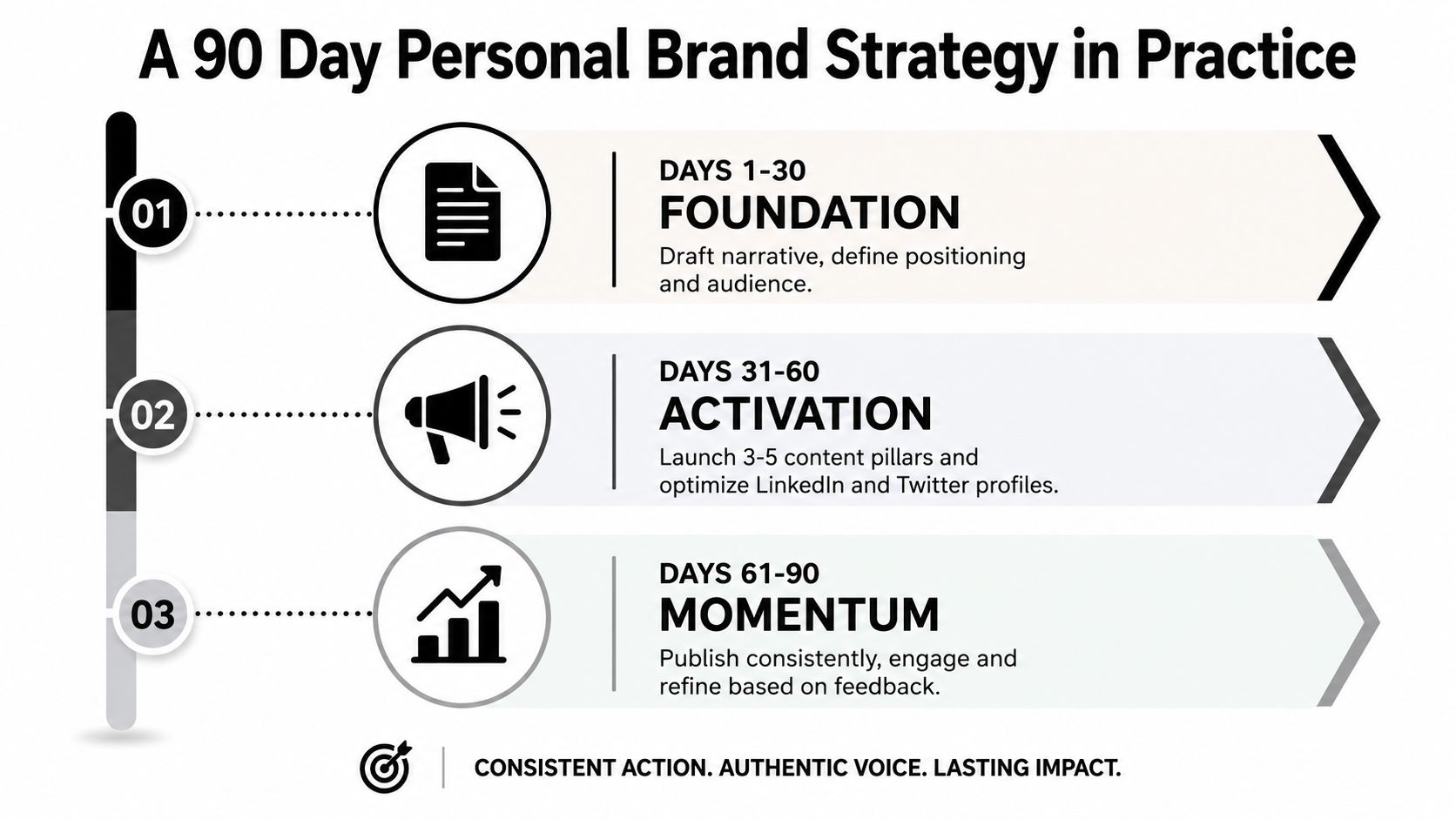
Draft the positioning sentence, map the audience, and list the proof that supports your claim. Choose three content pillars and audit your primary profile against the narrative.
Don't publish heavily yet. Write enough sample ideas to expose gaps. If you can't generate useful posts from a pillar, the pillar is probably too broad, too distant from your experience, or disconnected from the audience's real questions.
Lock in the weekly cadence and create simple templates for each pillar. Rewrite the headline, About section, Featured area, cover image, and experience entries on your primary profile.
Choose one primary distribution channel. Add a secondary repurpose loop only after the first channel has a repeatable workflow. The system should make publishing easier, not create six new jobs.
Publish consistently, respond to relevant conversations, and run two focused distribution experiments. Review the first monthly dashboard, identify the pillars and formats producing the best trust signals, and prune what isn't earning attention from the right people.
If your audience increasingly discovers experts through AI-assisted search, you can also learn how to measure AI brand citations as an additional visibility check. Treat that as a supporting signal, not a replacement for direct conversations and qualified opportunities.
Avoid five traps:
Legacy Builder offers a strategy deep dive that extracts positioning, voice, and content pillars from a focused conversation, alongside content strategy, profile optimization, and ongoing publishing support. If you want help turning your expertise into a coherent system, visit Legacy Builder to explore a practical path from narrative to consistent execution.


You could – but most in-house teams struggle with the nuance of growing on specific platforms.
We partner with in-house teams all the time to help them grow on X, LI, and Email.
Consider us the special forces unit you call in to get the job done without anyone knowing (for a fraction of what you would pay).
Short answer – yes.
Long answer – yes because of our process.
We start with an in-depth interview that gives us the opportunity to learn more about you, your stories, and your vision.
We take that and craft your content then we ship it to you. You are then able to give us the final sign-off (and any adjustments to nail it 100%) before we schedule for posting.
No problem.
We have helped clients for years or for just a season.
All the content we create is yours and yours alone.
If you want to take it over or work on transitioning we will help ensure you are set up for success.
We want this to be a living breathing brand. We will give you best practices for posting and make sure you are set up to win – so post away.
Subscribe to our newsletter and get insights on how to grow your personal brand.
