.svg)
Subscribe to our newsletter and get insights on how to grow your personal brand.
Thank you! Your submission has been received!
Oops! Something went wrong while submitting the form.
.svg)



Most advice on brand narrative development is wrong.
It tells founders to "find your why," polish an inspiring origin story, and trust that emotional connection will somehow turn into pipeline. That's lazy strategy. A brand narrative that doesn't change buyer behavior is just decorated brand theater.
This job is simpler and harder. You need a narrative that makes your company easier to remember, easier to trust, and easier to buy from. That matters because the cognitive advantage of storytelling makes people 22 times more likely to remember facts when delivered in a narrative format, and when a strong narrative aligns with buyer needs, it can improve conversion rates by about 30% according to storytelling market data and conversion research. That's why this isn't a copywriting exercise. It's a commercial system.
Founders who treat narrative as a revenue lever build sharper positioning, stronger messaging, and more consistent sales conversations. Founders who treat it like a values workshop usually end up with soft language, generic claims, and a team that says ten different things about the same company.
Most brand narratives fail for one reason. They describe the brand instead of selling a change in the customer's world.
You can see the pattern everywhere. "We're passionate about innovation." "We believe in enabling businesses." "We're on a mission to transform the future." None of that gives a buyer a problem to care about, a tension to resolve, or a reason to choose you now.
The most popular myth says authenticity is enough. It isn't.
Authenticity without structure becomes rambling. Purpose without proof becomes wallpaper. A founder can be sincere and still be forgettable. Buyers don't reward you for self-expression. They reward clarity.
A weak narrative usually has three flaws:
That creates a message problem fast. Your homepage says one thing, your LinkedIn posts say another, and your sales team improvises the rest.
A story that doesn't help a buyer make a decision isn't strategy. It's branding cosplay.
A strong narrative gives shape to facts. It tells buyers what problem matters, why it matters now, and what changes when they choose you. That's why narrative has become a core business tool, not a soft creative add-on.
Use this simple test:
| Weak narrative | Strong narrative |
|---|---|
| Describes beliefs | Frames a buyer problem |
| Centers the brand | Centers the customer |
| Sounds inspiring | Creates urgency |
| Lives in a deck | Shows up in every touchpoint |
If your narrative can't sharpen a landing page headline, a sales opener, and a founder post on LinkedIn, it isn't finished.
A powerful narrative isn't invented in a copy doc. It's uncovered by asking harder questions than most founders want to answer.
You don't need a prettier mission statement. You need the central truth your market already feels, even if they can't articulate it cleanly yet.
Forget "integrity," "excellence," and "community" for a moment. Those are supporting ideas, not the engine.
Start here instead:
A SaaS founder shouldn't say, "We help teams collaborate better." That's mush. A sharper narrative might be: teams don't have a collaboration problem, they have a decision-lag problem, and scattered tools hide accountability until revenue slips.
That's usable. Sales can run with it. Content can build on it. Product marketing can support it.
Your backstory matters, but only when it helps explain the customer's problem or your method. Buyers don't need your autobiography. They need a reason to trust your point of view.
The anti-polish approach proves effective. A 2025 Edelman Trust Barometer found that 68% of consumers trust brands more when they admit mistakes, and 54% are more likely to buy after seeing vulnerability, according to this breakdown of vulnerable brand narrative strategy.
That doesn't mean performative oversharing. It means using real friction.
That kind of honesty signals maturity. It tells buyers you've done the work.
Practical rule: Use struggle to show earned insight, not to ask for sympathy.
Run a working session with your team or by yourself and answer these prompts in plain language:
If you need help tightening your perspective into public-facing authority, this guide on insights for becoming an authoritative voice is useful because it forces the same discipline. Clear opinions beat vague expertise every time.
You are looking for one sentence that creates tension and direction.
Not: "We help founders grow."
Better: "Most founders don't have a content problem. They have a credibility gap, and inconsistent messaging keeps them invisible."
That's the beginning of a narrative foundation. It names the pain, implies the stakes, and points toward a transformation.
Once you've found the raw truth, you need structure. Without structure, every campaign turns into improvisation and every team rewrites the brand from scratch.
The cleanest framework I've seen uses five elements: Protagonist, Conflict, Transformation, Proof, and Values. Companies that master this kind of disciplined narrative approach see 30% higher customer retention rates, according to this brand storytelling methodology.
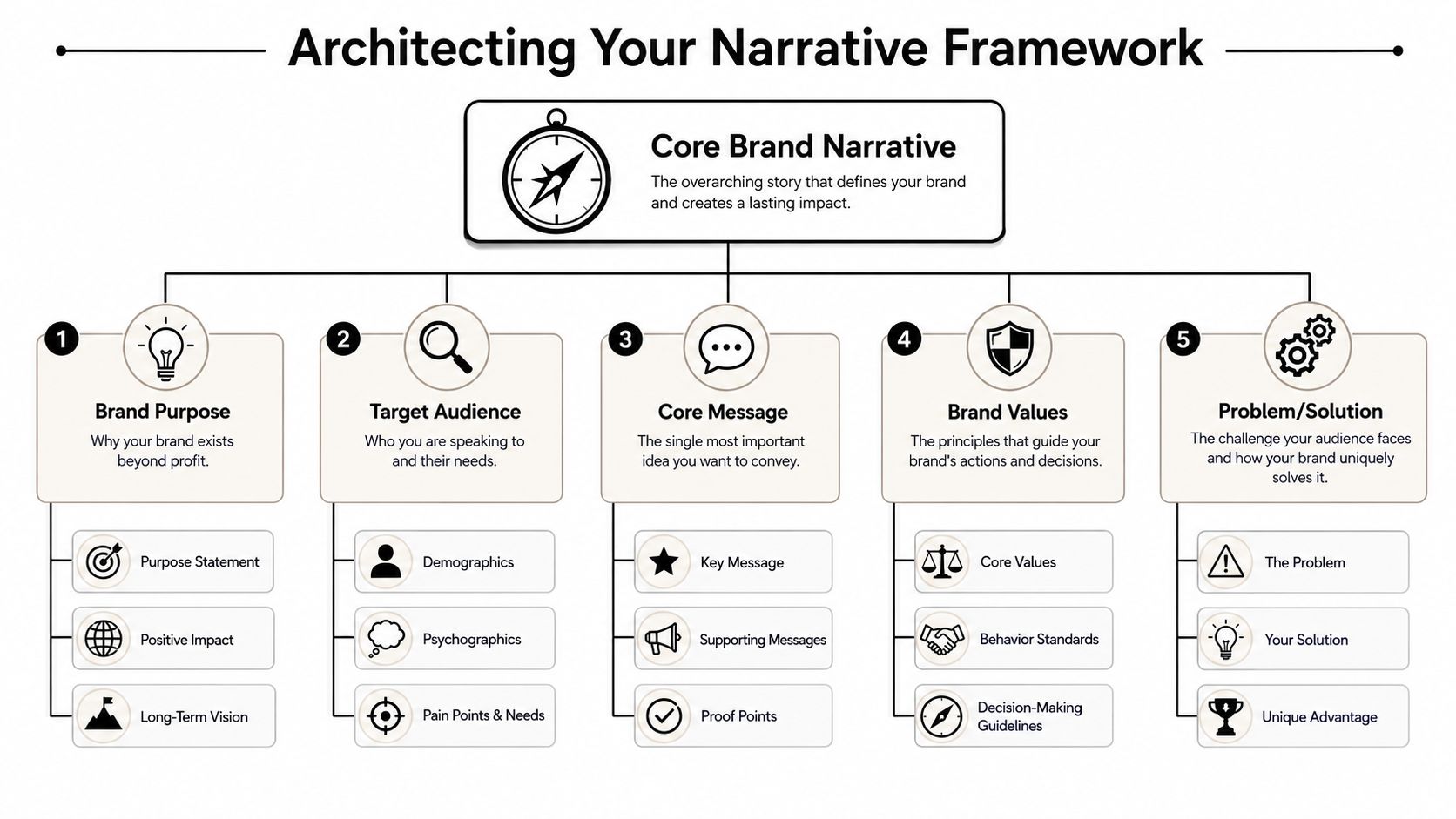
The protagonist is the customer, not your company.
That sounds obvious, yet founders break this rule constantly. They make themselves the hero, then wonder why the message feels self-centered. Your buyer needs to recognize their own situation in your narrative immediately.
Write one sentence that defines who they are at the moment of tension.
Example: A founder with real expertise but low market visibility, posting inconsistently and losing trust because their message keeps shifting.
Conflict is the frustrating, expensive, emotionally charged problem.
Most brands soften this part. They say "challenges" when they should say "stalled demand," "buyer confusion," or "slow sales cycles." Good conflict names the obstacle and the consequence.
Ask yourself: what is breaking down in the buyer's world, and why has it become unacceptable?
Transformation is the state change you create.
Not the feature list. Not the deliverables. The change. A founder moves from scattered content and weak positioning to a coherent market presence that builds trust before the sales call.
Keep this specific enough that your team can repeat it everywhere.
Proof stops the narrative from becoming empty rhetoric.
Proof can include customer evidence, product behavior, before-and-after contrasts, testimonials, demos, and pilot results. If you make a strong claim, support it. Don't ask buyers to believe your story on vibes alone.
Values are the standards behind your method.
Purpose finds its place, but only after the commercial logic is clear. Values explain why you work the way you do and what you won't compromise on. They shape tone, partnerships, offers, and hiring.
Use this working template:
| Element | What to write |
|---|---|
| Protagonist | Who the customer is when they arrive |
| Conflict | What pain or friction they face |
| Transformation | What changes after working with you |
| Proof | What evidence supports the claim |
| Values | Why your approach exists and what guides it |
A lot of creators and founders overcomplicate this. If you want a practical outside reference on branding for content creators, it's worth reviewing because it pushes identity into repeatable expression rather than abstract theory.
You should also pressure-test your draft against a real storytelling system, not a vague manifesto. This resource on how to build your brand storytelling framework that wins hearts is useful for translating a story into a durable communication model.
If your narrative can't survive contact with sales calls, buyer objections, and homepage copy, it isn't a framework yet. It's a brainstorm.
Do not turn the framework into literary fiction. You're not writing a screenplay. You're building a decision-making asset.
The best brand narrative development work feels almost blunt. Clear protagonist. Clear pain. Clear outcome. Clear evidence. Clear reason for existing. That's what scales.
A narrative only matters when the team can use it without asking you what you meant every week.
Most brands often falter by writing a smart strategy document, saving it in Notion, and never turning it into operating language. Then the founder sounds one way on podcasts, the website sounds another way, and the sales deck drifts into generic promises.
Among successful CMOs, 78% rely on regular workshops to ensure story alignment across all teams, and 36% find story creation exercises extremely helpful according to research on brand storytelling alignment. That should tell you something. Messaging consistency doesn't happen because the strategy is "good." It happens because leaders operationalize it.
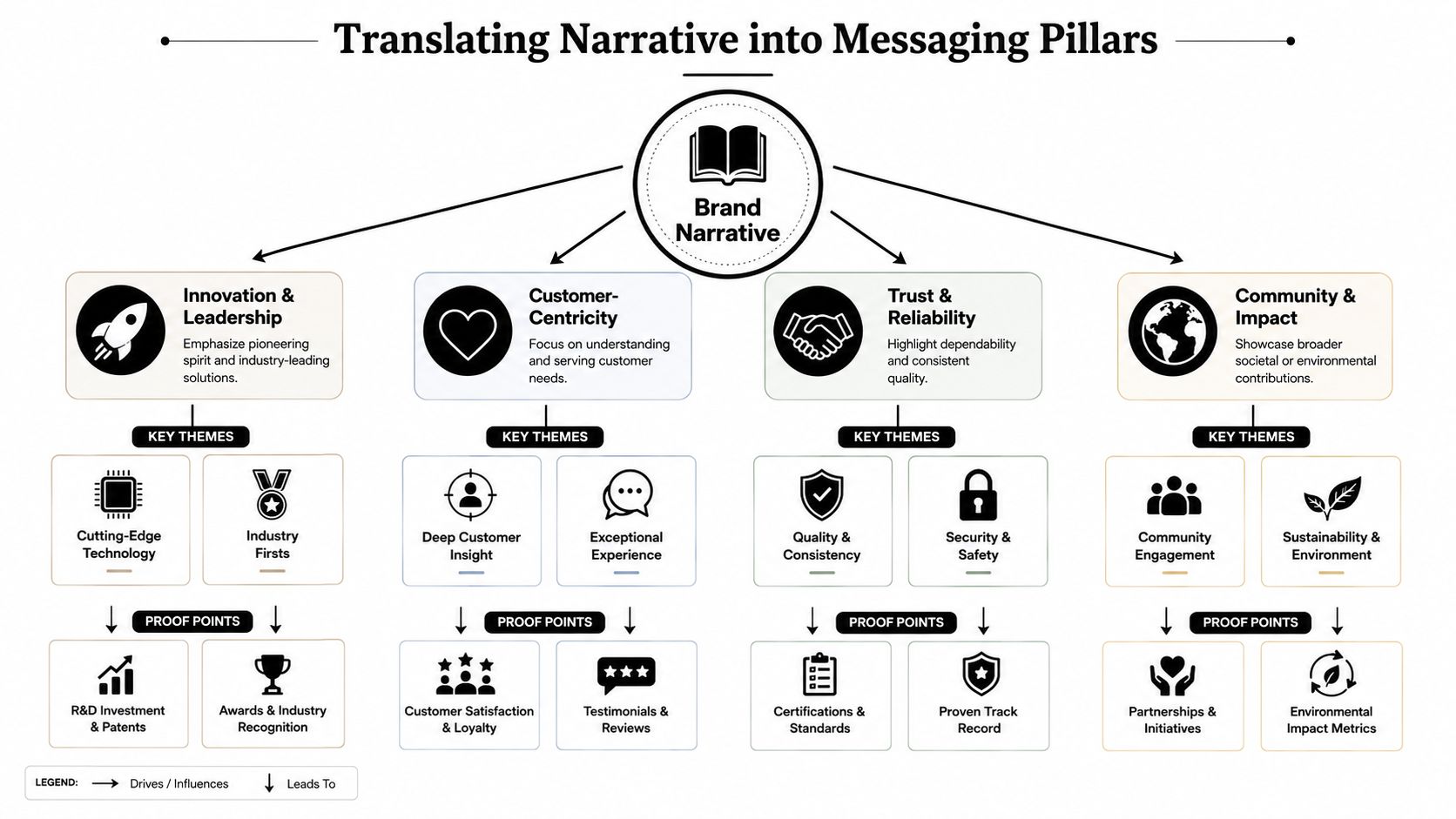
You don't need dozens of themes. You need a handful of messaging pillars that repeat your narrative from different angles.
A solid set usually includes:
If your core narrative is about helping founders fix a credibility gap, your pillars might become "inconsistent content kills trust," "clarity beats volume," "authority comes from repeatable ideas," and "buyer trust compounds through aligned messaging."
Don't host a fluffy brainstorming session. Run a hard-edged translation workshop.
Ask each team member to draft:
Then compare drafts. Anywhere people describe the brand differently, you've found a messaging gap.
| Pillar | What it does | Where it shows up |
|---|---|---|
| Problem | Names the pain sharply | Hooks, headlines, sales openers |
| Method | Explains your angle | Web copy, sales decks, newsletters |
| Outcome | Describes change | Case narratives, demos, landing pages |
| Credibility | Supports trust | Founder content, testimonials, objection handling |
If you want another reference point for turning strategic language into practical communication, this guide on what brand messaging is and how to create it is worth reading.
Every messaging pillar should answer three questions:
That's how you move from a narrative document to a company-wide language system.
Once the pillars are set, stop reposting the same message everywhere and calling it distribution. Channel activation is adaptation, not duplication.
Here's a practical example. Say one of your messaging pillars is Founder Strength Through Clear Positioning. The goal isn't to repeat that phrase across every platform. The goal is to express the same idea in the native language of each channel.
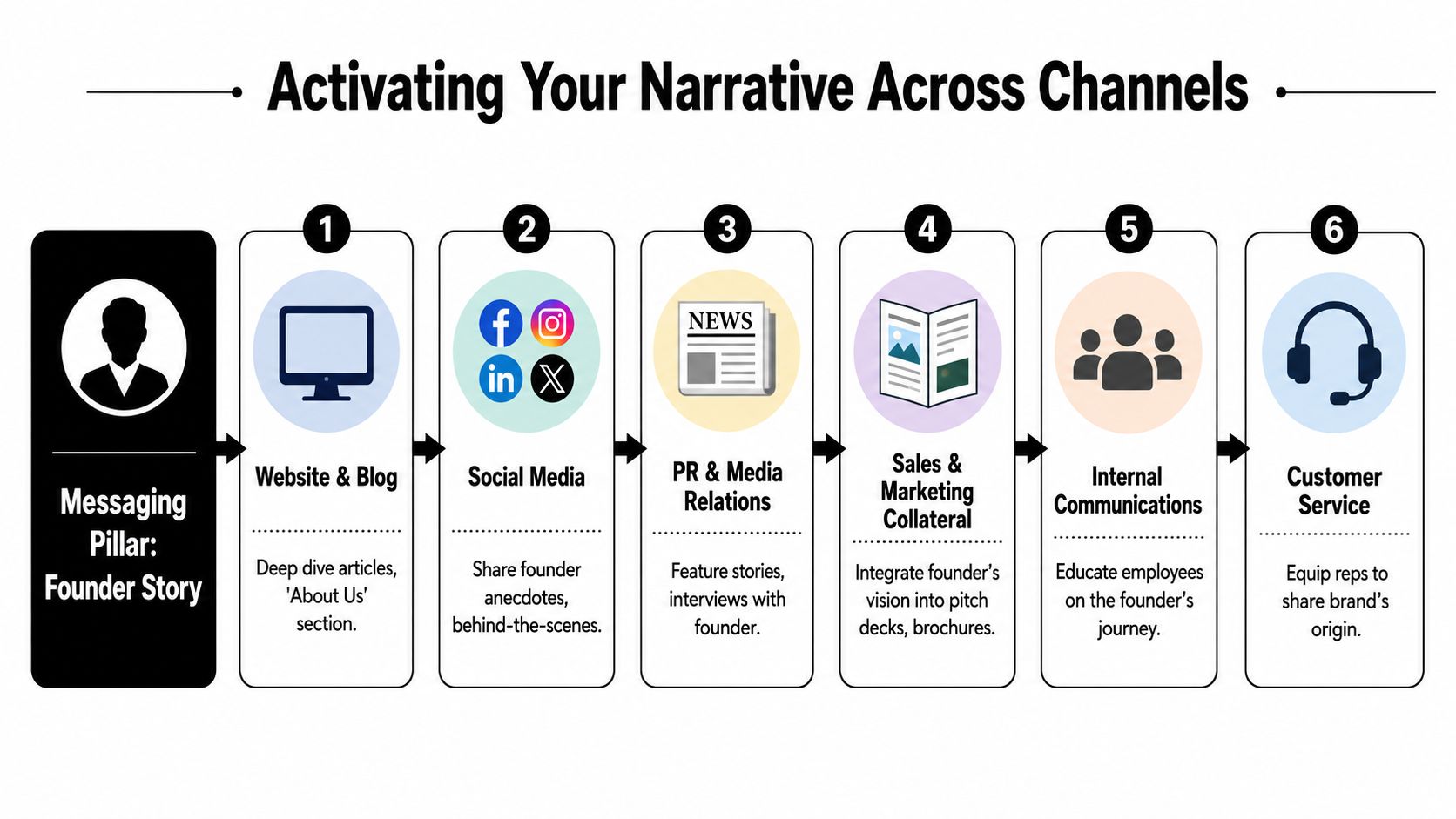
On LinkedIn, the founder might publish a post about a mistake: talking too broadly to attract "everyone," then realizing broad messaging attracts low-fit conversations. That post should end with a point of view, not a diary entry.
On X, the same idea becomes a thread that breaks down the signs of weak positioning. Short, sharp observations work better there than polished storytelling.
In a newsletter, that pillar turns into depth. Explain why founders confuse content output with authority, where the message breaks, and how to fix it with a tighter narrative.
Those aren't duplicates. They're channel-fit expressions of the same strategic idea.
Your audience shouldn't hear a different brand on each platform. They should hear the same conviction in different formats.
A usable activation process looks like this:
A lot of teams struggle here because they have content, but no distribution rhythm. If you need a practical operating model, this blueprint for your content distribution is a useful reference for getting strategic content seen by the right audience instead of buried in one channel.
Here's a useful walkthrough on video before you build your rollout:
Different channels support different buyer states.
| Channel | Best use for narrative |
|---|---|
| Website | Core framing and trust-building |
| Point of view and founder authority | |
| X | Fast insight, tension, market commentary |
| Newsletter | Depth, nuance, belief-building |
| Sales collateral | Objection handling and proof |
| Internal comms | Alignment and consistency |
A founder reading your LinkedIn post isn't in the same mindset as a buyer on your pricing page. Respect that difference. Keep the pillar intact, but change the angle, depth, and call to action.
That's how brand narrative development becomes visible in action. Not as one big brand video. As repeated, coherent expressions that compound trust across touchpoints.
If you can't show how your narrative affects the business, it will eventually lose budget, attention, and internal support.
Most brands demonstrate a critical vulnerability. A 2024 McKinsey study found that only 23% of brands with declared purpose narratives could demonstrate a direct link to financial performance, according to this analysis of purpose-led storytelling and commercial value. That's the gap. Plenty of brands can talk about meaning. Very few can prove commercial impact.
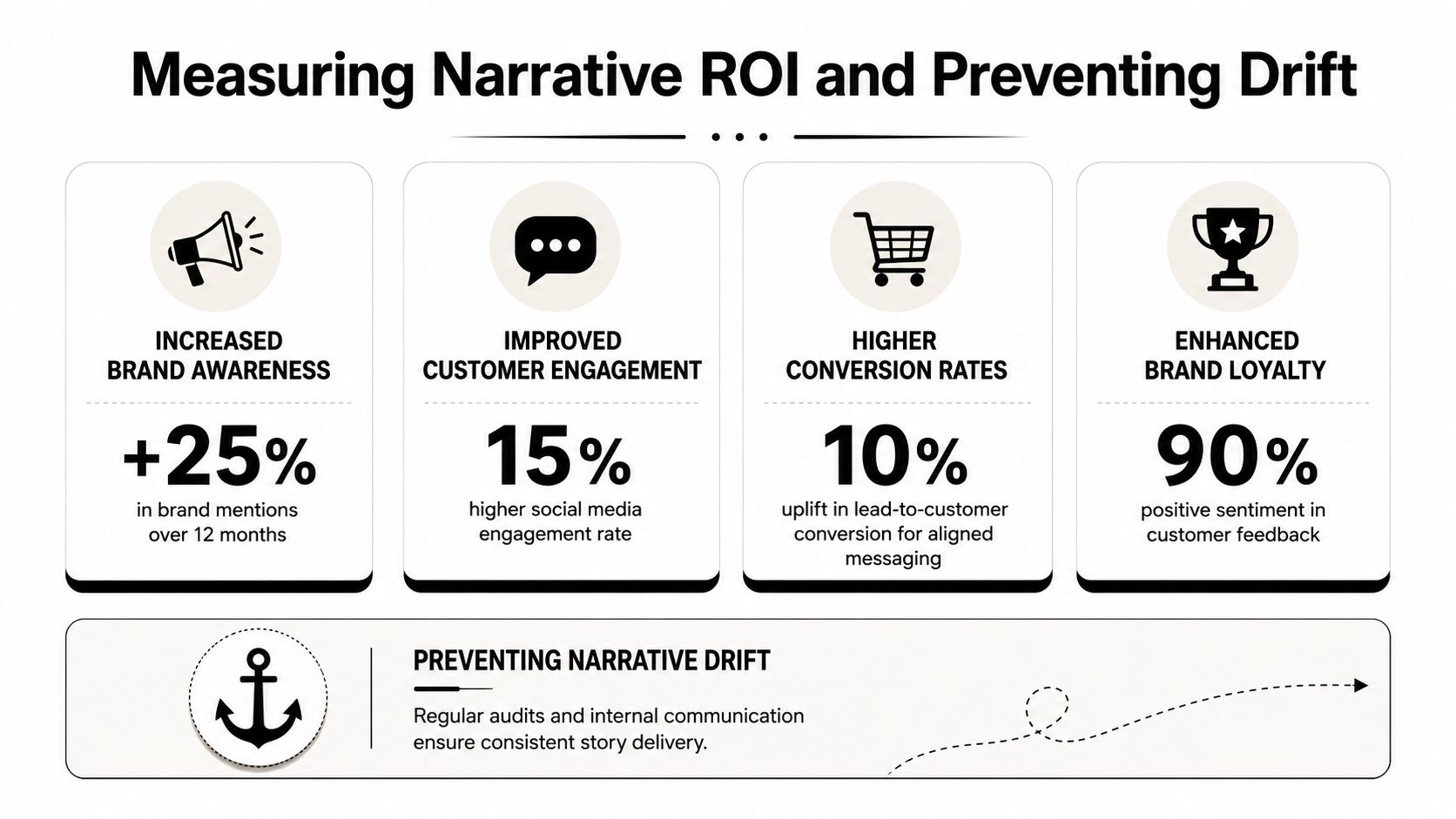
Your dashboard should combine quantitative and qualitative signals. If you only track impressions and engagement, you'll confuse attention with movement. If you only track revenue, you'll miss the message problems earlier in the funnel.
Track metrics in four buckets:
A practical supporting framework for your broader tracking discipline is this guide on how to measure brand awareness and fuel your growth.
Narrative drift happens when the original message gets diluted across teams, channels, and time. It's common, expensive, and avoidable.
You can spot it when:
Review comments, sales notes, call recordings, and customer feedback together. Drift usually shows up in language before it shows up in revenue.
Don't refresh your narrative because the team is bored. Refresh it when evidence says clarity is slipping or the market context has changed.
Use a recurring review process:
That's the part most founders skip. They build the story, but they don't govern it. Measurement and maintenance are what turn a narrative from a branding asset into a growth asset.
Brand narrative development isn't a one-off exercise for a rebrand deck. It's the operating language of a company that wants to grow on purpose.
Done well, it sharpens your positioning, gives your team a common script, makes your content more memorable, and improves the odds that buyers understand your value before a sales conversation even starts. Done poorly, it creates expensive confusion wrapped in inspirational language.
The path is straightforward. Pinpoint core buyer tension. Build the narrative around the customer, not your ego. Turn that narrative into messaging pillars your team can leverage. Adapt those pillars across channels without losing the core idea. Then measure what changed in lead quality, conversion behavior, retention, and buyer understanding.
Most founders don't need more content. They need a clearer story carrying that content.
The brands that win don't just sound good. They make sense fast, they feel consistent everywhere, and they give buyers a reason to believe. That's what a revenue-generating narrative does. It creates trust with structure, not sentiment alone.
If you want help turning your expertise, story, and point of view into a consistent brand presence that compounds, Legacy Builder helps founders and professionals develop authentic narratives, translate them into high-impact content, and stay visible without sounding generic.


You could – but most in-house teams struggle with the nuance of growing on specific platforms.
We partner with in-house teams all the time to help them grow on X, LI, and Email.
Consider us the special forces unit you call in to get the job done without anyone knowing (for a fraction of what you would pay).
Short answer – yes.
Long answer – yes because of our process.
We start with an in-depth interview that gives us the opportunity to learn more about you, your stories, and your vision.
We take that and craft your content then we ship it to you. You are then able to give us the final sign-off (and any adjustments to nail it 100%) before we schedule for posting.
No problem.
We have helped clients for years or for just a season.
All the content we create is yours and yours alone.
If you want to take it over or work on transitioning we will help ensure you are set up for success.
We want this to be a living breathing brand. We will give you best practices for posting and make sure you are set up to win – so post away.
Subscribe to our newsletter and get insights on how to grow your personal brand.
