.svg)
Subscribe to our newsletter and get insights on how to grow your personal brand.
Thank you! Your submission has been received!
Oops! Something went wrong while submitting the form.
.svg)


A founder posts a polished company update on LinkedIn. It gets a few likes, maybe a polite comment from a teammate. The next day, that same founder shares a personal story about a hard lesson from hiring, a clear opinion about the market, or a simple behind-the-scenes takeaway from the week. That post starts conversations.
That difference is the story behind personal brand marketing.
The old model was corporate broadcasting. Push messages from the brand page, hope people notice, and call it awareness. The newer model is human-led trust at scale. That shift shows up clearly in the data. 92% of people trust recommendations from individuals over brands, employee social shares receive 8x more engagement than brand-channel posts, and employee-shared content can generate 561% more reach than the same content from a company account, according to industry reporting compiled by Entrepreneur.
That's why personal brand marketing isn't just a content trend. It's a distribution advantage.
If you're a founder, executive, operator, or creator, your audience usually doesn't need more polished company copy. They need a person they can understand, evaluate, and trust. They want to know how you think, what you believe, how you solve problems, and whether your view of the world feels credible.
The good news is that this is learnable. You don't need to become a full-time influencer. You need a system. A clear position. A few repeatable content themes. A channel mix that fits your goals. Daily habits that create familiarity. And a way to measure whether your brand is building actual market value, not just collecting likes.
That's the lens I want to use here. Not personal branding as self-promotion. Personal brand marketing as a practical machine for trust, distribution, and commercial momentum.
A lot of smart operators still think the problem is, “We need to post more.” Usually that's not the problem.
Problem is that company channels often sound like brochures. People scroll past brochures. They stop for perspective, judgment, and lived experience. A founder explaining why they changed pricing gets more attention than a brand page announcing “exciting updates” because one feels human and the other feels filtered.
This change didn't happen by accident. Social platforms trained audiences to evaluate people before companies. Buyers now check the founder, the CEO, the head of product, the consultant, the operator. They want signals they can trust.
That's one reason executive visibility has become commercially meaningful. In a 2024 follow-up study summarized by Instant Press coverage, 75% of B2B buyers and C-suite executives said a piece of thought leadership prompted them to research a product or service they hadn't previously considered, and 95% said strong thought leadership made them more receptive to sales and marketing outreach.
Those numbers explain something founders feel every week. The market often meets the person before it meets the offer.
Strong personal brand marketing shortens the distance between “Who are you?” and “I trust how you think.”
If your company page is quiet while your personal posts earn replies, saves, DMs, and introductions, that isn't random. Your personal brand is carrying two jobs at once:
This is especially useful in B2B, services, consulting, SaaS, recruiting, and advisory work, where buying decisions often start with “Do I trust this person?”
Personal brand marketing wins today because it meets how attention works now. Audiences don't just buy products. They buy judgment, conviction, and credibility. A company can communicate those things. A person usually communicates them faster.
Hear “personal brand” and think profile photo, headline, bio, maybe a polished content calendar. That's the surface. The thing runs deeper.
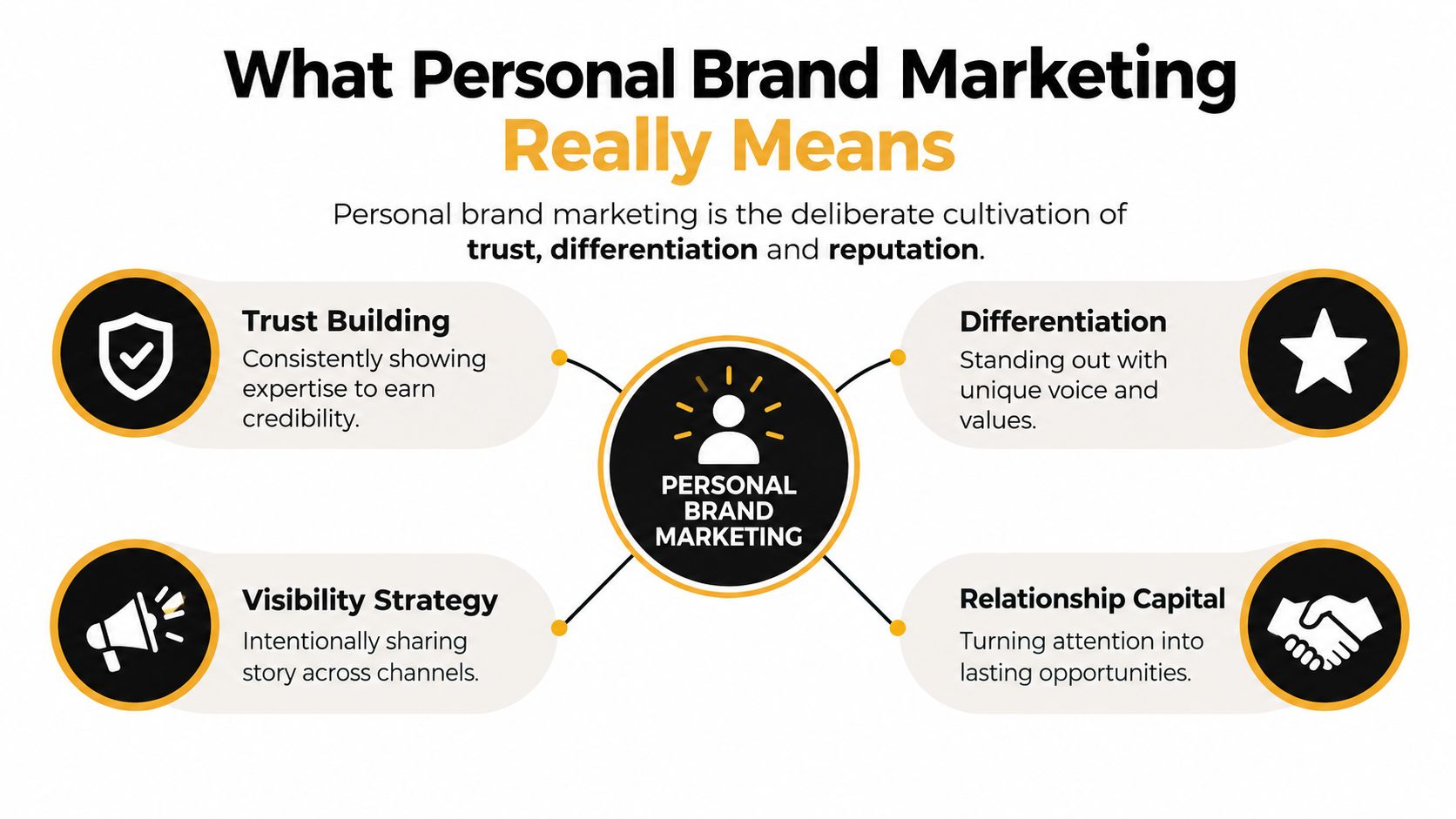
Personal brand marketing is the deliberate work of making your expertise, point of view, and reputation easy to discover and easy to trust. It's less like hanging a billboard and more like building a lighthouse. A billboard interrupts. A lighthouse helps people find their way.
Readers often get stuck. They assume personal brand marketing means talking about yourself all day. It doesn't.
It means making your thinking visible in a way that helps other people. You're turning private expertise into public proof. That can look like:
If you're tightening the visual side of your profile while doing this work, strong photography also helps reduce friction. Clean, credible personal branding images from AiHeadshots can make your profiles feel more consistent with the authority your content is building.
Trust doesn't arrive because you posted often. It forms because several signals work together.
A study on digital personal branding found a strong positive effect of personal branding on perceived credibility, reporting β = .58, with a trust scale reliability of α = .88 in the IJCRT paper on digital personal branding and credibility. The useful takeaway is practical. Credibility grows from a combination of content quality, consistency, engagement, and authenticity.
That means daily output matters, but not in the way people think. Volume alone doesn't build a brand. Repeated useful contact does.
Practical rule: Don't ask, “How can I post more?” Ask, “How can I become easier to trust every week?”
Think of personal brand marketing as four connected assets:
When people miss one of these, their brand stalls. High visibility without trust looks noisy. Trust without visibility stays hidden. Differentiation without consistency feels random.
The goal is balance. You're not trying to look famous. You're trying to become a reliable signal in your category.
Most personal brands don't fail because the person lacks expertise. They fail because the market can't place them.
If I can't tell who you help, what you stand for, or why your viewpoint matters, I won't remember you. That's why positioning comes before posting. It gives your audience a mental shelf to put you on.
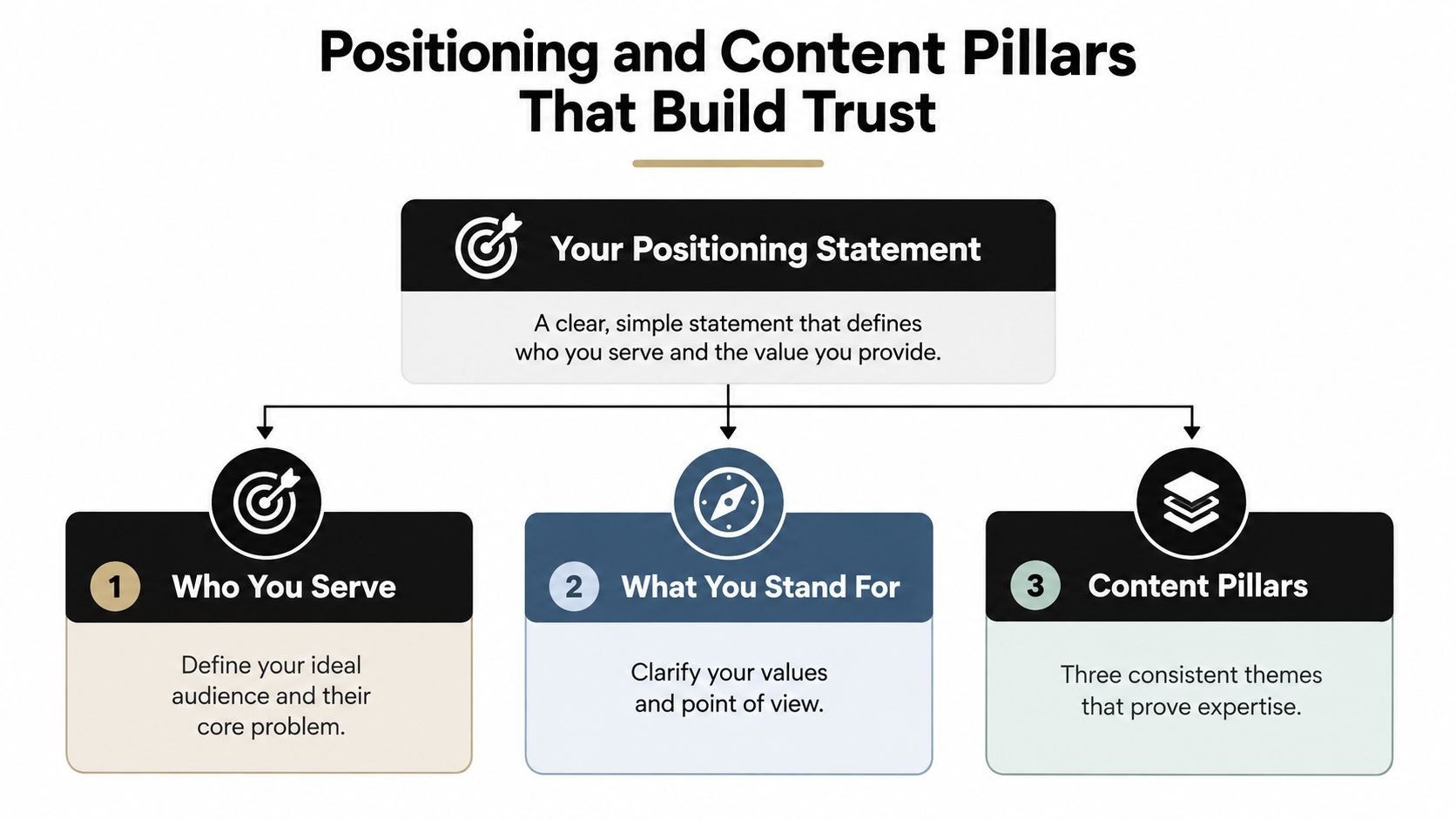
You don't need a clever slogan. You need a clear sentence.
A good starting template is:
I help [specific audience] solve [specific problem] by combining [your expertise] with [your point of view or method].
Examples:
That sentence won't appear word-for-word in every post. But it should guide every post.
Content pillars make your brand recognizable. They also make content creation easier because you're no longer asking, “What should I post today?” You're asking, “Which pillar does today's idea belong to?”
A useful structure looks like this:
Problem pillar
Write about the pains your audience already feels. For a SaaS founder, that might be poor activation, weak demos, or low response rates.
Proof pillar
Show how you think. Break down decisions, frameworks, mistakes, audits, or lessons from the field.
Point-of-view pillar
Share contrarian or clarifying beliefs. These posts sharpen differentiation.
Story pillar
Use personal experiences to make your expertise memorable.
Future pillar
Talk about where your category is heading and what your audience should prepare for.
For readers who want a stronger framework for this step, this guide on how to create content pillars that build your personal brand is a useful companion to the exercise.
Many people get bored too early. They think repeating pillars means repeating themselves. It doesn't.
A single pillar can generate many formats:
If you want help turning broad expertise into a repeatable content engine, the AI thought leadership content plan from LLMrefs is a practical reference for structuring ideas around authority rather than randomness.
Your audience doesn't experience your content as repetition. They experience it as pattern recognition.
When your pillars are right, people begin to know what you stand for before they click your profile. That's when trust starts compounding.
A strong personal brand can still underperform if it's distributed poorly. A lot of smart people waste effort. They treat every platform like it deserves equal attention.
It doesn't.
For most founders, executives, and B2B operators, LinkedIn is the primary arena because buyers, peers, hires, and partners are already there. And personal content has a built-in edge on that platform. One 2026 benchmark set estimates 2 to 4% engagement for personal brand content, compared with 0.5 to 1.5% for organic B2B content and 0.3 to 1% for company announcements, according to InfluenceFlow's LinkedIn engagement benchmark guide.
That gap matters because engagement isn't just applause. Comments and shares extend reach, pull new people into the conversation, and create more trust-bearing impressions than static corporate updates.
You don't need every channel. You need a small stack that fits your business model.
| Tactic | Best For | Trust Impact | Cost and Effort |
|---|---|---|---|
| Personal LinkedIn posts | Founder visibility, thought leadership, buyer trust | High | Moderate effort, low direct cost |
| Company page posts | Official updates, hiring, product announcements | Lower than personal channels | Moderate effort |
| Newsletter | Deeper education and nurturing warm audiences | High | High effort over time |
| Short-form video | Fast familiarity and stronger personality cues | High | Moderate to high effort |
| Employee advocacy | Expanding distribution through the team | High | Coordination effort |
| Creator partnerships | Borrowed trust and new audience access | High if aligned | Paid or relationship-based effort |
| Paid amplification | Extending reach of proven messaging | Medium on its own | Direct budget required |
Organic content tells you what your market cares about. Paid media helps you scale what already resonates. If you reverse that order, you often amplify weak messaging.
One useful rule is simple:
The channel question also isn't just “Where should I post?” It's “Where should I deepen?” A founder might use LinkedIn for discovery, email for nurture, and occasional short-form video for familiarity.
If you're weighing owned channels against rented ones, this guide on email vs social media marketing for founders helps clarify how each plays a different role in the system.
A lot of people still think personal brand marketing is mainly a writing problem. It's increasingly a format and distribution problem too.
LinkedIn's creator ecosystem has become more operationalized. According to LinkedIn's 2025 creator economy workforce trends coverage, video uploads and watch time were both up 36% year over year, and creator partnerships delivered a 39-point lift in brand awareness, a 30-point lift in lead generation, and a 30-point lift in revenue growth versus traditional marketing alone.
The lesson is straightforward. If your message only exists as text while your market is rewarding native video, collaborations, and repeat presence, you're leaving distribution on the table.
Content alone rarely builds the audience you want. Posting is the invitation. Engagement is how relationships begin.
The operators who grow strongest personal brands tend to follow a rhythm. They publish. They refine their profile so new visitors know what they do. Then they spend time inside conversations that matter. That last part gets overlooked because it's quieter work, but it often creates the fastest lift in familiarity.
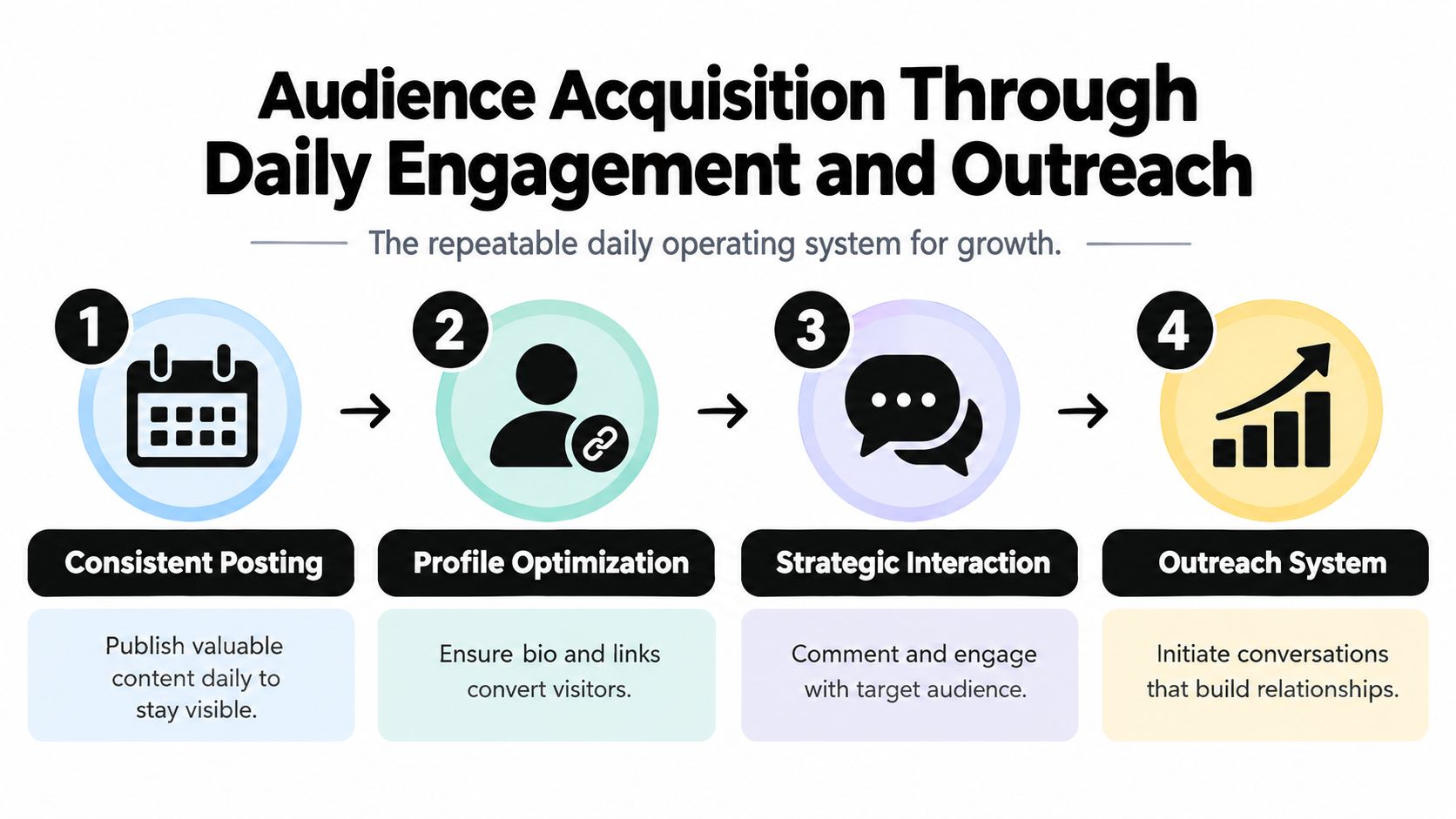
Here's a practical pattern for busy founders and executives:
Publish one useful idea
Keep it focused. A lesson, opinion, pattern, or story is enough.
Check your profile path
Make sure a new visitor can quickly understand who you help, what you talk about, and where to go next.
Engage before outreach
Leave thoughtful comments on posts from peers, buyers, industry voices, and adjacent creators.
Start a small number of direct conversations
Don't pitch. Respond to something specific they said. Ask a real question. Continue a thread.
Here's a short visual walkthrough of how this can work in practice:
A simple way to avoid random outreach is to create a “Dream 100” list. These are people and accounts that sit near the audience, opportunities, and conversations you want to be part of.
Your list can include:
Then behave like a thoughtful regular, not a pop-up salesperson.
Comment in a way that adds context, not in a way that asks for attention.
That means no “Great post” drive-bys. Add a lesson, example, counterpoint, or question. Over time, your name becomes familiar before your DM arrives.
Most outreach fails because it starts too cold and too self-focused. Better outreach sounds like continuation.
For example:
For brands that need help running this daily machine without sounding outsourced, options range from in-house support to ghostwriting systems to done-for-you teams. Legacy Builder is one service in that category. It handles strategy interviews, content creation, daily publishing, and audience interaction in the client's voice. If Instagram is part of your channel mix, this review of the best Instagram growth service 2026 from Sup Growth gives a broader look at how support models differ for personal brands.
Personal brand marketing gets fuzzy for many teams. They can see activity, but they can't tell whether the activity is building equity.
Follower count is the most common shortcut. It's also one of the weakest signals on its own. A larger audience can help, but size doesn't automatically mean trust, relevance, or buying intent.
That measurement gap is real. Recent academic work identifies a need for a more standardized way to quantify personal brand equity, and industry reporting tied to that discussion notes that 70% of respondents say personal branding is important, but only 15% report having a clearly defined strategy, as summarized in the research overview on personal brand equity measurement.
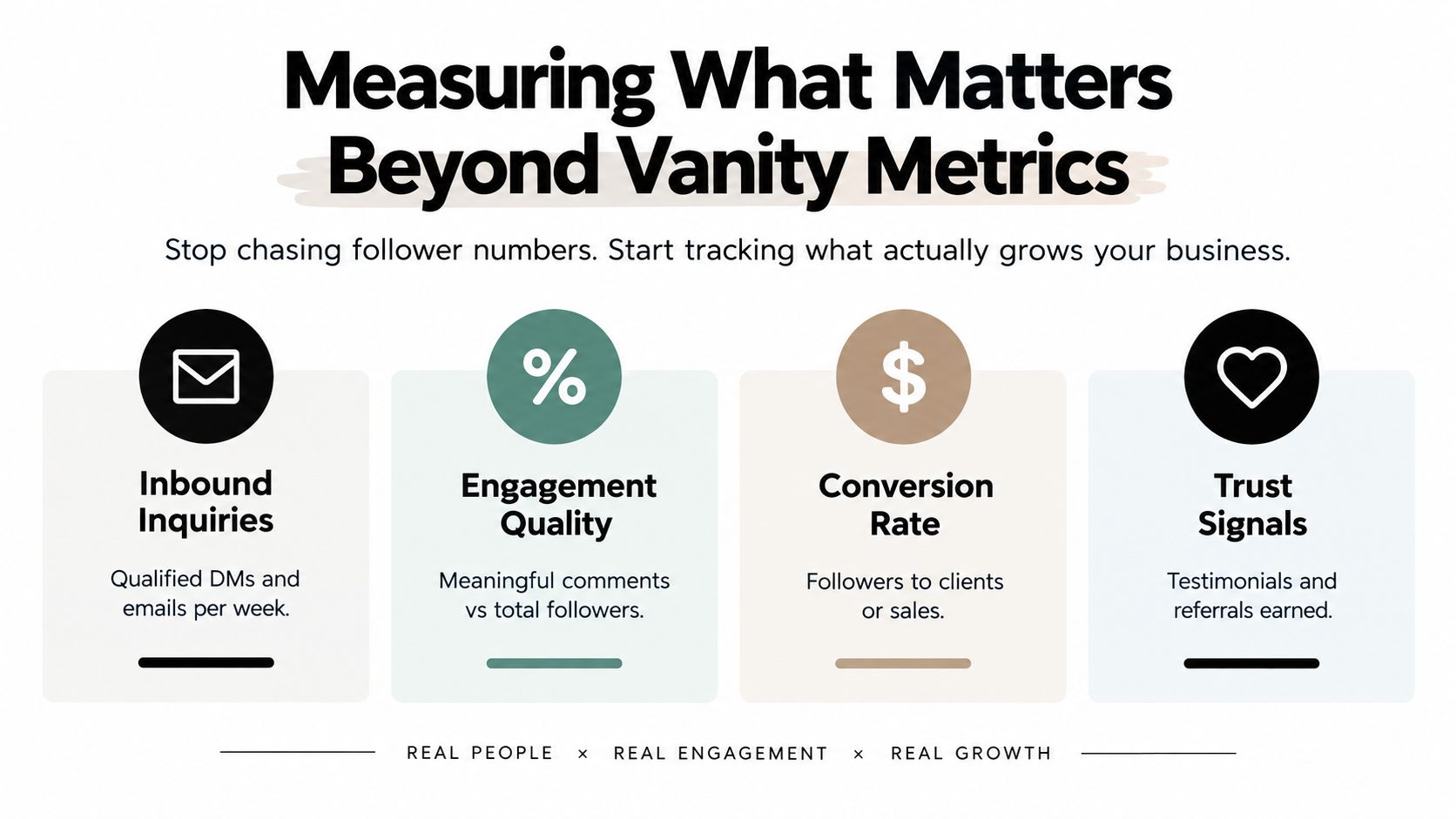
A useful measurement system tracks whether your brand is becoming more trusted, more remembered, and more commercially influential.
Watch these categories:
Inbound inquiries
Count qualified DMs, emails, podcast invites, speaking requests, and collaboration asks.
Engagement quality
Look for thoughtful comments, repeat commenters, peer recognition, and questions that show real interest.
Pipeline influence
Track when prospects mention a post, a video, or your LinkedIn presence during sales conversations.
Trust signals
Save testimonials, referrals, warm introductions, and replies that reflect changed perception.
Not every metric should be checked at the same pace.
Weekly, monitor:
Quarterly, review:
If you want a more rigorous business lens for this kind of review, this guide on how to calculate marketing ROI that actually means something helps connect activity to outcomes.
Good personal brand marketing doesn't just attract attention. It changes what buyers do next.
That's why thought leadership metrics matter more than vanity spikes. Earlier in the article, we looked at evidence showing buyers research new products after encountering strong thought leadership, and that they become more receptive to outreach. That is the kind of influence worth tracking. Not just “Did people react?” but “Did this content change the quality of conversations entering the business?”
The best metric for a personal brand is often a sentence from the market: “I've been following your content, and I already trust how you think.”
The easiest way to think about personal brand marketing is as a loop.
You position yourself clearly so the market can place you. You publish around a few recognizable pillars so people learn your patterns. You distribute in formats and channels that fit how attention works now. Then you measure whether that work is creating trust, conversations, and opportunities.
That loop works for different goals.
A founder might use it to build pipeline and shorten credibility gaps in sales. An executive might use it to attract talent, partnerships, and industry authority. A creator or consultant might use it to become the obvious choice in a narrower niche.
If you want to start without overcomplicating it, do this over the next month:
Week one
Tighten your profile, write a one-sentence position, and choose three to five content pillars.
Week two
Publish short posts from each pillar. Focus on clarity over polish.
Week three
Create a Dream 100 list and begin daily comments on relevant accounts.
Week four
Review which posts created real conversations, then double down on those patterns.
People usually stall for predictable reasons:
Personal brand marketing works best when you treat it like an asset, not a campaign. You are building a searchable body of proof about how you think, what you know, and why people should trust your judgment.
That takes repetition. It also pays back in ways that compound at first, then become obvious.
Legacy Builder helps founders, executives, and professionals run this system end to end through strategy interviews, ghostwritten content, daily publishing, short-form video, and audience support in the client's voice. If you want a more consistent way to turn your expertise into trust and distribution, visit Legacy Builder.


You could – but most in-house teams struggle with the nuance of growing on specific platforms.
We partner with in-house teams all the time to help them grow on X, LI, and Email.
Consider us the special forces unit you call in to get the job done without anyone knowing (for a fraction of what you would pay).
Short answer – yes.
Long answer – yes because of our process.
We start with an in-depth interview that gives us the opportunity to learn more about you, your stories, and your vision.
We take that and craft your content then we ship it to you. You are then able to give us the final sign-off (and any adjustments to nail it 100%) before we schedule for posting.
No problem.
We have helped clients for years or for just a season.
All the content we create is yours and yours alone.
If you want to take it over or work on transitioning we will help ensure you are set up for success.
We want this to be a living breathing brand. We will give you best practices for posting and make sure you are set up to win – so post away.
Subscribe to our newsletter and get insights on how to grow your personal brand.
