.svg)
Subscribe to our newsletter and get insights on how to grow your personal brand.
Thank you! Your submission has been received!
Oops! Something went wrong while submitting the form.
.svg)


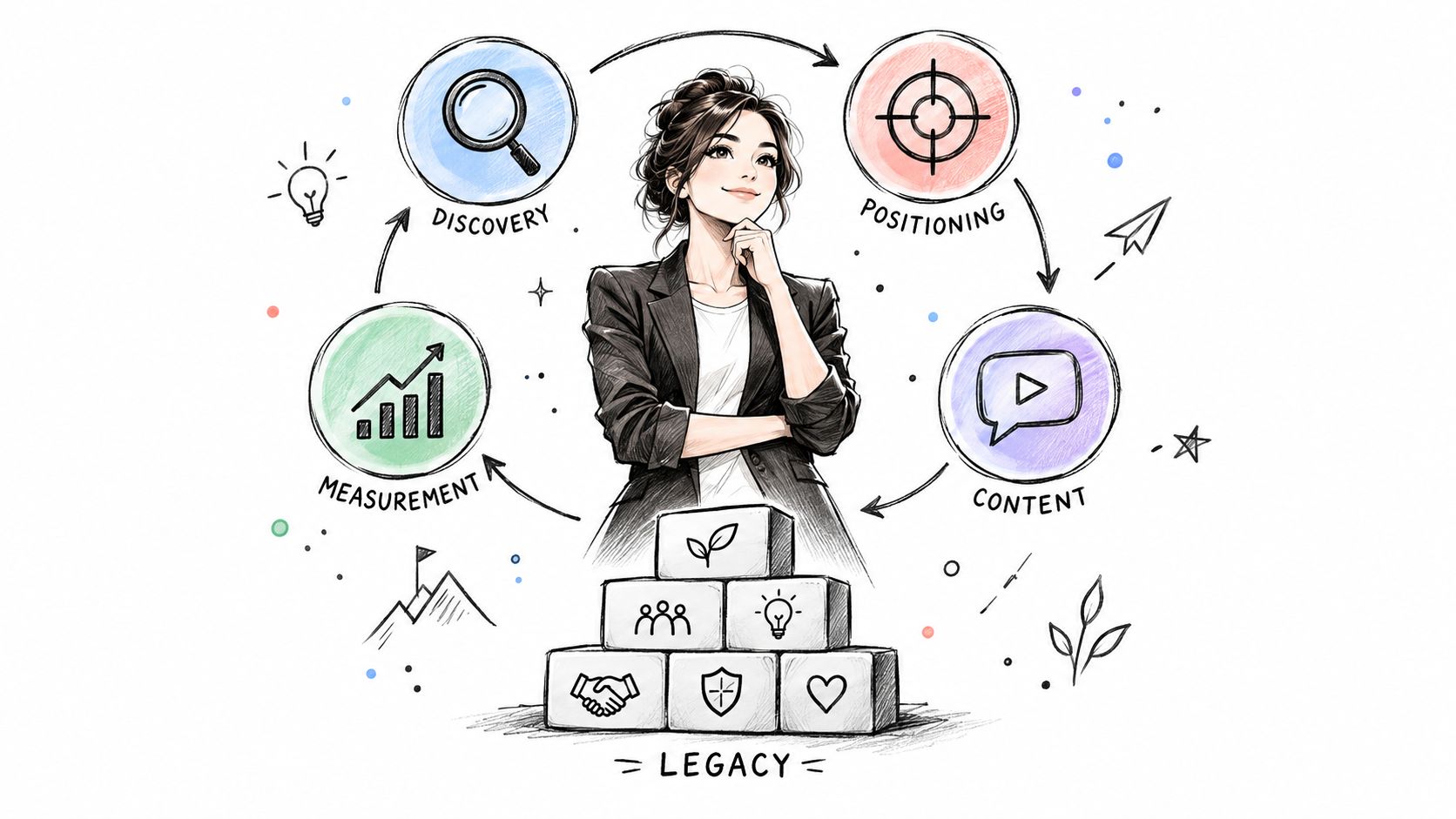
Personal brand management isn't about posting more content. It's the deliberate process of crafting a distinct professional narrative that earns trust, shapes perception, and opens doors before you ask.
The popular advice gets the visible part right and the strategic part wrong. Professionals are told to post consistently, optimize their LinkedIn profile, and increase their reach. Those activities can help, but they don't create a durable reputation by themselves. Consistency without differentiation is the fastest way to become invisible.
A strong personal brand works as an operating system. It guides what you say, where you show up, which opportunities you accept, and how people describe your expertise when you're not in the room. The aim isn't to look active. It's to become unmistakable to the people who matter.
High-performing professionals treat personal brand management as publishing. That mistake turns LinkedIn posts, profile photos, newsletters, and a polished About section into the strategy. These are visible outputs, not the operating system that shapes professional perception.
Personal brand management creates, positions, and maintains a differentiated narrative and visual identity for a specific audience. Research presents it as a multidimensional system involving identity cues, social capital, mediated self-presentation, authenticity, and appearance. Your audience judges whether those visible signals align, not how often you publish. The research literature on personal branding supports a systems view rather than a volume-based approach.

Social platforms make visibility accessible. They do not make attention valuable. 72% of U.S. adults use at least one social media platform, and 70% of consumers feel a stronger connection to brands whose leaders are active on social media, according to recent personal branding research summaries. Yet only 57% say visible, authentic leadership influences purchasing decisions. Reach creates an opportunity, while distinctiveness gives that attention a reason to continue.
A professional who publishes generic leadership advice may look active while blending into similar accounts. A professional who repeatedly shows a defined point of view, a recognizable method, and relevant proof gives the audience something memorable and useful.
Practical rule: Ask, “What should the right people understand about my expertise after seeing me repeatedly?” Build every post around that answer.
Your profile, conversations, presentations, website, and content must reinforce one promise. If each channel presents a different version of you, the audience must connect the signals themselves. They usually will not. They will choose someone whose expertise is easier to understand.
Personal brand management becomes practical when you treat it as a lifecycle rather than a collection of disconnected tactics. The sequence matters. Publishing before you understand your audience creates noise, and measuring before you define the intended outcome produces meaningless dashboards.
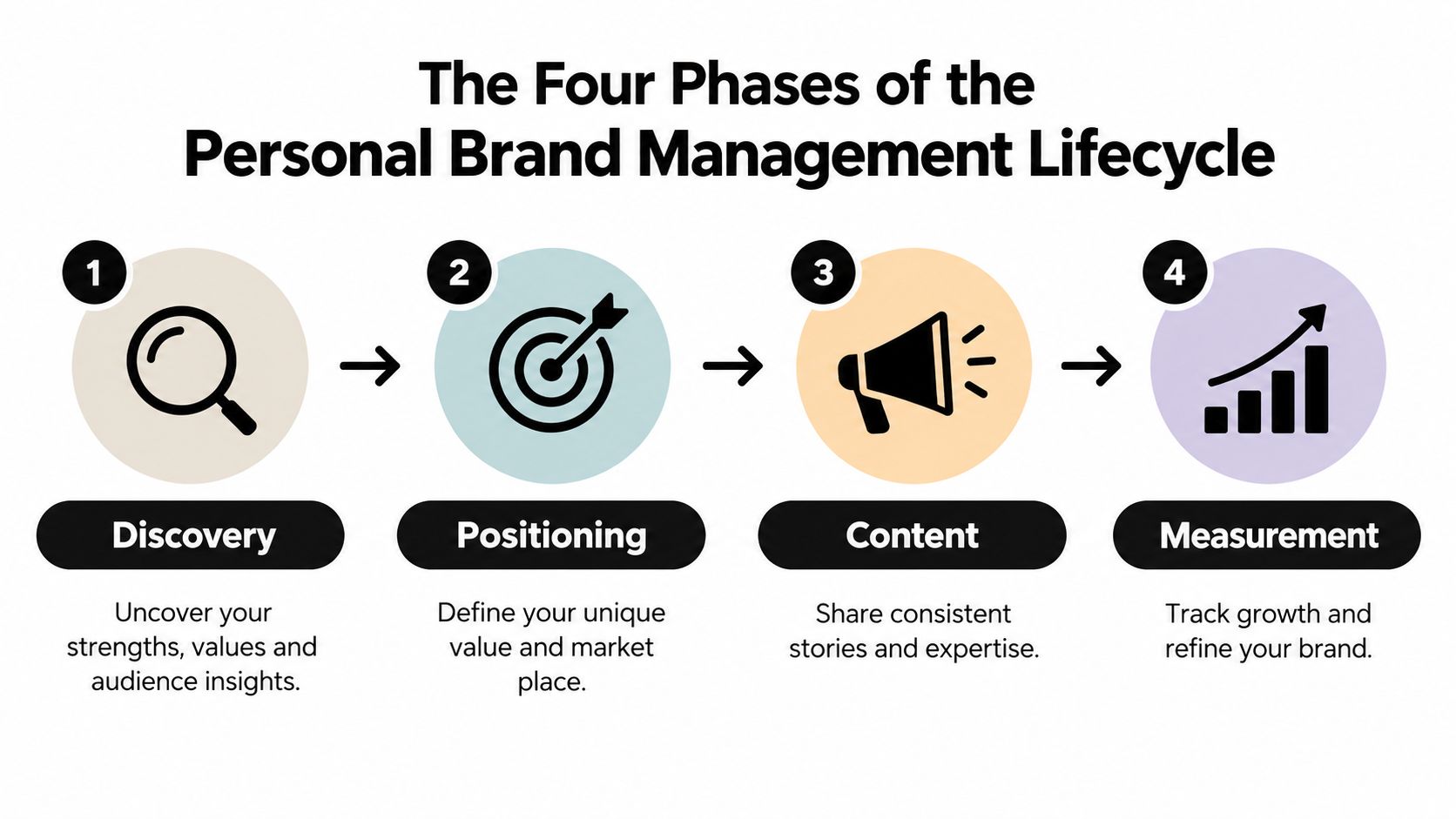
Start by identifying the intersection of your experience, convictions, and audience demand. Review the questions clients ask repeatedly, the problems colleagues trust you to solve, and the decisions you can explain better than others in your market. Then define the audience that benefits from hearing your perspective.
Discovery should produce raw material, not a slogan. Collect your recurring stories, hard-earned lessons, working principles, and evidence of competence. You're looking for patterns that can support a credible public identity.
Positioning turns those patterns into a deliberate market promise. Choose the problem you want to be associated with, the audience you want to serve, and the perspective that makes your approach distinct. A founder might focus on operational simplicity for scaling software teams. A consultant might own the connection between executive communication and organizational trust.
The strongest positioning is narrow enough to be memorable and broad enough to support sustained work. It shouldn't depend on exaggerated claims. Your audience should be able to explain what you do and why your viewpoint differs.
Content delivers proof of the position. Use repeatable proof points, practical explanations, original observations, and stories that show how you think. A post, talk, newsletter, or interview should make the same underlying promise visible in a format suited to its channel.
Measurement closes the loop. Track whether the right people are responding, remembering, replying, referring, and initiating relevant conversations. Reach can indicate distribution, but qualified inquiries, invitations, meaningful comments, and strong introductions reveal whether your reputation is becoming useful.
Skipping discovery usually creates vague positioning. Skipping positioning makes content interchangeable. Skipping content leaves the promise unproven, while skipping measurement prevents refinement. The lifecycle works because each phase supplies the conditions required by the next.
A company page represents an institution. A personal profile represents judgment, experience, and accountability. On LinkedIn, that distinction affects how people notice and interpret a message.
Benchmark evidence reports that personal LinkedIn profiles generate roughly 2.75 times more impressions and up to 5 times more engagement than company pages, as documented by LinkedIn profile and company page performance analysis. These figures don't mean every personal post will outperform every company post. They show that the platform's social graph and audience behavior generally favor human identity signals.
| Metric | Personal Profile | Company Page |
|---|---|---|
| Impressions | Roughly 2.75x more | Baseline comparison |
| Engagement | Up to 5x more | Baseline comparison |
| Primary strength | Trust, perspective, conversation | Institutional validation, amplification |
A named executive can explain why a decision matters, what changed their mind, or which trade-off a buyer should consider. A company page can publish the same topic, but the institutional framing often feels less accountable and less relational.
That difference is especially important for founders, executives, recruiters, advisors, and client-facing specialists. Their reputation is part of the buying experience. People aren't only assessing the firm. They're assessing whether the person behind the firm understands their problem and can be trusted to handle it.
This is why personal publishing should usually act as the primary demand-generation surface. The company page can validate the business, distribute selected posts, showcase announcements, and support credibility. It shouldn't carry the full burden of thought leadership.
A strong profile connects the headline, About section, featured work, experience, and recent posts. Each element should answer a different question:
For practical guidance on visible credibility, review this resource on trust signals on LinkedIn. You can also use these LinkedIn About section best practices for 2026 to tighten the profile's most important narrative space.
Don't duplicate corporate announcements and call that executive branding. Publish the reasoning, lessons, standards, and convictions that only a real person can communicate.
A SaaS founder, a leadership consultant, and a traditional business owner can use the same lifecycle without producing the same brand. The framework stays stable. The proof, audience, and channel choices change.

The founder begins with discovery by interviewing customers, sales colleagues, and implementation teams. A pattern emerges. Buyers don't need another broad productivity voice. They need a practical perspective on reducing operational friction as software teams grow.
The founder's positioning becomes clear: explain the operating choices that make complex software organizations easier to run. Content then turns that promise into proof through product lessons, anonymized customer situations, teardown posts, and direct opinions about process design. Measurement focuses on the quality of inbound conversations, relevance of replies, and invitations from people in the intended market.
The founder doesn't try to become a general business celebrity. They become useful to a defined professional community.
The consultant has a different asset: a deep library of workshop observations and executive conversations. Discovery reveals that clients value the consultant's ability to translate difficult leadership behavior into language teams can act on.
Positioning centers on practical communication during change. Short posts introduce an idea, a newsletter develops the reasoning, and speaking engagements create a live environment where the audience can experience the method. Each format does a different job, but they all reinforce the same promise.
The consultant measures whether readers reply with relevant situations, whether organizations request conversations, and whether speaking topics become associated with the consultant's name.
The business owner may start with no meaningful digital presence. Discovery begins offline, through customer questions, staff knowledge, and the owner's history of solving problems. Positioning turns that experience into a clear point of view instead of pretending to be an online creator.
Content can begin with practical explanations, customer education, and the standards behind the business. The owner doesn't need to imitate a technology founder. They need to make existing expertise visible and consistent across the profile, website, conversations, and local or industry communities.
The lesson is simple. Personal brand management doesn't require a fashionable personality. It requires a credible promise, repeated proof, and a measurement habit.
Some professionals don't fail because they lack discipline. They fail because they apply discipline to the wrong target.
Publishing frequently can create the appearance of momentum while making your expertise harder to identify. If your posts cover leadership, productivity, hiring, sales, mindset, and business trends without a connecting belief, the audience sees activity but not authority.
Replace topic accumulation with a small set of ideas you can defend. Your point of view should create useful tension. Explain what you reject, what you prioritize, and what you've learned through experience.
A profile that promises strategic advisory work, posts that sound like generic motivation, and private conversations that reveal a completely different professional focus create friction. The audience doesn't need perfect repetition, but they do need recognizable alignment.
Audit the places where people encounter you. Compare your headline, About section, website biography, speaking topics, visual presentation, and recent content. Remove claims you can't support and language you wouldn't use in a real conversation.
Likes and followers can provide feedback on distribution, but they don't prove that the right people understand or value your work. A large audience with no relevant conversation can distract you from a smaller group that introduces clients, invites you to speak, or asks for your judgment.
Track signals tied to your actual objective:
A visible brand gets attention. A differentiated brand gets remembered.
Your job isn't to maximize every metric. It's to improve the connection between your public signals and the opportunities you want.
A personal brand management system should fit the professional life you have. If the workflow requires constant inspiration, it will collapse. Build repeatable inputs, clear decisions, and a review rhythm that protects your voice.
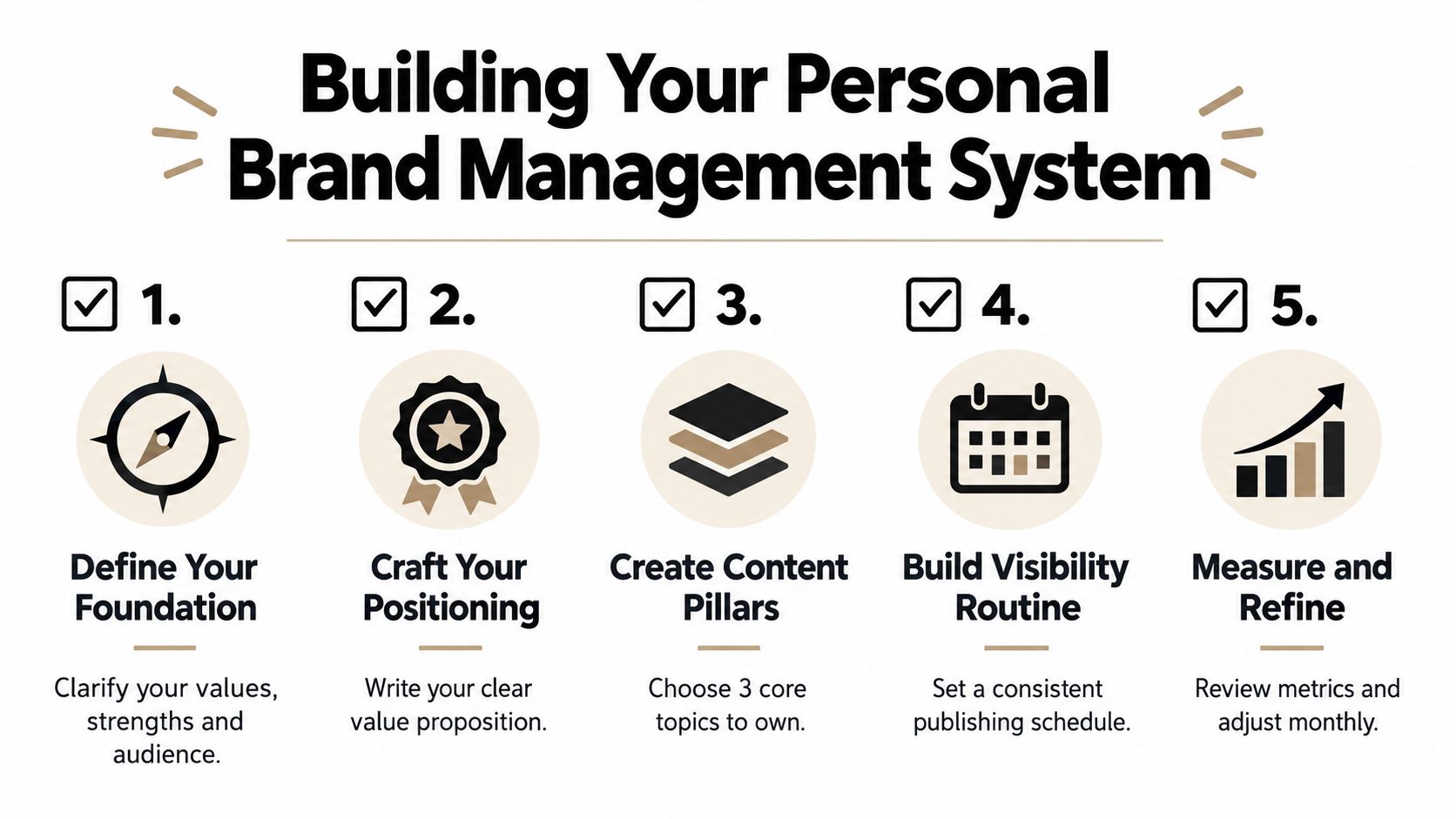
Write down three to five repeatable proof points. These might include a distinctive method, a recurring client problem, a leadership principle, a technical specialty, or a hard-earned lesson. Map each proof point to an audience need. If a point doesn't help your audience make a decision, avoid a clearer mistake, or understand a difficult problem, it probably doesn't belong in your core system.
Then audit your current presence. Search your name, review your profile, inspect your website, and read several recent posts as if you were a prospective client. Record every inconsistency in language, audience, promise, and visual identity.
Turn the foundation into a one-sentence value proposition. It should identify the audience, problem, and distinctive approach without relying on empty labels such as visionary, thought leader, or growth expert.
A useful executive-oriented reference is this branding framework for executives, particularly when your public identity needs to support both personal credibility and organizational responsibility.
Choose a few content pillars that your experience can sustain. Build a source bank from client questions, meeting notes, presentations, decisions, and lessons learned. One strong idea can become a post, a newsletter passage, a video explanation, and a speaking point through a deliberate content repurposing framework that actually scales.
Use AI for transcription, outlining, editing, and format adaptation. Don't let it invent your convictions or flatten your language. In an AI-saturated environment, the advantage comes from using tools to sharpen a recognizable voice, not from publishing more indistinguishable material.
Review the signals that connect to your objective. Note which topics attract relevant people, which formats produce thoughtful responses, and which messages lead to useful conversations. Remove weak pillars and strengthen the ideas that make your expertise easier to recognize.
Current trend discussions increasingly emphasize niche expertise, micro-communities, and real-world impact over broad reach. Treat selective relevance as a strategic choice, not a consolation prize.
Legacy Builder is one service option for professionals who want support with strategy, profile optimization, ongoing content, video, newsletters, and audience interaction. The important question isn't whether you outsource the work. It's whether the system preserves your judgment and keeps your public promise coherent.
Personal brand management matters because reputation compounds. Every useful explanation, principled decision, thoughtful conversation, and documented result adds another piece to the public record of how you think and what you can do.
That record creates professional value beyond a current role or company. It helps prospective clients understand your approach before a meeting, helps collaborators identify shared principles, and gives future opportunities a reason to find you. A legacy isn't built through isolated visibility spikes. It's built through a body of work that remains coherent over time.
The discipline has modern roots. Tom Peters' 1997 article “The Brand Called You”, followed by his 1999 book The Brand You 50, helped popularize personal branding as an intentional business concept for professionals managing reputation and visibility. The history of personal branding shows how the field developed alongside the internet, social platforms, and algorithmic distribution.
The tools have changed, but the responsibility hasn't. Discovery keeps your identity grounded. Positioning gives your expertise a memorable place in the market. Content makes your thinking visible. Measurement prevents you from confusing activity with progress.
A lasting legacy also requires selectivity. You don't need to comment on every trend or appear on every platform. Choose the communities where your expertise can create real value, then show up with enough consistency that people can recognize your contribution.
For a broader view of how professionals turn intention into durable impact, explore these personal legacy examples from vision to impact.
Personal brand management is an investment in being understood before you need to be chosen. Define the promise, prove it publicly, and refine the system until your reputation reflects the work you want to be known for.
If you want help turning your story, expertise, and vision into a coherent personal brand system, visit Legacy Builder. Its team supports strategy, content creation, profile optimization, video, newsletters, and distribution so you can build a credible professional legacy without leaving your public presence to chance.


You could – but most in-house teams struggle with the nuance of growing on specific platforms.
We partner with in-house teams all the time to help them grow on X, LI, and Email.
Consider us the special forces unit you call in to get the job done without anyone knowing (for a fraction of what you would pay).
Short answer – yes.
Long answer – yes because of our process.
We start with an in-depth interview that gives us the opportunity to learn more about you, your stories, and your vision.
We take that and craft your content then we ship it to you. You are then able to give us the final sign-off (and any adjustments to nail it 100%) before we schedule for posting.
No problem.
We have helped clients for years or for just a season.
All the content we create is yours and yours alone.
If you want to take it over or work on transitioning we will help ensure you are set up for success.
We want this to be a living breathing brand. We will give you best practices for posting and make sure you are set up to win – so post away.
Subscribe to our newsletter and get insights on how to grow your personal brand.
