.svg)
Subscribe to our newsletter and get insights on how to grow your personal brand.
Thank you! Your submission has been received!
Oops! Something went wrong while submitting the form.
.svg)



Most advice about personal brand building starts with “be authentic and post consistently.” That advice is incomplete. Authenticity without a position produces pleasant noise, and consistency without a system turns a founder into a content machine with no clear commercial outcome.
A founder's reputation already influences how people interpret the company, the category, and the opportunity around it. The practical question isn't whether you have a personal brand. It's whether you're managing the one people are forming from your profile, content, interviews, customer conversations, and digital footprint.
Personal brand building works when it becomes an operating system. You need a defined point of view, evidence that supports it, governance for what gets published, and a feedback loop connecting attention to conversations, relationships, hiring, partnerships, and revenue.
Founders rarely lose opportunities because they lack a polished profile. They lose them because the market cannot quickly connect their judgment, company, and point of view. Personal brand building influences how buyers, candidates, partners, investors, and peers evaluate a founder before a formal conversation begins. Independent summaries report that 70% of employers consider a personal brand more important than a resume or CV, while 54% reject candidates because of a poor online presence. The same summary reports that 44% have hired someone because of their personal brand. These figures appear in this personal branding data summary.
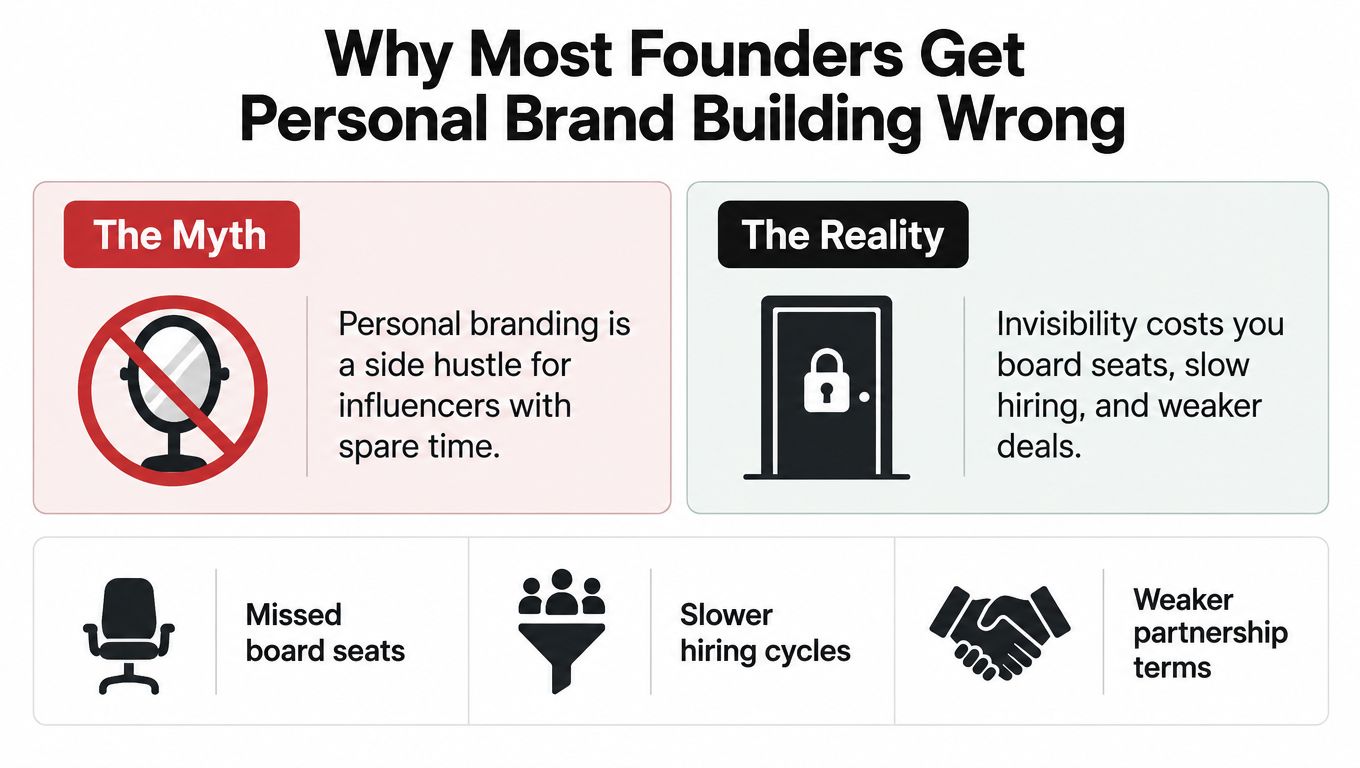
Invisibility creates commercial friction rather than a visible line item. A board may consider another leader, a strong candidate may fail to understand why the company matters, or a competitor may define the category before your team earns influence. Without recognition beyond existing relationships, every new room begins with a credibility explanation.
First, a brand is not a logo or polished bio. Those assets provide structure, but they do not explain the problem you solve, the principles guiding your decisions, or the evidence behind your judgment. A strong profile should make those signals easier to find.
Second, consistency does not create compounding results by itself. A publishing schedule can build familiarity, yet it also repeats the original positioning. Vague strategy produces a larger library of vague content. The operating system needs audience priorities, approval rules, reusable formats, and a way to connect response to business conversations.
Third, a ghostwriter cannot create founder credibility alone. A writer can research, structure, edit, repurpose, and distribute material. The founder must supply lived experience, specific convictions, and decisions worth examining. Remove that source material and the result may look polished while sounding interchangeable.
Operating rule: Treat your personal brand as a trust layer around the business, not as a stream of posts detached from commercial priorities.
The execution gap separates wanting a brand from operating one. Close it with a phased system that defines the audience, sets governance, captures founder insight, and measures movement in audience quality, pipeline conversations, hiring interest, partnership access, and deal velocity. Personal brand building becomes a revenue asset when those signals are managed as part of the business, not added to an already crowded calendar.
Personal brand building is the deliberate accumulation of perception capital. In practical terms, that means managing three connected questions: who you are, what you stand for, and what you're trusted to do. People form answers from your stories, opinions, proof, relationships, and repeated behaviour across channels.
The practice has evolved through distinct phases. A historical review describes a static phase from 1995 to 2005, when professionals were primarily discoverable through online resumes and profiles. The social phase from 2005 to 2015 shifted attention toward networks and conversation. The algorithmic phase from 2015 to the present has made continuous publishing, distribution, and community management central to visibility. The review also notes LinkedIn's growth from about 500,000 users in 2003 to 13 million by 2007, illustrating how quickly networked professional identity became useful. See the historical review of personal branding's development.
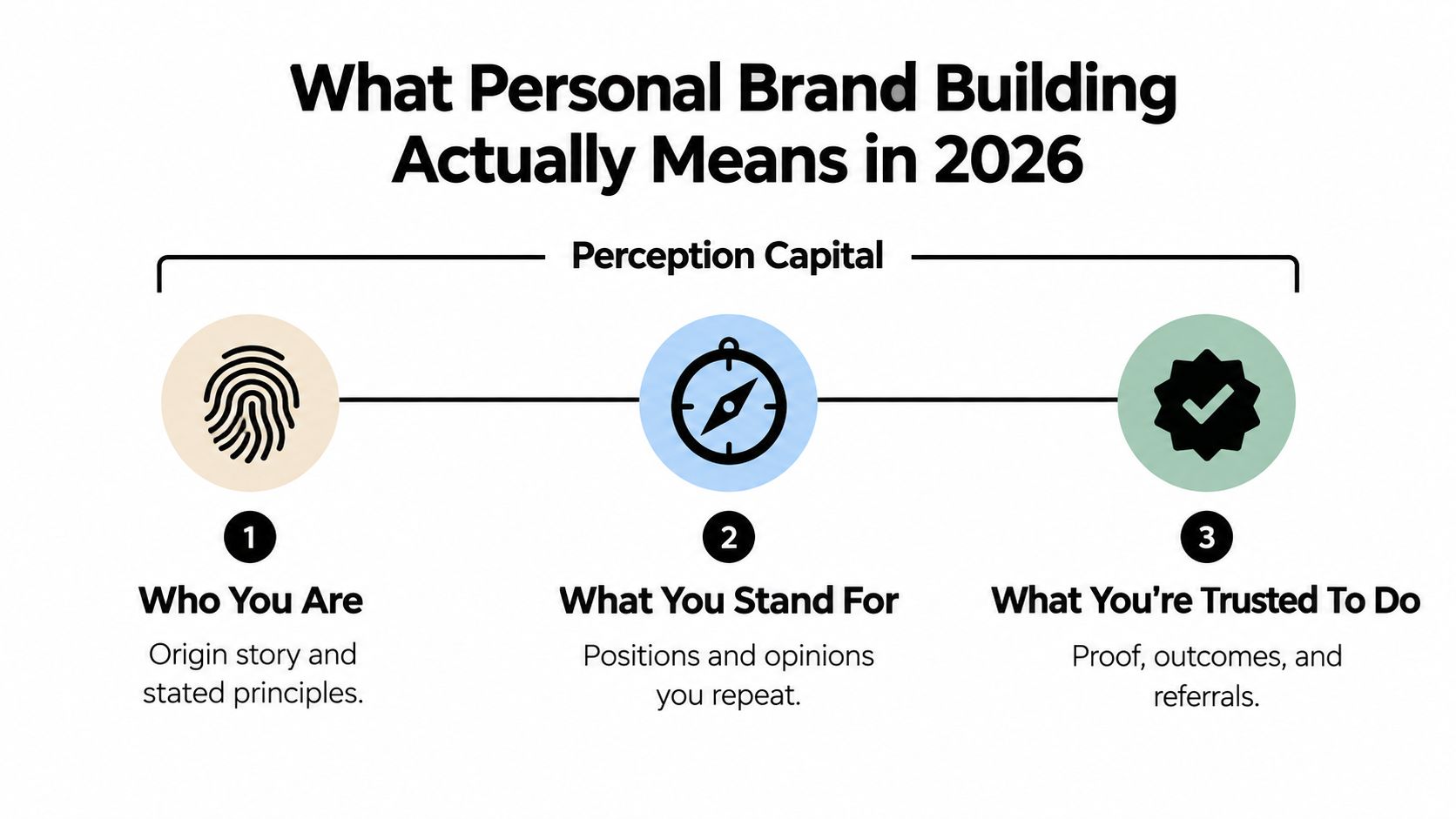
The modern practice isn't about acting charismatic online. It's about making your signals coherent.
AI-assisted publishing has increased the supply of fluent content. That makes generic advice easier to produce and less useful as differentiation. Originality now comes from the combination of a specific experience, a defensible opinion, and evidence that helps another person make a better decision.
A practical definition of personal branding should therefore include more than visibility. Your brand is the pattern people recognise when they encounter your profile, a post, a podcast appearance, a sales conversation, or a referral from someone in their network.
Perception capital becomes useful when it reduces uncertainty. A buyer wants to know whether you understand the problem. A candidate wants to know whether your leadership matches their ambitions. A partner wants to know whether you'll make sound decisions when the relationship becomes difficult.
That means every publishing decision should answer at least one operational question:
A brand system doesn't need to make you famous. It needs to make the right people more confident about starting a conversation.
A useful brand equity model identifies Brand Appeal, Brand Differentiation, and Brand Recognition as three measurable dimensions. The same 2025 framework identifies six attributes that drive them: visibility, credibility, differentiation, online presence, professional network, and reputation. Its practical implication is clear. Content, profile optimisation, and network activation have to work together rather than operate as separate marketing tasks. The framework is summarised in this personal brand equity research.
For founders, I translate those dimensions into three operating tests: clarity, credibility, and consistency. Appeal depends on whether people understand and value your relevance. Differentiation depends on whether your perspective is distinct enough to remember. Recognition depends on repeated exposure to the same meaningful signals.
| Dimension | Driving Attributes | What It Measures | How to Score It (1-5) |
|---|---|---|---|
| Clarity | Positioning, point of view | Whether the right audience can explain what you're known for | 1: unclear, 5: immediately understood |
| Credibility | Proof, people, reputation | Whether your claims are supported by evidence and trusted relationships | 1: assertion-led, 5: proof-rich and independently reinforced |
| Consistency | Presence, pipeline, positioning | Whether your message and behaviour remain coherent across channels and conversations | 1: fragmented, 5: recognisable and sustained |
A founder with strong credibility but weak clarity may have impressive experience that no audience can categorise. A founder with clarity but weak proof may have a compelling niche without enough reason for the market to believe the claims. A founder with both but weak consistency forces people to reconstruct the brand from scattered encounters.
Score each dimension. Then collect evidence:
One useful next step is to build a LinkedIn pillar strategy after you know which dimension is weakest. A content pillar shouldn't be selected because it sounds interesting. It should reinforce the positioning you need the market to remember.
Brand equity compounds in sequence. Clarity tells people where to place you. Credibility gives them a reason to believe you. Consistency gives that belief enough reinforcement to influence action. Fixing the wrong layer wastes effort.
Positioning decides whether your audience remembers you or scrolls past. Founders often start with content formats, but formats can't rescue an undefined point of view. Build the stack from the inside out, with each layer making the next one easier to specify.
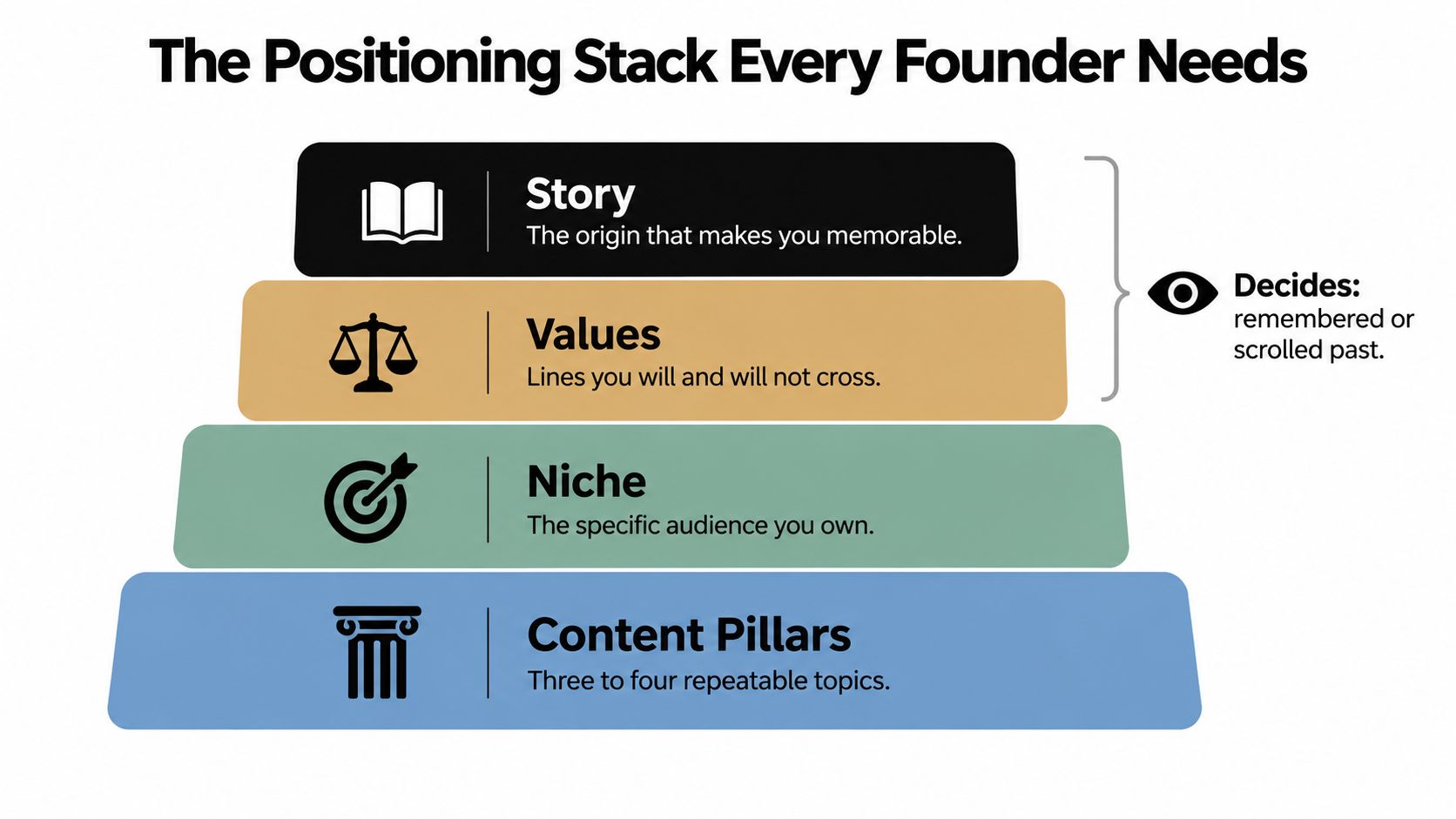
Your story provides texture. It should include the experience that shaped your expertise, the turning point that changed your approach, and the hard-won lesson you now apply for others. This isn't an autobiography. Choose the moments that explain why you see a problem differently.
A founder building an operations brand might talk about the recurring failure that forced them to redesign a process. A cybersecurity founder might explain the incident that changed how they evaluate risk. The story earns attention, but it shouldn't carry the whole brand. It gives context to the ideas that follow.
Values tell you what you will defend, what you won't compromise, and which debates deserve your time. They prevent a founder from commenting on every trending topic just because it might produce reach.
Write down the decisions that reveal your standards. Do you prioritise simplicity over feature volume? Long-term customer trust over short-term expansion? Direct feedback over consensus? Those choices become useful editorial boundaries.
A niche is not a prison. It's a recognition shortcut. Start with the audience you understand best, the problem you can explain with authority, and the context where your experience creates an advantage. Then test whether one person can describe your relevance in a single sentence.
If the niche is too broad, your content becomes interchangeable. If it's too narrow to support future work, widen it around the underlying problem rather than the current product.
Choose three to five repeatable themes that connect your expertise to audience decisions. Strong pillars might include founder lessons, industry teardowns, customer education, hiring principles, or behind-the-scenes operating notes. Each should support multiple formats, such as an essay, a short post, a video explanation, and a conversation prompt.
For additional perspective, review these personal branding articles for creators, especially when translating a personal point of view into repeatable creative formats.
A useful brand positioning strategy framework can help you test whether the stack is coherent. If your story doesn't support your values, your values don't narrow the niche, or your pillars don't express the niche, the audience receives disconnected signals.
The test is simple: can someone recognise your content before seeing your name? If the answer is no, strengthen the stack before increasing output.
Content without distribution is a private journal. The right channel depends on the job it must perform, not on whatever platform currently receives the most attention.
| Channel | Primary Job | Best Content Type | Cadence | Compounding Asset |
|---|---|---|---|---|
| Reach buyer-adjacent professionals and generate conversations | Operating insights, founder lessons, document posts | Sustainable weekly rhythm | Professional discovery and replies | |
| X | Develop niche credibility and respond quickly to ideas | Short arguments, commentary, threads | Flexible and conversation-led | Public point of view |
| Build an owned audience and deepen trust | Essays, analysis, useful notes | Regular newsletter rhythm | Subscriber relationship | |
| Blog, newsletter, or podcast hub | Create depth and searchable context | Long-form essays, interviews, frameworks | Predictable production cycle | Durable knowledge archive |
LinkedIn is useful when your audience includes executives, operators, candidates, partners, or buyers who already use professional networks. X can support fast-moving commentary and niche conversations, but it demands stronger judgment because speed magnifies weak opinions. Email creates a direct relationship that doesn't depend entirely on a platform feed. A long-form hub gives your ideas enough room to become reference material.
Don't publish identical content everywhere. Adapt the opening, context, and call to action while preserving the central argument. The channel should change the expression, not the point of view.
A practical mix is 60% pillar content, 30% curated commentary, and 10% personal or vulnerable updates. Treat that as a starting allocation, not a law. Pillar content demonstrates expertise, commentary proves you understand the market, and personal context makes the expertise easier to remember.
Use one weekly production loop:
The compounding effect comes from feedback loops, not volume. A personal brand evergreen content strategy is useful when you want strong ideas to remain discoverable after the initial publishing window.
Leaders often stall because they follow folklore instead of operating principles. The myths sound harmless, but each one encourages a costly behaviour: hiding expertise, chasing frequency, oversharing, or outsourcing judgment.
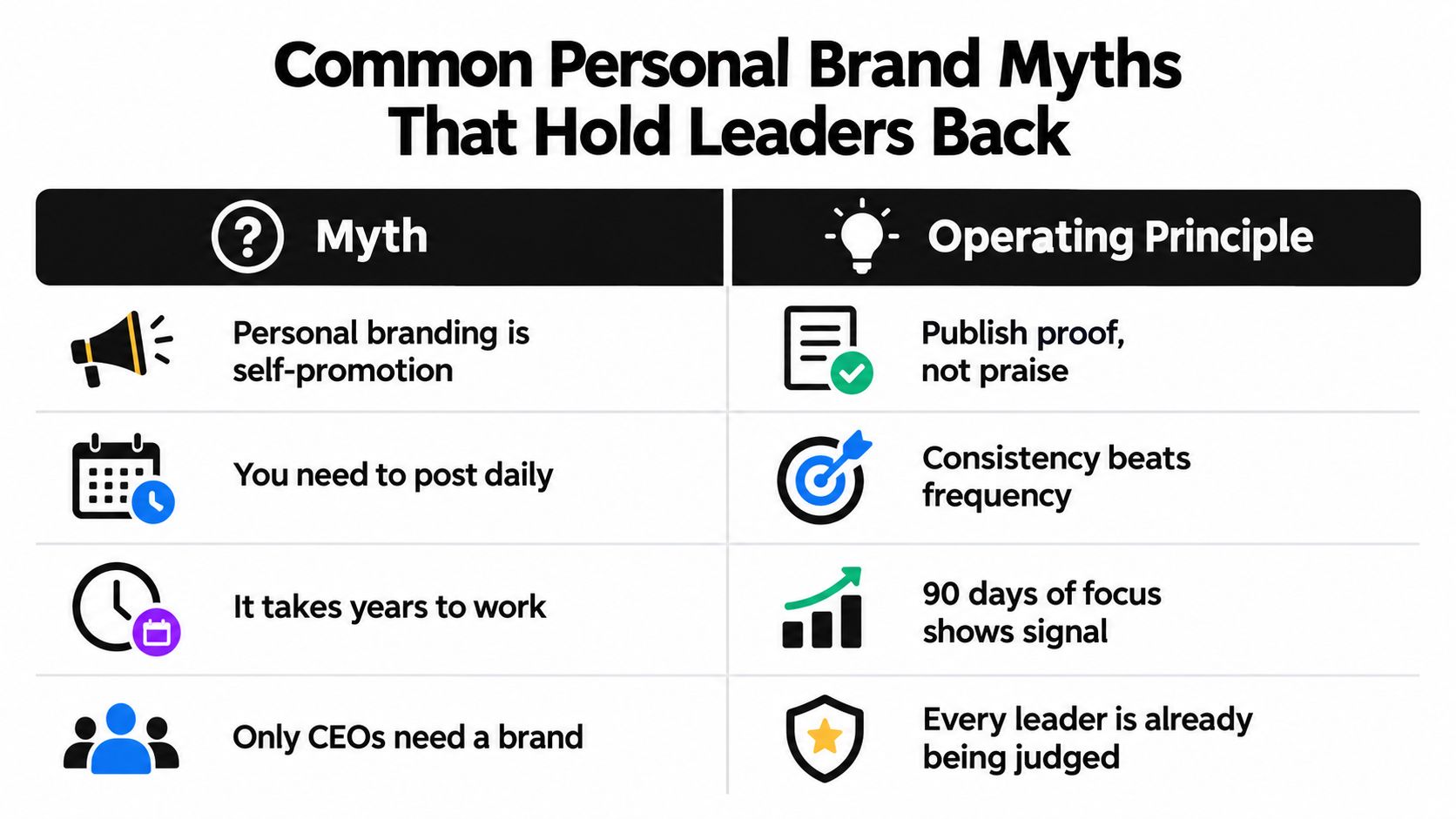
A founder who only posts praise creates little value. A founder who publishes useful proof gives the audience a reason to trust their judgment.
Operating principle: Publish the decision, the reasoning, the constraint, and the result. You don't need to announce that you're an expert when your work demonstrates how you think.
Frequency can create activity without recognition. A strong weekly rhythm on one important channel is more useful than weak daily publishing across several channels, particularly when the founder has no time to engage with replies.
Operating principle: Choose a cadence your team can sustain through launches, travel, hiring, and difficult operating periods. Reliability matters more than performance theatre.
Unfiltered disclosure isn't the same as honesty. Brand-building authenticity means selecting real experiences that clarify your values, teach a useful lesson, or explain a decision. Private information doesn't become strategically valuable just because it's private.
Operating principle: Share the experience, interpretation, and lesson. Keep boundaries around details that belong to your family, employees, customers, or legal counsel.
A writer can make the workflow faster, but the founder must supply the raw material. The voice depends on stories, opinions, objections, and decisions that no outside researcher can reliably invent.
Operating principle: Record a weekly founder interview, maintain a decision log, and review drafts for conviction rather than just grammar. Delegation should remove production friction while preserving authorship.
The implementation benchmark is sobering. One independent report found that only 22% of professionals had moved from awareness to strategic implementation, although that was up from 16% in 2024, as reported in the 2025 personal branding benchmark. The problem isn't that leaders don't know personal brand building matters. Most haven't built the operating habits to execute it.
A ninety-day launch works because it creates a bounded test. You aren't committing to an abstract content project. You're building the positioning, publishing, distribution, and measurement habits required to decide what deserves long-term investment.
Start with the positioning stack. Write the story, values, niche, and content pillars before creating a calendar. Then audit your digital footprint across search results, social profiles, speaker pages, podcast listings, and company bios.
Set up a simple dashboard with fields for date, channel, pillar, format, audience response, direct messages, introductions, and commercial relevance. Ship two pieces during this phase to test whether your voice sounds like you and whether the audience understands the subject.
Checkpoint: Can your target audience describe your lane? Which phrases feel natural in your voice? Which questions do people ask after reading the first pieces?
Move to a repeatable publishing rhythm of three posts per week. Launch a weekly newsletter if email fits your audience and operating capacity. Engage twenty target accounts directly by contributing useful comments, asking informed questions, and following up on real conversations.
Repurpose each flagship idea across LinkedIn, X, and email, but don't treat repurposing as copying. Change the framing for the audience and the channel. A useful content system for new creators can help organise production when video becomes part of the mix.
Checkpoint: Review the quality of replies, the number of meaningful conversations, the questions your content creates, and the production time required. Remove formats that consume time without producing learning or signal.
Introduce one flagship monthly asset, such as a long-form essay, a recorded founder conversation, or a podcast appearance. Run two community-driven conversations per week, using audience questions and objections as source material rather than inventing topics in isolation.
Review attribution notes. Look for replies that become calls, introductions from trusted contacts, relevant candidate interest, partner conversations, and customer questions that mention your content. Then double down on the pillar producing the strongest signals.
Final checkpoint: Keep the channel, format, and pillar combination that creates high-quality conversations with manageable effort. Prune the rest. A smaller system that survives a busy quarter is more valuable than an ambitious schedule that collapses after launch.
The governing principle is simple: specificity beats volume, and consistency beats originality. A founder does not need every trend or a stream of algorithm-friendly posts. They need a narrow point of view, a reliable way to express it, and enough time for the right people to recognise the pattern.
Restraint makes that system workable. Publish less than a platform suggests when the alternative is weak thinking. Repurpose a strong idea across channels when its underlying lesson remains useful, changing the framing for each audience. Measure the quality of inbound signals, including thoughtful replies, introductions, qualified conversations, and clearer market understanding. Remove channels that consume attention without producing those signals.
A consistent personal brand can strengthen trust with prospective customers, partners, and candidates. As noted earlier, the value comes from coordinated signals, not from appearing everywhere. A founder should add a platform only when its audience fits the business and the publishing workflow can support it.
Pick one audience, one lane, one flagship format, and one weekly cadence. Ship long enough to learn what compounds before you optimise the machine.
Personal brand building becomes valuable when trusted demand grows around a founder's ideas. The asset is not a polished feed. It is the accumulated confidence that makes the right people more willing to reply, refer, hire, partner, buy, or invite you into a better conversation. Governance keeps that confidence intact: document the core message, define approval rules, track meaningful attribution, and review the system before adding more output.
Legacy Builder helps founders and executives turn their stories, insights, and point of view into a managed personal brand system, including content strategy, profile optimisation, publishing, and audience engagement. If you want a team to operate the system without stripping away your voice, visit Legacy Builder and explore how the service fits your next ninety days.


You could – but most in-house teams struggle with the nuance of growing on specific platforms.
We partner with in-house teams all the time to help them grow on X, LI, and Email.
Consider us the special forces unit you call in to get the job done without anyone knowing (for a fraction of what you would pay).
Short answer – yes.
Long answer – yes because of our process.
We start with an in-depth interview that gives us the opportunity to learn more about you, your stories, and your vision.
We take that and craft your content then we ship it to you. You are then able to give us the final sign-off (and any adjustments to nail it 100%) before we schedule for posting.
No problem.
We have helped clients for years or for just a season.
All the content we create is yours and yours alone.
If you want to take it over or work on transitioning we will help ensure you are set up for success.
We want this to be a living breathing brand. We will give you best practices for posting and make sure you are set up to win – so post away.
Subscribe to our newsletter and get insights on how to grow your personal brand.
