.svg)
Subscribe to our newsletter and get insights on how to grow your personal brand.
Thank you! Your submission has been received!
Oops! Something went wrong while submitting the form.
.svg)


Most advice about evergreen content gets it backwards. It treats a long article like a finished product, then acts surprised when search demand shifts, competitors publish stronger versions, or AI-driven results change what gets clicked. Evergreen content strategy isn't about writing something “timeless,” it's about building content you can maintain, redistribute, and keep aligned with search intent as it evolves.
That's the practical difference between content that compounds and content that decays. Evergreen works best as a living system, with a stable architecture, modular sections, isolated dated elements, internal links that keep authority circulating, and review checkpoints that stop small problems from becoming losses. In other words, the win comes less from topic choice alone and more from the operating system around the topic.
A lot of personal brands publish one big guide, call it evergreen, and never touch it again. That approach usually fails because the page is frozen while the market around it keeps moving. Search intent shifts, AI summaries absorb some clicks, and readers start expecting fresher examples, cleaner structure, and tighter topical coverage.
The strongest evergreen assets are built with maintenance-by-design. That means the page has a stable core, modular sections that can be swapped or expanded, and dated references kept separate so they're easy to refresh without rewriting the whole thing. A technical evergreen workflow also leans on pillar-page clusters and scheduled checkpoints, not one-off publishing bursts, because durable pages perform best when the topic keeps getting searched month after month and can be updated without structural chaos, as described in this evergreen content framework.
If you can't update a page without unraveling it, it wasn't evergreen enough to begin with.
The other reason static content breaks is that AI-driven search has made semantic stability matter more. Ahrefs has started framing the problem through evergreen content in the age of AI search, which is a useful signal that the job isn't just to pick a timeless keyword, but to cover the topic cleanly, keep the intent matched, and close topical gaps when the SERP changes.
Durable content doesn't depend on a single date-stamped claim or a narrow trend hook. It uses sections that can survive small updates, like swapping an example, refining an FAQ, or adding a better internal link. It also avoids burying the reader in detail that only makes sense for one moment in time.
The simplest test is this, if the article still makes sense after you remove the publication date, the core idea is probably sound. If the article only works because of a current trend, a passing tool release, or a temporary platform change, it's not evergreen, it's just current.
Before creating anything new, audit what you already own. Most personal brands are sitting on a pile of posts that could become stronger with a rewrite, a merger, or a better internal link structure. That's where the easiest wins usually live.

The first pass is simple. Look for pages that target topics with consistent search volume over a long period, minimal seasonality, and clear alignment with your core expertise. That's the same logic behind pillar-page architecture, because evergreen pages work best when they sit on durable search intent rather than fashionable phrasing.
A useful companion to the audit process is this content audit template from Riff Analytics, especially if your library is already messy and you need a cleaner way to classify what should stay, merge, or disappear. If you want to measure whether those pages already pull their weight, it also helps to keep a separate internal review against your own performance framework, like the one in how to measure content performance for your personal brand.
A practical rubric helps you avoid emotional decisions. Score each piece on three questions, then rank the winners.
If a piece scores well on all three, it's a refresh candidate. If it scores well on topic fit but poorly on depth, merge it into a stronger pillar page. If it scores poorly across the board, retire it instead of keeping it alive out of habit.
Thin content is rarely worth “saving” one page at a time. Consolidation usually creates a better asset than patching three weak ones.
The goal isn't to preserve volume. It's to reduce noise so your strongest pages can carry more authority and become easier to maintain over time.
Good pillar topics are not just broad. They're resilient. They sit at the intersection of recurring pain, continuing curiosity, and expertise you can credibly own for a long time. That's why the smartest evergreen strategies start with topic durability, not volume alone.

The strongest pillar topics usually map to recurring needs. For founders, that might be positioning, hiring, customer communication, or distribution. For SaaS leaders, it might be onboarding, retention, pricing communication, or building trust at scale. For service providers, it often comes back to lead generation, authority building, and client education.
The point is to choose a subject you won't run out of angles for after one article. If the topic naturally branches into tutorials, mistakes, checklists, comparisons, and framework pages, it probably has pillar potential. If it only supports one angle and then starts feeling thin, it's too narrow for a durable hub.
A pillar page should anchor the topic, while feeder content handles the specific questions. That structure helps internal links do real work, because every supporting page passes readers and authority back to the core asset. It also makes refreshes easier, since the pillar can stay stable while the cluster absorbs new examples or subtopics.
If you want a clean way to think about this, build AI topic authority with a hub-and-spoke model instead of scattering loosely related posts across your site. The advantage is practical, not theoretical. You create a page that can rank for the main idea, then use smaller assets to answer the narrower questions people ask before they're ready to act.
Some topics appear timeless until the market shifts under them. A tool-specific tutorial can become brittle if the interface changes often. A trend-heavy thought leadership post can age badly if the argument depends on a temporary platform behavior. Even a broad topic can fail if it's framed around jargon your audience won't still use next year.
The safest pillar topics are the ones that can survive language changes, product changes, and search changes. They stay relevant because the underlying problem doesn't disappear.
A strong evergreen content strategy doesn't start with “How do we publish more?” It starts with “How do we make one idea work harder?” That mindset changes the workflow immediately, because the first output is no longer the final output.
The easiest way to build volume without sacrificing depth is to create one core piece, then atomize it. A long-form guide becomes the source file. From there, each section can become a post, a carousel, a script, an email, or a short educational clip. That's where modular writing pays off, because every section is built to stand on its own later.
One practical rhythm looks like this.
For creators who want a second lens on this process, content repurposing strategies for faceless creators is a helpful reference because it keeps the emphasis on format translation, not just copying and pasting the same message everywhere. That same thinking pairs well with your own internal workflow, such as the one in how to repurpose content and multiply your reach.
If a section only makes sense inside the full article, it won't repurpose cleanly. Good modular sections open with a clear claim, use a self-contained example, and avoid relying on nearby paragraphs for context. That makes it easier to lift them into newsletters, social posts, or scripts without turning them into fragments.
Many brands waste effort. They create content that looks detailed, but only the full page is useful. A better system is to write with reuse in mind from the start, so the same source file feeds your editorial calendar for weeks.
The best repurposing systems don't extract more content. They extract more surface area from the same insight.
That also keeps the tone authentic. You're not forcing a new idea for every platform, you're translating one real idea into the language each channel already prefers.
Evergreen content compounds when you treat refreshes like scheduled maintenance. The pages that grow are usually the ones that get checked before they break, not after traffic drops and the decay is obvious to everyone.
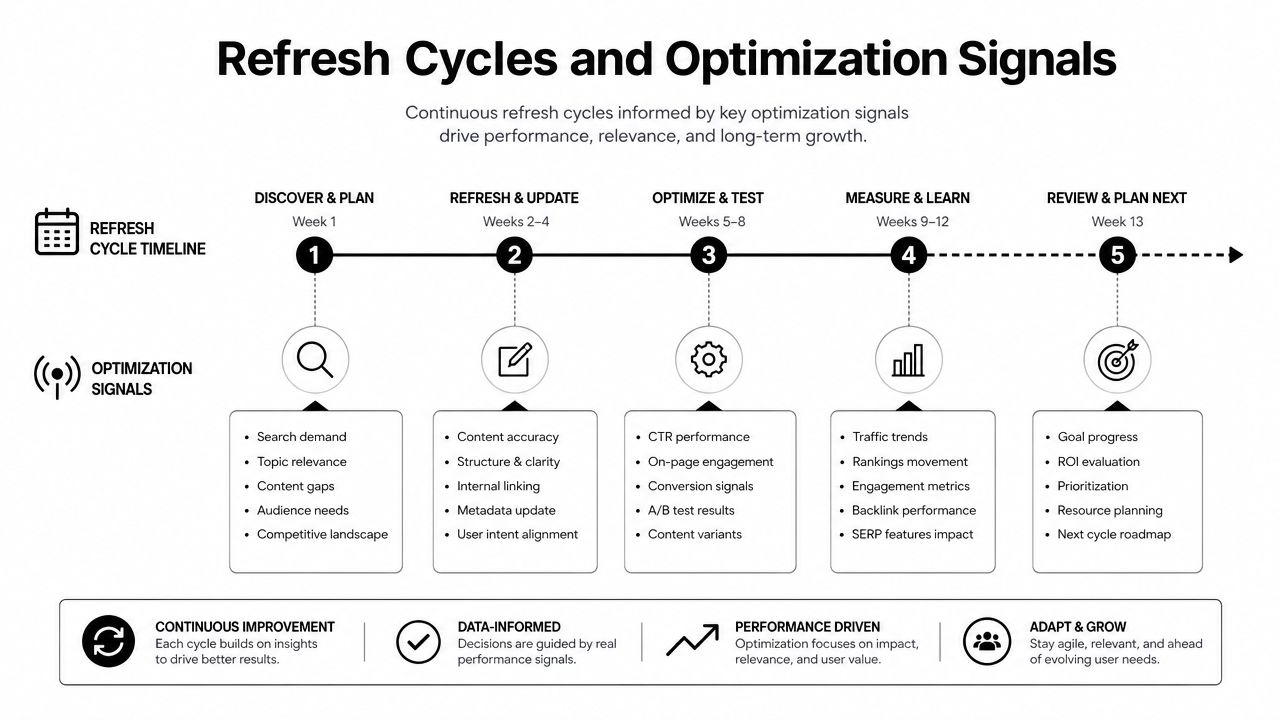
A practical refresh system separates pages by importance. High-traffic pages deserve attention about every 6 months, medium-priority pages about annually, and lower-priority content about every 18 months, which matches the structured refresh approach in this evergreen content strategy guide. The logic is simple, the more a page matters, the sooner a small issue can affect performance.
A useful schedule looks like this.
| Priority Tier | Refresh Frequency | Key Actions |
|---|---|---|
| High priority | Every 6 months | Update statistics, internal links, meta titles, examples, and visible freshness signals |
| Medium priority | Annually | Tighten sections, check search intent alignment, and revisit CTAs |
| Low priority | Every 18 months | Confirm relevance, prune weak sections, and merge if needed |
This isn't about endlessly editing every page. It's about spending your attention where the return is highest.
A page doesn't need a calendar reminder if Search Console already shows trouble. If impressions hold but clicks soften, the title or snippet may need work. If rankings drift, the page may need deeper topical coverage or a clearer match to current intent. If a page stays stable, leave it alone.
The highest-value refreshes usually involve five things, updated examples, cleaner internal links, sharper meta titles, clearer headings, and fresher visible cues that tell both readers and search engines the page is maintained. The important part is to improve the substance, not just swap dates and pretend the work is done. That's especially true now, when evergreen content needs to stay semantically stable while still closing topical gaps as search changes around it.
The best evergreen page in the world won't help much if nobody keeps seeing it. Distribution is what turns a useful asset into a long-lived one, because it keeps feeding the page from multiple directions instead of relying on one publish date.
A founder I worked with had one deep guide that kept generating leads months after launch, but only after we made it part of a recurring distribution loop. Every new article linked back to it. A monthly newsletter featured it in a different context. Short posts pulled one angle at a time, then sent readers back to the full page. Nothing about the content changed dramatically, but its visibility stayed alive because the distribution system never stopped.
Internal linking is the first loop. Every relevant new post should point back to the evergreen pillar, and the pillar should send readers into the cluster where they need more detail. That keeps authority circulating, and it makes your library feel connected instead of random.
Email is the second loop. A pillar page can become the entry point for a nurture sequence, a welcome flow, or a segmented newsletter path. Community channels are the third loop. When a post answers a recurring question, it can be resurfaced in groups, replies, and direct outreach without feeling repetitive.
Evergreen content should reappear in different formats and at different moments. A strong page can support a launch, a sales conversation, a customer education flow, or a credibility-building post long after publication. The trick is to change the framing each time so the audience sees the same idea as newly relevant.
Many personal brands underuse their best work. They create the asset, then move on to the next one. The stronger move is to keep the asset in circulation, especially when you already know it solves a real problem. That's how a content library starts acting more like an owned media system and less like a blog archive.
An evergreen calendar needs balance. If it only tracks new publishing, the library decays. If it only tracks refreshes, the brand goes quiet. If it only tracks distribution, nothing new enters the system. The point is to manage all three without letting any one of them swallow the others.
The most workable calendar has four lanes: new pillar creation, cluster support content, refreshes, and distribution. Each week should not be overloaded with all four. Instead, assign clear ownership so the work doesn't blur together. That makes it easier to see whether the system is producing durable assets or just activity.
A practical template for a personal brand looks like this.
For a practical planning reference, a content calendar template for social media that actually works can help you keep distribution from becoming random, even if your main focus is search-led content.
The right metrics tell you whether the system is getting stronger. Watch for compounding traffic on pillar pages, lead generation from those pages, internal link equity moving toward your core assets, and decay signals that show where updates are overdue. A page that keeps earning attention after distribution is stronger than one that spikes once and disappears.
You don't need to overcomplicate the dashboard. You just need a repeatable review rhythm and the discipline to act on it. The brands that win with evergreen content are the ones that treat it like an operating system, not a one-time campaign.
If you want evergreen content that compounds, Legacy Builder can help you build the system behind it, not just the post itself. Their team turns personal expertise into a content engine with strategy, creation, and distribution working together. Visit Legacy Builder if you're ready to turn your best ideas into assets that keep working long after publish day.


You could – but most in-house teams struggle with the nuance of growing on specific platforms.
We partner with in-house teams all the time to help them grow on X, LI, and Email.
Consider us the special forces unit you call in to get the job done without anyone knowing (for a fraction of what you would pay).
Short answer – yes.
Long answer – yes because of our process.
We start with an in-depth interview that gives us the opportunity to learn more about you, your stories, and your vision.
We take that and craft your content then we ship it to you. You are then able to give us the final sign-off (and any adjustments to nail it 100%) before we schedule for posting.
No problem.
We have helped clients for years or for just a season.
All the content we create is yours and yours alone.
If you want to take it over or work on transitioning we will help ensure you are set up for success.
We want this to be a living breathing brand. We will give you best practices for posting and make sure you are set up to win – so post away.
Subscribe to our newsletter and get insights on how to grow your personal brand.
