.svg)
Subscribe to our newsletter and get insights on how to grow your personal brand.
Thank you! Your submission has been received!
Oops! Something went wrong while submitting the form.
.svg)


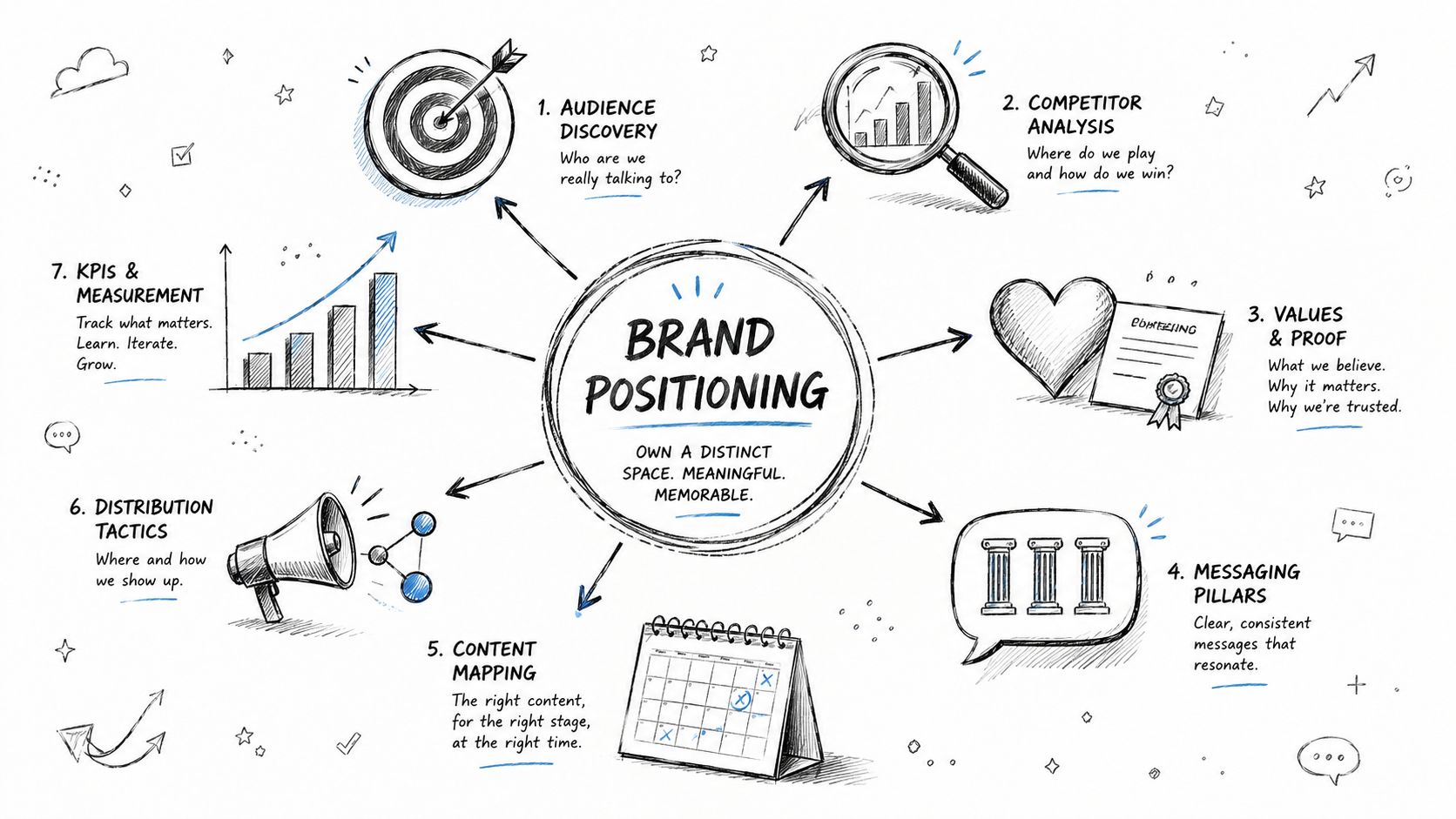
Most advice about brand positioning gets it backwards. It starts with a clever sentence, a prettier profile, or a tighter tagline, then acts surprised when leads don't change. Positioning only matters when it shapes what people remember, how they compare you, and whether your message stays intact across every channel.
That's why a strong brand positioning strategy isn't a writing exercise, it's an operating system for growth. Consistent, differentiated branding is linked to 10% to 20% revenue increases on average in the 2025 marketing-statistics roundups cited by brand positioning benchmarks, and one positioning line held across channels is commonly associated with 10% to 25% higher branded search lift versus fragmented messaging in the 2026 branding compilation at B2B awareness benchmarks. The practical lesson is blunt, if your positioning isn't clear enough to repeat everywhere, it won't compound anywhere.
Most founders treat positioning like a slogan challenge. They write a sentence that sounds sharp on a slide, then wonder why prospects still describe the business in generic terms, or why every post sounds slightly different from the last one. The core issue is operational, the market never gets a stable signal.
Crowded categories make that failure expensive. In the 2026 branding roundup from New Media's branding stats, many B2B brands outside the top tier sit in the 5% to 20% range for unaided awareness, which means people will not remember you unless your positioning does some heavy lifting. A single positioning line matters because fragmented messaging keeps forcing the market to relearn who you are.
The first failure mode is vague differentiation. If your line could sit on three competitors' websites without sounding wrong, it is decoration, not positioning. The second is inconsistent application, where the founder says one thing in calls, another on LinkedIn, and something else on the homepage.
Practical rule: If a prospect needs to guess what you are known for, the market is not getting a repeatable signal.
The commercial upside comes from coherence, not cleverness. A brand that presents a consistent, differentiated image is linked to 10% to 20% revenue increases on average in the brand positioning statistics compilation, and that same source ties one positioning line across channels to stronger branded search lift. That matters because search is often the first proof that your market remembers you before your sales team ever gets involved.
If you are building a personal brand, the lesson gets even sharper. Each post, profile update, and comment should reinforce the same buying idea, or your audience will experience you as competent but forgettable. Positioning fails when it stays conceptual instead of becoming operational.
Before writing a single sentence of positioning, build three artifacts that force real market clarity. Strong positioning starts with inputs, not phrasing. The work has to separate what you want to say from what buyers already believe, compare, and trust, or the final line will sound polished and still fail to drive recognition or leads.
Start with the audience drill. Write the exact person, what they have already tried, what they believe about the category, and the objection that shows up before they buy. Don't stop at “founders” or “leaders.” If you need a cleaner way to frame that work, use a buyer persona guide for founders as a prompt, then translate the answers into positioning language rather than generic personas.
Audience clarity sheet.
Capture the segment, the current belief, the failed alternatives, and the moment they start searching for help. If the segment is too broad, the positioning will drift toward safe language that sounds useful but does not create a buying reason.
Competitor language map.
List the three to five brands a prospect compares you against. Pull the exact phrases they use on homepages, bios, and pitch decks. A useful companion when building this map is the GenPPT competitor analysis pitch resource, because it helps you see how overlap shows up in slide-level messaging too.
Values-and-proof audit.
Write what you can credibly claim, then attach evidence to each claim. If a claim depends on experience, process, or outcomes, name the proof source now. If you can't back it, it reads well, but it doesn't carve out a defensible space in the buyer's mind.
A common trap is confusing personal taste with market differentiation. You may love a bold tone, a minimalist design, or a contrarian point of view, but if buyers do not use that difference to choose you, it is not a positioning edge. The test is simple. Does the market care enough to repeat it back?
Working standard: If you can't write the competitor's version of your claim, you have not found a real differentiator yet.
A founder in a crowded SaaS category might discover that buyers do not care about “automation” as a category claim, but they do care about reducing onboarding friction for non-technical teams. That insight changes the positioning from feature language to outcome language. Once that shift is clear, the rest of the system becomes easier to write and much harder for competitors to blur.
The discovery phase is also where defensibility starts. Buyer interviews, sales-call notes, and competitor pages should be read together, because positioning that sounds strong in isolation often collapses when it hits the market. That is the operational part founders miss. The message has to survive comparison, objection, and repetition by the sales team, not just approval in a workshop.
A practical way to pressure-test the inputs is to ask whether the claim still holds if a competitor copies the words. If the answer is yes, the message is probably too thin. Real differentiation comes from a combination of audience insight, proof, and a clear buying context, then that combination is repeated until the market starts associating it with you.
White space only matters when it connects to a real buying gap and holds up under competitive pressure. A clever angle can get attention for a week, but if a rival can mirror it quickly, it does not change the market position. Novelty is easy to spot. The harder test is whether a competitor can copy the edge within a quarter.
The practical gap map breaks white space into four types. Underserved needs are problems customers know they have, but the market handles badly. Unaddressed needs are problems the market barely talks about. Value gaps appear when buyers think existing offers are too expensive for what they deliver. Delivery-method gaps show up when the value exists, but the way it's delivered is clumsy, slow, or hard to adopt.
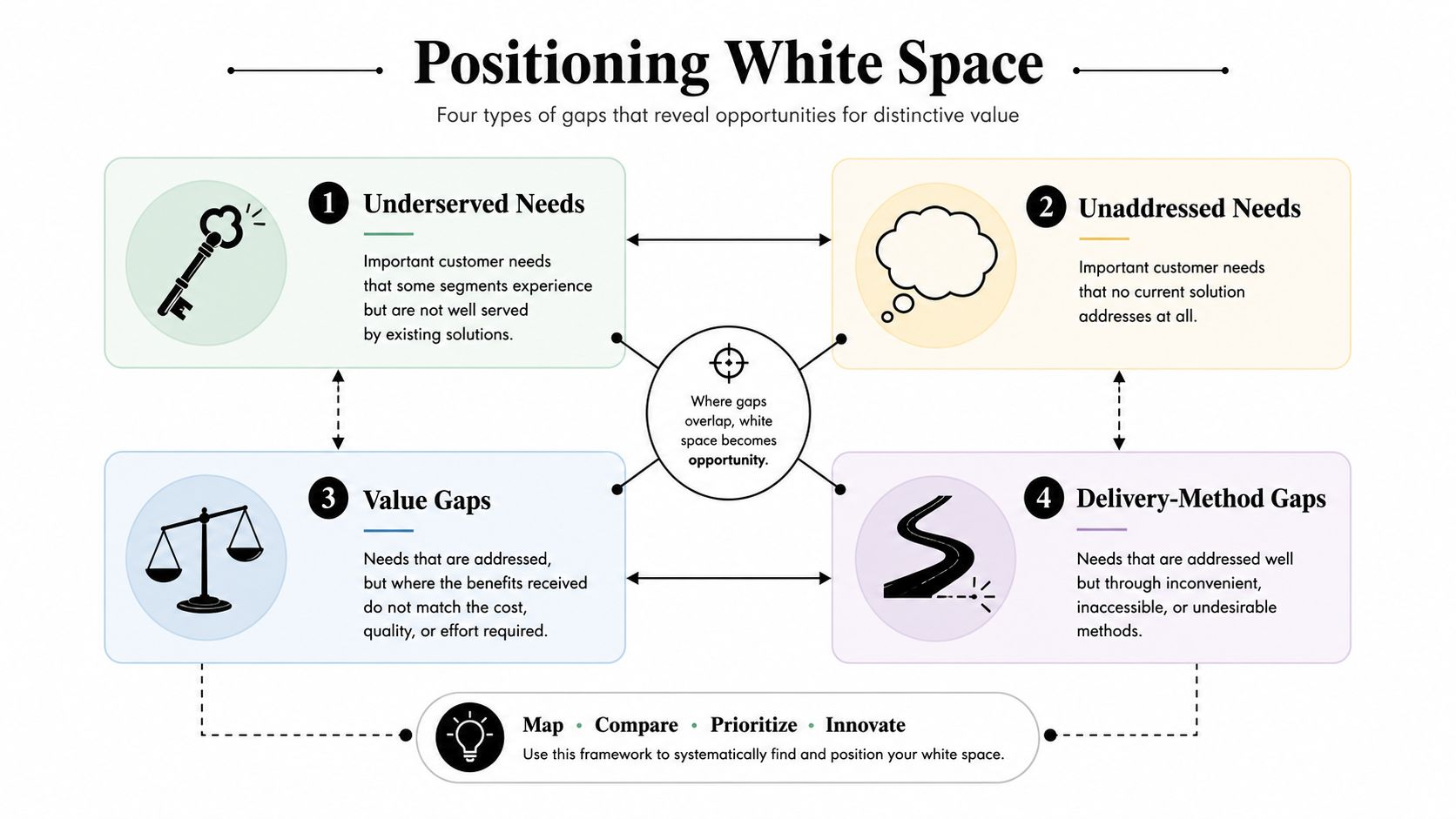
Crowded categories do not reward brands for existing. They reward brands that claim a gap competitors ignore and can prove they serve it better. The practical consequence matters more than the theory. If buyers cannot repeat the gap back in their own words, the position will not stick in sales conversations or referral loops.
The best question I've seen in positioning work is simple. If a competitor copied your offer exactly tomorrow, would customers still choose you? That question forces a check for durability, not just a clever angle.
A defensible position usually has at least one of these anchors:
A crowded content founder might say “I explain strategy in plain English.” That is easy to say and easy to copy. “I translate abstract positioning into weekly content systems for operators who need inbound leads” is more concrete, more valuable, and harder to imitate without the same process discipline.
For a sharper check on whether your angle works as a unique value proposition, the unique value proposition guide is a useful companion. The goal is not finding something nobody has ever said. It is finding something your market will believe, remember, and choose.
Positioning built on style can be copied in a week. Positioning built on proof, process, and audience relevance takes much longer to clone.
The other red flag is when your difference disappears the moment a competitor matches the feature. That is fragile positioning. Durable positioning survives imitation because it rests on a clearer customer need, a stronger proof story, or a more believable delivery model.
For teams pressure-testing a category claim, the GenPPT competitor analysis pitch is a useful reference point for seeing how rivals frame themselves and where your message still has room to separate.
A positioning statement should compress the strategy, not decorate it. The cleanest structure still follows the classic sequence, frame of reference, points of parity, and points of difference, which is the three-part architecture laid out in the academic positioning guidance at Crafting the Brand Positioning. That sequence works because it forces the sentence to answer three questions in order, what category are we in, what must we match, and what makes us meaningfully different.

A working template looks like this.
For [target market] who need [core need], [brand] is the [category frame] that delivers [main benefit] because [proof or reason to believe].
That sentence should sound plain. If it sounds impressive, you've probably made it too vague. If it sounds interchangeable, you've probably kept too many generic claims and too little proof.
The brand mantra is internal language, not ad copy. It should be three to five words that help your team remember the center of gravity behind every message. In practice, it often captures a functional promise plus an emotional tone, like “Clear growth through proof” or “Calm authority for founders.”
The important part is usefulness. A mantra should help a team decide what belongs in a bio, a homepage, or a pitch, and what doesn't. When a brand manager, writer, or founder can use the mantra to reject weak copy fast, it's doing the job.
Here's how the sentence and mantra can differ by context:
If you want a reference point for reviewing how published copy sounds once it's live, the Testimonial handbook reviews are useful because they show how language gets evaluated in practice, not just drafted in theory. A statement that reads beautifully internally can still fail if the market can't tell what category you're in or why you're different.
Positioning usually evolves when the market shifts, the offer changes, or the buyer changes. It should stay stable when the proof, audience, and category logic haven't moved. The wrong move is rewriting it every quarter because the homepage feels stale.
A positioning line sitting in a document doesn't create demand. It has to become messaging pillars, the repeatable themes that shape posts, profiles, talks, emails, and sales conversations. Once those pillars exist, content stops feeling like invention and starts feeling like disciplined reuse.
The cleanest way to do this is to turn one positioning line into three content pillars. One pillar should explain the problem better than competitors do. One should prove your method, process, or perspective. The third should show the outcome, transformation, or credibility signal buyers care about. That mix keeps the brand from sounding either too abstract or too self-congratulatory.
A helpful planning tool for this kind of mapping is the UGC Copilot content pillar planner, because the job is not to brainstorm endlessly, it's to organize what you'll publish. For a founder, that usually means deciding which stories, opinions, and proof points belong under each pillar before the week begins.
| Messaging Pillar | Content Formats | Best Platforms | Posting Cadence |
|---|---|---|---|
| Problem framing | Short posts, hot takes, carousel posts, founder notes | LinkedIn, X | Weekly |
| Method and proof | Case breakdowns, long-form posts, video scripts, FAQ answers | LinkedIn, YouTube, website blog | Weekly or biweekly |
| Outcome and credibility | Client stories, opinion-led threads, email essays, podcast talking points | LinkedIn, email, podcast guest spots | Weekly |
A 30-day calendar becomes much easier once each pillar has a job. If your positioning emphasizes clarity and trust, one week can alternate between an insight post, a proof post, and a perspective post. That creates repetition without boredom, which is exactly what most founder brands need.
The biggest mistake is overextending the line into every format the same way. A podcast appearance, a LinkedIn post, and a homepage hero section should all express the same positioning, but not in the same words. The underlying idea stays fixed, the execution flexes.
Strong content systems don't produce more ideas, they produce fewer, better repeats.
That's the compounding effect. One clear positioning line gives you a stable filter for what to say, what to ignore, and what to keep publishing until the market remembers it.
Distribution is where positioning either becomes recognizable or dissolves into noise. A founder can have a crisp message in one place and a different one everywhere else, and the market will trust the pattern, not the intention. If your positioning is real, it should survive the journey from homepage to comment thread to DM.
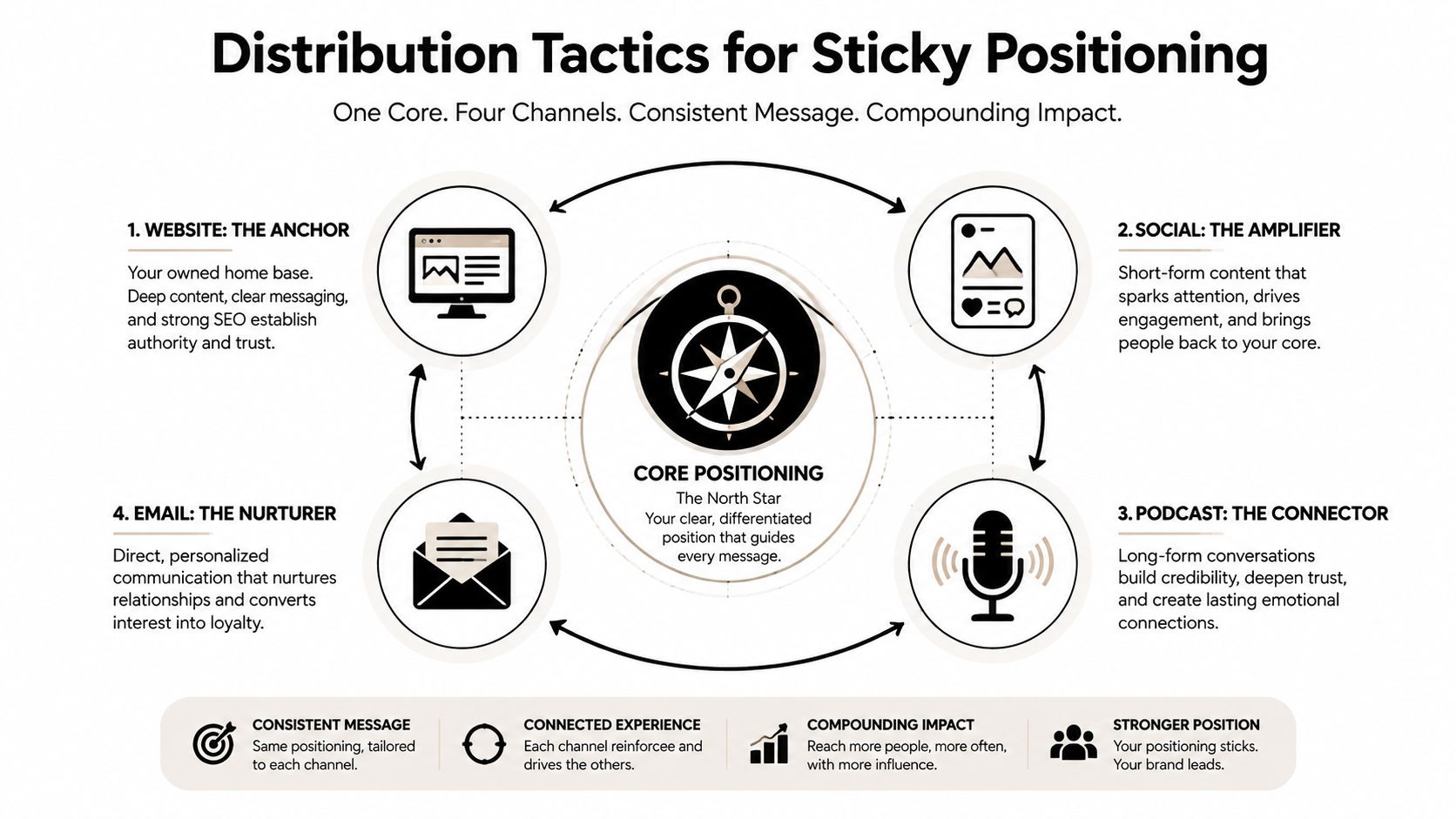
Choose channels for positioning fit, not just audience size. A personal site works as the anchor because it can hold the full statement, proof, and offer architecture. LinkedIn often works as the amplifier for founders and operators because profile language, recurring posts, and comments can reinforce the same idea. X can be useful if the message is sharp and opinion-led, but only if the line survives brevity.
Your profile headline, banner, about section, and featured content should all support the same core promise. If your website says one thing and your social bio says another, buyers notice the inconsistency faster than you do. Commenting and DM behavior matter too, because casual replies can either reinforce your authority or dilute it with generic engagement.
A simple Dream 100 approach helps keep the line in front of the right people. Pick the peers, partners, creators, and potential buyers who already sit close to your market, then engage in a way that mirrors your positioning. If your brand is built around clarity, your comments should sound clear. If it's built around technical depth, your replies should show it.
One practical rule keeps the whole system stable.
Don't add a new platform until the current positioning has been enforced consistently long enough to show up in your responses, not just your posts.
That restraint matters because fragmenting the message across seven channels is usually worse than doing two channels well. A focused distribution plan builds recognition faster because every touchpoint says the same thing in a slightly different form.
The best execution looks boring from the outside. The founder keeps repeating the same core idea, the proof keeps getting sharper, and prospects start bringing the language back in their own words.
A positioning statement can sound airtight and still miss the market. Measurement catches the gap early, before the mismatch shows up in longer sales cycles, weak replies, or prospects who can't restate what you do in one clean sentence.
The dashboard should stay small and tied to buying behavior. Watch whether target buyers are searching for you by name, whether profile visits turn into direct messages, whether comments from the right peers sound specific, and whether inbound notes repeat the same problem language you use. Saves and reposts matter too, but only if they come from the audience you want more of.
Positioning work should move through review, not guesswork. Researchers describe a nine-stage loop for positioning work, from environment analysis and design through differentiation, strategy, target-setting, planning, execution, evaluation, and corrective action, which is a useful reminder that positioning improves through iteration and evidence positioning implementation loop. Review the signals, adjust what needs tightening, and leave the core line alone unless the market has clearly shifted.
For a practical model of awareness tracking and growth monitoring, the brand awareness measurement guide is a useful reference point. The point is to know whether your positioning is sticking or slipping, not to collect every possible signal.
When positioning is working, sales conversations get easier and inbound language becomes more consistent. When it is off, each channel sounds slightly different, and buyers keep asking you to say the same thing in new words.
If you want help turning a rough positioning idea into a system that drives leads, Legacy Builder can extract your positioning, voice, and content pillars in a strategy analysis, then turn that into daily content and consistent distribution. Visit Legacy Builder if you want a positioning system built to hold up across content, profiles, and outreach, not just in a slide deck.


You could – but most in-house teams struggle with the nuance of growing on specific platforms.
We partner with in-house teams all the time to help them grow on X, LI, and Email.
Consider us the special forces unit you call in to get the job done without anyone knowing (for a fraction of what you would pay).
Short answer – yes.
Long answer – yes because of our process.
We start with an in-depth interview that gives us the opportunity to learn more about you, your stories, and your vision.
We take that and craft your content then we ship it to you. You are then able to give us the final sign-off (and any adjustments to nail it 100%) before we schedule for posting.
No problem.
We have helped clients for years or for just a season.
All the content we create is yours and yours alone.
If you want to take it over or work on transitioning we will help ensure you are set up for success.
We want this to be a living breathing brand. We will give you best practices for posting and make sure you are set up to win – so post away.
Subscribe to our newsletter and get insights on how to grow your personal brand.
