.svg)
Subscribe to our newsletter and get insights on how to grow your personal brand.
Thank you! Your submission has been received!
Oops! Something went wrong while submitting the form.
.svg)


Personal branding is the strategic process of creating and shaping a public identity for yourself as an authority in your industry to advance your career, grow your business, and build influence. It isn't optional anymore. A projected 85% of hiring decisions in 2025 are influenced by a candidate's personal brand presence online.
The popular advice on this topic is weak. "Just be authentic" sounds nice, but it doesn't tell a founder what to build, what to measure, or why so many people post for months and get nothing from it.
My view is simple. Your personal brand is a business asset, not a vanity project. It should help you win trust faster, create better opportunities, attract stronger partners, and generate real conversations that turn into leads, hires, referrals, and invitations. If it doesn't do that, you don't have a strategy. You have content.
What is personal branding? It's the deliberate management of how people understand your expertise, values, and relevance when they encounter you online or offline. You're already being interpreted by clients, peers, investors, recruits, and buyers. Personal branding means you stop leaving that interpretation to chance.
Tom Peters formalized the idea in 1997 with The Brand Called You, arguing that professionals need to manage their careers like brands to stand out. That shift matters even more now because your digital footprint often introduces you before you ever speak to someone. The concept and its modern business relevance are captured well in this guide to personal branding, and if you're building as a founder, this entrepreneur-focused personal branding guide is also worth reading.
A real personal brand is built from a few visible parts working together:
If those pieces are messy, people hesitate. If they're clear, people move faster.
Your personal brand exists whether you build it or not. The only question is whether you're shaping it or letting random posts, old bios, and scattered opinions shape it for you.
Personal branding is not being loud. It isn't posting selfies with motivational captions. It isn't manufacturing a fake founder persona because you think the internet rewards certainty.
It also isn't "thought leadership" if all you do is repeat safe opinions everyone else posted yesterday.
Think like the CEO of You, Inc. A smart CEO doesn't chase attention for its own sake. A smart CEO clarifies market position, sharpens messaging, improves perception, and makes it easier for the right people to say yes.
| Misconception | Reality |
|---|---|
| Personal branding is self-promotion | Personal branding is trust-building |
| Personal branding is about followers | Personal branding is about relevance and recall |
| Personal branding is for influencers | Personal branding matters for founders, operators, consultants, and leaders |
| Personal branding is fake | Bad personal branding is fake. Good personal branding makes the real value easier to understand |
Individuals often don't fail at personal branding because they lack talent. They fail because they treat it like a content hobby instead of a positioning system.
A 2025 LinkedIn survey of 5,000+ professionals found that 68% of people who attempted personal branding saw no career advancement within a year. Among them, 42% cited inauthentic content and 37% cited inconsistent posting as the main barriers, according to the HBS Online discussion of personal branding at work.
That's the part most articles skip. Personal branding has a high failure rate. Not because the idea is flawed, but because the execution usually is.
The first mistake is performing expertise instead of sharing it. Founders start sounding like generic business templates. Every post becomes a recycled lesson about discipline, growth, or leadership. Nothing sounds earned. Nothing feels specific. People can smell that instantly.
The second mistake is inconsistency. A strong profile followed by long silence tells the market you're not serious. Then people return in bursts, post ten times in a week, disappear again, and wonder why nothing compounds.
Practical rule: If your content could be posted by ten other founders without changing a word, it isn't brand-building. It's noise.
Successful founders do three things differently.
That last point matters most. A founder who gets fewer likes but more qualified conversations is winning. A founder with high engagement and no pipeline isn't.
Treat personal branding as an operating discipline.
Start with one clear market promise. Decide what problem space you want your name attached to. Build a repeatable publishing habit around that promise. Then engage like a real person, not a content machine.
The internet rewards clarity more than charisma. If people can quickly answer, "What does this person know, who do they help, and why should I trust them?" your brand is working.
An authentic personal brand isn't one thing. It's a stack of aligned choices. When one piece is weak, the whole brand feels unstable.
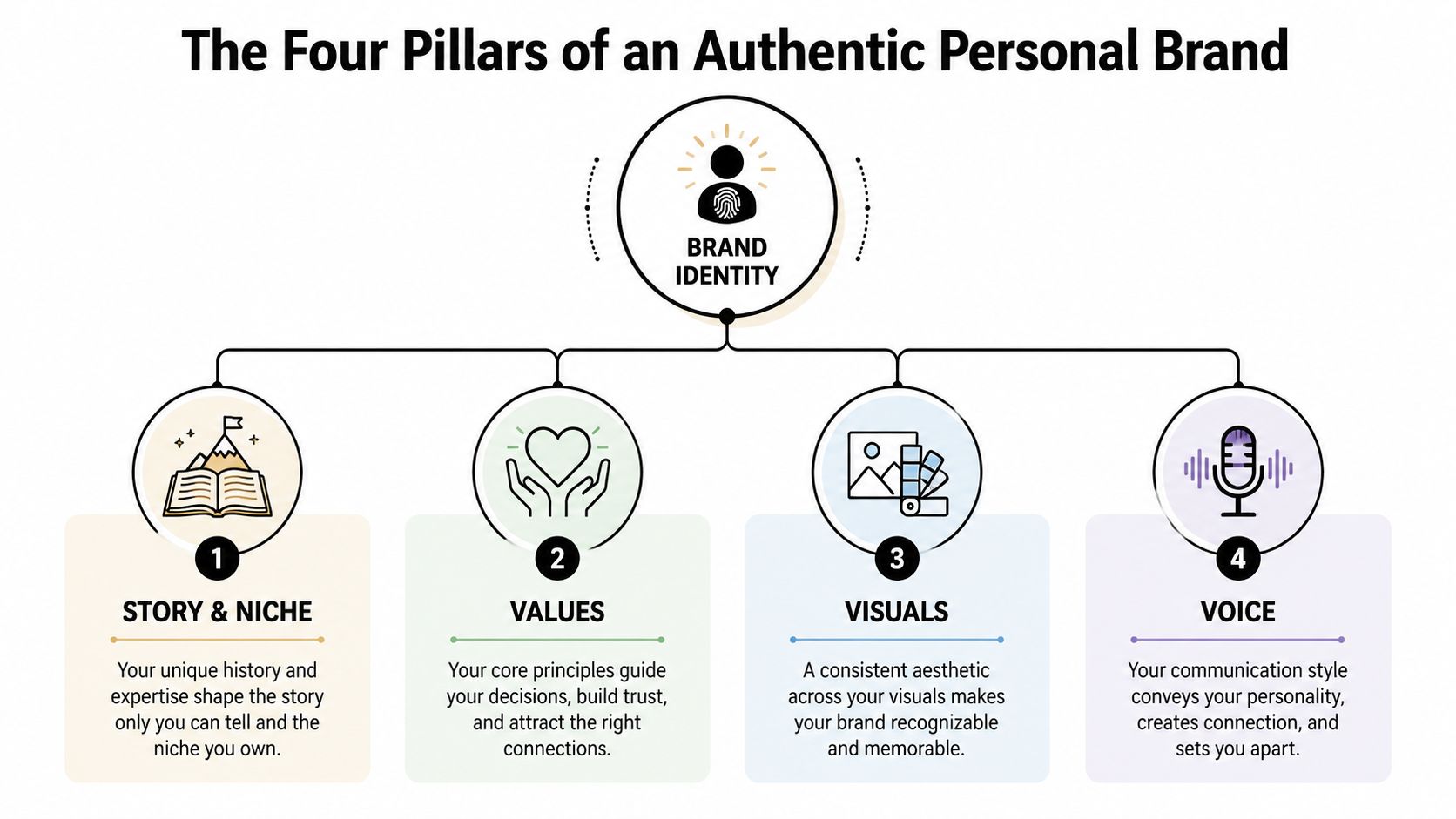
Your story gives people a reason to care. Your niche gives them a reason to remember.
Founders often get this backward. They lead with a broad label like "entrepreneur" or "marketing leader," which says almost nothing. Your niche should be tighter. Maybe you help SaaS companies improve activation. Maybe you help service firms turn expertise into demand. Maybe you lead revenue operations for complex B2B teams.
Your story then explains why you're credible in that lane. Not your life story. The relevant story.
A good version sounds like this: "I spent years watching companies waste money on channels they couldn't measure, so I built my approach around clearer attribution and better operator feedback."
That works because it's specific and grounded.
Voice is how you sound. Messaging is what you repeatedly make clear.
A founder's voice might be sharp and contrarian, calm and analytical, or generous and teacher-like. The point isn't to pick a trendy tone. The point is to communicate in a way that feels natural enough to sustain.
Messaging needs more discipline. If people read five of your posts, they should see the same themes emerge. That's how recognition forms. One post on hiring, one on AI, one on culture, one on fitness, and one on travel isn't a brand. It's a diary.
Here are signs your messaging is too loose:
For a deeper look at why coherence matters, read this breakdown of brand authenticity and why it matters.
People trust patterns. If your message keeps shifting, they stop trying to understand you.
Visual identity doesn't need to be fancy. It needs to be recognizable.
That includes your headshot, banner, typography choices, website style, slide design, and content layout. If your LinkedIn looks polished but your website feels abandoned, that's a brand leak. If your posts are thoughtful but every visual looks borrowed from a random Canva experiment, that's another leak.
A useful standard is this: your visual presentation should match the level of client, investor, or partner you want to attract.
A strong brand isn't just well defined. It's well placed.
Choose platforms based on buyer behavior and your own communication strengths. If you write clearly and sell into professional markets, LinkedIn may do more for you than trying to force short-form video. If you explain nuanced ideas well on camera, YouTube or podcast guesting may fit better.
Many founders overcomplicate things. You don't need to be everywhere. You need to show up where your credibility can compound.
| Pillar | Core question | Example in practice |
|---|---|---|
| Story and niche | Why you, and for what? | A founder shares lessons from scaling a B2B sales process |
| Voice and messaging | How do you sound, and what do you keep reinforcing? | Clear opinions on go-to-market mistakes and customer education |
| Visual identity | Do you look coherent and credible? | Consistent profile photo, clean website, repeatable post design |
| Distribution and platform | Where do people reliably see you? | LinkedIn posts, podcast appearances, and targeted comments |
Most founders don't need a massive rebrand. They need a working system they can maintain.

Search your name. Review your LinkedIn profile, website, X bio, podcast appearances, guest posts, speaker bios, and old headshots. Then ask one blunt question: if a buyer or investor found this today, what conclusion would they draw?
Look for friction points:
This audit usually reveals the underlying problem. Many individuals don't need more content first; cleanup is a greater priority.
You can't build a brand without a business reason for doing it.
Pick one primary objective. Maybe you want better inbound leads. Maybe you want to recruit stronger operators. Maybe you want partnerships, speaking invitations, or market authority in a narrow category. One main objective creates discipline.
Then define the audience that matters. Not "everyone in business." Be sharper. Early-stage SaaS founders. Marketing leaders at mid-market companies. Operators moving into advisory work. The narrower your audience, the clearer your content gets.
A useful planning tool is any framework that forces you to match message, audience, and offer. Even resources built for adjacent branding work can help. This BeYourCover template for book marketing is a good example of a simple brand strategy structure you can adapt for personal positioning.
A brand grows when your ideas become a repeatable publishing process.
That doesn't mean churning out content for the sake of activity. It means creating a small set of repeatable content types you can sustain. For example:
Batch ideas in a notes app. Draft in Google Docs or Notion. Schedule when useful, but don't over-automate your voice. Founders who delegate everything too early usually flatten the very perspective people came for.
Publishing is only half the job. Distribution happens in comments, DMs, introductions, and follow-up.
Spend time responding to thoughtful comments. Leave useful comments on other people's posts. Send direct messages when there's a real reason to start a conversation. Reference something specific. Add context. Act like a peer, not a spammer.
If content is your signal, interaction is your proof that a real person stands behind it.
Opportunities often start here. Not with a viral post. With a credible presence repeated often enough that the right people begin to notice.
The easiest way to understand personal branding is to watch how it works in different business contexts. The mechanics stay similar, but the goal changes.
A SaaS founder in a crowded category can't rely on product features alone. Buyers see too many similar claims. So the founder builds in public around one specific problem their product helps solve.
Their story and niche come through in posts about patterns from customer calls and product decisions. Their voice is practical, operator-led, and unsentimental. Their visuals are simple: clean screenshots, product clips, a consistent headshot, and straightforward slides. Their distribution happens mostly on LinkedIn and in podcasts where buyers already spend attention.
What happens? Prospects don't just discover a tool. They start trusting the thinker behind it. Recruits also get a clearer picture of the company because the founder's public narrative makes the mission legible.
A consultant doesn't have a big company brand behind them. Their expertise has to do the selling.
So they narrow hard. Instead of calling themselves a "growth consultant," they become known for one kind of high-value problem. Their content doesn't try to impress everyone. It speaks directly to buyers who already feel the pain.
Here, the voice and messaging matter most. The consultant publishes sharp breakdowns, teardown posts, and opinion pieces that show judgment. Their story includes enough background to establish credibility without turning every post into autobiography. Their distribution is selective. LinkedIn for reach, email for depth, maybe guest appearances for borrowed trust.
That brand doesn't just attract attention. It gives them an advantage. When buyers already understand what makes them different, pricing pressure tends to ease because the consultant feels less interchangeable.
Personal branding matters inside companies too. Senior leaders often assume their title does the work. It doesn't. Titles create access. Brands create influence.
A corporate leader with a strong personal brand communicates clearly about the areas they lead, the principles they operate from, and the kind of outcomes they drive. Their story often centers on transformation or organizational learning. Their voice is measured but distinct. Their visual identity is polished enough to reflect leadership, without feeling staged. Their distribution includes internal visibility, industry panels, LinkedIn posts, and interviews.
The best personal brands don't make people think, "This person posts a lot." They make people think, "This person understands something important."
That difference is why some leaders become magnets for opportunities while others stay invisible despite doing strong work.
If you're still measuring your personal brand by followers and likes, you're measuring the wrong thing.
A validated 12-item scale for personal brand equity measures three dimensions: brand appeal (trustworthiness and likability), brand differentiation (how unique you are relative to peers), and brand recognition (awareness and recall). According to this personal branding statistics roundup, higher differentiation scores correlate with a 25-40% increase in job offer rates and freelance premiums. The same source also notes that modern metrics like influence conversion rate predict 4x revenue growth, which makes it far more useful than vanity metrics.

For founders and operators, I recommend a simpler applied version of that model.
Ask: do people trust me enough to respond, refer, or invite?
Look for qualitative signals. Are decision-makers replying with context instead of one-line praise? Are peers tagging you when a relevant topic comes up? Are podcast hosts, event organizers, or prospects referencing your content unprompted?
Ask: can people explain why I'm different without using generic words?
If your audience describes you with the same labels they use for everyone else, your brand isn't differentiated. "Smart," "strategic," and "experienced" are table stakes. Specificity is the win.
Ask: does my name come to mind in the right buying or opportunity moments?
Recognition isn't broad fame. It's targeted recall. The right people should think of you when the right problem appears.
A useful outside reference is how social teams think about campaign outcomes across platforms. This guide to measuring creator campaign success for social teams is useful because it forces attention back to performance signals, not surface metrics.
Track outcomes that connect your brand to revenue or opportunity.
If you want a useful mindset shift, watch this short breakdown on branding and perception before you redesign your dashboard.
A strong personal brand should make good opportunities easier to start and easier to close.
That's the test. Not applause. Not reach for its own sake. Movement.
Personal branding isn't about becoming internet famous. It's about becoming legible, credible, and memorable to the people who matter most to your work.
If you strip away the jargon, the answer to what is personal branding is simple. It's the practice of making your reputation more intentional. Done well, it helps buyers trust you faster, helps opportunities find you sooner, and helps your expertise travel further than your calendar allows.
Many individuals fail because they copy formats instead of building clarity. They chase visibility before they earn recognition. They publish generic content and call it strategy. Don't do that.
Start with your story. Tighten your niche. Choose a voice you can sustain. Show up with enough consistency that people can connect your name to something useful and specific. If you need help finding the right narrative, this guide on how to tell your story and build an unforgettable brand is a strong next step.
You don't need permission to build a serious personal brand. You need a point of view, a clear market position, and the discipline to keep showing your work.
If you want help turning your expertise into a personal brand that creates real opportunities, Legacy Builder helps founders, executives, and professionals turn their story, insights, and vision into consistent, high-impact content that reflects who they are.


You could – but most in-house teams struggle with the nuance of growing on specific platforms.
We partner with in-house teams all the time to help them grow on X, LI, and Email.
Consider us the special forces unit you call in to get the job done without anyone knowing (for a fraction of what you would pay).
Short answer – yes.
Long answer – yes because of our process.
We start with an in-depth interview that gives us the opportunity to learn more about you, your stories, and your vision.
We take that and craft your content then we ship it to you. You are then able to give us the final sign-off (and any adjustments to nail it 100%) before we schedule for posting.
No problem.
We have helped clients for years or for just a season.
All the content we create is yours and yours alone.
If you want to take it over or work on transitioning we will help ensure you are set up for success.
We want this to be a living breathing brand. We will give you best practices for posting and make sure you are set up to win – so post away.
Subscribe to our newsletter and get insights on how to grow your personal brand.
