.svg)
Subscribe to our newsletter and get insights on how to grow your personal brand.
Thank you! Your submission has been received!
Oops! Something went wrong while submitting the form.
.svg)


A one-point increase in a hotel's Global Review Index can move the revenue needle in ways many owners still underestimate, with Cornell Hospitality Research linking that lift to up to a 0.89% increase in ADR, a 0.54% increase in occupancy, and a 1.42% increase in RevPAR. In the same research stream, a one-point increase on a five-point rating scale made potential customers 13.5% more likely to book the property, which is why online reputation management for hotels belongs in the same conversation as pricing, distribution, and service recovery, not just marketing. Cornell Hospitality Research's reputation and revenue findings changed the way serious operators look at reviews, because they turned guest feedback into a measurable commercial signal.
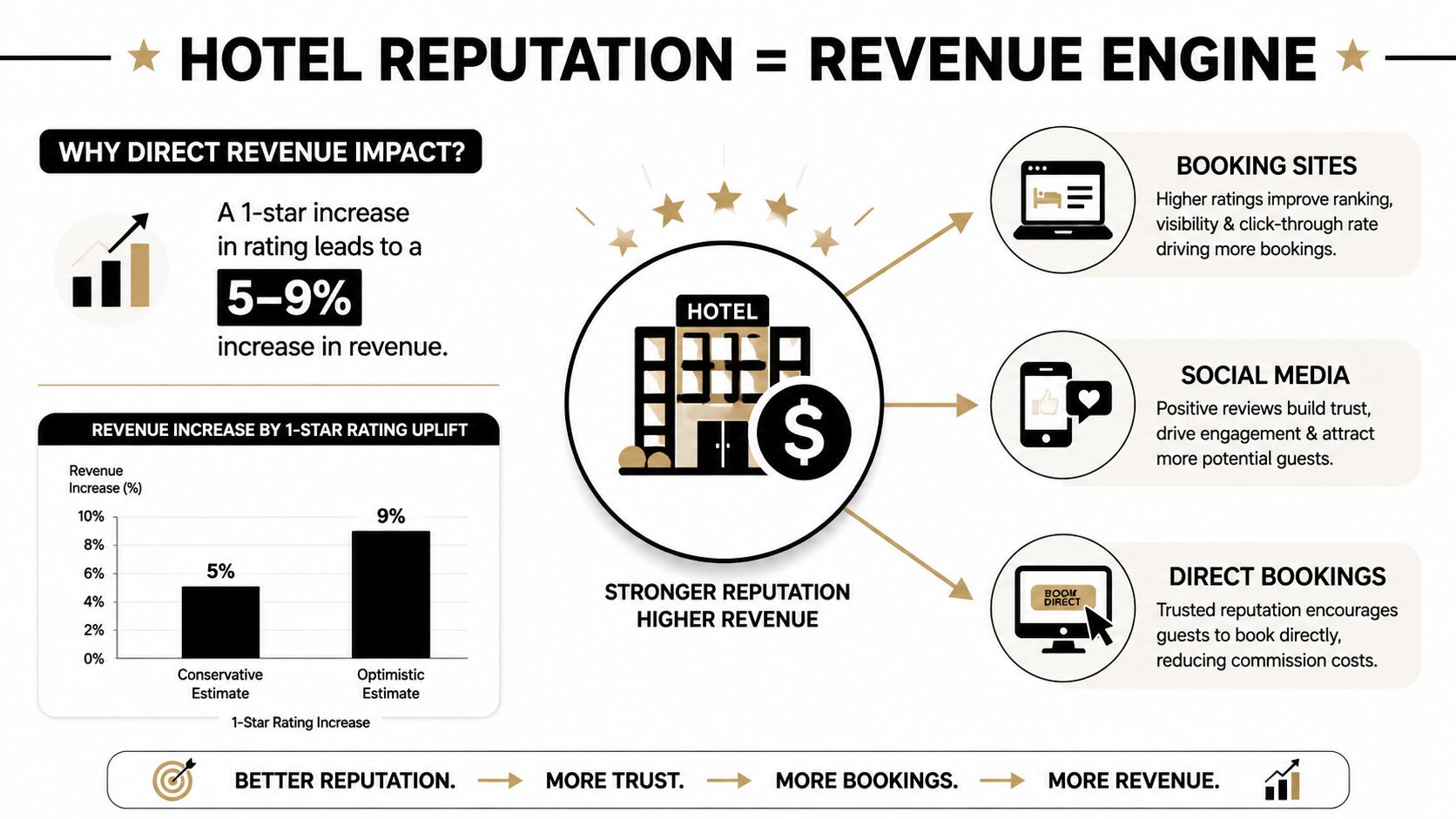
Many independent hotels still treat reviews like a soft brand issue, something the sales team checks after the quarterly numbers come in. That mindset breaks down once reputation is tied to pricing power and demand. Cornell's work shows that review score improvements can support higher room rates and stronger occupancy at the same time, which is why reputation belongs in operations, not as an occasional marketing task.
The commercial effect is straightforward. A hotel with a stronger reputation can defend rate more confidently, hold demand longer, and convert comparison shoppers who are already looking at competing properties. When a guest sees two similar hotels, the higher-rated one often wins before the booking engine even loads. That is the reality behind review management.
Reputation works like a control surface for ADR, occupancy, and conversion. A stronger review profile does not replace revenue management, it supports it. If the property is clean, responsive, and consistent, rate increases are less likely to push demand down.
That is why reputation work pays off most when it is tied to pricing decisions and service standards. It is not enough to “have good reviews.” The hotel needs to earn them repeatedly through operations that guests can feel, then use those signals to hold or improve pricing. For a broader strategic framing, online reputation strategies for hotels is a useful companion resource, especially for teams that want to connect review work to commercial outcomes.
Practical rule: if your review profile improves but your team never adjusts rate strategy, staffing, or service recovery, you are leaving the value stranded.
That is also why reputation management sits naturally beside Legacy Builder's growth playbook on brand reputation. The channel may be different, but the logic is the same, trust compounds when the organization responds consistently.
A hotel's reputation is not a side metric. It is a demand signal that affects what guests are willing to pay, how quickly they book, and whether they trust the property enough to finish the reservation.
A hotel can't fix what it only notices once a guest complains at checkout. The first operational step is building a monitoring system that captures comments from Google, Tripadvisor, Booking.com, OTA review feeds, and social channels in one workflow. European hospitality guidance recommends a closed-loop setup that identifies what was said, where it was said, and which department owns the issue, so feedback becomes operational input rather than noise. The EU's ORM project guide is a useful reference for that kind of structure.
The right stack depends on the property size, but the logic stays the same. Smaller independents can start with native alerts, review inboxes, and a shared internal tracker. Larger hotels and multi-property groups need a dedicated platform that centralizes alerts, tags themes, and routes tasks to the right department quickly.
Here's the practical split:
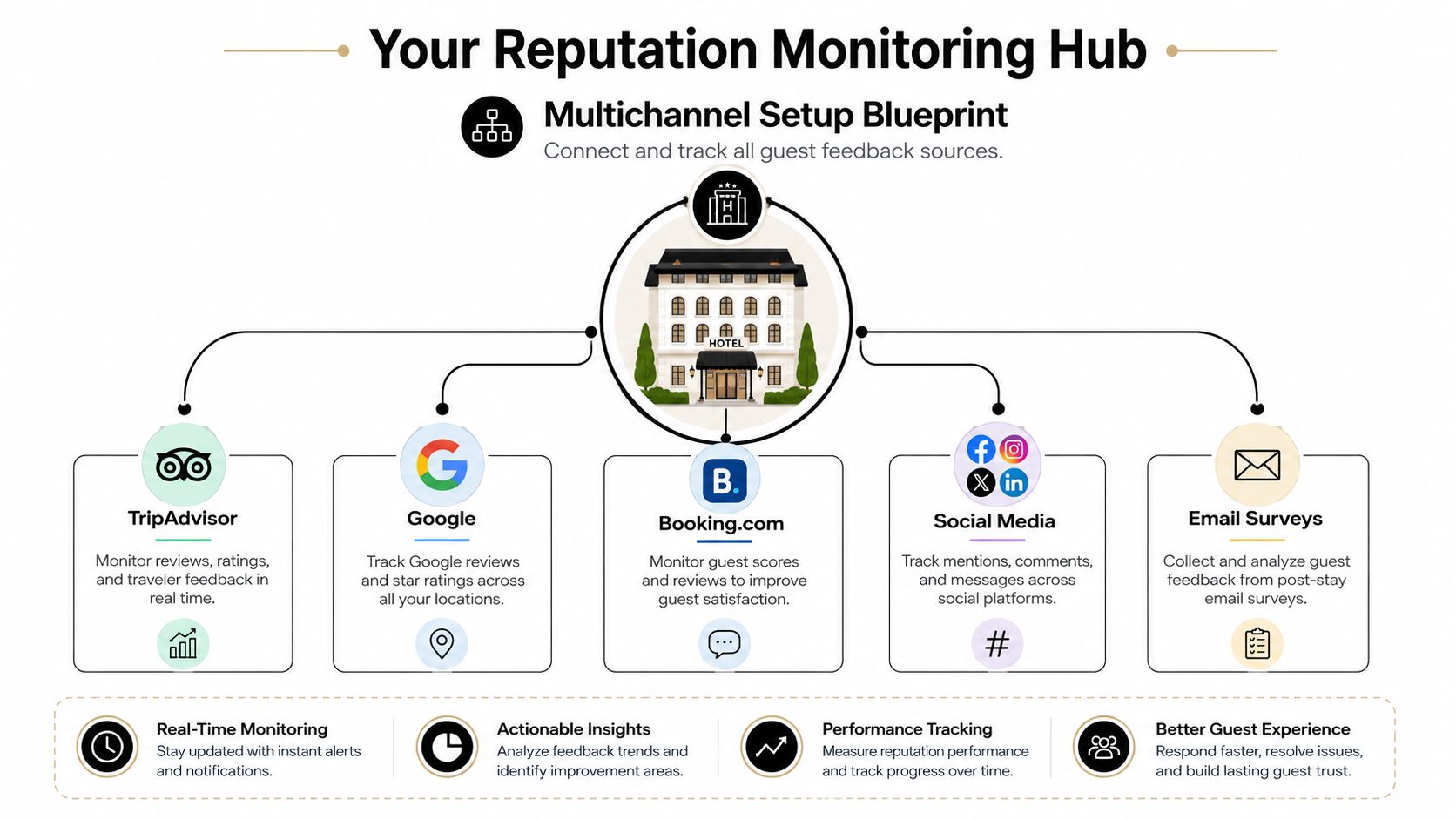
A review alert that lands in a general inbox is almost useless. The front office manager needs different feedback than the head of housekeeping, and the GM needs escalation only when the issue is repeatable, severe, or public-facing. Configure alerts so the first reader can act, not just forward.
That means tagging by department, topic, and urgency. If a guest mentions room cleanliness, housekeeping should see it. If the complaint is about check-in friction, the front office owner should get it. If the review hints at a safety issue or repeated service breakdown, management should be notified immediately.
For teams looking at software options, a guide to online reputation management services is a practical place to compare service types without overbuying features you won't use.
The monitoring system works only when someone owns the next step. Without ownership, the alert becomes a notification instead of an improvement loop.
A strong hub doesn't just collect reviews. It turns guest comments into a work queue, so every recurring complaint has a visible path to action.
A generic “thank you for your feedback” reply doesn't recover service failures, and it doesn't persuade future guests. I've seen properties spend hours responding to every review with the same polished sentence, then wonder why their reputation didn't improve. The problem is not effort. The problem is sameness.
A better response reads like a human wrote it for that specific stay. A one-star housekeeping complaint needs acknowledgment, accountability, and a sign that the issue was addressed. A glowing mention of a staff member should be amplified without sounding like an ad. A mixed review, especially one where the guest also made a poor choice, needs firmness without defensiveness.
The best replies usually do four things in plain language:
That structure matters because it tells future readers the hotel takes criticism seriously. It also gives the guest a reason to believe the property is managed by people, not by templates. If you want a procedural lens on public response behavior, the browser speculation rules guide is unrelated to hospitality but useful as a reminder that web behavior and perceived speed both shape user expectations online.
The timing window is just as important. Replying within a day or two is the practical standard, because delayed responses make recovery feel performative. A guest who sees a reply weeks later assumes the hotel only reacts when it remembers.
A scathing complaint about housekeeping shouldn't get a warm, generic apology. It should get a specific note that the lapse is being reviewed with the team, plus a private contact path. A praise-filled review mentioning a named employee should be personal and short, with gratitude that reinforces the behavior you want repeated. A complaint that is partly the guest's fault should still be handled calmly, because future readers care less about assigning blame than about whether the hotel can remain professional.
Useful test: if your reply could be pasted under ten other reviews without anyone noticing, it's too generic.
For teams that need a deeper framework for handling criticism, Legacy Builder's negative feedback playbook is a relevant reference point. The objective is simple, make the response good enough that an undecided shopper trusts you more after reading it.
The best reputation programs don't stop at replying. They push guest feedback back into the departments that caused the problem in the first place. That closed loop is what separates a busy inbox from a working improvement system. Without it, hotels keep apologizing for the same cleaning issue, the same check-in delay, or the same breakfast complaint month after month.
A practical workflow starts with review triage, then routes each issue to a department owner. Housekeeping gets cleanliness and room condition themes. Front office gets arrival friction, queueing, and communication gaps. F&B gets breakfast, service pace, and menu consistency. Management only needs the items that repeat, escalate, or affect multiple departments.
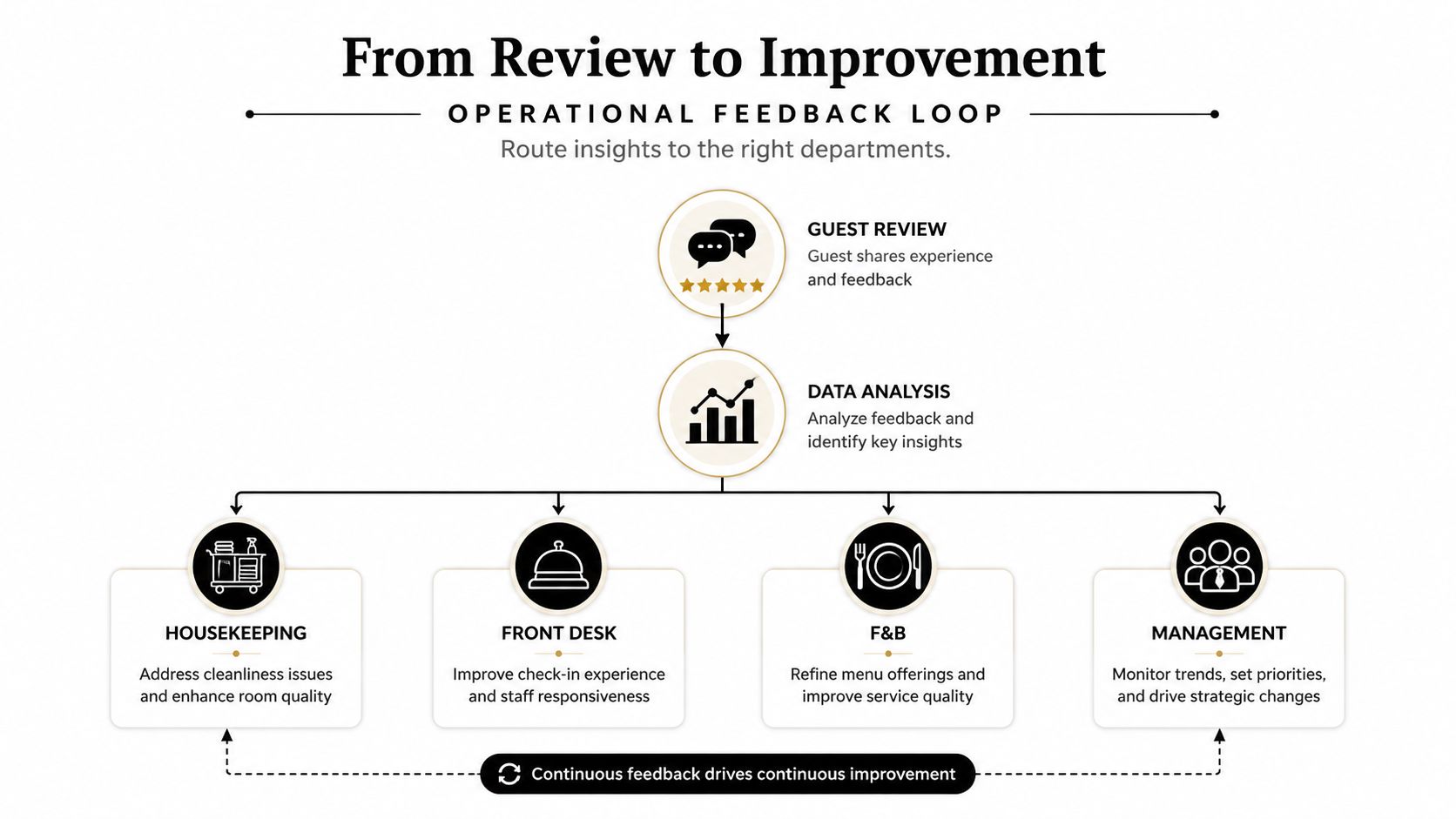
The trick is to translate review language into action language. “Room felt tired” becomes maintenance inspection. “Breakfast ran out” becomes service par levels. “Front desk was slow” becomes staffing review, queue design, or training. If you don't convert the complaint into a task, the feedback dies in the comments section.
Pre-arrival and mid-stay messaging help here because they catch problems while they're still fixable. Revinate reports a 22.42% average guest engagement rate with messaging in its 2025 hospitality benchmark, which shows why outreach before checkout can create a useful feedback loop, and the same source says personalized review responses increase booking likelihood by 77%. Those figures make the case for outreach and response quality as operational tools, not courtesy work. Revinate's hospitality benchmark discussion is useful context for teams planning messaging touchpoints.
A monthly reputation meeting should be short and specific. Review the top recurring complaints, the department owner, the fix, and whether the issue disappeared in later feedback. If the same problem keeps resurfacing, the conversation should move from “who replied” to “why did operations allow this to repeat?”
For hotels looking for a broader guest satisfaction lens, ScanStay's guest satisfaction strategies fits naturally with this approach.
Management rule: recurring feedback is not a communications problem. It's a process problem until proven otherwise.
The hotels that improve fastest don't collect more comments. They assign more accountability.
Fake reviews are one of the messiest parts of hotel reputation work because they distort the data used for real decisions. Some are obvious spam. Others are retaliatory, manipulated, or written to pressure the property into a refund or upgrade. The goal is data hygiene, stopping bad input from shaping the wrong response.
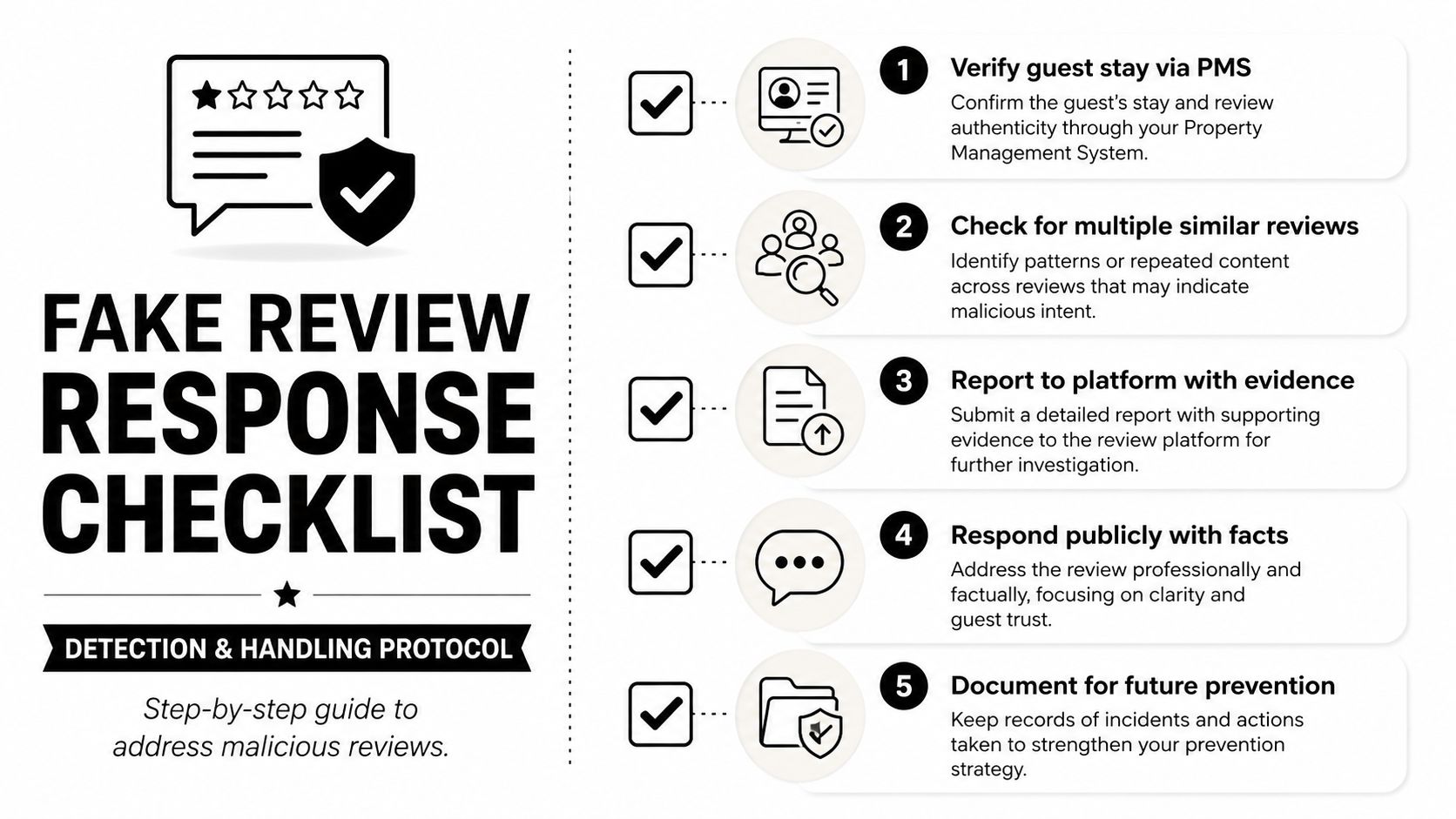
Start with pattern recognition. A review deserves scrutiny if the stay cannot be verified in the PMS, if the language reads like copied complaints, or if several similar reviews appear in a short window. The aim is not to accuse every difficult guest of dishonesty. It is to separate operational feedback from content that does not appear to come from a real stay.
When a review looks suspicious, document everything before you contact the platform. Save timestamps, reservation status, guest correspondence, internal incident notes, and any repeated pattern across channels. That file becomes the basis for a removal request or a legal review if the issue escalates.
Public replies should stay factual and calm. Avoid calling the reviewer a liar. State that you take feedback seriously, you cannot locate the stay in your records, and you would like the guest to contact the hotel directly so the issue can be reviewed. If the review appears tied to extortion or a coordinated attack, the case should move to management and counsel quickly.
The practical frame here is reputation hygiene. A hotel that lets suspicious reviews sit unchecked eventually muddies its own decision-making. Response priorities shift. Staff morale takes a hit. The credibility of the whole profile weakens.
One odd review is rarely a significant threat. Repeated patterns across Google, OTAs, and social channels are more concerning than a single angry post. That is why the monitoring system matters, because it lets teams compare claims across sources and identify when a complaint belongs in operations versus moderation.
A strong internal rule helps: verify, document, report, then respond. If the platform removes the review, the hotel gains clean data again. If it does not, the written record still protects the property from making policy decisions based on bad input. That discipline keeps the rest of the reputation system honest.
Hotels need steady review volume, but aggressive solicitation can do more harm than good. Guests notice when a property asks too often, pushes too hard, or makes the process feel transactional. The better approach is to ask at the right moment, in the right channel, without nudging people toward a specific score.
The best timing is usually right after the stay, while the experience is still fresh and the guest's memory is clear. Post-stay email remains the cleanest channel for many properties, especially when it links directly to the platforms the guest already trusts. Front desk teams can also mention the request at checkout when the stay went well, but that handoff needs to feel natural, not scripted.
A good sequence usually has three traits. It thanks the guest first, it asks for honest feedback, and it avoids incentives that distort the result. If you promise a reward for a positive review, you're not generating reputation. You're manufacturing risk.
Keep the process simple:
A healthy review program also depends on staff behavior. When employees solve issues early, guests are more likely to share balanced feedback instead of writing from frustration later. That's why review generation and service quality can't be separated.
In practice, the hotels that get this right are the ones that make review requests part of the guest journey rather than a last-minute campaign. They don't chase volume at any cost. They build a culture where the guest leaves with a real reason to talk about the stay.
A reputation program that cannot prove value is usually the first thing trimmed when budgets tighten. That makes the reporting layer as important as the response workflow. Ownership wants evidence that the work is improving the hotel's commercial position, not just clearing inboxes with courteous replies.
Start with a monthly dashboard that shows trend lines, not isolated snapshots. Global Review Index movement, response rate, response speed, recurring sentiment themes, and comp-set comparison should sit on the same page. Cornell's review of reputation and revenue shows why that matters, because score movement can affect pricing power, occupancy, and RevPAR. Leadership should see guest sentiment in the same conversation as rate and demand. Cornell Hospitality Research's review and revenue analysis
A useful reporting set does not need to be large. It needs to stay consistent and lead to decisions.
| Star Rating | Average GRI | Response Impact on Rating | Review Volume Lift |
|---|---|---|---|
| 5-star hotels | 86% | 0.12-star increase when hotels respond to reviews | Review response research showed a 12% increase in review volume |
| 4-star hotels | 80% | 0.12-star increase when hotels respond to reviews | Review response research showed a 12% increase in review volume |
| 3-star hotels | 73% | 0.12-star increase when hotels respond to reviews | Review response research showed a 12% increase in review volume |
These figures come from the PwC hotel review analysis and later industry summary data in the verified brief. That matters because it reminds leadership that review performance varies by segment, not only by brand size. PwC's hotel reputation analysis shows that star category already mattered materially in the mid-2010s, and the same research stream supports response as a measurable reputation lever.
A strong dashboard should also separate signal from noise. Response rate matters, but only if the responses are timely and useful. Review speed matters, but only if the team is resolving the issue behind the comment. Recurring sentiment themes matter most when they point to a department, a shift pattern, or a process failure that management can fix.
Monthly reporting is usually enough for ownership. Weekly review triage belongs with operations, not the board deck. The dashboard should answer three questions, what changed, which department drove it, and what got fixed. If a KPI does not lead to action, drop it.
A solid ORM audit should also test whether review themes are being converted into staff training, service standards, and property-level priorities. That closed loop is the difference between a reporting exercise and a commercial discipline. The hotel that can show guest feedback moving through operations, from inbox to department owner to corrected process, will always have a stronger case for continued investment.


You could – but most in-house teams struggle with the nuance of growing on specific platforms.
We partner with in-house teams all the time to help them grow on X, LI, and Email.
Consider us the special forces unit you call in to get the job done without anyone knowing (for a fraction of what you would pay).
Short answer – yes.
Long answer – yes because of our process.
We start with an in-depth interview that gives us the opportunity to learn more about you, your stories, and your vision.
We take that and craft your content then we ship it to you. You are then able to give us the final sign-off (and any adjustments to nail it 100%) before we schedule for posting.
No problem.
We have helped clients for years or for just a season.
All the content we create is yours and yours alone.
If you want to take it over or work on transitioning we will help ensure you are set up for success.
We want this to be a living breathing brand. We will give you best practices for posting and make sure you are set up to win – so post away.
Subscribe to our newsletter and get insights on how to grow your personal brand.
