.svg)
Subscribe to our newsletter and get insights on how to grow your personal brand.
Thank you! Your submission has been received!
Oops! Something went wrong while submitting the form.
.svg)


Let's be honest. When someone Googles your name, what do they find?
That search result is your new first impression. It’s the digital handshake that decides whether a potential client, investor, or partner even takes the next step.
Online reputation management (ORM) services are what separate a powerful first impression from a damaging one. Think of it less like a service and more like a personal PR team, working 24/7 to make sure the story people find online is the one you want them to see.
Your online reputation isn't just a vanity metric. It's your modern-day resume, character reference, and business card all rolled into one.
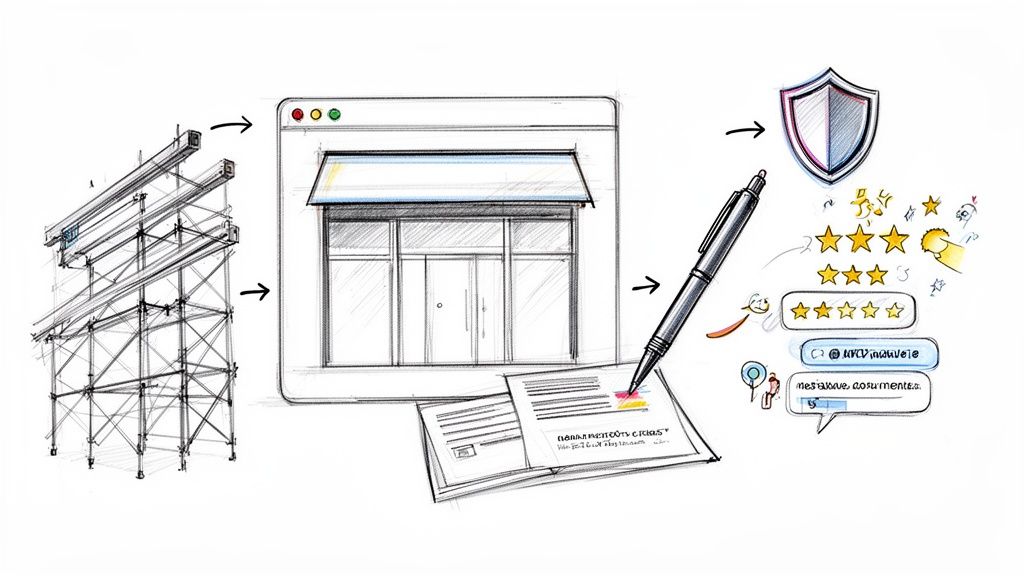
Imagine your online presence is a storefront in the busiest city in the world. Online reputation management services are the architects who design that storefront to look authentic and impressive. They’re also the crew that cleans up the digital garbage—like a bad article or a misleading review—so that what people see reflects your true value.
For a long time, people thought of reputation management as the emergency service you call when something blows up online. And while cleaning up a crisis is still a huge part of it, that's old-school thinking.
Today, for any serious entrepreneur, CEO, or professional, a proactive reputation strategy is about growth, not just defense.
The reason is simple: trust is the only currency that matters online. A strong, positive digital footprint builds that trust on autopilot. It opens doors and creates opportunities you didn’t even know were there. It’s about building an asset that works for you around the clock.
They say your reputation is what people say about you when you're not in the room. Online, that room is Google—and everyone's invited. A proactive ORM strategy ensures you're leading the conversation.
And the market shows that leaders are catching on. The demand for online reputation management services is exploding. Valued at USD 427.96 million in 2025, the global ORM market is set to hit USD 499.43 million in 2026. It’s projected to surge to an incredible USD 1,305.72 million by 2032, growing at 17.27% every year.
This isn’t just a trend. It’s a fundamental shift in how business gets done.
Modern ORM isn’t just about playing defense. It's about going on offense to build your authority. You don't just clean up the negative; you actively create and promote the positive.
Here’s how we do it:
When you do this, you stop leaving your reputation to chance. You take control. You make sure the person people meet online is the best, most accurate version of you.
The direct business benefits of reputation management are too significant to ignore. If you're ready to start building an online presence that works for you, you can learn more about how to manage your online reputation and boost trust in our complete guide.
When you hire a firm for online reputation management services, you're not just paying for a quick fix or a PR clean-up job. You’re bringing in a dedicated team to build, defend, and grow your digital presence for the long haul.
Think of it like hiring an architect to design your legacy, a groundskeeper to maintain it, and a security detail to protect it.
So, what do these services actually involve day-to-day? It all comes down to five core activities working together. They ensure that when people search for your name, what they find matches the story you want to tell.
This is how you move from just having a presence to building a powerful personal brand that drives real business outcomes.
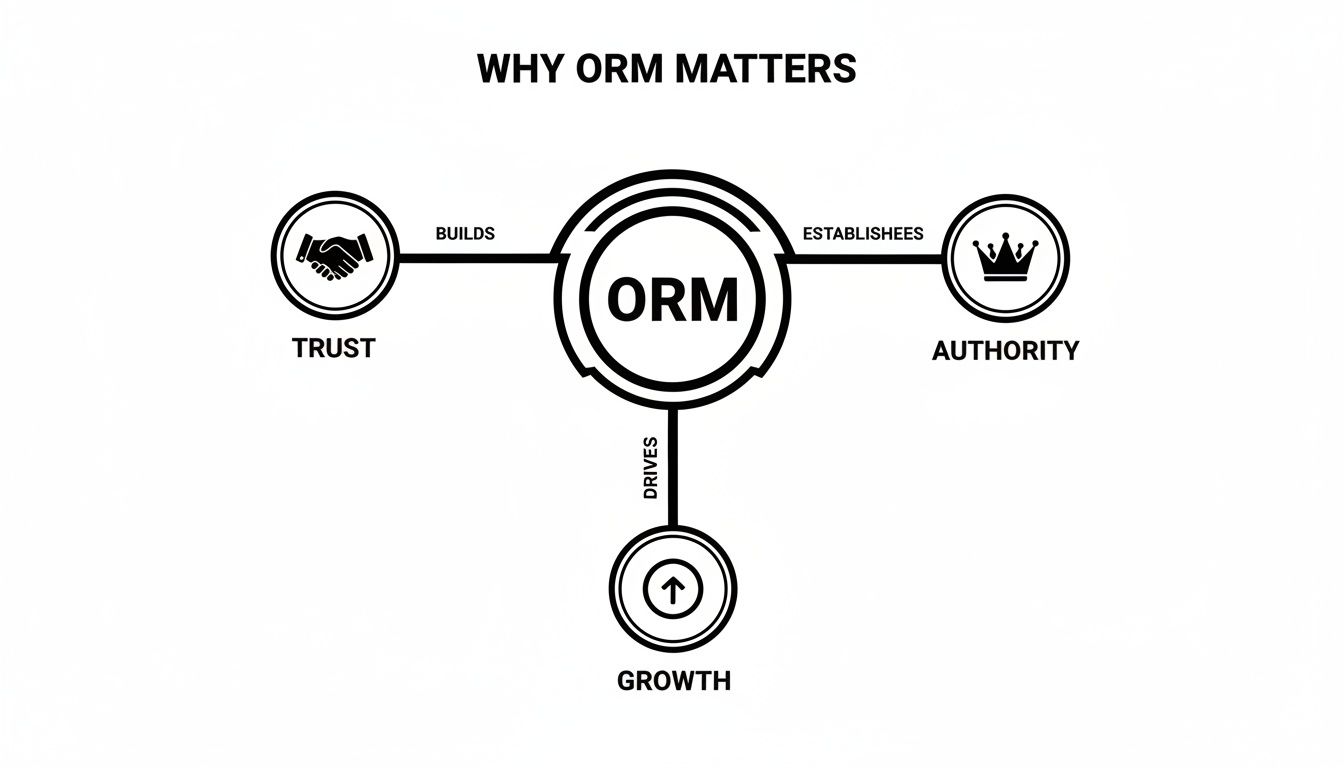
As you can see, a solid ORM strategy isn't just about defense. It’s about building the trust and authority that fuels tangible growth.
First things first: you can't fix what you can't see. The process always starts with a deep audit of your current digital footprint. This isn't just a Google search; it's a full-spectrum analysis of everything tied to you or your brand online.
We dig through search results, social media, review sites, forums, and news articles to map out every mention—good, bad, and neutral. This is the foundation of the entire strategy, and it’s why understanding what is brand monitoring is so important.
This initial audit gives us the answer to one crucial question: "Where do we stand right now?"
Once we know the battlefield, we go on offense. Real ORM isn't about playing defense and just reacting to negative comments. It's about proactively telling your story, on your terms.
This is where strategic content creation comes in.
The goal here is simple: build a library of positive, high-ranking content that you control. This becomes the first thing people see, establishing your credibility from the get-go.
Let’s be honest, reviews are everything. With 81% of people reading them before making any buying decision, managing your social proof is a must. A huge part of ORM is building a system to generate and manage your reviews on Google, Trustpilot, and other key platforms.
This isn't about faking anything. It’s about creating a simple, repeatable process to encourage your happy clients to share their real experiences. For a B2B company, a steady stream of five-star reviews builds immediate trust and can dramatically shorten your sales cycle.
And when negative feedback inevitably pops up? A professional team handles it quickly and effectively. Learning how to handle negative feedback is key to turning a potential problem into a public display of great customer service.
This is the part that truly separates professional ORM from standard marketing. The objective isn't just to get your website to rank. It's to own the entire first page of Google for searches of your name or brand.
We use a specialized type of SEO called "branded search" to make this happen.
The team works to push all your positive assets—your website, LinkedIn, published articles, positive press—to the top of the search results. This naturally shoves any negative or irrelevant links down to page two and beyond, where over 90% of users will never even see them.
It's digital real estate management, plain and simple. We make sure your best properties are front and center.
Finally, a complete strategy must account for the unexpected, protecting the brand you've worked so hard to build.

Think your online reputation is just some soft, fuzzy concept? Think again.
Every star rating, review, and search result tied to your name has a direct and measurable impact on your bottom line. It's either quietly building your bank account or draining it without you even noticing.
A powerful digital reputation is one of the most valuable financial assets you can own. It works around the clock, lowering your customer acquisition costs, attracting A-list talent, and even boosting your company's total valuation.
When prospects search for you and find a trail of positive reviews, strong articles, and authentic social profiles, they instantly trust you. That trust means they’re far more likely to buy from you, spend more when they do, and choose you over a cheaper competitor.
A strong reputation isn't just about defense—it's your best offense for growth. It directly shapes buying decisions and gives you a competitive edge that’s tough for anyone else to copy.
This is exactly why investing in professional online reputation management services isn't a cost. It's a high-return investment in your financial future.
Here’s how a great reputation directly translates to real dollars:
Your online reputation has become one of the most critical factors in your company's financial health. It's the invisible hand guiding customer choices and, ultimately, your revenue.
The data doesn't lie. Brand reputation is now estimated to account for a massive 30–40% of a company's total enterprise value.
This shift explains why poor customer experiences, blasted across online reviews, cost businesses an incredible $3.7 trillion globally each year. It's also why 70% of consumers say they'd jump to a competitor after just one bad interaction, making proactive reputation management non-negotiable. You can read more about these stats over on WiserReview.com.
A poor online reputation can be devastating. It’s not just about one lost customer; it’s a domino effect that erodes your business from the inside out.
The table below breaks down just how much is at stake. It shows the clear difference between a business that actively manages its reputation and one that lets it slide.
| Business Metric | Impact of Poor Reputation | Impact of Positive Reputation |
|---|---|---|
| Customer Acquisition Cost | Spend more on ads to overcome skepticism. | Attract organic leads through trust and word-of-mouth. |
| Sales and Revenue | Lose deals to trusted competitors, even if you’re cheaper. | Command premium prices and close more deals, faster. |
| Talent Acquisition | Top candidates go elsewhere; higher recruiting costs. | Attract A-players who want to work with a respected brand. |
| Company Valuation | Investors see a damaged reputation as a major liability. | Higher valuation and more attractive exit opportunities. |
| Customer Loyalty | One mistake leads to lost customers and negative reviews. | Customers are more forgiving and become loyal advocates. |
As you can see, the consequences are far-reaching. Lost revenue is just where the damage begins.
A negative online presence forces you to spend more just to tread water. You have to pour cash into marketing to convince skeptical buyers, and you'll find it nearly impossible to attract top talent when they see negative press about your company. For founders looking for an exit or trying to raise capital, a bad reputation can slash a company's valuation overnight.
Ultimately, ignoring your digital reputation is like letting your most valuable asset rust away. Investing in online reputation management services is how you build and protect that asset, making sure it pays dividends for years to come.
Here is the rewritten section, adopting the specified human-written style and voice.
Picking a partner to manage your reputation online feels like a huge, high-stakes decision. Because it is.
The right agency can help you build an authentic digital legacy that opens doors and drives real growth. The wrong one? They’ll burn through your money with risky tactics that end up doing more harm than good.
Let's get one thing straight: finding the best online reputation management services isn't about falling for a slick sales pitch. It’s about finding a real partner who gets your long-term vision and operates with total transparency.
Before you even book a single call, you need to have your standards set. This is your vetting process. These are the non-negotiables. Don't compromise on them.
Once you have a shortlist of agencies that meet these basics, it’s time to dig in. The answers to these questions will tell you everything you need to know about their philosophy.
How they answer is just as important as what they say. Are they direct and confident, or are they shifty and vague?
A partner focused on sustainable growth will talk about building assets, not just fighting fires. Their language will be about creating long-term value through authority content and positive search landscapes, contrasting sharply with the "quick fix" promises of black-hat providers.
Here’s the bottom line: a "provider" just sells you a service. A "partner" is invested in your success.
A provider checks boxes and executes tasks. A partner gets in the trenches with you and helps shape your strategy. This difference is everything when you're trusting someone with your reputation.
Think about how they approach your brand. Do they actually take the time to understand your story, your voice, and your vision? The best online reputation management services don't use a cookie-cutter template. They build a strategy that’s a true reflection of who you are, ensuring the online presence they create is your authentic legacy.
This is about building something that lasts. It’s about creating a digital reputation so strong and genuine that it doesn’t just survive scrutiny—it actively creates new opportunities. It's the difference between a temporary patch and a permanent foundation for growth. If you take the time to vet properly and ask the right questions, you'll find a partner who will help you build that foundation.

So, you’ve decided to invest in online reputation management services. That’s a big move. But how do you actually know if it’s paying off?
This isn’t about chasing vanity metrics like follower counts. It’s about tracking the numbers that prove your reputation is becoming a real business asset. Think of it like a regular health checkup for your brand—a good ORM partner will give you straightforward reports showing exactly what’s improving.
We boil it down to three core areas: what people see, what people feel, and how it impacts your bottom line.
First thing’s first: what do people see when they Google your name? The goal is simple. We want to own the digital real estate on that first page with positive, accurate, and authentic content.
This is how we measure it:
When you see assets you control rising in the ranks while the undesirable stuff fades into the background, you know the strategy is working.
Rankings are just one piece of the puzzle. It’s not just about what people see, but how it makes them feel. This is where sentiment analysis comes into play. It’s about understanding the tone and emotion behind the mentions of your name.
We like to say sentiment analysis is like reading the room—only the room is the entire internet. It tells you if the overall vibe around your brand is getting better.
A clear sign of progress is an upward trend in positive mentions and a decrease in negative ones. This shows that the narrative is genuinely shifting in your favor. Tracking these qualitative metrics is a core part of how you measure brand awareness and fuel your growth.
At the end of the day, your reputation needs to drive business. This is where we connect the dots between our work and your bottom line, proving a clear return on your investment.
These are the numbers that get executives and founders excited:
Think about it—the retail sector alone made up 24.20% of the ORM market in 2025 because reviews are the lifeblood of modern business. For many e-commerce brands, a dip in star ratings can even trigger automatic sales freezes. It's no wonder, given that 70% of shoppers say they’ll walk away after a single bad review.
By focusing on these three pillars—visibility, sentiment, and business impact—you stop guessing. You get a clear, data-backed view of how professional online reputation management services turn your name into your most powerful asset.
Of course. Here is the rewritten section, matching the requested human-like tone, style, and formatting.
Even when you get the big picture, the practical questions always pop up. That’s normal. Digging into your digital reputation is a big deal, so let's cut through the noise and answer the questions we get asked all the time.
Getting straight answers is the only way to demystify the process and make a decision you feel good about.
This is always the first question, and I'll give you the honest answer: almost never.
Getting something permanently deleted is rare. It typically only happens if the content is legally defamatory, breaks a website's rules, or violates a copyright. Anything short of that, and it’s probably staying put.
That's why our strategy isn't about deletion. It’s about suppression.
We don't try to erase the negative—we make it irrelevant. By creating and promoting a flood of positive, authoritative content that tells your real story, we bury the bad stuff so far down in the search results that no one ever sees it.
Think about it. When was the last time you clicked to page two of Google? Studies show that over 90% of people don't. If a negative result isn't on the first page, it might as well not exist.
The timeline depends entirely on where you're starting from. There are really only two scenarios.
Proactive Reputation Building: If you're just looking to build a stronger digital footprint from a neutral or positive starting point, you’ll see major improvements in 3 to 6 months. This is about building a powerful offense before you ever need a defense.
Crisis Cleanup: If you’re dealing with negative press, bad articles, or a full-blown crisis, it’s a longer fight. Pushing down deeply rooted negative content takes time, usually 6 to 12 months, sometimes longer for really tough situations.
Reputation management is a marathon, not a sprint. Consistency is what gets results that stick. One-off fixes don't last.
No. While we use some of the same tools as traditional SEO, the mission is completely different. It's the difference between a sniper and an army.
A traditional SEO agency wants to rank one website for a search term like "best coffee shop in Austin." Their goal is to get new customers who are looking for a product or service.
Online reputation management services, on the other hand, focus on your name. We're not trying to rank one website; we're aiming to control the entire first page of Google for your personal or company name. It's about curating the whole narrative, not just driving traffic to a single link. It's about shaping what people think when they look you up.
At Legacy Builder, we believe the best defense is a great offense. We don't just play whack-a-mole with negative results. We focus on building an authentic, powerful digital legacy that tells your true story, making you untouchable.
Our authenticity-first approach ensures the reputation we build is the one you deserve—and one that lasts.
Discover how Legacy Builder can transform your online presence.


You could – but most in-house teams struggle with the nuance of growing on specific platforms.
We partner with in-house teams all the time to help them grow on X, LI, and Email.
Consider us the special forces unit you call in to get the job done without anyone knowing (for a fraction of what you would pay).
Short answer – yes.
Long answer – yes because of our process.
We start with an in-depth interview that gives us the opportunity to learn more about you, your stories, and your vision.
We take that and craft your content then we ship it to you. You are then able to give us the final sign-off (and any adjustments to nail it 100%) before we schedule for posting.
No problem.
We have helped clients for years or for just a season.
All the content we create is yours and yours alone.
If you want to take it over or work on transitioning we will help ensure you are set up for success.
We want this to be a living breathing brand. We will give you best practices for posting and make sure you are set up to win – so post away.
Subscribe to our newsletter and get insights on how to grow your personal brand.
