.svg)
Subscribe to our newsletter and get insights on how to grow your personal brand.
Thank you! Your submission has been received!
Oops! Something went wrong while submitting the form.
.svg)


Most advice about online brand reputation management is weak because it starts too late. It treats your reputation like a cleanup job. Something bad happens, a harsh review lands, an old post resurfaces, and then you scramble.
That mindset is backward.
Your reputation is already selling you before you speak, pitch, apply, or publish. People search your name. They scan your LinkedIn. They judge your credibility from a handful of results and a few signals. If you only think about reputation when there's a problem, you're leaving trust, leads, and opportunities to chance.
Hearing "reputation management" often brings crisis PR to mind. That's outdated. The smarter view is simpler. Reputation is a growth asset.
The shift is already happening. InMoment notes that ORM is moving from crisis mitigation to a proactive growth channel, and that 94% of consumers avoid businesses with negative reviews. That's the obvious warning. The bigger insight is what many overlook. If negative perception repels buyers, then positive perception should be built deliberately, not left to luck.
Insurance matters after something goes wrong. Reputation works before anything happens.
It affects whether someone answers your message, books the call, forwards your name, invites you to speak, or trusts your pricing. For founders and professionals, that's not a side issue. That's deal flow.
A strong online presence does three jobs at once:
Practical rule: If your online presence doesn't make a clear case for your credibility, people fill in the gaps themselves.
Defensive ORM asks, "How do I remove or respond to something negative?"
Growth-focused online brand reputation management asks better questions:
| Focus | Weak approach | Strong approach |
|---|---|---|
| Search results | Hope nothing bad appears | Publish enough authority that your best assets dominate |
| Reviews and feedback | Reply only when upset customers post | Build a system that turns positive experiences into public proof |
| Content | Post randomly | Create a narrative people can repeat about you |
| Visibility | Wait for referrals | Use reputation to generate inbound interest |
That's the play. You don't just protect your name. You build a digital track record that compounds.
People who win online don't usually have spotless histories. They have stronger stories, better assets, and more control over what appears first. That's what this playbook is about.
Before you build anything, get honest about what already exists. Most professionals skip this because they assume they know what shows up. They don't.
Search results, tagged posts, stale bios, review profiles, old interviews, directory listings, and random mentions all shape perception. A professional ORM process starts with monitoring brand mentions across search engines, social platforms, and review sites. That's the foundation because you can't manage what you refuse to inspect.
Start with this visual checklist.
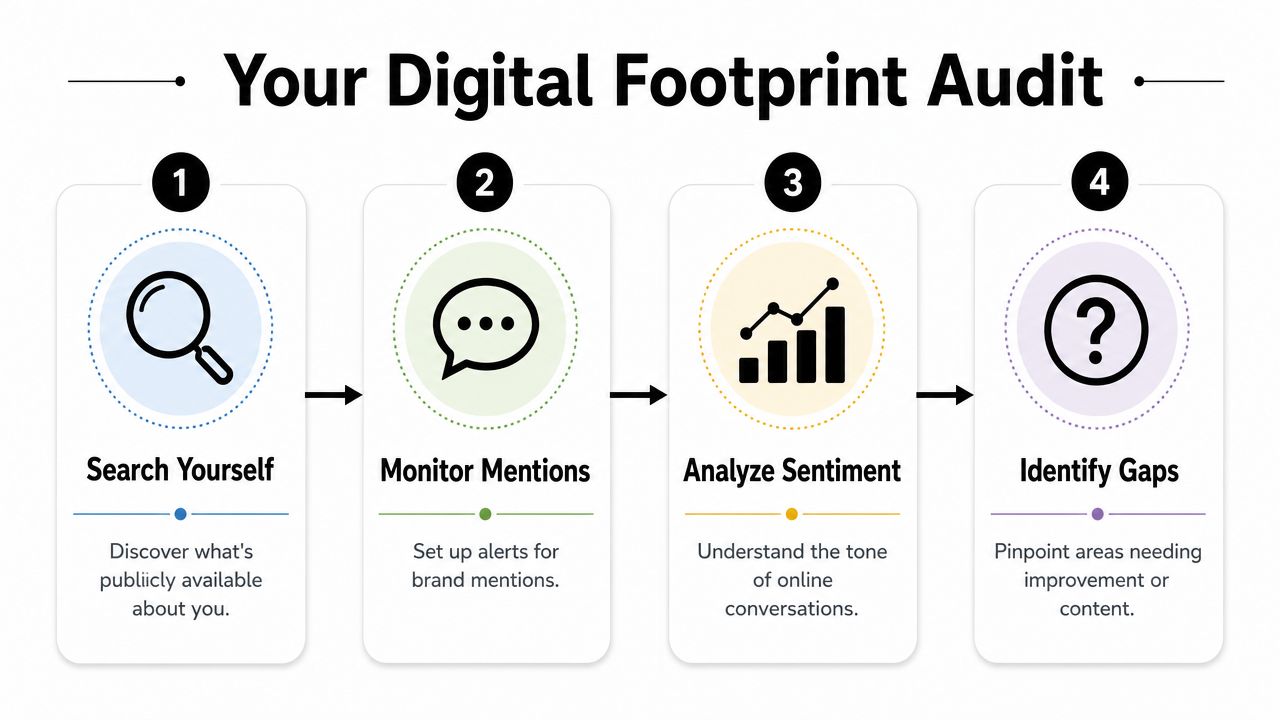
Don't type your name once and call it research. Run multiple searches in an incognito browser so your own history doesn't distort the results.
Use queries like these:
Check the first page carefully, then keep going. The first page shapes first impressions, but pages two and three often reveal dormant problems. Look for outdated bios, weak images, duplicate listings, irrelevant profiles, negative commentary, and content gaps.
A detailed walkthrough on how to check your online presence can help if you want a full inventory process.
You don't need enterprise software on day one. You need coverage and consistency.
Use a lean stack:
If you're building a stronger listening workflow, this brand sentiment tracking guide is useful because it shows how to organize mention monitoring into something repeatable.
Monitor your name the way a competitor would. That's when blind spots become obvious.
Don't just collect links. Label them. A rough scoring system is enough.
Use three buckets:
Then identify the gaps:
Later in the audit, watch this walkthrough for a practical overview of monitoring and cleanup basics.
A real audit gives you four things:
| Output | Why it matters |
|---|---|
| Baseline search results | You can see what people actually find first |
| Platform inventory | You know which assets to strengthen or delete |
| Sentiment pattern | You spot recurring praise, confusion, and complaints |
| Content gap list | You know what to publish next to shape perception |
Online brand reputation management starts. Not with panic. With visibility.
If you don't publish your story, the internet builds a weaker version of it for you.
That's the blunt truth. A thin profile, scattered posts, and occasional comments don't create a brand. They create ambiguity. Ambiguity kills trust. Strong narrative fixes that.
CS Design Studios notes that 79% of consumers trust online reviews as much as personal recommendations, and ties proactive content creation to the PESO model for shaping your narrative and controlling your digital footprint. For personal brands, that matters because people don't separate your reputation from your content. Your posts, interviews, comments, testimonials, and site copy all work together.
Consistent content does more than "increase visibility." It gives people evidence.
Evidence of what you believe. Evidence of how you think. Evidence that you know your craft. Evidence that clients, peers, or audiences trust you enough to engage.
You don't need to become a full-time creator. You do need a repeatable content engine that answers four questions:
A useful shortcut is to build around themes, not random ideas. Pick a few lanes and stay in them. One founder might focus on leadership, product lessons, and customer insight. A consultant might focus on strategy mistakes, client transformations, and market analysis. A creator might focus on process, philosophy, and behind-the-scenes decisions.
Most professionals post only on owned channels and then wonder why growth stalls. The PESO model fixes that by forcing distribution discipline.
Here's how to think about it:
| PESO channel | What it looks like for a professional |
|---|---|
| Paid | Targeted promotion for your best ideas, events, or lead magnets |
| Earned | Podcast interviews, media quotes, guest articles, newsletter mentions |
| Shared | Social conversations, reposts, collaborations, community engagement |
| Owned | Your website, blog, email list, LinkedIn profile, and core social accounts |
The mistake isn't failing to post. The mistake is letting good ideas die on one platform.
One insight can become a LinkedIn post, a short video, a newsletter section, a guest article pitch, a podcast talking point, and a website article. That's not content recycling in a lazy sense. That's strategic repetition. People trust what they see consistently.
For a practical framework, this brand narrative template for growth helps turn your experience into a clearer public story.
Your reputation improves faster when people can repeat your positioning in one sentence.
Most professionals post advice. Fewer post judgment. That's where trust comes from.
Instead of generic tips, use story structures like these:
These formats do two things. They make you easier to remember, and they reveal how you think under pressure. That's more persuasive than polished slogans.
Keep the narrative tight:
A weak content strategy sounds impressive and says nothing. A strong one is boring in the best way. It repeats clear ideas until the market associates them with your name.
That means:
People don't trust occasional brilliance. They trust visible consistency.
Online brand reputation management gets much easier once your content starts doing the heavy lifting. Then your reputation isn't just protected. It's producing demand.
Good content that nobody finds doesn't help your reputation much. You need your strongest assets to rank when someone searches your name.
This matters more than most professionals admit. NewMedia reports that 74% of users abandon a purchase immediately if they encounter negative content on the first page of search results. If the wrong result owns your page one, trust leaks before the first conversation starts.
Treat your search presence like digital real estate. The best spots need to be claimed, built, and maintained.
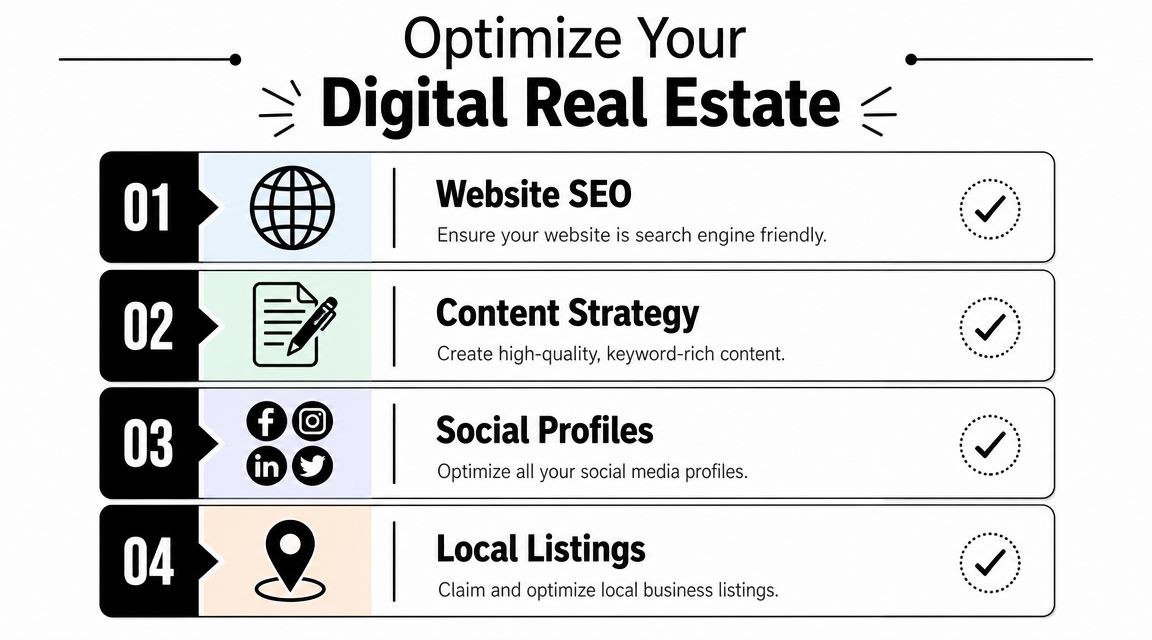
Start with the properties most likely to rank for your name:
Your job is simple. Make each asset complete, consistent, and keyword-aware.
That means your name should appear clearly in titles, profile headlines, bio sections, image alt text where relevant, and page copy. Your expertise should be described in natural language people search for. If you're a leadership coach, SaaS founder, email marketer, or fractional executive, say so directly.
A lot of people want advanced SEO while their profiles are unfinished. That's vanity.
Use this checklist:
| Asset | What to optimize |
|---|---|
| Website home page | Name, positioning, clear intro, updated bio, contact path |
| About page | Story, credibility signals, media features, testimonials |
| Headline, banner, featured section, custom URL, keywords in About | |
| Social profiles | Matching headshot, consistent bio, current links, clear category |
| Articles and blogs | Searchable titles, internal links, author attribution, relevant topics |
If your website platform is slowing you down, choosing the right system matters. This comparison of content management systems is useful for deciding what gives you enough control to publish and update efficiently.
Search is changing. People still Google names, but they also rely on AI-generated summaries and answer engines. That raises the bar for clarity.
If you want a smart primer on that shift, read what Generative Engine Optimization means. The key takeaway is practical. Publish clear, structured, authoritative content that makes your expertise easy for both search engines and AI systems to interpret.
Search rule: Own as many of the top results for your name as possible with assets you control or strongly influence.
Search optimization for reputation isn't mysterious. It usually comes down to disciplined publishing and linking.
Do this consistently:
The goal isn't to game search. The goal is to make the best truth about you easier to find than the noise.
Even strong brands get hit. Bad reviews happen. Unfair criticism happens. Misunderstandings spread fast. What matters is whether you respond with judgment or emotion.
Most reputational damage gets worse because people panic, argue, over-explain, or disappear. Don't do any of that. Use a simple sequence: Acknowledge, Assess, Act.

Silence can look arrogant. Defensive language looks worse.
If the complaint is real, acknowledge it quickly and calmly. Thank the person for raising it. State that you take it seriously. If needed, apologize plainly. Skip the corporate spin. Skip the passive voice. Skip the "we regret any inconvenience" nonsense.
Use responses like:
Short is better than polished.
Not every negative comment deserves the same response. Separate the issue type before you engage.
| Situation | Best move |
|---|---|
| Legitimate complaint | Respond publicly, then resolve privately if needed |
| Minor misunderstanding | Clarify once, briefly and respectfully |
| Bad-faith attack | Avoid a long public argument |
| False factual claim | Correct the record with evidence and stay calm |
| Harassment or abuse | Document it, report it, and don't engage emotionally |
Discipline matters. People often confuse visibility with urgency. A loud comment isn't always a meaningful threat. Some criticism should be answered. Some should be documented and ignored.
If a critic wants resolution, respond. If a critic wants spectacle, don't provide it.
The response isn't the finish line. The fix is.
Strong reputation repair usually includes a few moves working together:
If the issue exposed a real weakness, fix the system. Maybe your onboarding is messy. Maybe your communication lags. Maybe your offer creates the wrong expectations. Reputation repair works best when it changes behavior, not just messaging.
Some people think every negative mention must be challenged. That's ego, not strategy.
Don't engage when:
A weak response can create a bigger problem than the original complaint. Step away, draft carefully, and get a second set of eyes if the situation has real stakes.
A steady reputation doesn't come from never getting criticized. It comes from showing that you can absorb friction without acting sloppy.
If you're serious about online brand reputation management, stop measuring vanity and start measuring control.
The clearest signs of progress aren't likes alone. They are practical signals. What shows up on page one for your name. Whether your profiles tell the same story. Whether inbound leads mention your content. Whether opportunities arrive warmer because people already trust what they found.
Track a small set of indicators:

You can do this yourself if you have three things: time, editorial judgment, and consistency. Most professionals run out of one of them fast.
That helps explain the market direction. Mordor Intelligence projects the online reputation management market at USD 7.75 billion in 2026, with services dominating the market. That's not just industry trivia. It reflects a simple reality. A lot of people would rather delegate this work than let it stay half-finished.
Bring in help when:
Delegating doesn't mean losing your voice. It means getting support to express it clearly and consistently.
If you want help turning your reputation into a growth asset instead of a maintenance chore, Legacy Builder is built for that. They help professionals and founders shape a credible online presence through strategy, content, profile optimization, and consistent execution, so your digital footprint starts creating trust before you ever get on the call.


You could – but most in-house teams struggle with the nuance of growing on specific platforms.
We partner with in-house teams all the time to help them grow on X, LI, and Email.
Consider us the special forces unit you call in to get the job done without anyone knowing (for a fraction of what you would pay).
Short answer – yes.
Long answer – yes because of our process.
We start with an in-depth interview that gives us the opportunity to learn more about you, your stories, and your vision.
We take that and craft your content then we ship it to you. You are then able to give us the final sign-off (and any adjustments to nail it 100%) before we schedule for posting.
No problem.
We have helped clients for years or for just a season.
All the content we create is yours and yours alone.
If you want to take it over or work on transitioning we will help ensure you are set up for success.
We want this to be a living breathing brand. We will give you best practices for posting and make sure you are set up to win – so post away.
Subscribe to our newsletter and get insights on how to grow your personal brand.
