.svg)
Subscribe to our newsletter and get insights on how to grow your personal brand.
Thank you! Your submission has been received!
Oops! Something went wrong while submitting the form.
.svg)



The most counterintuitive thing about online reputation management is that it isn't mainly about praise, it's about revenue capture. A widely cited set of industry statistics says 68% of customers are willing to pay up to 15% more for a product or service with a better reputation, and businesses that respond to at least 25% of their reviews can see a 35% increase in revenue. That's not a branding footnote, that's pricing power, conversion, and pipeline velocity showing up in the same place: the search result, the review snippet, and the first impression.
Founders, SaaS leaders, professionals building personal brands, and traditional businesses entering digital need to think about ORM the same way they think about sales systems. If the market sees trust signals before it sees your pitch, those signals shape who clicks, who enquires, who books, and who pays more. A practical reputation program is worth studying because it can change the quality of demand long before a rep gets on a call, and if you want outside help with that layer, a PR agency reputation expertise resource like Carlos Alba Media's reputation management page is one place to compare what a managed approach looks like.
| Benefit | Primary Outcome | Key Signal | Time Horizon |
|---|---|---|---|
| Trust and credibility | Higher conversion confidence | Reviews and response quality | Near term |
| Lead generation | More qualified inbound | Search visibility and profile strength | Near term to ongoing |
| SEO and visibility | Better organic discovery | Fresh reviews and branded content | Ongoing |
| Crisis mitigation | Less downside from negative events | Response speed and narrative control | Immediate when needed |
| Talent and partnerships | Stronger inbound interest | Public reputation footprint | Ongoing |
| Pricing power | Less discount pressure | Reputation strength in market | Ongoing |
| Brand equity | More durable market value | Consistent trust signals | Long term |
A clean reputation profile can be worth more than a polished pitch deck because buyers often judge before they contact you. The same industry statistics that show positive online reviews can boost sales by up to 31% also point to a company's reputation accounting for 63% of its market value in a widely cited benchmark. That combination explains why ORM belongs in the commercial stack, not the design stack. Searchers, reviewers, and prospects are all reacting to the same trust signal, and that signal influences whether they believe your price, your promise, and your product.
The founder mistake is treating reputation as a post-sale polish job. In practice, it affects pricing power, because people pay more when they trust the brand behind the offer, and it affects conversion, because fewer objections surface when the public record looks strong. It also affects pipeline quality, since prospects who arrive through a strong reputation filter tend to self-select more seriously.
A useful way to think about this is simple. If your brand looks credible in the places buyers check first, your sales team spends less time proving you're real. That changes the economics of every lead that enters the funnel.
Practical rule: if a reputation initiative doesn't change a buying decision, a search result, or a response pattern, it's probably decoration.
For a SaaS company, ORM can shape enterprise confidence before procurement. For a founder building a personal brand, it can determine whether a speaking request, advisory conversation, or inbound partnership even starts. For a local business, it can change whether a searcher calls you or moves to the next result.
That's why the benefits in this article are tied to measurable business outcomes, not vanity metrics. Search visibility, review activity, response behavior, and the narrative that appears around your name all affect revenue in different ways. They don't sit side by side, they stack.
| Benefit | Primary Outcome | Key Signal | Time Horizon |
|---|---|---|---|
| Trust and credibility | Higher close rate | Public feedback quality | Near term |
| Lead generation | Better inbound flow | Search and profile visibility | Near term |
| SEO and visibility | More organic discovery | Review volume and response activity | Ongoing |
| Crisis mitigation | Lower reputational drag | Speed of response | Immediate |
| Talent and partnerships | Stronger inbound quality | Reputation footprint | Ongoing |
| Pricing power | Better margin resilience | Market trust | Ongoing |
| Brand equity | Compounding value | Consistent positive signals | Long term |
The right mental model is not “How do we look better?” It's “How does the market behave differently once trust shows up earlier in the process?” That's the reason the rest of this guide exists.
ORM now means managing the full surface area where people and algorithms judge you before direct contact. That includes search results, review platforms, social presence, and the owned content that frames your story. A practical 2026 ORM program shapes what appears when someone types your name, reads a snippet, scans reviews, or checks an AI-generated summary.
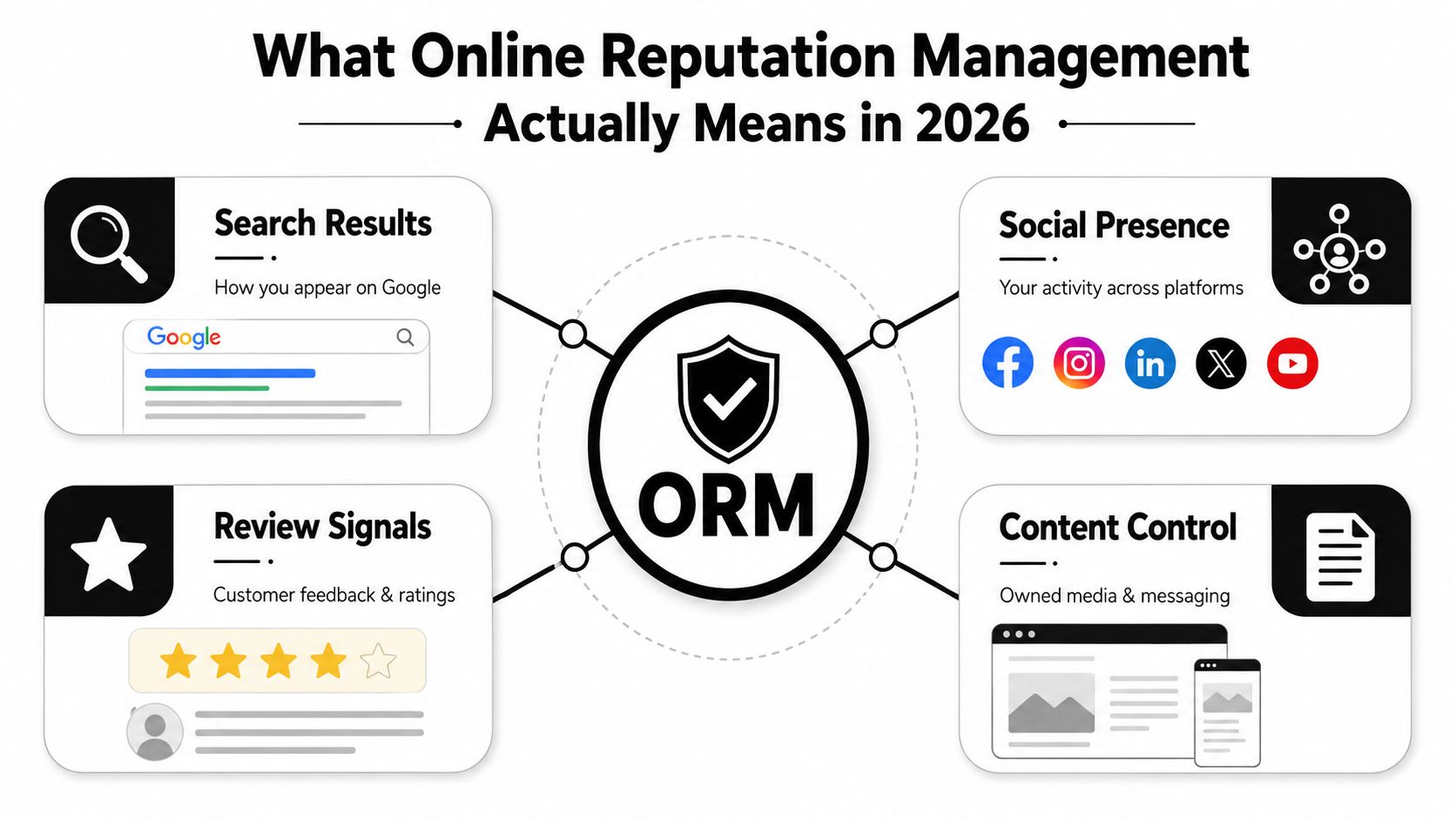
The closest comparison is credit scoring. Lenders do not wait for your explanation, they consult the file. Buyers and algorithms behave the same way, they look for trust cues, consistency, recency, and evidence. If the signal set looks reliable, friction drops. If it looks thin or messy, scrutiny rises.
That is why review volume, response activity, and star ratings matter together. They do not just describe sentiment, they feed discovery and evaluation. The practical move is to keep the record current, because stale profiles often read like neglected businesses.
ORM is less about persuasion after the fact and more about shaping the evidence people see before they decide.
The older version of reputation management focused on damage control after a complaint or bad article surfaced. The current version has to account for AI summaries and search-generated overviews that pull from the same public trust signals buyers already use. Recent guidance on preparing for SGE emphasizes more reviews, more detailed reviews, and replying to reviews, which makes response behavior part of discovery, not just customer service. See also own.page's 2026 playbook for how ownership of your presence connects to the wider content footprint.
This also overlaps with the process outlined in Legacy Builder's guide to online reputation management services. The core idea is the same, shape the surfaces people see first, then keep them aligned with the truth of the business.
In plain language, ORM is the disciplined process of monitoring, influencing, and improving how you appear across public channels. It is not a one-time cleanup, and it is not just review management. It is a system for making sure the market sees accurate, current, and trust-building evidence before it makes a decision.
That system produces seven business benefits, and each one lands in a different part of the funnel.
Trust is the first commercial outcome because it reduces hesitation. People move faster when they see a business that looks responsive, current, and consistently evaluated by real customers. The revenue logic is clear, positive online reviews can boost sales by up to 31%, and a better reputation can justify a higher price point.
What matters most isn't perfection, it's pattern. Buyers want to see that praise is frequent, criticism is answered, and the business looks like it's being run by adults. That's why response quality matters as much as star ratings.
ORM creates demand by improving the odds that searchers click, call, or inquire. Industry guidance says first-page search results capture the majority of clicks, so improving your review profile and branded content can raise organic traffic efficiency without leaning on paid media. In practice, that means your reputation work becomes a lead source, not just a defensive layer.
This is especially important for founders and personal brands, because people often search your name before they ever see a sales page. If the results are sparse, outdated, or negative, the funnel leaks before it starts.
Search visibility is where ORM behaves like an SEO multiplier. Review signals, response activity, and branded content all contribute to the picture searchers see, and research-oriented guidance notes that those signals correlate with visibility. The point isn't to game rankings, it's to make your public footprint more legible and more trustworthy.
For operators, the AI-search shift matters most here. Getting more reviews, more detailed reviews, and replying to reviews makes your reputation assets more usable in both classic search and newer summary experiences. If your brand story is consistent across the surfaces people check, your visibility gets more efficient.
ORM also protects downside. A negative event doesn't have to become a permanent narrative if your profile already contains evidence of responsiveness, consistency, and customer care. Research on reputation management stresses that better reviews, higher visibility, and stronger trust are linked with lower perceived risk, which means the market is less likely to assume the worst when something goes wrong.
That said, crisis mitigation is not the same as crisis prevention. A clean profile won't fix broken delivery, bad support, or weak operations. It only buys you time and credibility while you solve the underlying problem.
Strong reputation signals attract better inbound interest from candidates, collaborators, and strategic partners. People want to attach themselves to businesses that appear stable and respected. A weak reputation footprint forces you to explain yourself more often, which slows hiring and makes partnership conversations harder.
This benefit gets overlooked because it doesn't always show up in a direct conversion metric. Still, in competitive markets, who returns your email and who takes the first meeting is often shaped by your public reputation long before the call happens.
Pricing power is one of the clearest financial payoffs. If 68% of customers are willing to pay up to 15% more for a better reputation, then reputation is directly linked to margin, not just volume. The better the trust signal, the less pressure you face to discount just to get through the door.
That matters for service businesses especially. A credible reputation can make the difference between defending your rate and justifying it with ease. It doesn't remove price sensitivity, but it changes the starting point of the conversation.
Brand equity is the compounding asset behind all the other benefits. A company whose reputation stays healthy over time builds a larger trust reservoir, and that reservoir becomes useful during launches, hiring cycles, sales pushes, and market noise. The often-cited benchmark that a company's reputation may account for 63% of its market value shows how much intangible trust can matter over the long run.
These benefits don't operate in isolation. Trust helps visibility, visibility helps leads, leads create reviews, reviews support pricing, and pricing funds better service. That loop is what turns ORM from a cleanup task into a growth system.
Legacy Builder's social proof guide is useful here because reputation only works when proof is visible, not buried.
The numbers matter, but the workflow matters more. A founder doesn't experience ORM as a theory, they experience it as an inbound DM, a quieter sales objection, or a search result that finally looks right.
An emerging founder spends six months publishing on LinkedIn, tightening the bio, and asking happy clients for specific reviews. The benefit here is lead generation, because the public footprint starts doing pre-selling work before a discovery call. When the profile looks coherent, people arrive warmer and ask better questions.
That same founder may also benefit from a structured response plan. If negative comments appear, responding to online backlash is less about sounding clever and more about staying consistent, calm, and visible. The result a founder can notice is fewer false starts in the inbox.
A SaaS CEO feels ORM inside the procurement cycle. Enterprise buyers check review platforms, search results, and founder visibility before they send a contract through legal. The benefit in play is trust and credibility, and the action that triggers it is usually a combination of review management and better-owned content around product value.
That's where an internal process matters. A founder's guide to professional reputation management makes sense for leaders who need their public footprint to support sales rather than distract from it. In enterprise settings, a strong public record can reduce skepticism before the demo even starts.
A traditional business owner often sees the first effect in local search behavior. Updated profiles, fresh reviews, and timely replies start changing who clicks from Google, and the benefit is a mix of visibility and conversion. The observable change is simple, more of the right people are finding the business before a salesperson does any convincing.
Sustained execution matters more than one-off cleanup. Legacy Builder's ORM services guide fits that reality because reputation work only compounds when the owner keeps feeding the system with accurate content and active response habits.
A solopreneur often needs reputation to replace time, since every saved objection matters. A team, by contrast, uses reputation to improve coordination, since sales, support, and marketing all draw from the same public story. The underlying benefit is the same, but the workflow changes depending on who owns the system and how many people touch it.
The practical takeaway is that ORM shows up where buyers already are, in search, in reviews, and in the moments right before contact. If those surfaces look credible, the business feels easier to buy from.
ORM can become a cover story if leaders use it to suppress symptoms instead of fixing causes. A clean-looking profile that relies on review gating, fake volume, or heavy suppression can fail the first time a serious buyer checks the receipts. It's the business equivalent of credit repair that ignores underlying debt.
Durable reputation work comes from better service, faster replies, clearer communication, and more substantive customer reviews. Cosmetic work tries to hide patterns instead of changing them. The first creates trust that survives scrutiny, the second only works until someone digs deeper.
That distinction matters because buyers, partners, and candidates often use reputation signals as due diligence. If the public record feels too tidy, trust can drop. The market doesn't need perfection, it needs evidence.
If the public story gets better but the operating reality doesn't, the gap will show up somewhere else, usually in churn, complaints, or referral quality.
Ask whether the change would still hold up if the customer spoke to a teammate, a peer, or a vendor. If the answer is no, the fix is probably cosmetic. If the answer is yes, you're probably improving the business, not just the presentation.
That's why ORM should sit alongside operations, not above them. It's strongest when it reflects a healthier company, not when it hides a weaker one. The long-term brand equity comes from alignment, not varnish.
The cleanest way to make ORM useful is to treat it like an operating cadence. The first two weeks are for audit and baseline, looking at search results, review profiles, brand mentions, and any AI-overview presence that may already be shaping perception. If you don't know what the market sees, you can't improve it.
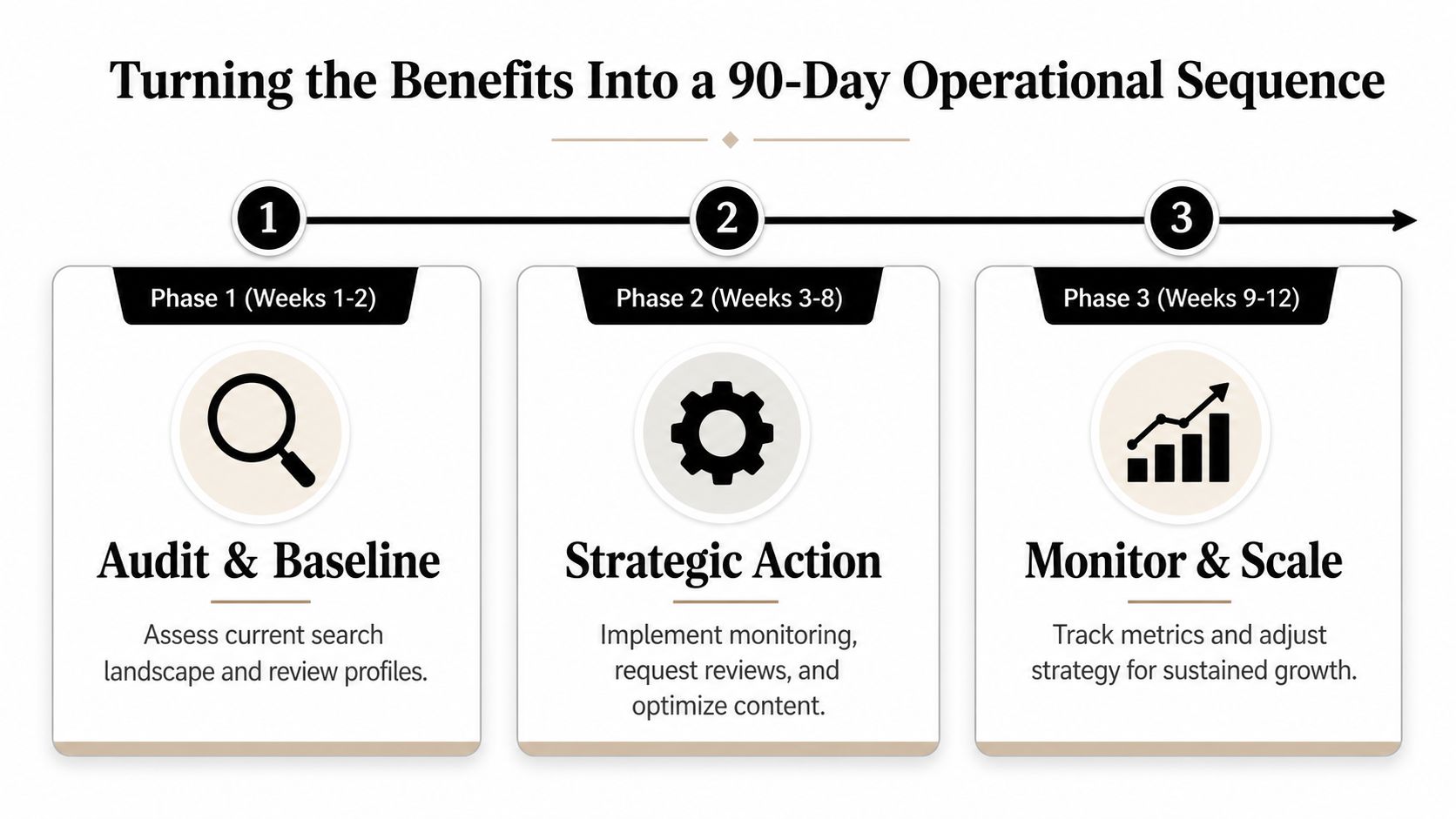
This is the content and profile optimization window. Tighten founder bios, update service pages, publish owned content that explains the business clearly, and make sure the same story appears across the surfaces buyers check. The goal is consistency, because inconsistency creates friction.
If you're using an outside team, a service model like Legacy Builder fits naturally, since its model combines strategy, content creation, profile optimization, and ongoing audience interaction. That kind of support matters because ORM falls apart when it's handled as a one-time task instead of a sustained workflow.
Now the focus shifts to review generation and response systems. Ask for reviews at the right moment, respond quickly and professionally, and make sure negative feedback doesn't sit unattended. This phase is where trust signals start compounding, because fresh reviews and active replies show that the business is alive.
Use this stretch to measure what changed. Look at branded search results, review quality, response consistency, and the way prospects reference your public footprint in sales conversations. If the work is working, you'll usually notice cleaner inquiries, fewer credibility questions, and a more coherent narrative around the brand.
The first 30 days should be judged on leading indicators, not final revenue. That means more visible proof, more complete profiles, faster response habits, and fewer gaps between what the business says and what the market sees. If you keep the system moving, the benefits start to stack.
Online reputation management benefits aren't separate perks, they're one operating system. Trust improves conversion, visibility improves discovery, response quality improves credibility, and all of that feeds the same commercial flywheel. The businesses that win here don't chase polish, they build a public record that matches how they operate.
The hard line is simple. Durable ORM is worth doing because it strengthens the business while it shapes perception. Cosmetic ORM is a distraction because it only changes the appearance of risk, not the risk itself.
If you want a reputation system that supports revenue instead of just smoothing over noise, Legacy Builder works with founders and professionals on profile optimization, strategic content placement, and ongoing brand management. If you're ready to turn search results, reviews, and public trust into a more reliable pipeline, visit them and start with a conversation about what your market sees today.


You could – but most in-house teams struggle with the nuance of growing on specific platforms.
We partner with in-house teams all the time to help them grow on X, LI, and Email.
Consider us the special forces unit you call in to get the job done without anyone knowing (for a fraction of what you would pay).
Short answer – yes.
Long answer – yes because of our process.
We start with an in-depth interview that gives us the opportunity to learn more about you, your stories, and your vision.
We take that and craft your content then we ship it to you. You are then able to give us the final sign-off (and any adjustments to nail it 100%) before we schedule for posting.
No problem.
We have helped clients for years or for just a season.
All the content we create is yours and yours alone.
If you want to take it over or work on transitioning we will help ensure you are set up for success.
We want this to be a living breathing brand. We will give you best practices for posting and make sure you are set up to win – so post away.
Subscribe to our newsletter and get insights on how to grow your personal brand.
