.svg)
Subscribe to our newsletter and get insights on how to grow your personal brand.
Thank you! Your submission has been received!
Oops! Something went wrong while submitting the form.
.svg)



A polished profile and a steady posting habit will not build your reputation. They will only make you look busy.
I see founders waste time on online presence advice that confuses attention with progress. A few LinkedIn posts, a refreshed bio, and some recycled thought leadership do not create demand. They do not make buyers trust you. They do not make investors, partners, or top hires take you seriously.
Your online presence has one job. It should turn curiosity into confidence, and confidence into action. If people find you online and still hesitate, your presence is costing you opportunities.
Founders rarely say this out loud, but weak digital signals kill momentum early. A prospect looks you up before replying. A candidate checks your footprint before taking the interview. A warm intro searches your name before making the referral. If what they find is thin, scattered, or forgettable, you lose ground before the actual conversation starts.
Online presence management is not about looking relevant. It is about becoming the credible choice, faster. The goal is not more likes. The goal is more trust, better conversations, stronger authority, and a pipeline that does not depend entirely on outreach.
That is how you build a legacy instead of a feed.
Your online presence is underperforming because you are treating visibility like the goal instead of treating it like infrastructure for trust.
Founders get pulled into the wrong work. They polish a headline, post a few updates, refresh the company page, and call it momentum. That activity can make you look present. It does not make you credible. It does not create demand. It does not help a buyer, investor, candidate, or journalist decide that you are the serious option.
Plenty of founders publish constantly and still fail the true test. Someone finds them online, checks three or four signals, and leaves unconvinced.
That happens when your digital footprint does not answer basic decision-making questions fast enough:
If a high-value prospect has to piece together your story from scattered profiles and outdated pages, you have already added friction. Friction kills response rates, referrals, and deal velocity.
A lot of founder advice still pushes the same bad assumption: post more, stay visible, and the market will notice. That is lazy advice.
Search carries intent. Social carries interruption.
As noted earlier, consumers search online constantly for products and services, and Google still dominates search behavior. That means your website, branded search results, directory listings, review signals, and press coverage matter more than another week of platform-native posting. If your presence depends on one social platform, you do not own your reputation. You are borrowing reach.
That is also why smart founders invest in assets that compound. Strong branded search results. Clear founder bios. Useful articles. Credible interviews. Newsworthy announcements that can rank press releases in Google News. A reputation strategy tied to trust signals will outperform a content treadmill every time.
If you need a stronger system around reviews, search results, and brand perception, study this guide to online reputation management services.
The market is not asking whether you post often. It is asking whether your digital footprint reduces risk.
Weak signal quality shows up fast. Your LinkedIn says one thing, your website says another, and search results surface old interviews, stale bios, or irrelevant mentions. You claim authority, but the supporting evidence is thin. You talk about growth, but nothing online proves customers trust you, peers cite you, or media takes you seriously.
Vanity metrics hide this problem. Likes can flatter you while your pipeline stays flat.
A working online presence does three practical jobs. It shortens the trust gap. It improves the quality of inbound. It gives people enough confidence to take the next step without needing extra reassurance from you.
That is the standard. Build a presence that turns searches into confidence and confidence into action. Anything less is noise.
You can't improve what you haven't inspected. Most founders audit their presence by searching their name once and calling it a day. That's shallow. A real audit looks at the full trail you leave across search, social, content, reviews, and brand consistency.
An effective online presence management workflow starts with a full audit of website analytics, social profiles, search rankings, reviews, and brand inconsistencies before you define KPIs or build a content calendar, as outlined in Prowly's guide to online presence management.
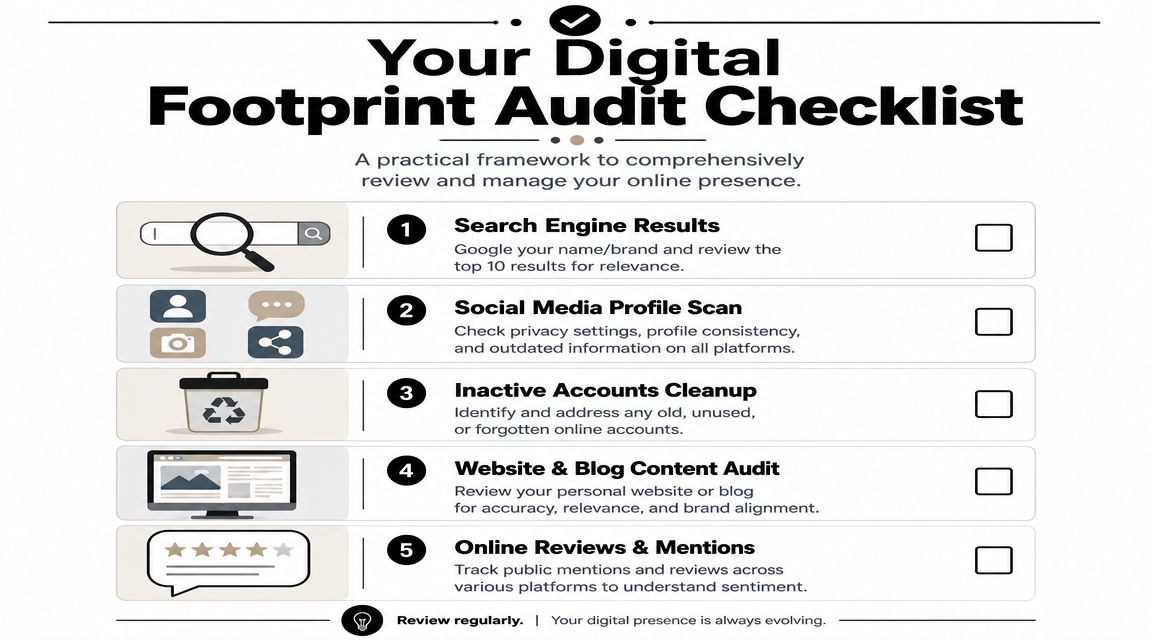
Run your audit from the outside in. Don't begin with what you meant to communicate. Begin with what a stranger sees.
Check these five areas first:
Search results for your name and brand
Look at the first page. Does it show your website, current company, strong profiles, interviews, articles, and relevant mentions? Or does it show old bios, stale directories, and content that doesn't reflect your current positioning?
Social profile consistency
Compare LinkedIn, X, company pages, speaker bios, author boxes, and any active creator platforms. Your headline, positioning, photo style, company description, and offer should feel aligned.
Inactive accounts and abandoned assets
Dead blogs, neglected profiles, and old landing pages create confusion. They dilute authority because they make you look scattered.
Website and owned content
Review your homepage, about page, service pages, founder bio, media mentions, and blog. If your website reads like a brochure instead of a credibility engine, fix it.
Reviews and public mentions
Effective narrative control is paramount in this area. If people mention you, review you, or discuss your company publicly, you need to know what they're saying.
If your reputation footprint feels weak, this is a good time to understand how online reputation management services fit into the broader presence picture.
Don't overcomplicate this. Build a basic scorecard and mark reality, not aspiration.
| Audit Area | Checklist Item | Status (Good/Needs Work/Missing) |
|---|---|---|
| Search Results | Top results reflect current positioning and authority | |
| Social Profiles | Bios, visuals, and messaging are consistent | |
| Inactive Accounts | Old accounts are updated, archived, or removed | |
| Website Content | Core pages are accurate and aligned with brand | |
| Reviews and Mentions | Public sentiment is monitored and addressed |
You're not just checking for errors. You're looking for friction points between what you want to be known for and what the internet currently says about you.
Here are the most common gaps I find:
A founder with a clear point of view but a messy digital footprint still looks risky online.
If search visibility is part of your authority plan, study how strong announcements and media assets can rank press releases in Google News. Not because you need PR for vanity, but because controlled visibility can support narrative control when done deliberately.
An audit should produce action. Decide what to delete, what to update, what to consolidate, and what to expand. If an asset doesn't support your future reputation, it shouldn't stay untouched.
Founders who win online aren't everywhere. They're coherent.
A polished profile without a narrative is just decoration. If you don't define your story, the market will do it for you, and it will usually flatten you into something generic.
Your brand narrative is not your life story. It's the strategic explanation for why you matter, what you stand for, and why the right people should trust you now.

Strong narratives have contrast. They don't say, “I help businesses grow.” That means nothing. They say, “I help technical founders turn complex products into clear market stories,” or “I help operators fix the messaging gaps that stall enterprise deals.”
Your narrative should answer four questions:
That last question is where your authority comes from. Your best content won't come from repeating consensus. It will come from naming bad assumptions and replacing them with better ones.
You don't need a clever tagline first. You need a working brief.
Create a one-page narrative with these parts:
Positioning statement
One clear sentence on what you do, for whom, and why it matters.
Audience definition
List the exact people you want to attract. Founders is too broad. Pre-seed SaaS founders, agency owners shifting upmarket, or in-house marketers moving into leadership is better.
Three content pillars
These are the recurring themes you can speak about for a long time without sounding forced.
Proof sources
Experience, frameworks, lessons, client patterns, product decisions, failures, and observations from the field.
Tone rules
Decide how you sound. Sharp and practical. Calm and analytical. Contrarian and precise. Don't switch voice every week.
If you want a structured framework for this exercise, use this brand narrative template for growth.
Your audience doesn't need your full background. They need the version of your background that explains why your perspective deserves attention.
This is a frequently avoided part. Once you define your narrative, you'll notice how much of your current content doesn't support it.
That's fine. Remove the fluff.
Stop posting broad motivational filler if you want to be seen as a serious operator. Stop sharing shallow trend commentary if you want to build executive authority. Stop mimicking creators whose business model has nothing to do with yours.
Authenticity doesn't mean saying everything. It means saying the right things consistently enough that people remember you for a specific kind of value.
Most founders don't need more content ideas. They need a publishing system that turns expertise into trust signals.
You already have raw material. Sales calls, team decisions, hiring lessons, product tradeoffs, customer objections, mistakes, opinion shifts, and strategic choices. That's your content engine. The problem is that you're either not capturing it or not shaping it into assets people can understand quickly.
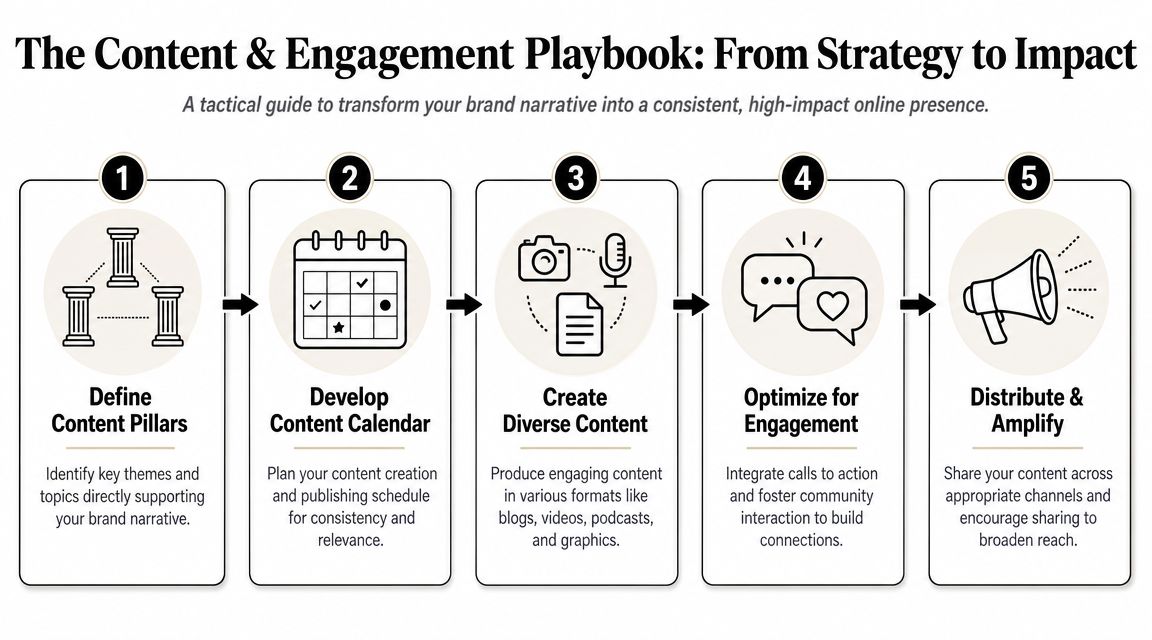
You don't need to reinvent your style every week. Pick a handful of content formats and repeat them until the market associates you with clarity.
A practical mix looks like this:
One useful reference for tactical online brand management strategies is worth reviewing if you need help organizing channels and consistency.
I don't care about aggressive posting schedules if they collapse after two weeks. Consistency beats intensity.
A sustainable founder rhythm usually includes:
Support can be beneficial. Tools like Buffer and Hootsuite can handle scheduling. Google Analytics can help you see traffic behavior. If you want done-with-you personal brand execution, Legacy Builder is one option that handles content creation, profile optimization, and strategic posting based on your narrative.
A lot of founders publish and disappear. That kills momentum.
Engagement isn't a courtesy. It's distribution and relationship building. If there are twenty people you'd like to know, read what they publish and add something useful to the conversation. Not flattery. Not “great post.” Add interpretation, challenge, context, or a better question.
The right comment on the right person's post can do more for your reputation than another mediocre post on your own feed.
Use a simple relationship map:
Work those groups intentionally. If you're trying to become known in a category, don't just publish into the void. Join the existing conversation with substance.
A quick visual summary helps if you need to operationalize this process:
Your calendar shouldn't ask, “What should I post on Tuesday?” It should ask, “What story does the market need to hear repeatedly before trust increases?”
Tie your content to business priorities:
Content becomes powerful when it reduces uncertainty. That's your job online.
If you're still reporting success with likes, impressions, and follower bumps alone, you're managing optics, not outcomes.
Vanity metrics aren't useless. They're just incomplete. They can tell you whether content got seen. They can't tell you whether your reputation got stronger, whether trust increased, or whether qualified opportunities improved.
Search performance alone should reset how you think about measurement. 27.6% of all clicks go to the #1 Google result, according to LeadNicely's guide to measuring and improving online presence. That's why small improvements in visibility and reputation can have outsized impact on traffic and credibility. You don't need to chase every metric. You need to track the ones that show movement toward authority and business value.

Likes are easy to count because platforms hand them to you. That doesn't make them the right scoreboard.
What matters more is whether your presence leads to signals like these:
If you need a practical framework, this guide on how to measure content performance for your personal brand is a useful starting point.
I recommend founders track measurement in layers.
| Layer | What to Track | Why It Matters |
|---|---|---|
| Visibility | Search rankings, branded search, direct traffic, profile views | Shows whether people can find you |
| Engagement quality | Meaningful comments, saves, replies, DMs, email responses | Shows whether people care enough to respond |
| Trust | Review trends, repeat visitors, positive mentions, referral context | Shows whether credibility is compounding |
| Opportunity | Sales conversations, partnership inquiries, speaking requests, hiring interest | Shows whether presence is producing outcomes |
Centralized reporting helps. If your metrics are scattered across platforms, you'll miss patterns. For a broader view of why integrated reporting matters, read how marketing metrics boost revenue.
Most founders ignore this because it sounds like a big-brand metric. That's a mistake.
Share of voice tells you whether you're becoming part of the conversation in your niche. Sentiment tells you whether increased attention is building trust or just noise. Standard guidance on online presence management increasingly points toward tracking mention volume, positive, negative, and neutral sentiment, along with keyword and hashtag trends and audience segmentation by geography or demographics, as explained by Adsmurai's article on organizing and optimizing online presence.
Here's the key distinction:
Don't ask whether content performed. Ask whether it moved the reputation you need.
Weekly data can be noisy. Monthly review gives you pattern recognition. Quarterly decisions give you enough signal to change direction with confidence.
Use your review to answer questions like:
That's online presence management done properly. You're not building an audience for ego. You're building a reputation system that provides an advantage.
A following can disappear fast. An algorithm changes. A platform cools off. Your reach dips. If your entire presence depends on borrowed attention, you're exposed.
Legacy works differently. It compounds through clear positioning, durable content, strong search visibility, consistent narrative, and repeated proof of expertise. People don't just recognize your name. They know what you stand for.
Treat your online presence like intellectual property, not daily performance art.
That means you should keep building assets that outlast a post cycle:
If you do this well, your digital footprint starts doing part of the filtering for you. Better prospects come in warmer. Hiring conversations start with more confidence. Partners approach you with more context. You spend less time explaining who you are because your presence already did the work.
You don't need to become a full-time creator. You need to become a reliable signal.
That means showing up with the same core message, the same standards, and the same quality of thinking over time. Not every post will land. That's fine. You're not trying to win the week. You're trying to build a body of work that makes your expertise undeniable.
Build the kind of online presence that still makes sense to someone discovering you six months from now.
The founders who benefit most from online presence management don't chase visibility for its own sake. They use it to reduce doubt, strengthen trust, and create influence around their name.
That's the definitive playbook. Not more noise. More proof. More clarity. More reputation that compounds.
If you want help turning your story, expertise, and point of view into a consistent online brand, Legacy Builder works with founders and professionals to develop content, optimize profiles, and build a presence designed for authority, trust, and long-term opportunity.


You could – but most in-house teams struggle with the nuance of growing on specific platforms.
We partner with in-house teams all the time to help them grow on X, LI, and Email.
Consider us the special forces unit you call in to get the job done without anyone knowing (for a fraction of what you would pay).
Short answer – yes.
Long answer – yes because of our process.
We start with an in-depth interview that gives us the opportunity to learn more about you, your stories, and your vision.
We take that and craft your content then we ship it to you. You are then able to give us the final sign-off (and any adjustments to nail it 100%) before we schedule for posting.
No problem.
We have helped clients for years or for just a season.
All the content we create is yours and yours alone.
If you want to take it over or work on transitioning we will help ensure you are set up for success.
We want this to be a living breathing brand. We will give you best practices for posting and make sure you are set up to win – so post away.
Subscribe to our newsletter and get insights on how to grow your personal brand.
