.svg)
Subscribe to our newsletter and get insights on how to grow your personal brand.
Thank you! Your submission has been received!
Oops! Something went wrong while submitting the form.
.svg)



Most advice about a brand narrative template is wrong.
It tells founders to fill in a polite worksheet, write a polished origin story, and paste it onto an About page. That approach produces content that sounds competent and forgettable. It might work for a large company with layers of brand managers. It does not work for a founder, CEO, or creator whose real advantage is a point of view people can recognize in a crowded feed.
If your story only lives in one document, you don't have a narrative. You have unused brand paperwork.
Most templates were built for companies that need safe language, committee approval, and broad positioning. Founders need the opposite. They need specificity, tension, and a story people can feel.
That mismatch is expensive. Generic templates often fail personal brands even though 78% of executives say authentic personal branding boosts career advancement by 2x, and people are 22 times more likely to remember facts when they're delivered in a story. Retention also jumps from 5-10% with statistics alone to about 67% when storytelling is added, according to storytelling statistics compiled here.

A corporate worksheet usually asks for mission, vision, values, and differentiators. Fine. But when a founder uses that format without adaptation, the result sounds like everyone else in their category.
You end up with lines like:
None of that is false. It's just empty.
A founder's brand is stronger when it reflects lived conviction. Why do you believe what you believe? What did you see firsthand that changed your standard? What are you willing to say that your industry keeps avoiding? That's the material people remember.
Practical rule: If your narrative could be pasted onto a competitor's profile with only minor edits, it isn't a narrative. It's category filler.
The job of a brand narrative template isn't to make you sound polished. It's to make your thinking usable across posts, interviews, sales calls, profile copy, and audience conversations.
That's why authenticity matters more than elegance. If your audience follows a person, not a logo, they expect signal. They want the worldview behind the content. If you haven't defined that clearly, your posting becomes inconsistent because every day starts with the same bad question: "What should I say today?"
A better starting point is knowing what you stand for and how that connects to the people you serve. If you're still fuzzy on that, this breakdown of what brand authenticity is and why it matters is worth reading before you write a single narrative line.
Most articles stop after "write your story." That's lazy advice.
Founders don't need a story they admire once a quarter. They need a story structure that generates posts, hooks, talking points, replies, and recurring themes without sounding repetitive. A strong brand narrative template should do two jobs at once:
| What weak templates do | What useful templates do |
|---|---|
| Summarize your company | Clarify your point of view |
| Sound professional | Sound recognizably like you |
| Sit in a folder | Drive daily content decisions |
| Focus on the brand as subject | Focus on the audience and the change they want |
If your current template can't turn into daily content, it isn't finished.
Most frameworks are bloated. You don't need more pages. You need a tighter narrative with sharper edges.
The template below is built for personal brands. Founders, CEOs, operators, consultants, and creators can use it without sounding like a startup brochure. It isn't designed to impress a board. It's designed to help you publish with clarity.
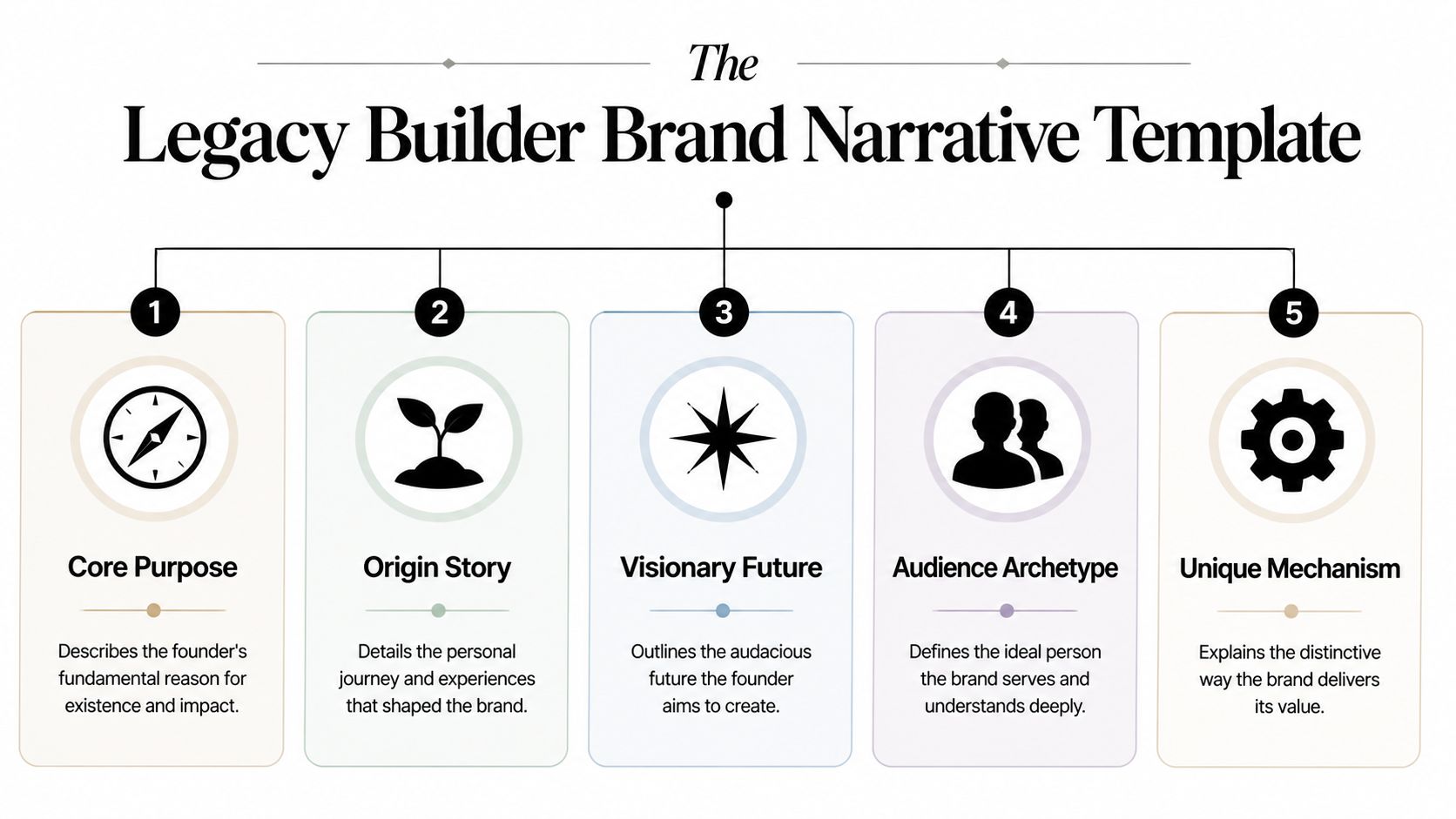
Use this as a working draft, not a polished bio.
Core purpose
I exist to help ___ do ___ so they can ___.
Origin story
I started caring about this because ___.
The moment that changed my perspective was ___.
Before I had a framework, I learned the hard way that ___.
Visionary future
I believe the future should look like ___.
The shift I want to help create is ___.
If this works at scale, people will no longer have to ___.
Audience archetype
I serve people who are currently ___.
They want ___.
They keep getting blocked by ___.
They are tired of ___.
The enemy
I stand against ___.
Not a competitor. A flawed belief, lazy practice, broken norm, or outdated system.
The cost of this problem is ___.
Your role as guide
My role is to help them see ___.
I bring credibility through ___.
I bring empathy because I've experienced ___.
The plan
The process I use is: ___, ___, ___, ___.
Proof points
I know this works because ___.
My evidence includes experience, observations, client patterns, operating principles, and clear examples.
Core values
I don't compromise on ___.
I refuse to build a brand around ___.
I want people to associate me with ___.
Signature message
In one sentence, what do you want people to repeat about you?
"___"
This isn't creative writing. Each section has a job.
Your brand narrative template should feel more like a strategic brief than a memoir.
A lot of founders write a decent narrative, then stall when they need to turn it into actual posts. That's why it's smart to pair your narrative work with practical publishing frameworks. If you want prompts that help translate strategy into recurring post formats, Mallary.ai's social content templates are useful because they push you toward output, not just introspection.
Keep the whole narrative short enough that you can explain it out loud without sounding rehearsed.
If it takes three minutes to explain who you help, what you fight, and how you create change, it's too long. The best brand narrative template doesn't trap you in a document. It sharpens your instinct. You should be able to use it in a podcast intro, a LinkedIn post, a DM, and a team briefing without rewriting your identity every time.
A template doesn't produce honesty. It only reveals whether you're willing to be specific.
Most founders stay vague because specificity feels risky. They say they value excellence instead of saying what behavior they reject. They describe their journey chronologically instead of naming the moment that changed them. They position themselves as the star instead of the person who helps others win.
Your origin story isn't your resume. It's the turning point that made your current belief inevitable.
Good prompts for this section:
Weak version: "I spent several years in leadership and developed a passion for helping teams grow."
Better version: "I watched talented people get overlooked because they couldn't communicate their value online. That changed how I think about visibility, credibility, and leadership."
The second one has tension. Tension creates content.
Most founders either avoid this section or misuse it. The enemy is not another brand. It's the bad assumption, broken habit, or industry norm that keeps your audience stuck.
For a founder, the enemy might be performative growth advice. For a leadership coach, it might be polished executive branding that says nothing. For a creator, it might be volume without substance.
A useful test is simple:
| Weak enemy | Strong enemy |
|---|---|
| My competitors | Shallow advice that rewards noise over clarity |
| The market | Corporate messaging that hides the human behind the expertise |
| Social media | Inconsistent publishing driven by guesswork |
Name the idea you are trying to replace. That's what gives your narrative force.
Here, most personal brands go off the rails.
The strongest founder narratives don't make the founder the center of gravity. They make the audience's transformation the point. The StoryBrand 7-Part Framework is useful here because it positions the brand as the Guide, not the Hero. In B2B contexts, that approach has been shown to produce 7x higher engagement rates, while making the brand the hero leads to 55% lower trust, according to this StoryBrand framework breakdown.
Ask yourself:
If your content keeps saying "I did this, I built this, I know this," you're forcing the audience to admire you. That's weaker than helping them see themselves more clearly.
For founders who also create short-form video, FlowShorts' video scripting guide is a practical companion because it helps turn your guide role into concise spoken content.
A quick visual helps if you're training yourself out of self-centered messaging:
"Integrity" is not a value until it changes what you do.
Write your values as standards with consequences:
Instead of: I value authenticity
Write: I don't publish opinions I don't hold just because they perform well.
Instead of: I value excellence
Write: I would rather post less often than publish generic advice that dilutes trust.
Instead of: I value impact
Write: I create content people can use in meetings, decisions, and conversations the same day they read it.
You don't need chest-beating claims. You need grounded proof.
Use proof like this:
That creates authority without turning your brand narrative template into a brag document.
The same structure can produce very different stories when it's done properly. That's the point. A good brand narrative template creates clarity without making everyone sound identical.
The founder serves operations leaders at growing software companies who are drowning in fragmented workflows and internal chaos. The origin story starts with years spent watching teams buy more tools while losing more clarity. The enemy is not inefficient employees. It's tool sprawl and leadership teams that mistake software adoption for operational design.
The founder's role is guide, not genius inventor. They help teams simplify systems, reduce friction, and make decisions faster. Their plan is straightforward: audit the workflow, remove duplication, rebuild handoffs, and train the team on one operating rhythm. The narrative feels sharp because the founder isn't selling software features first. They're fighting complexity.
This coach works with senior executives who are respected internally but invisible externally. The origin story isn't "I've always loved leadership." It's a more believable moment: seeing brilliant leaders lose opportunities because they communicated like risk managers instead of visionaries.
The enemy is executive blandness. The coach stands against polished corporate language that hides judgment, conviction, and perspective. Their audience wants authority without becoming self-promotional. The coach guides them through message development, thought leadership themes, and public communication habits that sound like a real person.
The best leadership narratives don't say "I help leaders lead." They identify the belief that keeps strong leaders silent.
This creator started as a generalist posting whatever came to mind. The audience grew slowly because nothing connected. The turning point came when they realized their most useful content always returned to one belief: creators don't need more hacks, they need a stronger body of work and a clearer point of view.
The enemy is trend-chasing. The creator now serves ambitious people who are tired of posting for algorithms without building authority. Their role is to help others create work that compounds, not just content that spikes. Their plan includes defining themes, documenting lessons, packaging ideas, and turning lived experience into repeatable assets.
These examples work because each narrative has friction, belief, and a visible change it wants to create. None of them sound like corporate copy. That's why people would follow them.
A narrative file sitting in Notion doesn't build authority. Publishing does.
The move that matters is turning your brand narrative template into messaging architecture. That means every part of the narrative becomes a recurring content lane. This approach matters because a structured narrative framework can accelerate team alignment by 40% and increase short-term sales lift by 15-25% by creating a clear problem-promise-proof-personality structure, according to Hamilton Sherwind's framework analysis.
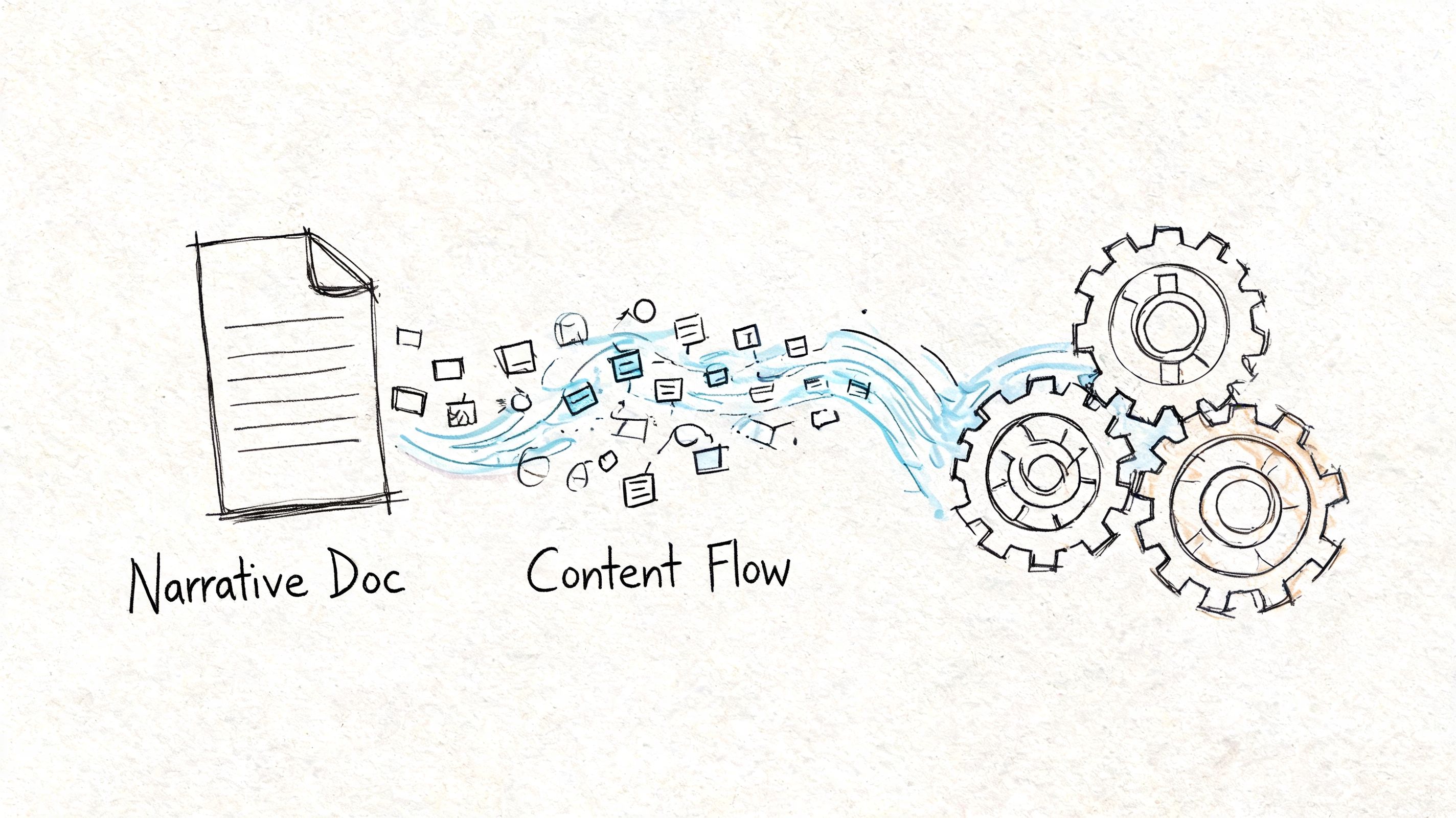
Don't invent content categories from scratch. Pull them directly from your narrative.
This is how consistent brands stay consistent. They don't guess. They rotate.
You don't need a complex calendar. You need categories that keep your message balanced.
| Day | Content focus | Example angle |
|---|---|---|
| Monday | Enemy | A common industry belief that's hurting smart people |
| Tuesday | Guide | A step from your process, broken down simply |
| Wednesday | Origin | A lesson from your own experience that shaped your method |
| Thursday | Hero | A post that names what your audience is feeling but not saying |
| Friday | Vision or values | The future you're building or the standard you refuse to lower |
That structure stops two common problems. First, sounding repetitive. Second, becoming a one-note educator with no larger narrative.
Operator's note: If a post idea doesn't connect to your enemy, your guide role, your audience, your values, or your vision, skip it.
Founders with teams need one shared reference. Founders working solo need it too.
Create a simple working doc with these fields:
That document becomes the filter for drafts, interviews, profile updates, podcast talking points, and social posts. If you want a practical way to organize the publishing side, this content calendar template for social media helps translate your narrative into a sustainable schedule.
You should be able to answer these questions fast:
If you can't answer those, the problem usually isn't discipline. It's that the narrative is still too abstract.
Most profiles are a wasted asset. They list credentials, stack vague claims, and bury the actual reason someone should care.
Your profiles should express the same narrative logic as your content. Your headline should state who you help and what shift you create. Your About section should establish your origin, your enemy, and your role as guide. Your bio should be short enough to understand in seconds and distinct enough that people remember it later.
A practical benchmark is this: if someone lands on your LinkedIn or X profile after seeing one post, they should immediately understand your point of view. If they can't, your profile is forcing them to work too hard. This guide for crafting powerful digital brands is useful if you're tightening the profile layer after the narrative itself is done.
Use your narrative in smaller places too:
If your voice still feels inconsistent, refine that before optimizing anything else. This guide on how to find your brand voice is the right next move.
If you want help turning your story into consistent, high-quality content that sounds like you, Legacy Builder does exactly that. They help founders, CEOs, and professionals turn lived experience, clear positioning, and strong ideas into daily content, optimized profiles, and a personal brand people remember.


You could – but most in-house teams struggle with the nuance of growing on specific platforms.
We partner with in-house teams all the time to help them grow on X, LI, and Email.
Consider us the special forces unit you call in to get the job done without anyone knowing (for a fraction of what you would pay).
Short answer – yes.
Long answer – yes because of our process.
We start with an in-depth interview that gives us the opportunity to learn more about you, your stories, and your vision.
We take that and craft your content then we ship it to you. You are then able to give us the final sign-off (and any adjustments to nail it 100%) before we schedule for posting.
No problem.
We have helped clients for years or for just a season.
All the content we create is yours and yours alone.
If you want to take it over or work on transitioning we will help ensure you are set up for success.
We want this to be a living breathing brand. We will give you best practices for posting and make sure you are set up to win – so post away.
Subscribe to our newsletter and get insights on how to grow your personal brand.
