.svg)
Subscribe to our newsletter and get insights on how to grow your personal brand.
Thank you! Your submission has been received!
Oops! Something went wrong while submitting the form.
.svg)


Your online presence probably doesn't match how you see yourself.
That's the problem.
You've grown. Your work has changed. Your expertise is sharper than it was two years ago. But search results, old bios, forgotten profiles, random directory listings, stale headshots, and half-finished social accounts are still introducing you to people before you ever get a chance to speak.
If you're a founder, executive, creator, consultant, or ambitious professional, you can't afford that gap. People vet you before they reply, before they book, before they buy, before they refer. If what they find is messy, outdated, or thin, they fill in the blanks themselves. They rarely fill them in your favor.
Learning how to check your online presence isn't a vanity exercise. It's brand control. It's risk management. It's reputation strategy. And now, because AI search and data brokers pull information from places not commonly thought of for inspection, a basic Google search isn't enough.
People decide fast. Brutally fast.
One compilation cited by Hedera's online presence statistics roundup says users form an opinion about a website in 0.05 seconds, 76% of consumers research a company online before visiting, and 88% won't return after a bad experience. That same source also reports 57% won't recommend a business with a poorly designed website, 67% are more likely to purchase if a site is mobile-friendly, and 61% leave if they don't find what they want within about five seconds.
That should end the debate.
If someone checks you out online and finds a weak website, an inactive LinkedIn profile, clashing bios, old media, or irrelevant results, they don't think, “This person is probably excellent but just busy.” They think you're less established, less current, or less credible than someone who presents clearly.
A lot of smart professionals make the same lazy mistake. They assume that because they're competent offline, their online presence will somehow take care of itself.
It won't.
Search engines, social platforms, review pages, podcast appearances, old interviews, staff bios, event pages, and scraped data listings create a public identity whether you manage it or not. If you don't shape it, the internet does.
Practical rule: If a stranger can form a conclusion about you before you speak to them, that conclusion deserves active management.
This isn't about looking polished for applause. It's about removing friction from trust.
A prospect may be ready to hire you, but hesitate because your site looks abandoned. A podcast host may skip inviting you because your expertise isn't obvious online. A potential partner may move on because your search results are cluttered with low-value noise instead of clear proof of authority.
The professionals who win more opportunities usually aren't just better. They're easier to understand, easier to verify, and easier to trust online.
That's why checking your online presence needs to become a recurring discipline, not a one-time cleanup.
A client, recruiter, or podcast host hears your name, opens Google, and makes a decision before you ever speak. That search is not a formality. It is your visible reputation under pressure.
Start there, but do it properly. A lazy vanity search tells you almost nothing. You need to see what a stranger sees, what AI systems summarize, and what third-party sites have attached to your name without your permission.
Use a private browser window first. Personalized search results distort reality. Search on desktop and mobile if you can, because the layout changes what gets attention first.
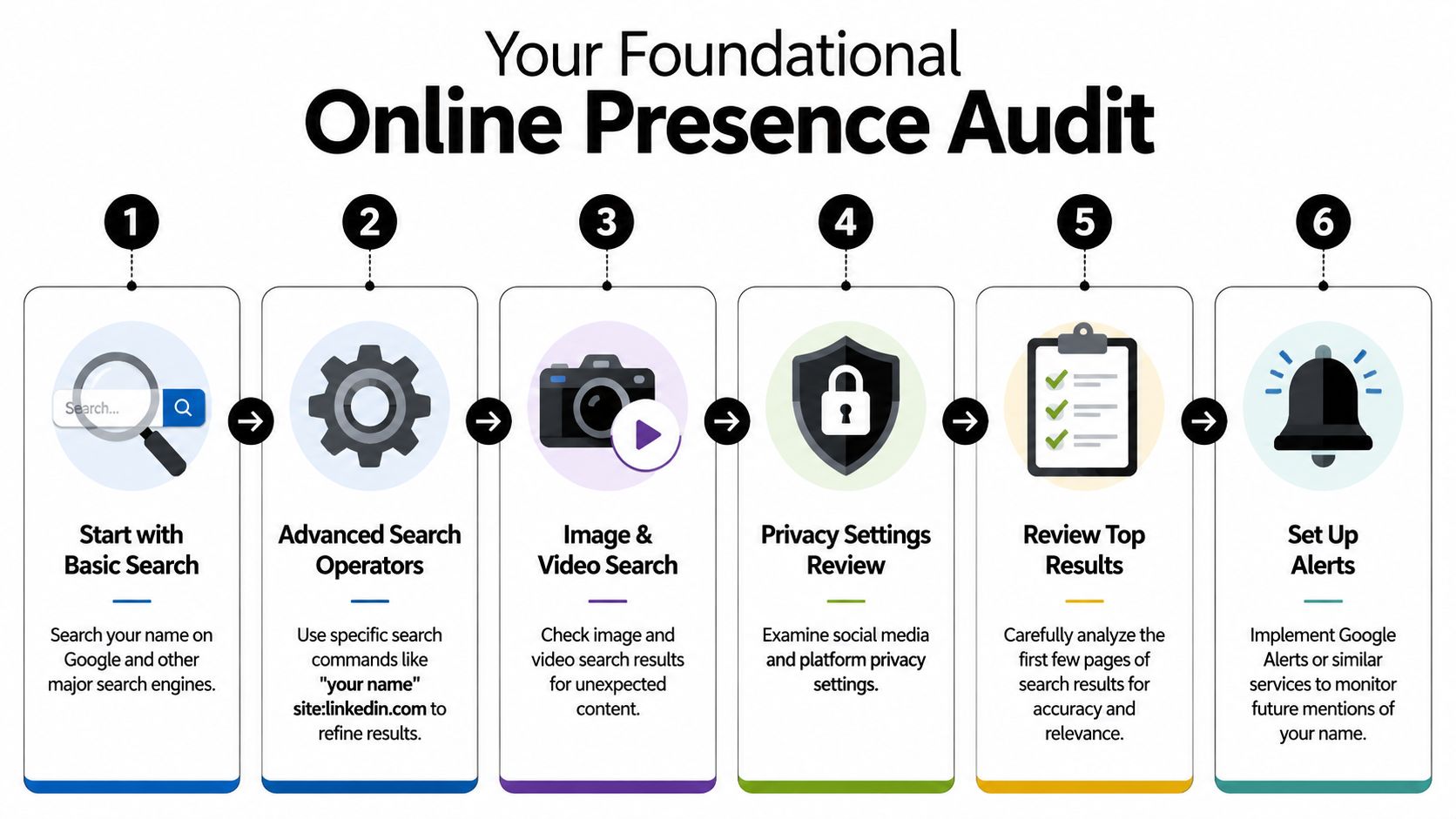
One search for your name is not an audit. It is a glance.
Run these searches and review at least the first two pages of results:
Your full name
Use the exact version people know you by.
Your name plus your role
Add terms like founder, consultant, attorney, physician, keynote speaker, author, investor, or your actual specialty.
Your name plus company
This surfaces staff bios, press mentions, directory listings, and old affiliations.
Your name plus city or region
Do this if you work locally or share a common name.
Your name in quotes
This helps isolate exact-match mentions.
Your name plus risk terms
Search combinations with words like review, complaint, lawsuit, scam, controversy, fired, and whatever else a skeptical buyer might type.
Platform-specific searches
Check your name with LinkedIn, X, YouTube, Substack, Medium, podcast, interview, Reddit, and industry directories.
If your visibility problems are tied to crawl issues, weak indexing, or poor machine-readable structure, review this guide on auditing technical SEO and AI visibility. It is useful when your search presence is thin even though you have published enough material to rank.
Google is still the starting point. It is no longer the full picture.
Look at featured snippets, People Also Ask boxes, knowledge panels, image results, video results, and autocomplete suggestions. Then test AI-powered search tools and answer engines that summarize names, companies, and expertise. If those systems describe you inaccurately, they can spread a distorted version of your professional identity faster than a stale bio ever could.
Pay attention to what appears in the first screen view. That is the part busy people judge. A strong LinkedIn profile, a credible website, recent media, and a clean brand message help. Random directories, broken pages, old conference listings, and irrelevant personal accounts hurt.
Do not trust your memory. Screenshots and notes beat vague impressions every time.
Use a simple sheet like this:
| Search Query | Result Type | Position | Positive or Negative | Action Needed |
|---|---|---|---|---|
| Your full name | LinkedIn profile | 1 | Positive | Update headline |
| Your name + company | Old staff bio | 3 | Mixed | Request revision |
| Your name in quotes | Guest podcast page | 5 | Positive | Share more |
A baseline matters because reputation work fails when people guess. You need a record of what ranks, what misrepresents you, and what deserves to be pushed higher.
Do not start editing after the first bad result. Examine the whole picture.
Look for outdated authority signals, weak search coverage, inconsistent positioning, high-ranking third-party pages you do not control, and broken links tied to your name. Also note whether the search results support one clear professional story. If one page presents you as an executive, another as a freelancer, and a third as a hobbyist, trust drops fast.
This is also where personal branding and reputation management overlap. Search results should reinforce a clear narrative, not scatter attention across disconnected identities. If you need a stronger framework for that, read this guide to online reputation management for building a powerful brand.
Use this video if you want a quick visual walkthrough before you begin.
Search results keep score for a long time. Audit them with the discipline you would bring to a board meeting or a client pitch.
Search results tell you what the internet says about you. Your owned platforms tell you whether you've done your job.
Professionals often sabotage themselves. Their LinkedIn looks serious. Their website looks abandoned. Their X account sounds like a different person. Their Instagram is either private, chaotic, or confusing. Their headshots don't match. Their bios compete with each other instead of reinforcing one identity.
That creates friction. Trust hates friction.

Go through every profile you control. LinkedIn, personal site, company bio, X, Instagram, YouTube, podcast pages, author pages, newsletter profiles, community bios, speaker pages. Anything public counts.
Ask each platform the same hard questions:
Does this reflect who I am now
If your title, positioning, or expertise has evolved, old language needs to go.
Does this look active and intentional
Silence isn't always bad. Neglect is.
Would a high-value stranger understand what I do within seconds
If not, the profile is failing.
Does the visual identity match across platforms
Headshot, colors, tone, and message should feel related, not random.
Does the content support the claim
If you say you're a thought leader but your recent posts say nothing useful, people notice.
A lot of people want to jump straight into creating more content. That's backward.
Consistency comes first. If your LinkedIn says you help B2B founders clarify messaging, your website shouldn't describe you as a general marketing professional. If your company bio makes you sound corporate, but your social feed is full of off-brand commentary, you're forcing people to reconcile two identities.
Read your profiles back to back. Open them side by side and compare:
| Element | What to Check |
|---|---|
| Headline | Is your role clear and current? |
| Bio | Does it match your actual focus? |
| Headshot | Does it look current and professional? |
| Featured links | Do they lead somewhere useful? |
| Recent content | Does it prove your expertise? |
If your work spans several channels, studying approaches to Taja AI multi-channel solutions can help you think more clearly about cross-platform management. The point isn't to be everywhere. The point is to stop sounding fragmented.
Not every profile deserves to stay public.
Old side projects, half-built creator pages, empty social accounts, bios from jobs you left years ago, and random platform signups all create noise. If they don't strengthen your professional reputation, update them, archive them, or delete them.
Your online presence should feel like one person with range, not five people fighting over the same name.
This is also where brand consistency matters more than people admit. If you want a sharper framework for that, read what brand consistency is and why it builds unshakable trust. Most credibility problems online aren't caused by a lack of talent. They're caused by mixed signals.
A strong audit doesn't ask, “Do I have content?” It asks, “Does every public asset support the reputation I want to own?”
If your entire strategy for how to check your online presence is “I Googled myself,” you're already behind.
Google shows part of the picture. Sometimes the cleanest-looking public profile sits on top of a messy data trail underneath. That trail can include old usernames, exposed email addresses, phone numbers, stale directory entries, breach records, scraped profiles, and brokered personal information that doesn't rank prominently in normal search.
That's the modern problem. Your reputation isn't shaped only by what's obvious.

According to Reputation X's digital footprint guidance, modern tools now scan usernames, emails, and phone numbers across 500+ public platforms, data brokers, and breach databases. That matters because a person's visible footprint is increasingly fragmented across places a normal search may miss, especially when AI-powered discovery and brokered data create identity trails beyond social profiles.
That single point changes the whole audit process.
A founder might think their digital presence is clean because page one looks fine. Meanwhile, a personal email is tied to forgotten accounts, an old username connects to off-brand forum activity, and a data broker profile exposes details that make impersonation or unwanted contact easier. None of that is theoretical. It's common.
Search your:
Use dedicated discovery tools when needed. Even a handle checker like Handles by Kare Social can help you map where usernames appear across platforms. It won't solve everything, but it can quickly surface naming exposure and inconsistencies.
Don't turn this into paranoia. Turn it into triage.
Here's the order I recommend:
Exposure that affects safety or impersonation
Public personal contact details, reused usernames tied to sensitive accounts, or compromised account traces.
Exposure that damages professional perception
Off-brand old accounts, inflammatory old content, irrelevant public profiles.
Exposure that creates confusion
Duplicate bios, inactive creator pages, conflicting portfolio descriptions.
Exposure that's merely messy
Low-value clutter you can address later.
Most reputation issues don't begin with scandal. They begin with scattered information that nobody bothered to clean up.
This hidden layer matters more for visible professionals. Founders, executives, speakers, and creators tend to leave more trails because they appear in more places. That means your audit can't stop at the surface. You need to inspect the data that follows your name even when you didn't publish it intentionally.
A weak audit creates false confidence. You looked yourself up, spotted a few issues, and then did nothing. Meanwhile, recruiters, clients, conference organizers, and AI search tools keep pulling from outdated profiles, stale bios, and third-party pages you forgot existed.
Turn the audit into a working plan. Split it into two buckets. Fix what people see now, then set up a system to catch new problems before they shape your reputation for you.
Handle the edits that improve clarity, trust, and discoverability right away.
| Area of Focus | Action Item | Priority Level |
|---|---|---|
| Search results | Review your top branded results and flag anything inaccurate, outdated, or off-brand | High |
| Rewrite your headline and About section, update your headshot, and clean up featured links | High | |
| Personal website | Tighten your homepage message, bio, and contact path | High |
| Social profiles | Match bios, profile photos, titles, and positioning across platforms | High |
| Old accounts | Archive, privatize, or delete abandoned profiles | Medium |
| Third-party bios | Request updates on old speaker pages, podcast bios, author pages, and company listings | Medium |
| Alerts | Set up monitoring for your name, company, and branded terms | High |
| Metrics | Track visibility and response trends each month | Medium |
Do the visible work first. A polished LinkedIn profile and a clear website usually do more for your professional reputation than obsessing over minor clutter buried on page six of search results.
One cleanup session is not enough. Your online presence changes every time you publish, switch roles, get mentioned, appear on a podcast, or get indexed by a new AI search product.
Use a schedule that is simple enough to keep:
Your reputation is no longer shaped only by what ranks in Google. Data aggregators, scraped bios, and AI answer engines can surface old information long after you changed it. If you are not checking those patterns regularly, you are letting stale data define you.
Vanity metrics waste time. Track signals that help you decide what to fix, publish, or update next.
Focus on questions like these:
If LinkedIn is a primary discovery channel for your work, review this guide on increasing LinkedIn profile views with stronger profile positioning. Use it to improve what happens after the audit, not just to chase attention.
You do not need a complicated dashboard. You need a short list of indicators you will indeed review and act on every month.
One practical option for professionals who do not want to manage this alone is Legacy Builder, which helps individuals turn their stories, insights, and vision into consistent content and profile optimization. That is useful when the underlying problem is not just cleanup. It is a lack of structure, consistency, and follow-through.
Treat your online presence like a reputation system. Maintain it, measure it, and improve it on purpose.
A clean online presence is the baseline. It's not the finish line.
Once you remove the obvious problems, you need to replace randomness with intention. That means publishing ideas that support your reputation. It means making your expertise easier to discover. It means ensuring the version of you people find online is the version you want associated with your work.
Entrepreneurs should treat their online presence as part trust layer, part business development engine. Leaders should use it to make their thinking visible, not just their job title. Creators should build around recognizable themes so people know what they'll get from following them.
This is the key shift. You stop asking, “How do I clean this up?” and start asking, “What do I want to be known for?”
Build a body of proof, not just a polished profile.
That proof can look different depending on your goals. It might be thoughtful LinkedIn posts, a stronger founder bio, a sharper website, a clear media page, better search results, a more disciplined content archive, or public commentary that reflects what you believe and know.
Your digital footprint is what the internet collects. Your legacy is what you build on purpose.
If you're done guessing and want a team to help shape a more intentional online brand, Legacy Builder works with professionals to turn their ideas, story, and expertise into consistent content and a clearer public presence.


You could – but most in-house teams struggle with the nuance of growing on specific platforms.
We partner with in-house teams all the time to help them grow on X, LI, and Email.
Consider us the special forces unit you call in to get the job done without anyone knowing (for a fraction of what you would pay).
Short answer – yes.
Long answer – yes because of our process.
We start with an in-depth interview that gives us the opportunity to learn more about you, your stories, and your vision.
We take that and craft your content then we ship it to you. You are then able to give us the final sign-off (and any adjustments to nail it 100%) before we schedule for posting.
No problem.
We have helped clients for years or for just a season.
All the content we create is yours and yours alone.
If you want to take it over or work on transitioning we will help ensure you are set up for success.
We want this to be a living breathing brand. We will give you best practices for posting and make sure you are set up to win – so post away.
Subscribe to our newsletter and get insights on how to grow your personal brand.
