.svg)
Subscribe to our newsletter and get insights on how to grow your personal brand.
Thank you! Your submission has been received!
Oops! Something went wrong while submitting the form.
.svg)


The most common advice about Instagram for professionals is still wrong. It tells serious operators to make the grid look polished, post inspirational quotes, and hope consistency turns into authority.
That approach usually produces a clean profile and weak business results.
Instagram isn't just a visual platform for lifestyle brands. It's a place where founders, consultants, executives, and service-based experts can earn trust in public. That matters because trust is what drives profile visits, DMs, referrals, podcast invites, speaking opportunities, and client conversations. If your work depends on credibility, Instagram can support the business. But only if you treat it like a professional positioning channel, not a scrapbook.
A lot of professionals still dismiss Instagram because they assume serious buyers live elsewhere. That's outdated thinking.
Instagram reached 3 billion monthly active users globally as of late 2025, and 60% of U.S. adults earning over $100,000 use the platform, according to Sprout Social's Instagram stats roundup. That changes the conversation. You're not posting into a lightweight consumer app. You're showing up where affluent decision-makers, operators, and future clients already spend time.
For founders, this matters for a simple reason. People rarely trust a business solely because of a website anymore. They check the founder. They check the company page. They look for signs of real expertise, clear thinking, and proof that an actual person stands behind the offer.
The mistake isn't usually absence. It's passivity.
Professionals create an account, upload a logo, post a few company updates, and disappear. That doesn't build authority. It tells the market you know you should be present but haven't decided what you want to be known for.
Instagram works better when you use it as a visible layer of your reputation. That means your content should answer questions like:
Instagram isn't replacing your website. It's giving buyers a faster way to evaluate your judgment.
If you also plan to support organic authority with paid distribution, a strong overview of campaign structure lives in this full-funnel Meta ads guide. It's useful when you want Instagram content and paid acquisition to reinforce each other instead of operating as separate systems.
Instagram for professionals works best when the goal isn't vanity. The goal is market perception.
You want the right people to think, “This person knows their craft, communicates clearly, and looks credible enough to trust.” That's a much better benchmark than follower count.
Most weak professional accounts don't fail because the owner lacks expertise. They fail because the profile doesn't translate that expertise fast enough.
A visitor gives you seconds. Your profile has to reduce confusion immediately.
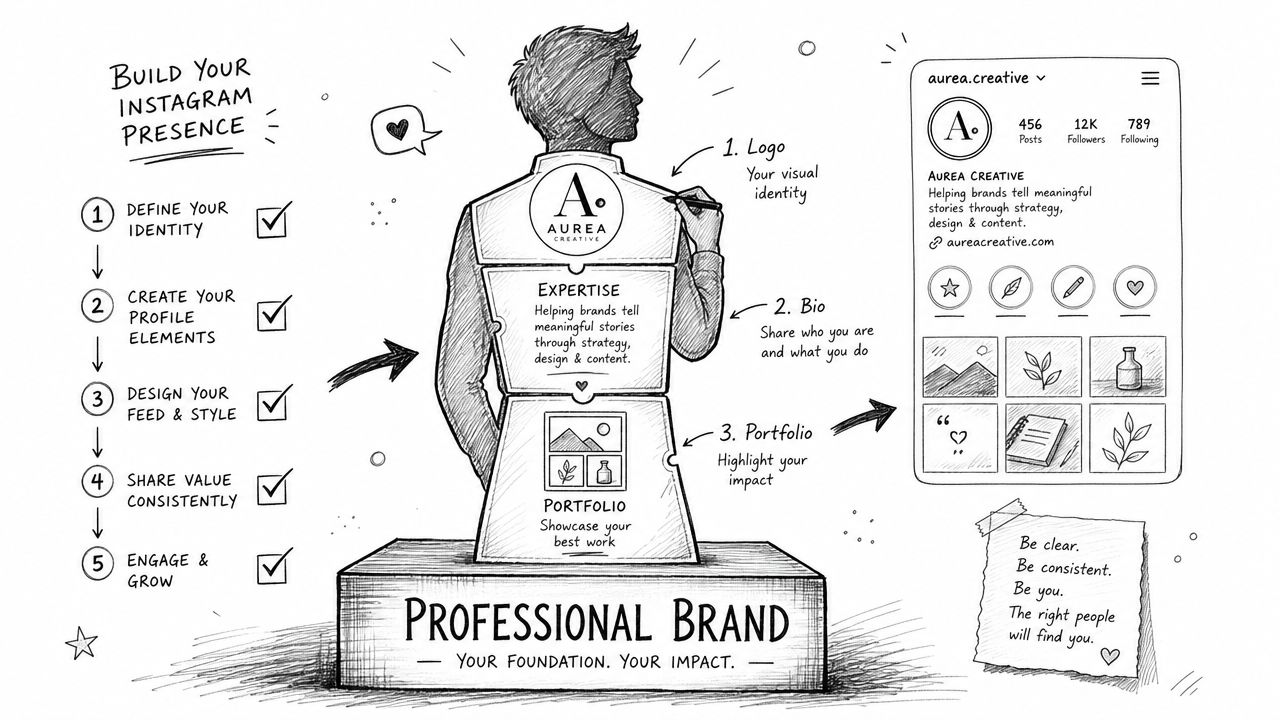
Use a real headshot unless your personal brand is secondary to a media brand. For service professionals, hiding behind a logo is usually a mistake. Buyers want to know who they're dealing with.
Your username should be simple, searchable, and close to your real name or known brand. If people hear your name on a podcast or from a referral, they should be able to find you without guessing. Your profile name should also include what you do, not just who you are. That helps both search and clarity.
A good profile name doesn't try to be clever. It helps the right person identify you fast.
The bio should tell a visitor three things:
Weak bios list job titles. Strong bios communicate relevance.
Compare the difference:
| Approach | Example |
|---|---|
| Vague | Founder. Speaker. Building cool things. |
| Clear | I help B2B founders clarify positioning and turn expertise into content that drives inbound demand. |
The second version gives a prospect something to hold onto. They can tell whether they fit.
Too many professionals send people to a generic homepage. That creates friction.
Send traffic to the next logical action. That could be a booking page, a lead magnet, a case-study hub, a newsletter signup, or a page explaining your offer in plain language. The link should match the kind of attention your content earns.
If most of your content educates, send people to a deeper resource. If your content attracts warm prospects, send them to a page that makes starting a conversation easy.
For a broader view of how personal brand foundations fit into a larger growth plan, this guide on building your personal brand on social media in 2026 is worth reading.
Story Highlights are underrated. They let professionals answer trust questions before a DM ever happens.
Useful Highlight categories include:
Practical rule: Your profile should make sense to someone who has never heard of you before.
A strong profile doesn't close the deal. It earns the next click.
Professionals usually don't struggle because they have nothing to say. They struggle because they haven't organized what they know into repeatable categories.
That's why content pillars matter. They stop you from posting randomly and help your audience understand what you're known for over time.
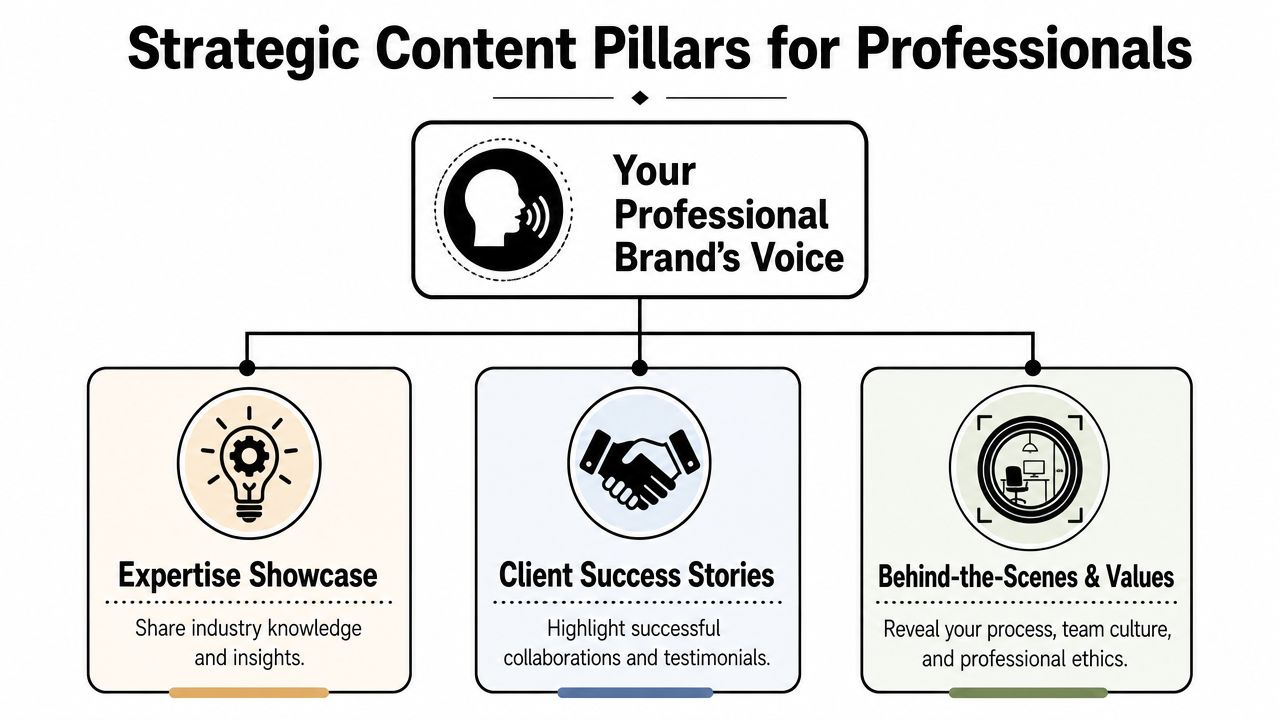
A practical setup usually includes three to five recurring themes. For most founders and experts, these are enough:
Teach what you know in plain language. Break down mistakes, frameworks, decisions, and industry shifts. Doing so proves your depth.
If you're a CFO consultant, explain cash flow decisions founders misunderstand. If you're a SaaS operator, show how you prioritize growth channels when resources are limited. If you're an attorney, clarify the consequences of common contract errors without sounding like a textbook.
Show evidence of applied expertise without violating privacy.
That's where many professionals freeze. They think proof requires public client details. It doesn't. As noted in this video on trust-building Instagram content for professionals, posts by professionals such as tax preparers work better when they share anonymized wins and founder stories instead of polished stock imagery. The key is earning trust without exposing client data.
That insight is bigger than one niche. Service buyers want to see that you've solved real problems before.
Share your standards, operating principles, and point of view. This is how people decide whether they align with you.
Your perspective can include what you refuse to do, what you think your industry gets wrong, why your process looks different, or what shaped your current philosophy.
A simple weekly mix could include:
If you want a useful companion framework for planning these categories, this quso.ai blog on content strategy gives a solid structure.
Not every professional post builds authority.
Avoid content that signals activity but not substance:
The best professional content doesn't try to impress strangers. It helps the right people recognize depth.
Good pillars make content creation easier because they remove the daily question of what to post. You're no longer inventing from scratch. You're selecting from categories that already support your authority.
The format matters because buyers don't consume every idea the same way. Some content needs reach. Some needs depth. Some needs intimacy.
If you treat every post format as interchangeable, you'll work harder than necessary.

If you want new people to find you, prioritize Reels. They account for roughly 46% of the total time users spend on Instagram, and the average engagement rate for a Reel was 2.8%, compared with the platform's overall average post engagement rate of 0.50%, according to Hootsuite's Instagram statistics roundup.
That doesn't mean every professional needs to dance, perform, or chase trends. It means short video is where attention lives.
For professionals, strong Reels often look like this:
If you need practical creation ideas, this Instagram Reels marketing strategy is a useful operational resource.
Here's a practical video example to study:
Carousels usually won't generate discovery the same way Reels can, but they're excellent for teaching. They let you structure a nuanced point without compressing everything into a short video.
Use carousels when you need sequence:
| Best use case | Why it fits |
|---|---|
| Breaking down a framework | Multiple slides create logical flow |
| Explaining a mistake | You can move from symptom to fix |
| Sharing a founder lesson | Narrative lands better in steps |
| Clarifying a decision | Each slide can handle one trade-off |
A good carousel should feel like a mini consulting session. If the first slide promises something useful, the rest should deliver cleanly.
Stories are where professionals become real. This is the place for in-progress thoughts, daily observations, quick answers, office clips, meeting prep, event takeaways, screenshots of wins, and low-production commentary.
Stories work because they lower the distance between expertise and personhood. Buyers don't just want competence. They want a sense of how you think and how you operate.
Most professionals fail because they choose a schedule they can't sustain.
A workable rhythm is better than an ambitious one you abandon. A simple content calendar often beats a complicated publishing system, especially if your business already demands your attention. This guide on how to create a content calendar that actually works is helpful if you need a planning process that doesn't become a second full-time job.
Try a cadence like this:
Field note: Consistency matters more than intensity. Buyers trust the professional who keeps showing up with clear thinking.
Cadence should match capacity. If you can only sustain two strong pieces a week, start there. The point isn't maximum output. It's reliable presence tied to useful ideas.
Posting alone is defensive. It waits.
Professionals who grow fastest on Instagram use offense. They don't just publish and hope the right people arrive. They actively place themselves inside the conversations that matter.
Think in terms of relationships, not impressions.
Create a list of people you want to be visible to. That might include potential clients, strategic partners, podcast hosts, journalists, peers in adjacent industries, local business leaders, or founders you respect. Some people call this a Dream 100 list. The label matters less than the discipline.
Then engage with intention:
This is networking in public view. Done well, it creates warm recognition before you ever pitch, DM, or meet.
Trend-chasing is crowded and often shallow. Professionals usually get better results by finding smaller conversations where their expertise is unusually relevant.
An emerging shift on Instagram points toward underserved space. As described in this Instagram Reel on niche positioning and underserved conversations, the stronger skill is finding spaces where no one is actively searching, which creates room for organic authority building.
That's a sharp insight for professionals because the best opportunities often sit between categories.
A few examples:
Not all engagement is equal.
Here's the difference:
| Weak engagement | Strategic engagement |
|---|---|
| Commenting everywhere for visibility | Showing up where ideal buyers and peers already gather |
| Chasing trend threads | Owning a niche conversation |
| Sending cold DMs with offers | Building familiarity before outreach |
| Reacting to everyone equally | Prioritizing aligned accounts |
Stop trying to be known by everyone in your category. Be remembered by the people who can open doors.
Professionals often underestimate how many opportunities start as repeated low-friction interactions. A few comments turn into profile visits. A few Story replies turn into DMs. A few DMs turn into referrals, partnerships, or serious inquiries.
That's why engagement isn't optional. It's part of the distribution strategy.
Most professionals either ignore analytics or obsess over the wrong numbers.
The job isn't to watch vanity metrics all day. The job is to read signals and make better decisions. Instagram gives you enough native data to do that if you use it properly.

Instagram Insights is available on Professional accounts. According to Improvado's guide to the Instagram analytics dashboard, it provides built-in access to reach, impressions, engagement, audience demographics, and related performance data for the past 7 to 90 days across posts, Stories, Reels, and Live content.
If you're still on a personal account, switch. You need the data.
Once Insights is active, review performance at two levels:
The first tells you what happened. The second tells you what to repeat.
A professional account doesn't need perfect numbers. It needs useful interpretation.
Focus on what each metric suggests:
A post with modest likes but strong saves and profile visits may be more valuable than one that gets surface-level applause. Professionals should care less about public affirmation and more about buyer intent.
Native Insights are only part of the picture. The real question is whether your content leads to conversations and opportunities.
Track business-facing indicators such as:
If you want a broader framework for connecting social activity to outcomes, this guide on how to measure social media ROI for your personal brand gives a practical lens.
Use a recurring review rhythm and ask:
Then adjust.
Data should change your next move. If it doesn't, you're collecting numbers, not learning.
One caution matters here. Don't confuse audience growth with business traction. A professional brand can be performing well even when the account looks modest from the outside. If the right people are watching, replying, and reaching out, the system is working.
The professionals who win on Instagram usually aren't the ones with the most free time. They're the ones who build a repeatable workflow.
That means reducing reinvention.
A single strong insight can become several pieces of content. If you solved a meaningful client problem, you don't need to mention it once and move on. You can adapt it across formats.
For example, one anonymized client lesson can become:
This is how professionals stay visible without spending every day inventing fresh ideas.
Burnout usually comes from two bad habits. Trying to post in every format, and trying to say everything at once.
You don't need to cover your entire industry. You need to own a defined set of conversations. Repeat your best themes. Refine your strongest formats. Keep showing the market what you want to be remembered for.
A good professional Instagram presence should feel cumulative. Each month adds evidence. Each post strengthens positioning. Each interaction makes the account more useful as a trust asset.
Instagram for professionals works best when you stop treating content like a campaign and start treating it like reputation infrastructure.
The account becomes a living record of how you think, what you solve, and how consistently you show up. That's valuable even when individual posts underperform. Buyers, partners, and collaborators rarely judge you by one post. They judge the body of work.
Stay clear. Stay specific. Stay human. That combination compounds.
If you want help turning your expertise into a consistent Instagram presence without sounding generic or overproduced, Legacy Builder helps professionals shape authentic personal brands through strategy, content creation, profile optimization, and ongoing brand growth support.


You could – but most in-house teams struggle with the nuance of growing on specific platforms.
We partner with in-house teams all the time to help them grow on X, LI, and Email.
Consider us the special forces unit you call in to get the job done without anyone knowing (for a fraction of what you would pay).
Short answer – yes.
Long answer – yes because of our process.
We start with an in-depth interview that gives us the opportunity to learn more about you, your stories, and your vision.
We take that and craft your content then we ship it to you. You are then able to give us the final sign-off (and any adjustments to nail it 100%) before we schedule for posting.
No problem.
We have helped clients for years or for just a season.
All the content we create is yours and yours alone.
If you want to take it over or work on transitioning we will help ensure you are set up for success.
We want this to be a living breathing brand. We will give you best practices for posting and make sure you are set up to win – so post away.
Subscribe to our newsletter and get insights on how to grow your personal brand.
