.svg)
Subscribe to our newsletter and get insights on how to grow your personal brand.
Thank you! Your submission has been received!
Oops! Something went wrong while submitting the form.
.svg)


Before you even think about outreach, let's get one thing straight: you need a powerful speaker brand.
This isn't just marketing fluff. It's the foundation that makes event organizers seek you out instead of you chasing them. It starts by defining your expertise, carving out your message, and developing a few signature talks that make you the obvious choice.
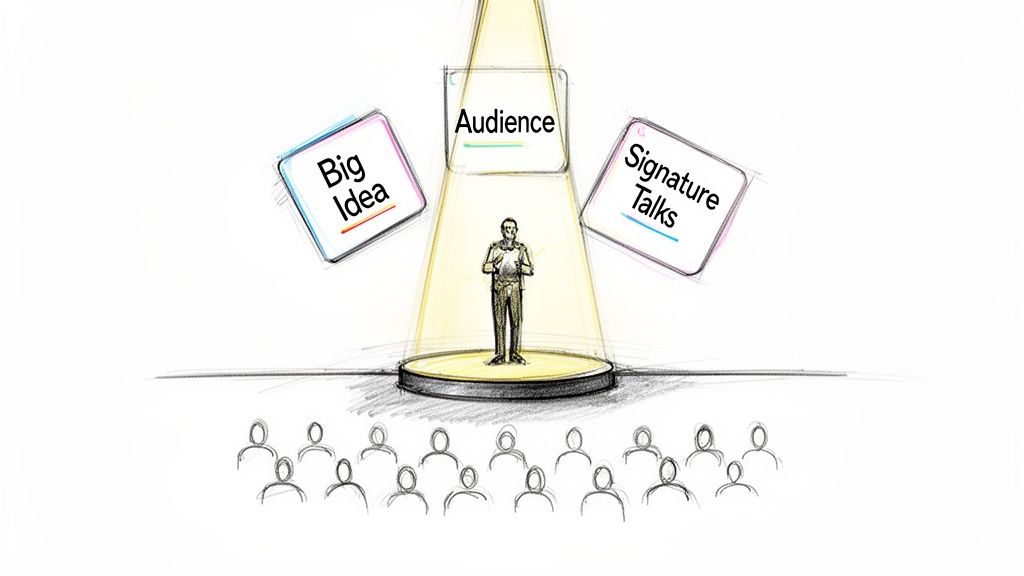
Before anyone books you, they have one simple question: "Who are you, and why should my audience care?" A strong speaker brand answers that question before they even have to ask.
Forget trying to be everything to everyone. That's a surefire way to get lost in the noise. The real money and impact are in becoming the go-to expert on a very specific topic. Think laser-focused, not a wide net.
Your niche is where your passion, expertise, and your audience's problems collide. What could you talk about for hours without a script? What unique experience do you have that nobody else does? Most importantly, what specific problem can you solve for a specific group of people?
To nail this down, ask yourself:
Getting clear on this is the first step in building your personal brand as a speaker. If you're struggling to connect the dots, we've got a whole playbook on how to develop your personal brand provides a proven plan to stand out online.
This isn't just a suggestion; it's a requirement in today's market. An analysis of over 10,000 speaking engagements showed that speakers with highly specialized topics saw much higher demand and booking rates.
Once your niche is crystal clear, you need to package that expertise into a handful of "signature talks." I'm talking 2-3 core presentations that you become known for. Don't try to create a dozen topics—master a few.
Each talk should hit a specific pain point for your audience and deliver actionable, no-fluff takeaways. This makes it dead simple for an event planner to see exactly how you solve a problem for their attendees.
Key Takeaway: Event organizers don't book speakers; they book solutions. Your signature talks are your products. Make them irresistible.
When I first started, I didn't just say I talked about "marketing." That's way too broad. Instead, I developed three very specific talks:
See the difference? That specificity changed my outreach from a weak "Can I speak at your event?" to a confident "I see your event serves startup founders. My talk on community building is a perfect solution for the challenges they're facing."
Before you start hunting for gigs, make sure your foundation is solid.
Here are the essential components to develop before you start seeking speaking opportunities.
| Component | Description | Why It Matters |
|---|---|---|
| Clear Niche | The specific topic you are an expert in. | Positions you as a specialist, not a generalist, making you easier to find and book. |
| Ideal Audience Profile | A detailed picture of who you serve. | Helps you tailor your message and find the right events. |
| Signature Talks (2-3) | Your core, repeatable presentations. | Gives event planners a clear "product" to buy that solves their audience's problems. |
| Professional Headshot | A high-quality, professional photo. | Your first impression. It conveys professionalism and brand alignment. |
| Compelling Bio | A short, impactful summary of who you are and what you do. | Hooks the reader and quickly establishes your credibility and relevance. |
Nailing these fundamentals is non-negotiable. This is the work that gets you noticed and, ultimately, gets you on stage.
For a complete playbook on the entire process, this guide on how to get speaking gigs is an incredible resource.
Alright, let's talk about packaging yourself. You've nailed down your brand and figured out your signature talks. Now what? You need to build a professional speaker marketing kit.
This isn't some vanity project. It’s about making an event organizer's job so easy that booking you is a no-brainer.
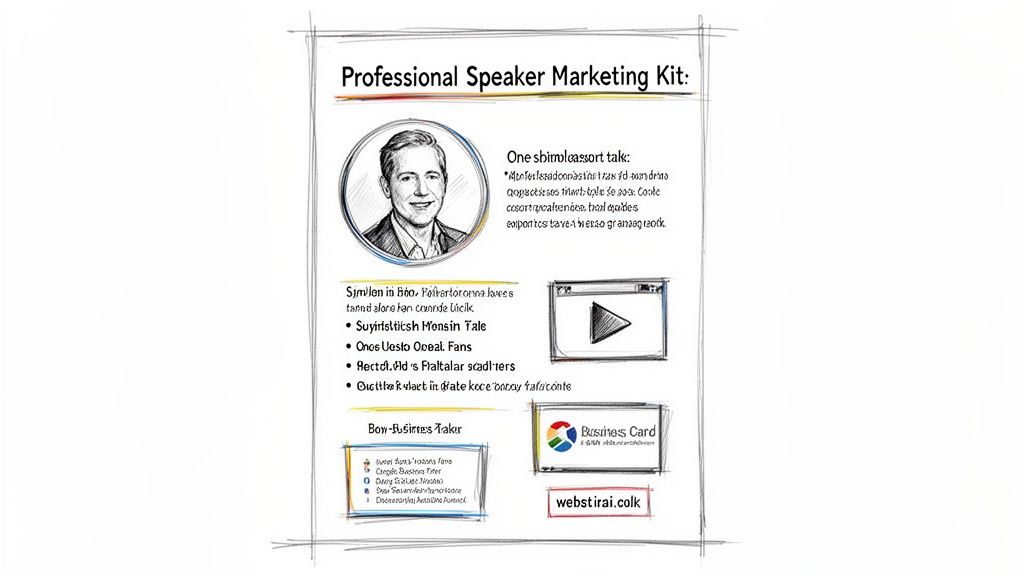
Think of it this way: your marketing kit is your resume, sales pitch, and proof of value all rolled into one. If it’s sloppy or confusing, you’re getting tossed in the "no" pile before you ever get a chance to talk to a real person.
The single most important piece of your kit is the speaker one-sheet. I tell all my clients to think of it like a movie poster for their speaking career. It's a single, sharp-looking document an event planner can scan in 30 seconds and get everything they need.
When an organizer is drowning in emails from potential speakers, a killer one-sheet is what makes you pop. It has to be polished, professional, and scream value from the get-go.
Your one-sheet absolutely must include:
Building a great one-sheet is a lot like creating a media kit. If you want to go deeper, check out our guide on how to create a media kit that gets you noticed.
A one-sheet is essential, but let me be blunt: nothing sells you like video. Nothing.
An organizer wants to see you in action. They want to feel your energy and see how you connect with a crowd. A solid speaker reel is the most powerful sales tool you have. Period.
But what if you're just starting out and have no footage? I hear this all the time. It’s the classic chicken-or-egg scenario, but it’s totally solvable.
Don’t wait for the perfect gig to get footage. Create your own opportunity. A sharp 2-3 minute reel is all you need to start getting booked.
Here’s how I got my first reel done with basically no budget:
The goal isn't a Hollywood production. The goal is to prove you can hold a room and deliver real value.
Your one-sheet and reel need a home base. That’s your website and LinkedIn profile. They're the central hub for your speaking business, giving organizers the confidence and a clear path to book you.
Your online presence has to be primed to convert.
Your Speaker Page Checklist
Your website needs a dedicated "Speaking" page that’s dead simple to find. Here’s what it must have:
When you create a marketing kit this comprehensive, you change the entire conversation. You're not just another person asking for a slot—you're a professional partner with a packaged solution. It makes booking you the easiest, most confident decision an event organizer can make.
You’ve got a polished speaker kit. Great. Now the real work begins.
Don’t make the mistake of waiting for opportunities to fall into your lap. That’s a rookie move. If you want to get speaking gigs that actually build your career, you have to go on the offensive. This is your playbook for hunting down the right stages for your message.

Let's be clear: the market for speakers is exploding. The global professional speaker market is set to grow from USD 2.27 billion in 2026 to USD 2.69 billion by 2031. And with the corporate world making up over 30% of that pie, the demand for true experts has never been higher. You can dig into more of the data on this trend over at Technavio.
More stages are popping up every day. But not all stages are created equal. You need a strategy.
Look, you don't go from zero to a paid keynote overnight. It’s a climb. I call this the "opportunity ladder"—a strategy I've used with clients to build momentum and get that all-important footage without burning out.
It’s a simple progression.
Rung 1: Local and Internal Gigs. This is your training ground. Local business meetups, chamber of commerce events, even internal trainings. The stakes are low, the crowds are forgiving, and it's the perfect place to get your first recordings.
Rung 2: Niche and Regional Events. Once you’ve got a few gigs under your belt and a solid reel, you start targeting smaller industry conferences or regional events. The audience is dialed in, and the connections you make will be far more valuable.
Rung 3: National Conferences and Paid Corporate Gigs. This is where the game changes. Armed with a proven track record, killer testimonials, and a reel that proves you can command a room, you can confidently pitch the big leagues and start naming your price.
Following this path stops you from getting discouraged by aiming too high, too soon. It’s about stacking small wins that make the next step feel easy.
Knowing where to look is half the battle. Just typing "call for speakers" into Google isn't going to cut it. You need to be looking where your competitors aren't.
Here are a few goldmines I tell my clients to use:
A quick pro-tip: Stop searching for "speaking" opportunities. Start searching for "learning" opportunities. Any event that needs to teach its audience something needs an expert. That expert is you.
Getting an offer feels good. But a mismatched gig is a massive waste of your time and theirs. Before you even think about writing a pitch, you need to vet every single opportunity.
For more on creating events that hit the mark, check out our guide on innovative business networking event ideas to grow your brand.
Ask yourself these three non-negotiable questions:
This isn't about being picky; it's about being strategic. Vetting ensures you pour your energy into the gigs that will actually move you up that ladder, one step at a time.
Let's get one thing straight: even the best speaker kit is useless if your pitch gets deleted on sight.
Event organizers' inboxes are a warzone. If you want to get booked, your outreach can’t just be “good.” It needs to be so sharp, so relevant, that they have no choice but to pay attention.
This isn’t about finding a magic template. It's about building a real process for outreach that feels authentic and gets you into conversations that lead to speaking gigs.

A killer pitch isn't a beg—it's a confident solution to their problem. It’s short, to the point, and all about the event organizer, not you.
Every pitch that’s ever worked for me (or that I've received and actually read) follows a few simple rules. It respects their time and proves you've done your homework.
Here’s the breakdown:
The biggest mistake I see is people making the pitch all about themselves. Stop. Make it about the organizer, their event, and their audience. Shift from "I want to speak" to "I have something your audience needs," and watch your response rate explode.
Most gigs aren't booked from the first email. The real wins happen in the follow-up. But there's a thin line between persistent and annoying.
I use a simple three-step sequence that keeps you top-of-mind without making you look desperate. The key is to add value every single time you hit their inbox.
Here’s the game plan:
This isn't just about getting a slot; it's about building relationships. It proves you're a partner, not just another speaker looking for a stage.
Of course, none of this matters if your emails go straight to spam. To make sure your hard work actually gets seen, mastering email deliverability strategies is a non-negotiable part of the process.
Alright, you've pitched your heart out, and the event organizer just sent back an enthusiastic "Yes!"
Pop the champagne? Not quite yet.
This is where the real work begins. Getting the "yes" feels like the finish line, but it’s actually the starting gun for the most critical part: the negotiation.
Too many speakers get swept up in the excitement and fumble the ball here. They either take the first offer on the table—no questions asked—or are too terrified to even bring up money.
You need to walk into this conversation with the same confidence you bring to the stage. This is where you go from applicant to partner.
Before you can negotiate like a pro, you have to speak the language. Not all "payment" is the same, and knowing the difference is your key to getting a deal that’s actually worth your time.
You'll run into a few common structures:
Look at the entire package. A smaller fee might be fine if they cover all your travel and throw in a professionally shot video of your talk.
Let's get this out of the way. As a rule, you get paid for your work. Period.
But when you're just starting, a few strategic, unpaid gigs can be an investment in your career. Keyword: strategic.
A "free" gig should never actually be free. You must get something tangible in return. If the only one winning is the event organizer, you’re being taken for a ride.
Before you accept a zero-dollar offer, make sure it ticks at least one of these boxes:
This isn't about devaluing yourself; it's about building a foundation. And make no mistake, live events are where you want to be. In-person events made up 88% of all professional speaking bookings in 2025. That proves people are still hungry for live, in-person connection. You can dig into more data on the future of speaking to see the trends for yourself.
Putting a price on your expertise feels weird at first. You feel like you’re just pulling a number out of thin air. You’re not.
Your fee is a reflection of your experience, the results you deliver, and the market rate. Do some digging. See what others in your niche with a similar level of experience are charging.
For your first few paid gigs, a fee in the $500 - $1,500 range (plus travel) for a breakout session is a solid starting point. As you get more testimonials, better videos, and a stronger brand, you can start commanding $5,000, $10,000, or even more for keynotes and corporate workshops.
When they ask about your fee, don't freeze up. Use this script:
"My standard fee for this kind of talk is [Your Fee], plus travel. But I'm happy to discuss your budget and see if we can find a number that works for both of us."
It’s confident, not cocky. It shows you’re a professional who is also willing to collaborate. That’s how you open the door to a real conversation and a great contract.
Got questions about landing speaking gigs? I get it.
When you're trying to break into the speaking world, it's easy to get stuck. Let's cut through the noise and tackle the hurdles I see trip up new speakers all the time.
This is the big one. The classic "chicken-or-egg" problem. How do you get a speaker reel without gigs, and how do you get gigs without a reel?
Let’s clear this up right now: stop waiting for permission. Create your own stage.
Your goal isn't to land a paid keynote on day one. It's to get video proof that you can hold a room and deliver real value.
Your first "gig" might be a free workshop you host for your network. Or a presentation for a local business group. It could even be you, in an empty room, delivering a 10-minute gold nugget from your talk. Organizers don't care about the size of your first audience—they care that you can deliver.
Forget "experience." Start thinking in terms of "evidence." Go create your own.
When you’re starting out, your goal is simple: find friendly audiences, refine your talk, and get that all-important video footage. Forget the big conference directories for now.
Instead, go where the real communities are.
These aren't just practice rounds. These are low-risk environments where you build confidence and make connections. I’ve seen countless speakers get referrals for bigger, paid events from a free talk they gave at a local Meetup.
Your social media—especially LinkedIn—is your 24/7 marketing engine. Event organizers are scrolling these platforms every single day, looking for experts. You just need to make it dead simple for them to find you.
The key? Stop using social media as a resume. Start using it as your personal stage.
Consistently post about the exact topics you want to get paid to speak on.
When you do this right, you stop chasing gigs and start attracting them. Organizers see you delivering value every day, and booking you for their event becomes the obvious next step.
At Legacy Builder, we turn your expertise into a powerful personal brand that pulls in opportunities just like this. We help you build the strategy that gets you noticed.
Learn more at https://www.legacybuilder.co.


You could – but most in-house teams struggle with the nuance of growing on specific platforms.
We partner with in-house teams all the time to help them grow on X, LI, and Email.
Consider us the special forces unit you call in to get the job done without anyone knowing (for a fraction of what you would pay).
Short answer – yes.
Long answer – yes because of our process.
We start with an in-depth interview that gives us the opportunity to learn more about you, your stories, and your vision.
We take that and craft your content then we ship it to you. You are then able to give us the final sign-off (and any adjustments to nail it 100%) before we schedule for posting.
No problem.
We have helped clients for years or for just a season.
All the content we create is yours and yours alone.
If you want to take it over or work on transitioning we will help ensure you are set up for success.
We want this to be a living breathing brand. We will give you best practices for posting and make sure you are set up to win – so post away.
Subscribe to our newsletter and get insights on how to grow your personal brand.
