.svg)
Subscribe to our newsletter and get insights on how to grow your personal brand.
Thank you! Your submission has been received!
Oops! Something went wrong while submitting the form.
.svg)



Trying to manage a handful of social media profiles at once? It’s a beast.
If you’re just bouncing between platforms, posting whenever you get a spare second, you're playing a losing game. The real pros don't just "post"—they operate from a centralized command center. We're talking about a unified dashboard to schedule content, talk to your audience, and actually see what's working, all from one spot.
It's the difference between being a reactive content creator and a proactive brand builder.
Welcome to the new reality. If you're an entrepreneur, executive, or creator, having just one social media profile isn't going to cut it anymore. To build something that lasts, you need to be where your people are—and they're everywhere.
But this is where the wheels usually fall off.
The real challenge isn't just finding the time to post. It's a logistical nightmare. How do you keep your voice authentic and professional on LinkedIn, but then switch gears to be visual and personal on Instagram? This daily grind of creating, scheduling, and monitoring content is a fast track to burnout. Most people get stuck here, treating each platform like another chore on an endless to-do list.
Here's the secret: stop thinking of it as a problem. This isn't chaos; it's a strategic opportunity.
Each platform is a different stage for your personal brand. It’s your chance to connect with unique segments of your audience in the way they want to be engaged. LinkedIn is for your professional deep-dives. X (formerly Twitter) is for your real-time thoughts. Instagram tells your story visually.
The goal is to get out of the "post whenever I can" mindset and into a centralized, proactive strategy. This shift is the foundation for everything we're about to build.
This isn't just a trend; it's the standard. The average brand is now juggling 4.5 social media accounts. Dig into the data, and you'll find that nearly 61% are managing at least three profiles, with a hardcore 17% running seven or more.
To get a clearer picture of this shift from reactive chaos to strategic control, let's break down the common traps and the winning mindset required to escape them.
Moving from the "Reactive Approach" column to the "Strategic Solution" column is the entire game. It’s about building a system, not just working harder.
Instead of feeling like you're being pulled in a dozen different directions, you need a unified system. To really win this game, you have to learn how to manage multiple social media accounts with a playbook that actually works.
That's what this guide is for. We're going to give you that structure, moving you past the pain points and into a sustainable workflow. By the end, you’ll have a system to manage your digital footprint without losing your mind or your authentic voice.
Trying to manage multiple social media accounts without a system is a recipe for chaos. It’s like trying to conduct an orchestra where every musician is playing from a different sheet of music. You get a lot of noise, but no harmony.
To stop the madness and move from scattered, daily tasks to a real strategic operation, you need to build a “Content Command Center.” This isn't just about scheduling posts; it's your single source of truth for your entire social media presence.
This is the engine that will power a consistent, high-quality, and authentic brand across every single platform you’re on. It’s how you move from reactive to strategic.
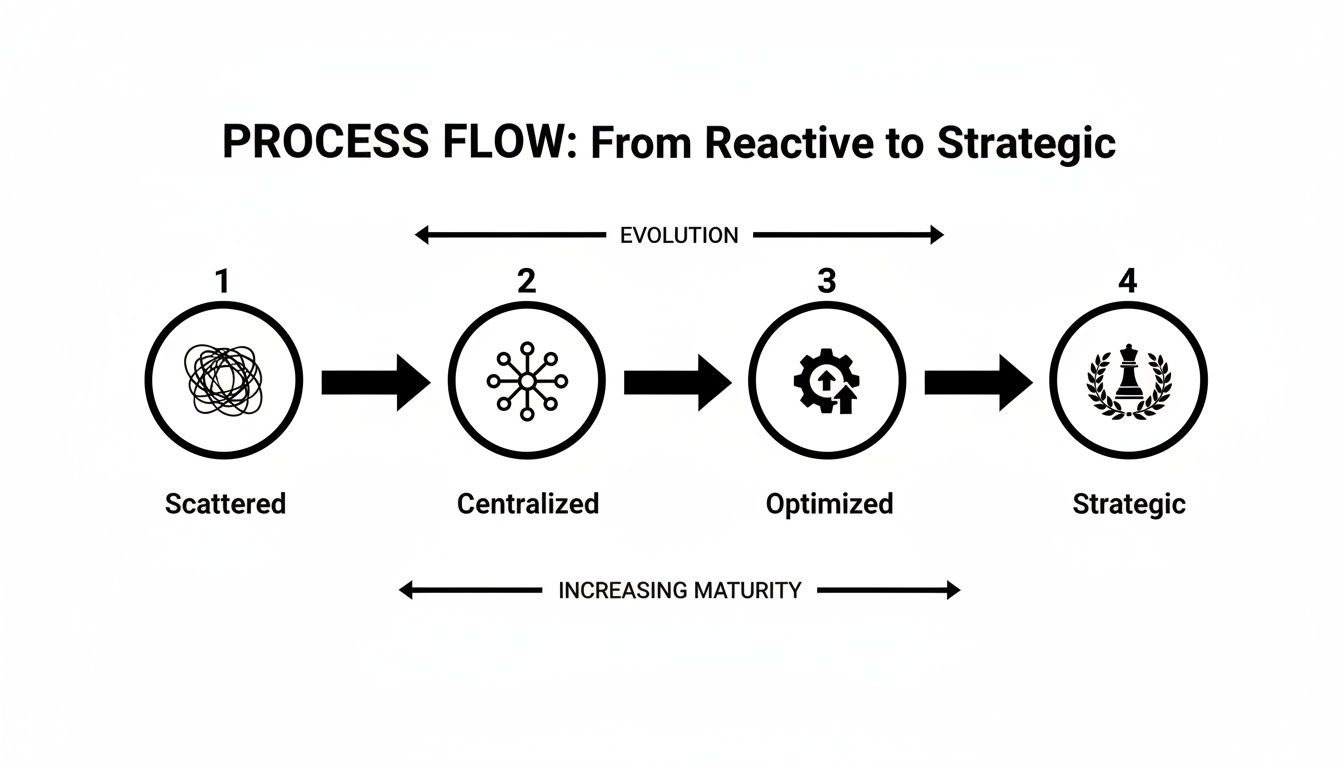
The difference between the tangled, messy approach and a streamlined hub is night and day. It all starts with building an intentional system.
First things first, you need to establish a master brand voice. This is your core personality—the unshakable tone, values, and perspective that define you, no matter where you show up. Think of it as your brand's true north.
But a master voice doesn't mean you sound like a robot everywhere. Instead, you develop platform-specific “dialects.”
By defining these nuances upfront, you make sure your brand feels native to each platform without ever losing its core identity. This document becomes the playbook for you or anyone posting on your behalf.
Next up, stop thinking in terms of one-off posts for each platform. Instead, lock in three to five core content pillars. These are the big-picture topics and themes your brand is going to own.
For a SaaS founder, these pillars might be:
From now on, every single piece of content—from a long-form article to a 15-second video—must tie back to one of these pillars. This approach makes content creation unbelievably efficient.
One idea under the "Productivity" pillar, like "My Top 5 Productivity Hacks," can be spun into a LinkedIn article, an Instagram carousel, an X thread, and a short-form video. It's a game-changer.
Your content pillars are the foundation. They give you the strategic direction that guides every post and makes sure your message is always focused, valuable, and reinforcing what you stand for.
With your voice and pillars defined, you need the right tech to bring your command center to life. A social media management tool is non-negotiable if you're serious about this. These platforms pull all your scheduling, engagement, and analytics into one dashboard.
When you're picking a tool, think about your specific needs:
Don’t get hung up on finding the "perfect" tool. The best one is the one that fits your workflow now and saves you the most time. Most have free trials, so kick the tires on a couple and see what feels right.
For a truly robust command center, you need documented processes. A solid standard operating procedure template can bring serious clarity to all your social media operations. When you combine that documented process with the right tool, you have the backbone of a system that can run without you constantly looking over its shoulder.
Consistency is what grows a brand, but let’s be real—burnout is the fastest way to kill your momentum. You feel this constant pressure to be "on" 24/7, but posting without a plan is just shouting into the void. A sustainable posting cadence isn't about hitting some magic number of posts; it's about finding a rhythm you can actually stick with for the long haul.
Think of this rhythm as your strategic pulse. It should be built around your goals, what you can realistically manage, and—most importantly—when and how your audience actually listens. Instead of chasing trends, a smart cadence builds anticipation and trust.
This is more critical than ever. We're now looking at over 5.2 billion people on social media globally, with the average user spending 2 hours and 28 minutes scrolling each day. But here's the kicker: for the first time since 2018, that number has actually dropped a bit. People are starting to be more intentional with their time online. Your strategy needs to respect that by focusing on quality, not just quantity. You can dig deeper into these shifts with these latest social media statistics.
Forget the generic advice to "post three times a day." That's old news, and frankly, it's terrible advice. Every platform has its own vibe, its own clock, and its own audience expecting different things. Getting this wrong is one of the biggest mistakes I see people make when trying to manage multiple profiles.
The right cadence isn't about being everywhere all the time. It's about being in the right place, at the right time, with the right message. Your schedule should serve your strategy, not the other way around.
Let's make this real. A SaaS founder and an executive coach have completely different content and goals, so their schedules shouldn't look the same.
Here’s a look at how a SaaS Founder might structure their week:
And for an Executive Coach:
Think of these as templates to get you started. The goal is to build a foundation you can execute without fail, then tweak it based on what the data tells you is working. If you need a hand organizing this, you can grab this content calendar template for social media to map everything out.
To make this even more practical, here’s an example of what a balanced weekly schedule could look like across the major professional platforms.
This schedule shows how you can distribute high-impact content across key platforms without feeling like you're chained to your desk.
This cadence allows you to hit each platform with purpose, playing to its strengths without creating a ton of extra work.
So, how do you maintain this kind of consistency without going crazy? The secret is content batching.
This is my go-to workflow. You block off one chunk of time—maybe four hours on a Monday morning—and create and schedule all of your social media content for the entire week. All at once.
Instead of waking up every day scrambling for an idea, you get into a deep creative flow and produce better content, faster. This frees up your brain for the rest of the week to do the high-value stuff: actually engaging with people, building relationships, and figuring out what’s resonating. It’s the single best productivity hack for anyone who's serious about making their personal brand work.
If you're trying to create brand-new, from-scratch content for every single platform, every single day, let me be blunt: you're on a fast track to burnout.
The most successful people I know aren't working harder; they're working smarter. They've mastered the art of content repurposing. This isn't about lazily copy-pasting the same message everywhere. It's about strategically multiplying your impact without multiplying your effort.
The core idea is simple: create once, distribute natively.
You start with one solid, in-depth piece of "pillar" content—maybe a deep-dive blog post, a podcast episode, or a webinar. From there, you strategically slice and dice it into dozens of smaller, platform-specific "micro-assets." This is how you maintain a high-volume, high-quality presence everywhere without losing your mind.
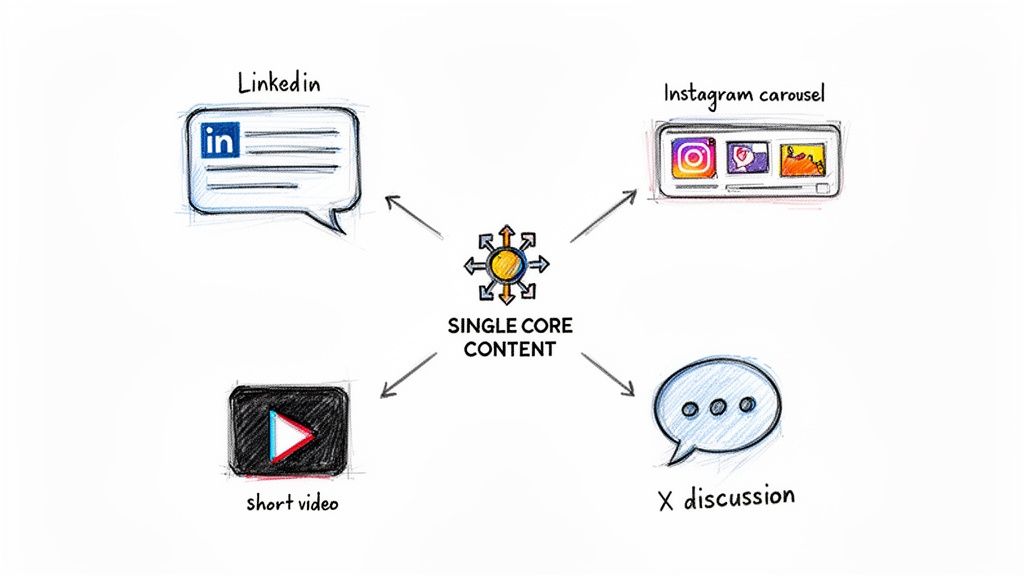
Let's get practical. Imagine you just published a 2,000-word blog post titled "5 Strategies to Boost Team Productivity in a Remote World." This is your pillar. Instead of just dropping the link everywhere and hoping for the best, you deconstruct it.
Here’s what that looks like in the real world:
Just like that, one major effort becomes at least four unique pieces of content, each one custom-fit for the platform it’s on.
The point of repurposing isn't to be lazy—it's to be efficient and effective. You're showing respect for each platform's culture by giving people content in the format they actually want.
To make this a habit, you need a system. Don't wing it.
The second you finish a piece of pillar content, immediately map out how you’ll repurpose it. A simple checklist or spreadsheet is all you need.
Here’s a quick look at a potential workflow:
This structured approach kills the daily "what should I post?" anxiety. It also keeps your messaging tight and reinforces your expertise across the board. When you truly master how to repurpose content and multiply your reach, you build a content engine that does the heavy lifting for you.
Changing the format is only half the battle. You also have to adapt your tone. The way you talk on LinkedIn should be different from how you talk on X.
Let’s look at the copy for assets based on that same email marketing guide:
See the difference? The core idea is identical, but the delivery is completely customized. This is what separates the pros from the amateurs. It shows your audience you get the platform and respect their time—and that's how you build a real following.
If you're an entrepreneur or leader, you'll eventually hit a wall. You become the bottleneck. You simply can't scale your brand or your business if you're the one personally crafting and scheduling every single post.
Let's be real: handing over the keys to your personal brand is terrifying. The biggest fear? That the authentic voice you worked so hard to build will get watered down, lost in translation, or turned into generic corporate-speak. This is the exact reason most founders hold on too tight, for too long.
But avoiding delegation isn't the answer. The real solution is to build a system so solid that your voice is protected, no matter who's behind the keyboard.

Before you even think about hiring someone, you need to get your voice down on paper. This is non-negotiable.
What you need is a simple, one-page Brand Voice Guide. This isn’t some 50-page corporate brand book nobody reads. It's a practical, at-a-glance playbook that anyone can use to immediately understand how to sound like you.
Your guide should be dead simple and cover:
This guide becomes the filter for every single piece of content. It empowers your team to make confident decisions because they have your brand’s DNA right in front of them.
Think of your brand voice guide as an insurance policy for your authenticity. It’s the difference between scaling successfully and watching your brand fade into a sea of soulless, generic content.
With your voice guide in hand, the next step is to document your process. Standard Operating Procedures (SOPs) might sound overly corporate, but they're really just simple, step-by-step instructions for tasks you do over and over.
SOPs kill the guesswork. They ensure consistency.
Don't overcomplicate this. Use a tool like Google Docs or Notion and create short, actionable guides for your key workflows.
Here’s an example SOP for scheduling content:
That's it. Create similar SOPs for creating graphics, engaging with comments, and pulling weekly reports. You'll free yourself from answering the same questions a hundred times.
Now you’re finally ready to bring someone on board. Whether it’s a virtual assistant (VA), a freelance social media manager, or a specialized agency, your documented system will make the entire process a breeze.
When you're hiring, don't just look at their resume. Give them a small, paid test project. Ask them to write three sample posts based on a recent blog article and your brand-new Voice Guide. This little test will reveal more about their ability to capture your voice than any interview question ever will.
Once you’ve found the right person, onboarding is straightforward:
By setting your team up with clear guardrails, you can finally step back with confidence. You shift from being the day-to-day creator to the high-level strategist—and your audience will never know the difference. This is how you manage multiple accounts and build a brand that truly scales.
Look, posting consistently is a huge win. But if you’re just throwing content out there without measuring what’s landing, you’re flying blind.
Activity doesn’t equal progress.
The secret to managing multiple social profiles without burning out is knowing what's actually moving the needle. It's about cutting through the noise and building a dead-simple dashboard that tells you the real story.
It’s easy to get a dopamine hit from a post that racks up a ton of likes. But likes don't pay the bills. If you want to understand your real impact, you have to track the metrics that actually connect to your business goals.
I tell my clients to focus on a few key areas:
Here's a mistake I see all the time: treating every platform the same. A 2% engagement rate on LinkedIn might be phenomenal, but that same number on Instagram could be just average. Context is everything.
You don’t need fancy software to get started. Just open up a spreadsheet and build a basic dashboard. At the end of each month, track these core metrics for each platform. The goal isn't complexity; it's consistency.
Once you have the data, you need to use it. I have all my clients run a "Social Media Health Check" at the end of every month. It’s a quick, 30-minute session—either solo or with your team—to review the dashboard and ask three simple questions:
This simple process turns analytics from a boring report into a powerful strategic tool. It’s how you refine your approach month after month. If you want to go deeper on this, our guide on how to measure brand awareness covers more advanced techniques.
Measurement isn't just about spreadsheets; it's also about protecting the brand you've worked so hard to build. As your presence grows, so does your risk. A single mishandled negative comment can spiral out of control fast.
This is why you need a simple Crisis Communication Plan.
I'm not talking about a 50-page document. A one-page guide that outlines exactly how to respond to different types of feedback is all you need.
Your plan should have clear, simple rules:
This approach ensures you always look professional and composed, no matter what comes your way. It turns potential problems into opportunities to show you care, reinforcing the trust you've built with your audience.
When you're scaling up your social media, a lot of questions pop up. It’s natural. Here are the straight-up answers to some of the most common hurdles I see professionals hit when they start managing multiple accounts.
For anyone running the show solo, the best tool is a perfect mix of power, simplicity, and a price that doesn't make you wince. Big enterprise platforms like Sprout Social or Hootsuite are great, but they’re often overkill for a one-person team. You’ll end up paying for features you never touch.
A much smarter place to start is with a tool like Buffer or Later. Buffer is known for its clean, no-fuss dashboard, which means you can get your content scheduled without a steep learning curve. Later, on the other hand, is killer for visual-heavy platforms like Instagram because it lets you plan your feed visually.
If you want something with a bit more horsepower—like content curation and the ability to automatically recycle your top-performing posts—then SocialBee is another fantastic option to look at.
Here’s my advice: figure out what you really need first. Is it scheduling? Analytics? Engagement? Once you know, sign up for a free trial of your top two picks. See which one actually saves you time and feels right. Don't overcomplicate it.
This is a big one. The fear of sounding like a generic corporate robot is real, but it’s completely avoidable if you build the right system from the get-go.
First, create a simple, one-page personal brand guide. I’m not talking about some 50-page corporate branding manual. This is a quick-glance doc that covers:
Next, you need a rock-solid collaboration process. Use a shared content calendar where your team can draft posts based on the guide. Your job is to be the editor-in-chief—you swoop in, review the drafts, make tweaks, and give the final thumbs-up. This keeps you in control of the strategy without getting sucked into the daily grind.
And here’s a pro tip I give all my clients: record short, raw videos or voice notes every week. Just talk about what’s on your mind, your take on industry news, or a recent client win. This is pure gold for your team. They can pull your exact words and ideas to craft posts that are genuinely you, without you having to write a single thing.
Absolutely not. Copy-pasting the same post across every platform is one of the most common mistakes I see. It’s a shortcut that screams you don’t understand the culture of each network, and your engagement will flatline because of it.
A much better approach is what I call "Create Once, Distribute Natively."
You start with one core idea—a "pillar" piece of content. Then, you chop it up and customize it to fit how people actually use each platform. This is way more efficient than creating brand new content for every channel, and it shows your audience you respect their time.
Let's say your pillar content is an in-depth blog post. Here’s how you’d play it:
It's the same core message, just delivered in a way that feels natural to each platform. That’s how you win.
Managing your personal brand is the single best way to build a lasting legacy. At Legacy Builder, we help you turn your expertise into high-impact content that grows your influence—without you having to manage the daily grind.


You could – but most in-house teams struggle with the nuance of growing on specific platforms.
We partner with in-house teams all the time to help them grow on X, LI, and Email.
Consider us the special forces unit you call in to get the job done without anyone knowing (for a fraction of what you would pay).
Short answer – yes.
Long answer – yes because of our process.
We start with an in-depth interview that gives us the opportunity to learn more about you, your stories, and your vision.
We take that and craft your content then we ship it to you. You are then able to give us the final sign-off (and any adjustments to nail it 100%) before we schedule for posting.
No problem.
We have helped clients for years or for just a season.
All the content we create is yours and yours alone.
If you want to take it over or work on transitioning we will help ensure you are set up for success.
We want this to be a living breathing brand. We will give you best practices for posting and make sure you are set up to win – so post away.
Subscribe to our newsletter and get insights on how to grow your personal brand.
