.svg)
Subscribe to our newsletter and get insights on how to grow your personal brand.
Thank you! Your submission has been received!
Oops! Something went wrong while submitting the form.
.svg)


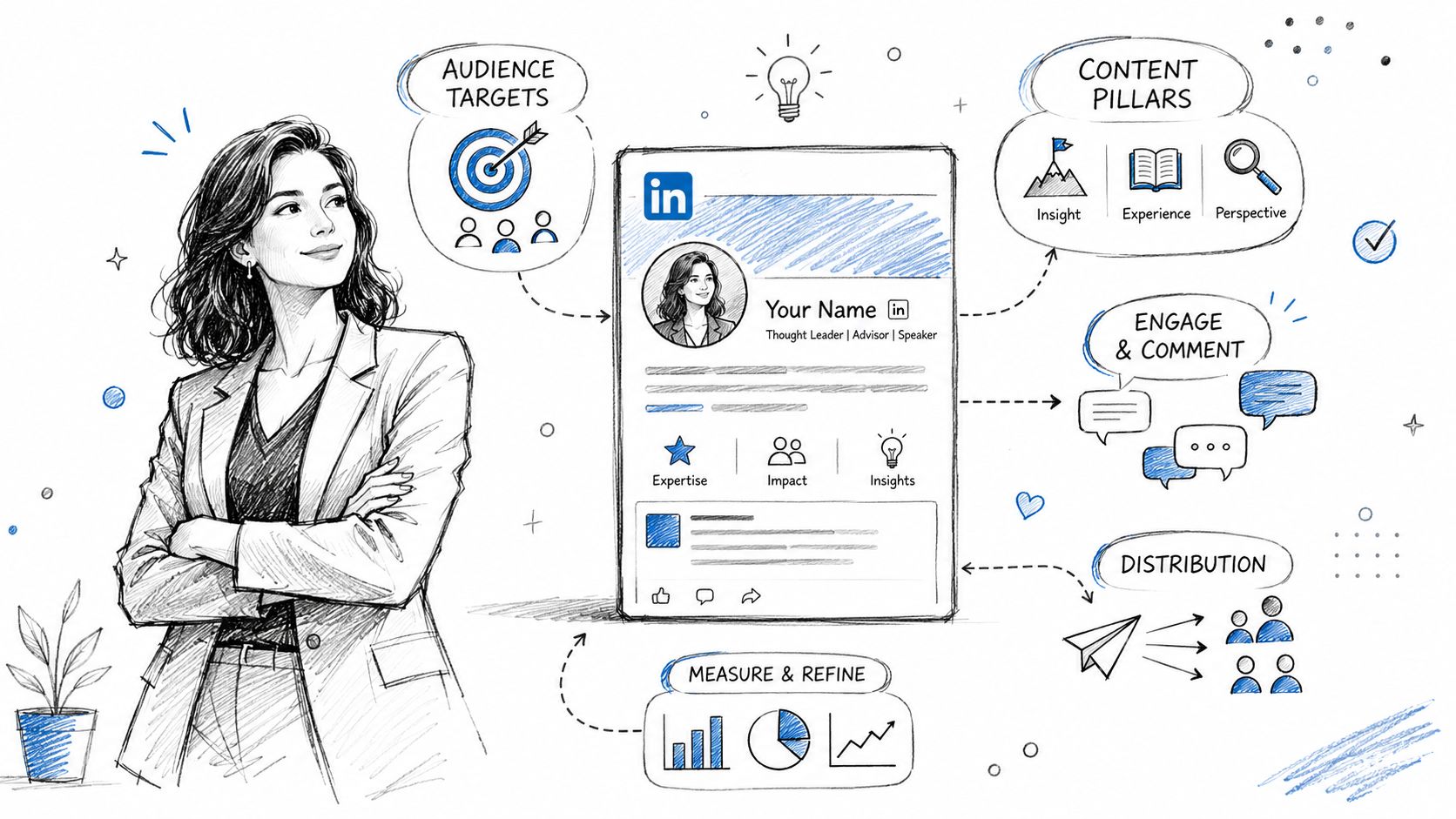
Most LinkedIn advice is lazy. “Post every day.” “Be authentic.” “Comment more.” That's not a strategy. That's a content treadmill.
If you're posting into the void, getting a few likes from peers, and seeing zero impact on pipeline, the problem isn't effort. The problem is that you're treating LinkedIn like a publishing habit instead of a business system.
A real LinkedIn thought leadership strategy does one job: it builds trust with the right buyers before your sales team ever talks to them. That trust changes how people read your profile, how they respond to your outreach, and how quickly they move once a conversation starts. It also tells you when to stop winging it alone and start scaling with process, people, and paid distribution.
The worst metric on LinkedIn is the one often prioritized: visible engagement.
Likes feel good. Views flatter your ego. Neither matters if the wrong people are seeing your content or if the right people see it and do nothing. A serious LinkedIn thought leadership strategy isn't built to entertain your peers. It's built to influence buyers.
That matters because buyer behavior has already changed. Nearly 75% of decision-makers place more trust in an organization's thought leadership content than in traditional marketing or product materials, according to the LinkedIn and Edelman research cited by Whiteoaks on LinkedIn thought leadership strategy.
That should reset how you think about content.
Most professionals make one of three mistakes:
If your content doesn't shape perception, it won't shape revenue.
A strong point of view does. Clear expertise does. Repetition around a narrow problem does. When the same audience sees you explain a problem better than everyone else, they start assigning authority to you before they ever book a call.
Practical rule: Your content should make the right person think, “They understand my problem,” not “They're active on LinkedIn.”
You're not trying to become internet famous. You're trying to become the obvious choice in a specific category.
That means your content should do four things:
Here's the shift many need to make:
| Weak approach | Strong approach |
|---|---|
| Post for reach | Post for relevance |
| Share generic motivation | Share applied expertise |
| Measure reactions | Measure buying signals |
| Stay personal but vague | Be personal and commercially useful |
If your current approach feels noisy and unrewarding, that's normal. LinkedIn punishes random effort and rewards coherent positioning.
The fix isn't “post more.” The fix is to build a system that turns expertise into trust, trust into conversations, and conversations into revenue.
Individuals often start with post ideas. That's backward.
Before you publish anything, fix the foundation. If your profile is weak, your audience definition is sloppy, and your topics are all over the place, even great content leaks value. LinkedIn rewards clarity, and LinkedIn's own guidance frames success around clarity, consistency, and connection in its thought leadership marketing plan advice.
Use that as your baseline.
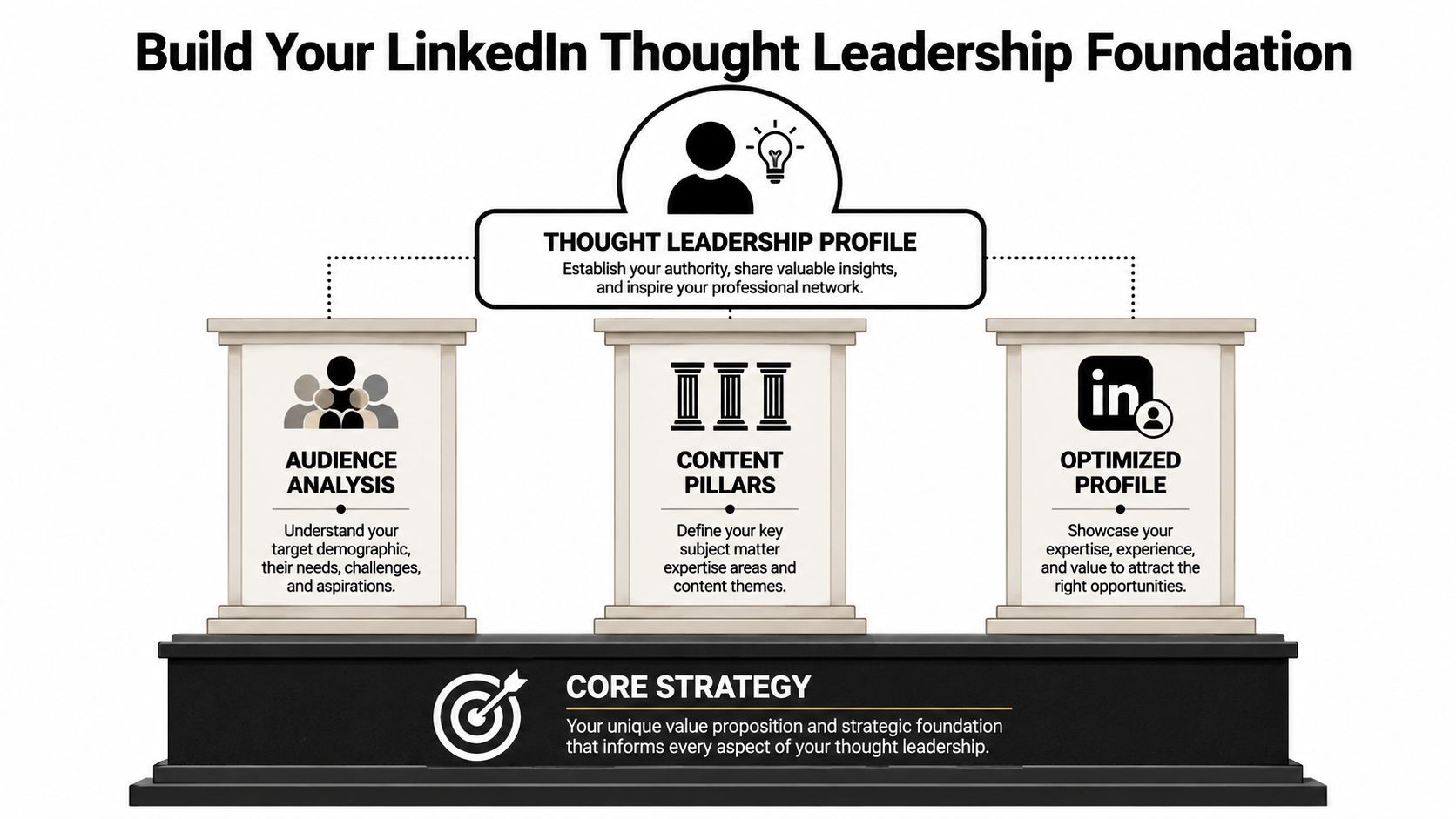
Your profile isn't a resume. It's a conversion page for attention you've already earned.
When someone reads a strong post, they click your profile to answer one question: “Is this person relevant to me?” If your headline is vague, your banner is generic, and your About section reads like a CV, you lose momentum.
Fix these first:
If your visuals are dated, weak, or inconsistent with the level you want to attract, clean that up too. A polished profile photo matters more than people admit, and resources like DreamShootAI for LinkedIn success can help you tighten the first impression without overcomplicating it.
For a deeper profile overhaul, this guide on how to stand out on LinkedIn with profile optimization is worth reviewing before you touch your content calendar.
“Founders” is not an audience. “B2B SaaS founders struggling to create authority-led content that supports sales conversations” is closer.
You need to know:
This changes your writing immediately. Instead of posting broad professional lessons, you start writing for live business tension.
Your best content usually answers a question your buyer is already asking in private.
Don't aim for reach across everyone. Aim for resonance with a narrow group that can hire, refer, or influence a deal.
A simple filter helps. Before you publish, ask: would my ideal buyer save this, send this, or mention this in a call? If the answer is no, it's probably filler.
It's not a consistency problem. It's a randomness problem.
Pick three to five recurring pillars and stay there. These are your zones of authority. They keep your feed coherent and your expertise memorable.
A good set of pillars usually includes:
Drop this into your planning process before you create anything else:
If a post doesn't fit one of your pillars, don't publish it. Discipline creates authority. Randomness creates noise.
You don't need more inspiration. You need a machine.
The biggest reason smart professionals fail on LinkedIn is simple: they rely on mood. They post when they feel sharp, disappear when work gets busy, then restart from scratch. That's why consistency breaks. And it's why a sustainable LinkedIn thought leadership strategy has to be operational, not emotional.
The recommendation I agree with most is this: post once or twice a week for six months and batch-create two weeks of content in advance. That guidance appears in this LinkedIn thought leadership post on consistent execution. It's boring. It works.
You should not face a blank page every week.
Build around a few reliable formats:
Here's the standard I use: every post needs tension, a point of view, and a useful takeaway. If it only has one of those, it won't travel.
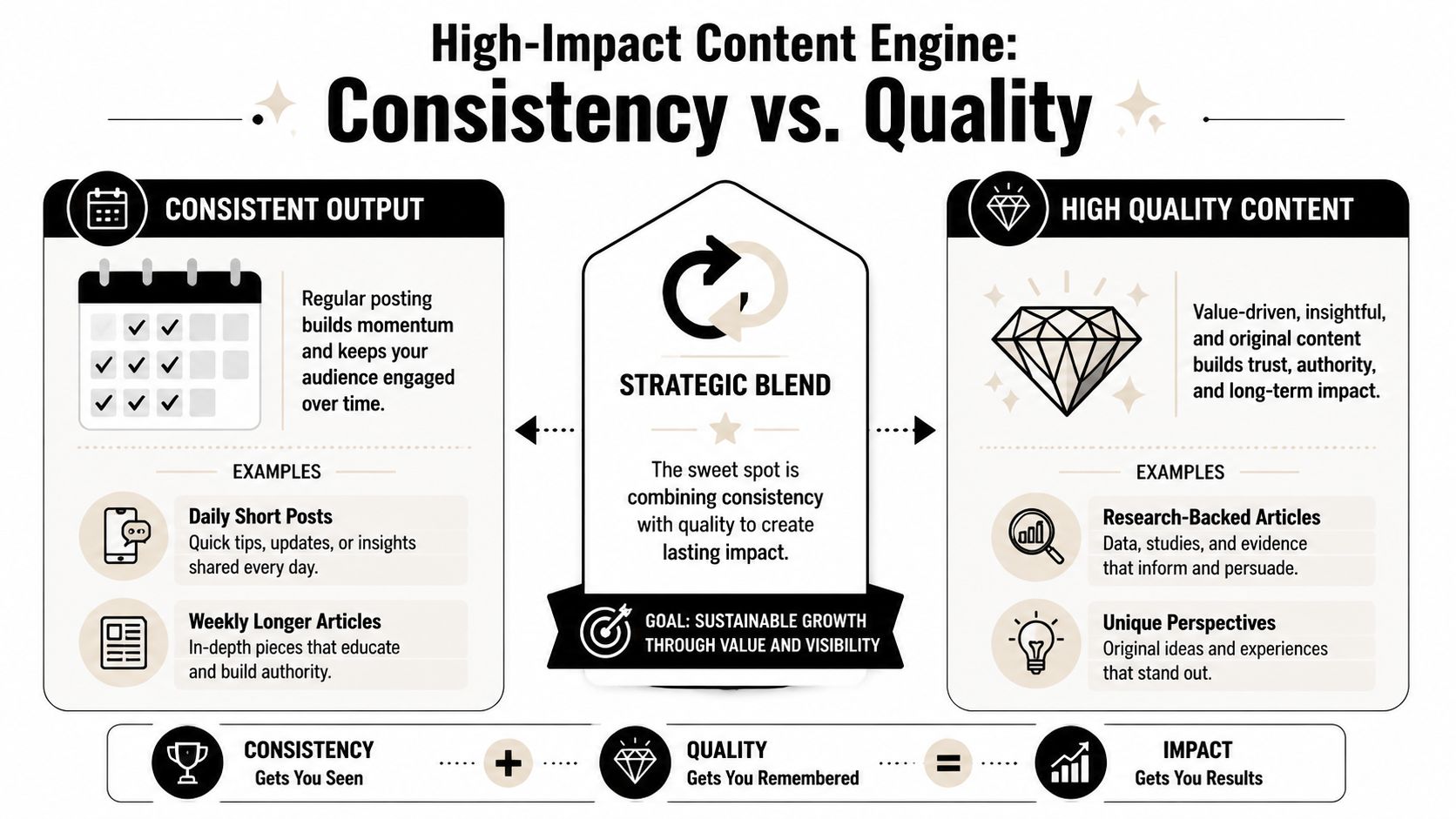
Different formats do different work. Stop posting everything as plain text because it feels easier.
| Format | Best use |
|---|---|
| Text post | Sharp opinions, short lessons, fast reactions |
| Carousel | Frameworks, processes, visual breakdowns |
| Short video | Face-to-camera trust, nuance, personality |
| Poll | Fast audience input, content research |
| Document post | Templates, checklists, summaries |
If you're building authority, short video plus written context is especially strong. It shows how you think, not just what you type.
For teams building process around this, a practical social media content guide for agencies can help structure editorial planning without turning your feed robotic.
Don't write one post at a time. That's amateur hour.
Use a single working session to create two weeks of material:
Good content rarely starts as polished writing. It starts as raw pattern recognition.
If you need prompts to fill the queue, this list of LinkedIn content ideas for professionals is a useful starting point.
The point isn't to sound busy. The point is to make consistency easy enough that it survives real life.
Publishing is only half the job. Distribution decides whether your content dies unnoticed or compounds.
Engagement is often treated like cleanup work: replying to comments when remembered, perhaps liking a few posts in one's feed, then wondering why nothing happens. That's passive behavior. A strong LinkedIn thought leadership strategy uses engagement as deliberate market presence.
If your ideal clients or referral partners post regularly, your comments are part of your content strategy.
Not throwaway comments. Not “great point.” Real comments that add perspective, sharpen the original idea, or bring a relevant example from your own experience. Done well, this puts your name in front of the exact people who should know you exist.
Use a simple rule set:
This is how unknown experts get known. Not by lurking, and not by posting in isolation.
A comment section is often the first low-friction buying signal you'll get.
When someone asks a smart question, disagrees thoughtfully, or adds detail from their own context, that's a reason to continue the conversation privately. Not with a pitch. With relevance.
Try this approach:
| Situation | Better next move |
|---|---|
| Someone asks for clarification | Reply publicly, then offer to send a deeper example by DM |
| Someone shares a similar challenge | Acknowledge it and continue with a specific question |
| Someone engages repeatedly | Send a message referencing the discussion, not your service |
| Someone from a target account reacts often | Connect and start with shared context |
Don't force a sales conversation. Earn a business conversation.
At this crucial point, many individuals ruin momentum. They jump from a comment to a meeting link. Buyers pull away because the trust wasn't there yet.
Organic content gives you signal. Paid distribution gives you scale.
Once a post clearly resonates with the right audience, amplify it. Thought Leader Ads on LinkedIn can achieve engagement rates as high as 15% while reaching a much larger audience, according to The B2B Playbook on LinkedIn Thought Leader Ads.
That matters because you shouldn't promote unproven content. You should scale content that already demonstrates relevance.
A simple decision filter works well:
At that point, LinkedIn stops being a place you “show up on” and becomes a distribution channel tied to demand generation.
If you can't tie your LinkedIn effort to business outcomes, eventually you'll stop prioritizing it.
That's why vanity metrics are dangerous. They give you activity without proof. A post can get strong engagement and still contribute nothing to revenue. Another post can look quiet and subtly influence a deal because the right buyer read it, remembered it, and brought it into a sales conversation later.
That's the shift smart teams are finally making. A 2025 shift shows B2B marketers are now monitoring “prospect references in sales discussions” and “AI Overview mentions” as primary ROI indicators, as discussed in this B2B marketing conversation on Reddit.
Executives don't care that a post “did well” unless you can explain what “well” means in commercial terms.
Here's the difference:
| Vanity metric | Revenue-relevant signal |
|---|---|
| Likes | Inbound messages from qualified people |
| Impressions | Profile visits from target accounts |
| Follower growth | Repeat engagement from buying committee members |
| Comments | Sales conversations that reference content |
The right dashboard is simple. It doesn't need to impress anyone. It needs to help you make decisions.
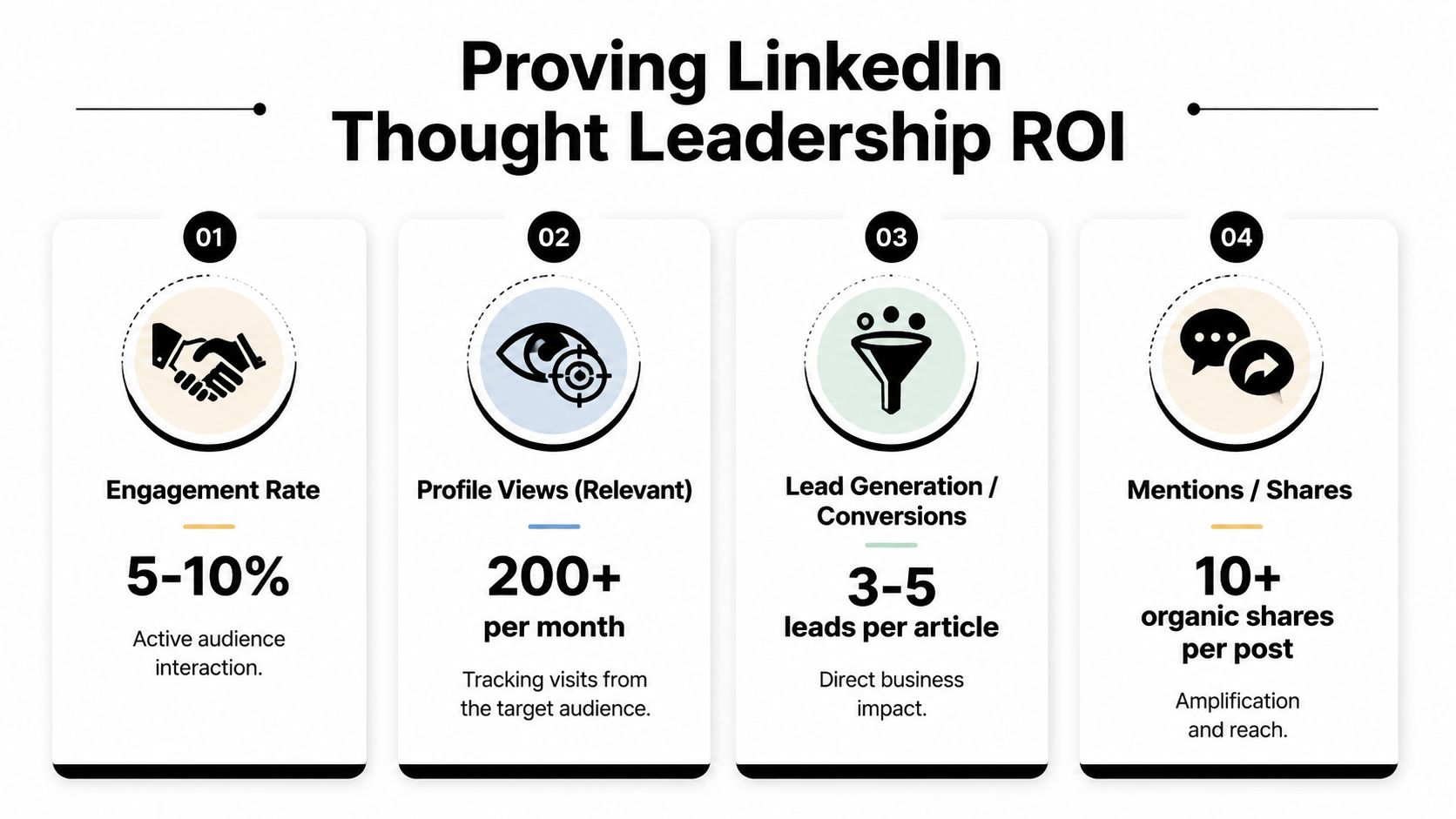
Track what your team can use:
If you need a framework for thinking about return beyond surface engagement, tools that help you discover the returns from your AI expert can be useful for pressure-testing how content connects to broader business value.
Every month, ask three questions:
That review rhythm matters more than a flashy report. It helps you double down on themes that move buyers and cut the content that only entertains your network.
For a broader breakdown of attribution and personal brand tracking, this guide on how to measure social media ROI for your personal brand gives a useful structure.
The best metric is the one your sales team actually notices.
That's when LinkedIn stops being a branding side project and becomes part of your revenue system.
The final test of a LinkedIn thought leadership strategy is whether it survives success.
A lot of founders prove they can do LinkedIn. Then they become the bottleneck. They're the strategist, writer, editor, publisher, commenter, and reviewer. It works until the business gets busy. Then content slips, engagement drops, and momentum disappears.
That's not a content problem. It's a systems problem.
You do not need more ideas. You need more output from each good idea.
One strong founder insight can become:
This is how experienced teams create consistency without draining the founder. They capture one raw insight, then atomize it into multiple assets.
Don't hand off your voice. Hand off the work around your voice.
Start with the tasks that slow you down but don't require your direct judgment every time:
| Keep with the founder | Delegate to support |
|---|---|
| Final point of view | Draft formatting |
| Story selection | Editing and repurposing |
| Core messaging | Scheduling and publishing |
| Strategic priorities | Design, clipping, admin follow-up |
That split matters. If you delegate too early to the wrong person, your content starts sounding generic. If you wait too long, you stay trapped in manual execution.
You should consider support when these signs show up together:
At that point, the goal isn't “help me post more.” The goal is “help me build a repeatable authority engine that doesn't depend on my spare time.”
That's the difference between a personal habit and a strategic growth asset.
If you're done guessing and want a team that can turn your expertise into consistent, high-quality LinkedIn content, Legacy Builder is built for that. They help founders, executives, and professionals turn raw insight into an actual brand system, from profile positioning to content creation and strategic distribution, without flattening your voice into agency fluff.


You could – but most in-house teams struggle with the nuance of growing on specific platforms.
We partner with in-house teams all the time to help them grow on X, LI, and Email.
Consider us the special forces unit you call in to get the job done without anyone knowing (for a fraction of what you would pay).
Short answer – yes.
Long answer – yes because of our process.
We start with an in-depth interview that gives us the opportunity to learn more about you, your stories, and your vision.
We take that and craft your content then we ship it to you. You are then able to give us the final sign-off (and any adjustments to nail it 100%) before we schedule for posting.
No problem.
We have helped clients for years or for just a season.
All the content we create is yours and yours alone.
If you want to take it over or work on transitioning we will help ensure you are set up for success.
We want this to be a living breathing brand. We will give you best practices for posting and make sure you are set up to win – so post away.
Subscribe to our newsletter and get insights on how to grow your personal brand.
