.svg)
Subscribe to our newsletter and get insights on how to grow your personal brand.
Thank you! Your submission has been received!
Oops! Something went wrong while submitting the form.
.svg)



Let's get one thing straight: your personal brand isn't just a fancy LinkedIn profile or a side project. It's the conscious effort of building a reputation that screams expertise and value.
It's about becoming the person everyone thinks of when a specific problem comes up in your field. It’s how you go from being a choice to being the choice.
In a world where everyone is connected, your digital presence has become your single most important career tool. Doing nothing about your personal brand is the equivalent of letting fate decide your professional future.
You're letting a decade-old search result, a questionable social media photo, or—even worse—total radio silence define you.
Building a brand is about grabbing the microphone and telling your own story. It ensures that when a potential client, hiring manager, or partner Googles your name, they find a clear, compelling narrative that proves you know your stuff. This isn't about ego. It's about career survival.
Still not convinced? Look at the numbers. A massive 98% of employers are digging into your online presence before they even think about making a hiring decision.
This isn't just a casual glance, either. These digital first impressions have real consequences. Recent reports show 44% of employers hired someone specifically because their online brand was so impressive.
On the flip side, 54% have flat-out rejected applicants because of what they found online. If you want to dive deeper, you can explore more personal branding statistics and see just how much is at stake.
Your personal brand is what people say about you when you're not in the room. In 2026, that room is Google. Your online presence is either working for you or against you, 24/7.
The takeaway here is simple. A strong brand works behind the scenes, opening doors to opportunities you might not even know were there. It's the ultimate tiebreaker when you're up against someone with a similar resume.
The gap between someone who actively manages their brand and someone who doesn't is massive. It's not just a small difference; it can lead to two completely different career paths.
This table breaks down the day-to-day reality.
| Aspect | With a Strong Personal Brand | With a Weak Personal Brand |
|---|---|---|
| Opportunities | Inbound leads, job offers, and speaking gigs show up organically. | Constantly hunting for every single new opportunity. |
| Credibility | Instantly seen as a trusted authority in your niche. | Must prove yourself from square one in every interaction. |
| Networking | High-value connections actively seek you out. | Networking is an uphill battle limited to existing contacts. |
| Compensation | Command higher salaries and fees because of perceived value. | Forced to compete on price, capping earning potential. |
| Recruitment | Headhunted for premium roles that never even get posted publicly. | Stuck scrolling job boards and applying for listed roles. |
At the end of the day, investing in your brand is a direct investment in your career security and earning potential. It’s how you stop being just another name on a list and become the obvious, undeniable choice.
Before you can even think about building a personal brand that pulls in opportunities, you need a solid foundation. And that foundation has to be built on who you actually are.
This isn't about creating some fake persona or a highlight reel of your career. That's a rookie mistake. Real, effective personal branding is about clearly and intentionally showing your true value. It's what makes people believe you, remember you, and want to work with you.
So, let's stop thinking about your career as just a list of jobs on a resume. It's a story. A story of problems you’ve solved, skills you’ve mastered, and a unique perspective you’ve gained along the way. Your job now is to connect those dots into a powerful narrative that explains why you do what you do.
Your unique value proposition (UVP) is your sweet spot. It's that perfect overlap where your best skills and deepest passions meet a real, pressing need in the market. This is the zone where you can deliver value that no one else can.
To figure out your UVP, you need to get brutally honest and ask yourself three questions:
Authenticity is everything here. People can spot a fake a mile away. Research shows 65% of consumers connect more with brands that have authentic stories, and the same goes for professionals. But here’s the gap: while 70% of professionals get how important this is, only 48% are actively doing anything about it.
It's about taking your career from being an afterthought to being something you manage with intention.

When you stop neglecting your brand and start doing the research, you can build a career that doesn't just happen to you—it happens for you.
Here’s where most people go wrong: they try to be everything to everyone. The result? A weak, diluted message that no one pays attention to.
The secret to a powerful brand is to niche down. Hard. Don’t just be a “marketing expert.” Be the go-to authority on “customer retention strategies for early-stage B2B SaaS companies.” See the difference?
A narrow niche makes you a big fish in a small pond. You become the specialist, not the generalist. And specialists always have more authority and command higher fees.
To help nail down your brand's personality, you can explore frameworks like the 12 Brand Archetypes. This can give you a shortcut to finding a voice and identity that feels both authentic and consistent.
Once you’ve got your niche, you need to become obsessed with the people in it. And I don’t mean just their job titles and company size.
Get in the trenches. Read the forums, join the LinkedIn groups, and just listen to the conversations happening online. This is how you create content that doesn’t just get clicks, but actually builds trust. It's also the backbone of a strong personal mission statement, which you can learn more about in our guide to define your purpose and values with a personal mission statement template.
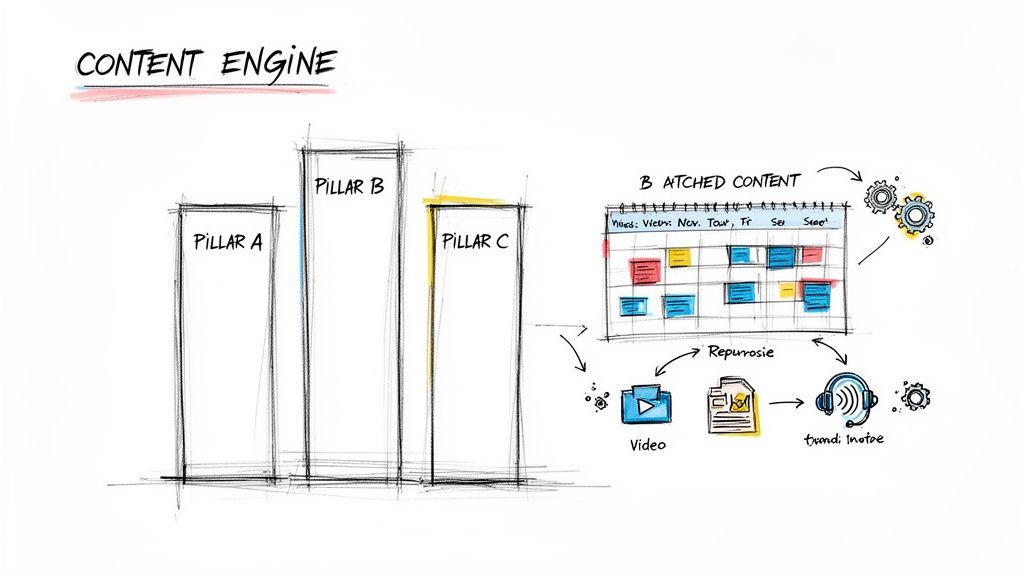
A powerful personal brand isn’t built on random bursts of genius. Sporadic posts get you nowhere. They just get lost in the noise.
If you want to build real authority and stay top of mind, you need a system. I’m talking about a sustainable content engine that works for you, not the other way around. This is how you stop the chaotic, last-minute scramble and start building a real asset library without burning out.
This whole system rests on content pillars. These are the 3-5 core topics you’re going to own. Think of them as the main sections of your expertise. For any professional building their brand, getting this right is how you create focus and prove you know your stuff.
Your pillars aren't just random topics you feel like talking about. They’re the strategic themes that connect what you do best with what your audience needs most. They give your brand a backbone and make it dead simple for people to understand what you're all about.
For a marketing consultant, pillars might be things like "Lead Generation," "Sales Funnel Optimization," and "Email Marketing Automation." Simple, clear, and valuable.
Here’s a quick way to nail down yours:
Once you have your pillars, every single piece of content you create should fall under one of them. No exceptions. This is how you stay consistent and hammer home your authority. You can get way more tactical with this in our full guide on how to create a content plan for your personal brand.
This is where the magic happens. With solid pillars, you’ll never stare at a blank page again. Brainstorming becomes a simple, repeatable process.
Just take each pillar and break it down into sub-topics and different angles. It’s that easy.
Pillar Example: "Team Leadership for First-Time Managers"
| Sub-Topic | Content Format: Article | Content Format: Short Video | Content Format: LinkedIn Post |
|---|---|---|---|
| Giving Feedback | "The Feedback Sandwich Is a Lie: How to Give Real Constructive Criticism" | "My 30-second script for correcting a mistake without killing morale." | "Personal story: The worst feedback I ever got and what it taught me." |
| Delegation | "How to Actually Delegate (Without Feeling the Need to Micromanage)" | "The one question you have to ask before delegating anything." | "Poll: What's your biggest barrier to delegation? Let's talk about it." |
| Meeting Culture | "How I Run 30-Minute Team Meetings That Aren't a Waste of Time" | "The 'silent start' trick I use for more productive meetings." | "Share your best tip for keeping virtual meetings engaging. I'll go first..." |
Look at that. One pillar just gave you a dozen content ideas. Do that for all 3-5 of your pillars, and you're set for months.
Your content engine isn't about creating more content. It's about creating the right content, more efficiently. This is a system for marathon runners, not sprinters.
Here’s the secret the pros know: consistency isn’t about having more time. It’s about being smarter with the time you have. Two strategies are non-negotiable here: batching and repurposing.
Content Batching is simple. You dedicate specific blocks of time to one type of task. Instead of trying to do a little bit of everything each day, you focus. Think of it like an assembly line for your content.
This crushes the mental drain from switching between tasks and lets you get into a deep state of flow. Your output will skyrocket.
Content Repurposing is about working smarter, not harder. You take one solid piece of content and slice it into many smaller pieces.
That 3,000-word guide you wrote? It can also be:
When you build an engine fueled by pillars, batching, and repurposing, you stop being just a content creator and become a content strategist. You’ll have a system that builds your brand’s assets on autopilot, freeing you up to do what really matters: engaging with your audience and building relationships.

Let’s get one thing straight: creating brilliant content is only half the battle. If clients, hiring managers, and collaborators can’t find you, your expertise might as well not exist.
This is where you turn your online profiles into magnets for opportunity that work for you 24/7. It's not about just filling out a few fields on a social media site. It's about strategically using the right keywords and platform features so the right people discover you at the right time.
Your profiles shouldn't be a dusty digital resume. They need to be a landing page for your entire career.
In the professional world, LinkedIn is the main event. Treating it like a simple job-hunting tool is one of the biggest mistakes I see professionals make. Your profile is the cornerstone of your personal brand—a dynamic hub that proves your value.
Let's break down how to get it right.
Your headshot is your first digital handshake. It has to be professional, high-quality, and approachable. Ditch the vacation photos and cropped group pictures. Invest in a clear shot where you look directly into the camera with a genuine expression. This builds trust before anyone reads a single word.
Next up is your headline—the most valuable real estate on your profile. The default "Job Title at Company" is a massive wasted opportunity. You need to use this space to nail your value proposition with keywords your ideal audience is searching for.
See the difference? That small tweak transforms your headline from a boring label into a powerful, searchable summary of exactly who you are and what you do.
Your "About" section is where you connect the dots and tell your story. Don't just list skills—that's what the skills section is for. Weave your core narrative into a few powerful paragraphs. Hook them with a strong opening, explain the problems you solve, and finish with a clear call to action.
Your bio shouldn't read like a formal resume. It’s your chance to speak directly to your ideal client or employer. Use "I" and "you" to create a personal connection and show them you understand their needs.
When you get to your work experience, focus on results, not responsibilities. Instead of just listing what you were supposed to do, quantify what you actually accomplished. This shifts the perception from someone who just shows up to someone who delivers real, tangible value.
Numbers cut through the noise. They provide concrete proof of your impact and make your experience far more compelling. A well-optimized profile is a key part of maintaining a positive digital presence. You can find more strategies in our guide on how to manage your online reputation and boost trust.
LinkedIn gives you plenty of tools to show off your expertise. The "Featured" section is your personal highlight reel. Pin your best stuff here—a popular article you wrote, a presentation you gave, or a key project you led. It immediately directs visitors to your most valuable assets.
Don't sleep on the "Skills & Endorsements" section. While endorsements can feel a bit superficial, they add crucial social proof and help you rank in LinkedIn's search algorithm. Be proactive. Add skills that align with your content pillars and ask a few trusted colleagues to endorse your top competencies.
Finally, customize your LinkedIn URL. A clean URL like linkedin.com/in/yourname is far more professional and easier to share than the default version full of random numbers. It’s a small detail, but it shows you’re intentional about your professional brand.
So, you’ve created some killer content. Great. But if you think your job is done once you hit "publish," you're setting yourself up for disappointment.
Let's be real: "post and pray" is a terrible strategy. Without a smart plan to get your work in front of the right people, even the best content just gathers digital dust. This is where you stop talking at an audience and start building a real community.
This isn’t about spamming your links everywhere. It's about turning passive scrollers into engaged fans who trust what you have to say. That's how you build real authority.
The thought of "engaging" every single day feels exhausting, I get it. But you don't have to live online. All you need is one focused hour to make a massive impact.
Here’s a simple breakdown of how to make that hour count:
This isn't just busy work. This consistent, daily effort tells the algorithms you’re a valuable player, which helps boost your content's reach. More importantly, it gets your name in front of the people who can change the game for your business.
The payoff for this kind of visibility is huge. Top professionals with a recognized personal brand can command fees up to 13.57 times higher than their peers hiding in the shadows. But here's the catch: only about 20% of people building a brand actually get consistent leads from it, usually because they're missing a clear strategy. When it takes 5-7 impressions for someone to even remember your name, this kind of daily, systematic engagement becomes non-negotiable.
Strategic outreach isn't about sliding into DMs with a cold pitch. Think of it more like planting seeds. You're building genuine connections that will eventually grow into clients, collaborations, and new opportunities.
Your goal is simple: become a familiar, trusted name people are happy to see.
When you consistently show up and add value to other people's discussions, they notice. That industry leader whose post you commented on for a month straight? They're the one who might just recommend you for a speaking gig or send a massive client your way.
Don't mistake motion for progress. Engaging with intention means focusing on quality interactions over quantity. One thoughtful comment on a key influencer's post is worth more than a hundred generic "likes."
To give your content the best possible shot at being seen, you also need to be smart about when you post. Understanding the best time to post on LinkedIn in 2026 is a critical piece of the puzzle. Posting at peak times means your hard work doesn't get buried before your audience even logs on.
This system is the engine that drives your personal brand forward. It takes your content from a static library of ideas and turns it into a dynamic tool for networking and creating opportunities. It’s how you make sure your expertise doesn't just exist—it gets seen by the people who matter most.
Alright, you've been putting in the work. Your content is flowing, your audience is growing, and you've got some real momentum. So, what's next?
The real challenge isn't just getting bigger; it's getting smarter. It’s about scaling your impact without chaining yourself to your desk 24/7. This is where we move past the vanity metrics and start looking at what actually moves the needle for your career.
It’s time to stop obsessing over likes and follower counts and focus on the results that matter. Are you getting more connection requests from people you actually want to know? Are inbound DMs about consulting gigs or speaking opportunities popping up? These are the signs your brand is truly working for you.
Your brand isn't just a reputation; it's an asset. The goal is to turn that asset from something that just builds awareness into something that actively creates real-world career and business opportunities.
This means getting brutally honest about your content. Dig into what’s actually performing. Pinpoint the posts, articles, or videos that spark real conversations in the comments and get shared into new, relevant circles. Forget the fluff—double down on what works.
Let's talk about money. Monetizing your personal brand is the natural next step, but you have to do it without alienating the audience you worked so hard to build. It’s not about selling out; it’s about cashing in on the value you've already created.
I see professionals do this successfully all the time. The most common paths include:
The secret is to offer something that feels like a natural next step from the free value you’ve been dishing out. If your brand is all about project management mastery, selling a project plan template or offering consulting on team efficiency is a no-brainer.
Look, you're going to hit a wall. A point where you simply can't do it all yourself. Recognizing that moment is the key to keep growing instead of burning out. Scaling your brand almost always means outsourcing the right tasks so you can focus on the big-ticket items—like networking, closing deals, and being the face of the brand.
You should seriously consider getting help when:
Hiring a virtual assistant (VA), a freelance creator, or a dedicated service like Legacy Builder can take the day-to-day operations off your plate. This frees you up to be the expert and visionary—the one steering the ship. That's how you scale your thought leadership and turn your influence into a real, lasting legacy.
I hear the same two excuses all the time when it comes to building a personal brand. It's easy to get stuck on the "what ifs" before you even start, but let's cut through the noise.
The first one is always time. "Clifton, how can I possibly manage this on top of my demanding job?"
Here’s the truth: it’s not about finding more hours. It's about being strategic with the hours you have. A powerful brand is built with consistent, focused effort—not by hustling yourself into the ground. A few targeted hours each week on content and engagement will do more for you than random, all-day sprints ever could.
The other one I get a lot, especially from seasoned pros, is the fear that they've missed the boat.
Let me be crystal clear: the answer is no. In fact, it's the opposite. Your years of experience are your single greatest asset.
A recent grad is out here building a brand on potential and theory. You? You get to build yours on a solid foundation of proven results and hard-won industry knowledge. Every tough problem you've solved and every project you've nailed is now a story, an insight, or a case study in your content library.
Your professional journey is what gives a personal brand its weight and credibility. You're not starting from zero. You're finally showcasing the value you’ve been building your entire career.
That experience is what makes your perspective authoritative from day one.
Ready to stop making excuses and start building your legacy?
My team at Legacy Builder can handle the entire strategy and content process for you, turning your expertise into real influence.
Let's talk. Learn more about how we can help at https://www.legacybuilder.co.


You could – but most in-house teams struggle with the nuance of growing on specific platforms.
We partner with in-house teams all the time to help them grow on X, LI, and Email.
Consider us the special forces unit you call in to get the job done without anyone knowing (for a fraction of what you would pay).
Short answer – yes.
Long answer – yes because of our process.
We start with an in-depth interview that gives us the opportunity to learn more about you, your stories, and your vision.
We take that and craft your content then we ship it to you. You are then able to give us the final sign-off (and any adjustments to nail it 100%) before we schedule for posting.
No problem.
We have helped clients for years or for just a season.
All the content we create is yours and yours alone.
If you want to take it over or work on transitioning we will help ensure you are set up for success.
We want this to be a living breathing brand. We will give you best practices for posting and make sure you are set up to win – so post away.
Subscribe to our newsletter and get insights on how to grow your personal brand.
