.svg)
Subscribe to our newsletter and get insights on how to grow your personal brand.
Thank you! Your submission has been received!
Oops! Something went wrong while submitting the form.
.svg)


Before anyone ever meets you—whether it's an investor, a potential hire, or a new client—they've probably already Googled you.
That first page of search results is your new handshake. It forms a powerful, and often irreversible, first impression. For founders and professionals, your digital presence isn't just a "nice-to-have" anymore. It's a critical asset that directly opens or closes real-world opportunities.
What people find dictates their next move. A collection of positive articles, a polished LinkedIn profile, and content showcasing your expertise? That builds immediate trust. On the other hand, outdated information, negative reviews, or a complete lack of presence can create friction and doubt before you even get a chance to speak.
Ignoring your online story has tangible financial consequences. Projections show that by 2026, brand reputation will make up 30–40% of a company's total enterprise value. That’s a direct line from digital perception to financial worth.
In fact, over 90% of professionals link online reputation management to at least 25% of their company's market value. Neglecting it could literally slash your company's worth by thousands or even millions.
So, how do you take control? It really boils down to three core pillars: Auditing where you stand now, Building the narrative you want, and Defending your reputation against threats.
This simple three-step cycle is the foundation of effective reputation management.
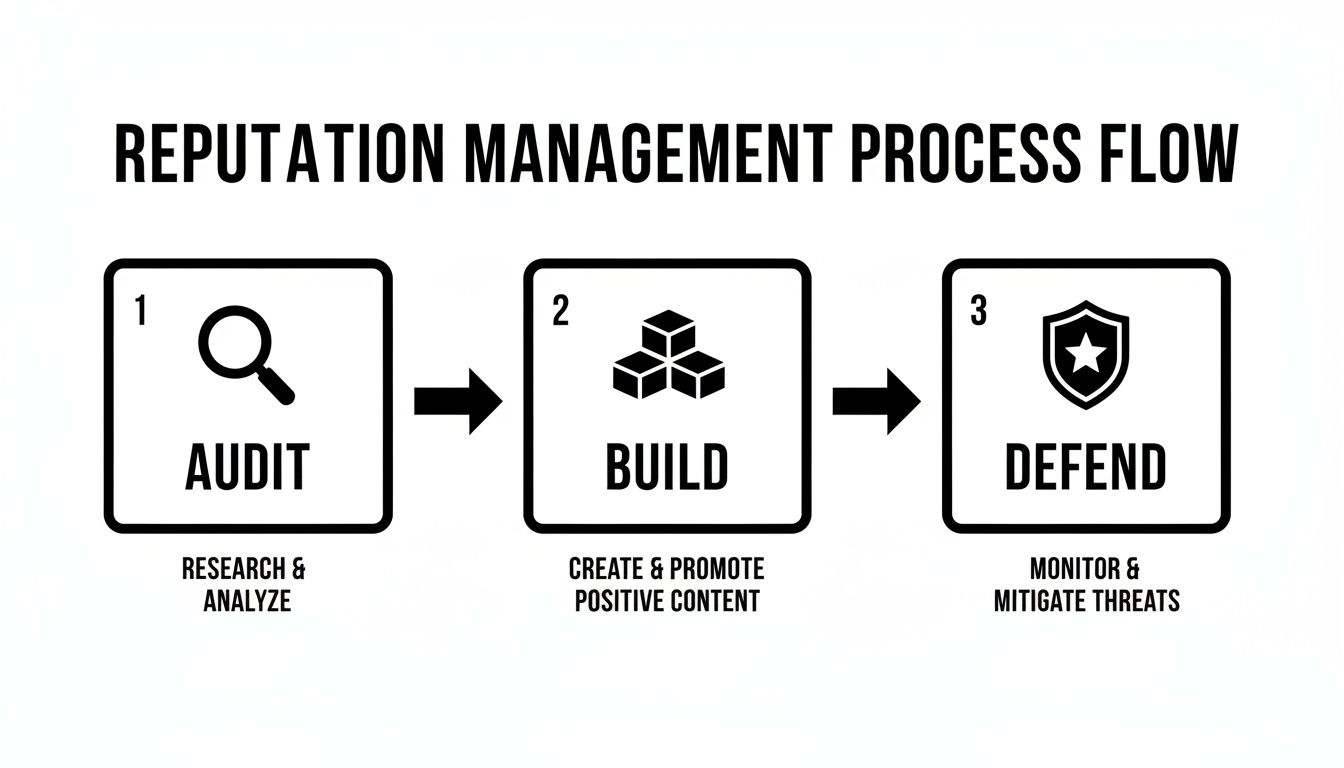
It all starts with a clear-eyed assessment, moves into proactive building, and finishes with ongoing protection. It's a loop, not a one-and-done task.
To give you a clearer picture, here’s a quick breakdown of this framework. Think of it as your go-to cheat sheet for managing your reputation.
This table maps out the entire strategy. It’s a simple but powerful way to stay focused on what really matters.
Here’s the good news: you have far more control over this narrative than you think. Every piece of content you create, every profile you optimize, and every interaction you have online shapes your digital footprint. It’s all part of the story. For example, knowing how to upload a resume to LinkedIn for maximum visibility is a small but practical step toward owning your professional image.
Your online reputation is the story that gets told about you when you're not in the room. The goal is to become the primary author of that story, not a passive observer.
Ultimately, knowing how to manage your online reputation means treating your digital presence with the same strategic care you give any other business asset. It’s a deliberate, ongoing effort to ensure that what people find online is an accurate reflection of your expertise, your values, and your vision.
If you’re just starting out, a great next step is to get the fundamentals right. For a deeper dive, check out our guide on how to build an online presence.

Before you can start building, you need to know what you’re working with. You have to get a clear, unfiltered look at your digital footprint as it exists right now.
Think of it this way: you wouldn't start building a house without surveying the land first. An audit isn't about judging your past; it’s about gathering intel to build a smarter future. This first step shows you exactly what potential clients, investors, or partners see when they google your name.
Without this realistic snapshot, you're just guessing. You could be pouring energy into a platform that nobody sees, all while a nasty review on some obscure site is quietly killing your credibility. This audit is your strategic starting point.
So, let's get our hands dirty.
First things first: you need to see what the rest of the world sees. Your everyday Google search is biased. It knows what you've clicked on before, where you are, and what you like, so it serves you a personalized version of reality.
To get around this, you have to use an incognito or private browsing window every single time you do this. It's non-negotiable. This strips away the personalization and gives you the most accurate, neutral view of what shows up on the search engine results page (SERP).
What exactly should you search for? Start broad, then get specific.
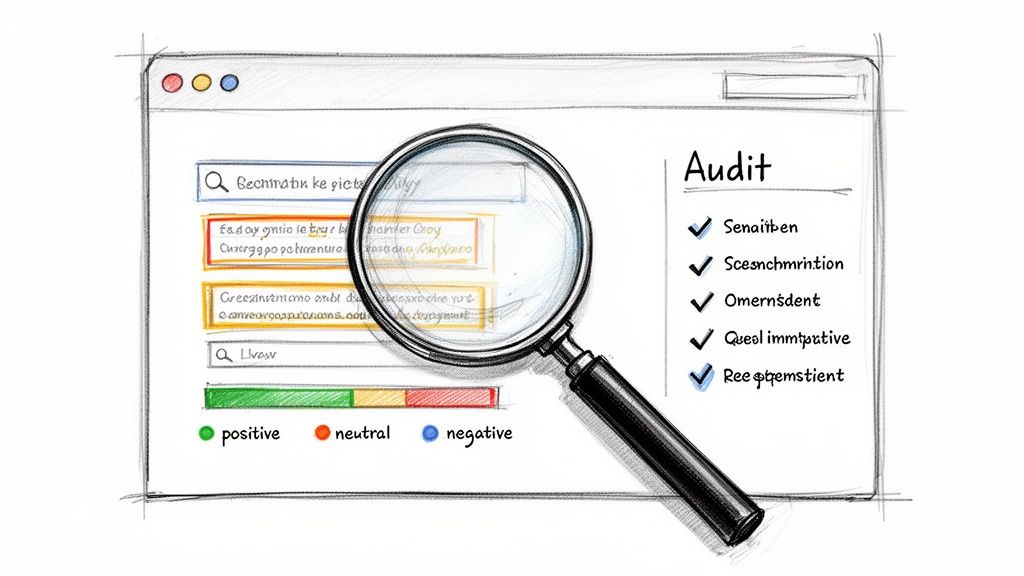
As you go, document everything you find on the first two pages of results. A simple spreadsheet will do the trick. Track the link, what it is (LinkedIn, article, review), and whether it's positive, neutral, or negative.
A basic name search is just scratching the surface. To really understand how to manage your online reputation, you need to find conversations happening about you beyond the obvious places. This is where Google's advanced search operators become your best friend.
These are just simple commands you can add to your search to get laser-focused results.
Here are a few of my go-to operators for this kind of work:
"Your Name" -site:linkedin.com: This search finds exact mentions of your name everywhere except LinkedIn. It's brilliant for uncovering articles, blog posts, or forum mentions you had no idea existed.site:reviewsite.com "Your Company": Want to see what people are saying on G2 or Capterra? Use this to search for your company name only on a specific review site."Your Name" + "review" OR "scam": This one goes straight for the jugular. It surfaces any content that pairs your name with potentially damaging keywords, letting you find fires before they become infernos.Using these operators is like putting on night-vision goggles. They reveal what's hiding in the shadows of your digital footprint.
Key Takeaway: An audit isn't a one-and-done task. Set a recurring reminder in your calendar to do a quick check-up every month. This helps you spot new things early and stay ahead of the narrative.
Now that you have your list of links, it's time to analyze what you've found. The stakes are incredibly high. A shocking 94% of consumers say that negative online information has convinced them to avoid a business. On the flip side, 76% of people trust online reviews as much as a personal recommendation.
Go through your spreadsheet and categorize each link: positive, negative, or neutral. Don't overlook the neutral stuff. An old, outdated directory listing isn't "bad," but it's a huge missed opportunity to tell your story and control the narrative.
With this audit in hand, you finally have a map. Now you can stop guessing and start strategically building and defending your personal brand.
Let's be real: the best defense is a good offense. Now that you've done the audit and know where you stand, it's time to stop playing defense and start building a proactive system. We're moving from just reacting to problems to actively shaping your brand narrative 24/7.
This isn't about nervously waiting for a negative review to pop up. It's about building a "digital firewall" that protects you from potential hits while making sure your best story is the one everyone sees and hears. To do this right, we need two key things: a way to monitor conversations in real-time and a solid game plan for responding to all feedback.
When you're prepared, you have the power to turn a potentially nasty comment into a public display of exceptional customer service. That's the goal.
You can't manage what you can't measure, and you certainly can't respond to conversations you don't even know exist. This is where a good monitoring system comes in. It's your real-time pulse check on what people are saying about you across the internet.
And you don't need a massive budget to get this going. There are plenty of fantastic tools out there, both free and paid, that can act as your digital eyes and ears.
Here are the essentials I recommend for your stack:
Once you have these running, you'll see a steady stream of mentions. The trick is not to get overwhelmed but to quickly sort out what needs your attention now.
Getting an alert is just the first step. How you respond is what separates the pros from the amateurs. A pre-planned playbook takes the panic out of the equation and ensures you're consistent, on-brand, and effective every single time.
Your playbook needs to cover both the good and the bad.
When that negative comment inevitably shows up, the absolute worst thing you can do is get defensive or pretend it didn't happen. Your response is a performance for everyone watching. Handle it well, and you can build more trust than a dozen 5-star reviews ever could.
Here’s a simple, four-part framework to use in your public reply:
The stakes here are incredibly high. By 2026, a four-star rating will be the new normal, and dropping just one star can slash revenue by 5-10%. On top of that, 85% of consumers say they pay close attention to whether a business replies to negative feedback. Your response strategy isn't just PR; it's a direct driver of growth. You can discover more insights on how engagement defines future business growth and learn about this trend's impact.
Positive feedback is pure gold. Don't just "like" it and scroll on. You need to amplify it.
When a client or customer leaves a glowing review, it's not just a compliment—it's a powerful marketing asset. Your job is to make sure as many people as possible see it.
So, how do you put these positive mentions to work?
By consistently keeping an ear to the ground and having a clear plan for praise and criticism, you turn reputation management from a reactive chore into a strategic tool for building unstoppable trust and credibility.

If you don’t tell your story online, the internet will piece one together for you from whatever scraps it can find. This is where you flip the script—shifting from damage control to proactively building.
It's about deliberately populating search results with positive, authoritative, and authentic content that you control. This isn't about creating a fake persona. It's about making sure the digital version of you actually reflects your expertise, your values, and the real value you bring to the table.
The goal is to build a "digital firewall" of positive assets. This becomes your first line of defense and, more importantly, your best introduction. By taking charge of the right platforms and having a clear content strategy, you become the primary author of your online story.
When someone searches your name, they should find exactly what you want them to see.
For most professionals and founders, LinkedIn is the single most important piece of online real estate you'll ever own. It often ranks as the #1 search result for your name, making it the default first impression for investors, clients, partners, and future hires.
Your LinkedIn profile needs to be more than a digital resumé. Think of it as a dynamic hub for your professional brand—a platform for sharing your insights and a powerful networking tool. Neglecting it is like boarding up the front door of your flagship store.
Here’s how to turn it from a static CV into a compelling narrative tool:
Optimizing your profile is the foundation. But to truly build a narrative, you have to participate. A big part of that is learning how to get more connections on LinkedIn, which is a key step in building a robust professional presence.
Once your core profiles are dialed in, it’s time to start publishing. A consistent content strategy is what separates a passive profile from a genuine thought leader. It’s how you demonstrate your expertise, share your unique perspective, and build a community around your ideas.
The key is to focus on value, not just self-promotion.
Every post, article, or video should answer one question: "How does this help my audience solve a problem or understand something better?"
This doesn't mean you need to become a full-time creator. Consistency trumps frequency. One thoughtful, well-written article a month is far more powerful than shallow daily posts that just add to the noise.
A strong content strategy is your long-term reputation insurance. Each piece of high-quality content you publish is another positive asset that ranks in search, pushing down irrelevant or negative results while cementing your authority.
Think about your core expertise. What are the common questions you get from clients? What industry trends do you have a unique take on? These are the seeds of your content strategy. It's essential to build your brand storytelling framework that wins hearts and genuinely connects with the people you want to reach.
You don't need to be everywhere. Trying to maintain a presence on every social platform is a recipe for burnout and diluted impact. The smarter approach? Pick one or two platforms where your target audience actually hangs out and go deep.
Where you build your content library depends on your strengths and your audience's habits.
One of the most powerful strategies is a "hub and spoke" model. Use a blog or a podcast as your central "hub" for long-form content, then use social media as the "spokes" to distribute that content and jump into daily conversations.
Ultimately, crafting your narrative is an ongoing process. By optimizing your core profiles and consistently sharing your expertise on the right platforms, you take back control of your story. You build the exact online reputation you want people to find.
Building a strong online reputation isn't a one-and-done project you can check off a list. It’s a living, breathing system you have to maintain.
Like any valuable business asset, it needs consistent, thoughtful upkeep to grow in value and shield you from whatever comes next. The biggest mistake I see people make is treating reputation management like a temporary cleanup job.
The real power comes when you turn these efforts into a sustainable, low-friction routine. For busy founders and professionals, this isn’t about adding another ten hours to your workweek. It’s about integrating small, high-impact habits into your schedule that keep your digital presence sharp, authentic, and resilient.
This is what ensures the positive story you’ve built continues to dominate search results, acting as a permanent buffer against any negativity that might pop up. It’s the difference between a reputation that's solid as a rock versus one built on sand.
The key here is a simple, repeatable checklist that doesn’t feel like a chore. If it’s too complicated, you won’t stick with it. Break down your reputation management into quick weekly and monthly actions.
This approach stops you from getting overwhelmed and makes sure nothing important slips through the cracks. It turns a vague goal like "manage my reputation" into a series of clear, achievable tasks. That consistency is what builds real momentum.
Here’s a practical schedule you can steal and adapt:
This weekly rhythm keeps you in the loop without eating up your time. It’s a small investment that pays off big in visibility and relationship-building.
Once a month, block out an hour to look at the bigger picture. This session is less about day-to-day mentions and more about strategic direction. It's your chance to see what’s actually working and plan your next moves.
Think of it as your personal brand's board meeting.
Consistent, strategic effort is what separates a fleeting online presence from an influential and resilient digital legacy. The small actions you take each month compound over time to build an unshakeable reputation.
Here are the key things to cover in your monthly check-in:
This disciplined approach ensures you’re proactively gathering social proof and creating content that reinforces your expertise. It’s also how you see the ROI on your efforts over time. For a deeper dive on expanding your content, our guide on how to scale content creation for your personal brand has some great strategies.
As your brand grows, so do the demands on your time and the complexity of your reputation. What starts as a manageable solo effort can quickly become a beast. Recognizing when to call in reinforcements is a smart strategic move, not a sign of failure.
Consider getting specialized support if you’re in one of these situations:
Bringing in a consultant or a specialized agency can give you the strategic firepower to hit that next level, freeing you up to focus on what you do best—running your business. The end goal is to build a system, whether managed by you or a team, that works tirelessly to make sure your online presence is a powerful asset, not a potential liability.
Even with a solid plan, you're going to have questions. It's just the nature of the beast. Specific situations pop up, and you need straight answers—not just theories. I've been in this game a long time, and the same questions come up again and again from founders and professionals just trying to get a handle on their digital footprint.
Think of this as the no-BS guide to those common hurdles. Getting these answers right helps you make smarter moves, set realistic goals, and put your energy where it'll actually make a difference.
Let's get one thing straight: fixing a damaged online reputation is a marathon, not a sprint. Anyone who tells you otherwise is selling you snake oil. The timeline really boils down to how bad the damage is and how much authority the negative content has.
If you're dealing with something relatively minor, like a single negative review on Yelp or G2, you can start to see a shift in one to three months by consistently bringing in new, positive reviews. It's a numbers game.
But for the big stuff? A nasty news article from a major publication? That’s a different battle. We're talking six to twelve months, maybe even longer, to push that down. It’s a slow and steady process of creating and promoting positive content—your profiles, blog posts, podcast appearances, good press—to systematically shove the negative stuff off the first page of Google, where almost no one will ever find it.
I wish it were that simple. The short answer is almost always no. You can't just ask Google to take down a bad review or a critical article because you don't like it. That’s not how it works.
Getting something removed is only a real possibility if the content breaks the law or violates Google's very specific rules. We’re talking about things like:
For everything else—which is 99% of negative content—the game isn't about removal. It's about suppression. This is the core of modern reputation management. You have to build a stronger, more positive presence that outranks and buries the negative, making it irrelevant.
If you're a professional, founder, or executive, this isn't even a debate: it's LinkedIn. Hands down. Go search your name right now. Your LinkedIn profile is probably one of the top results, if not the very first one. It’s your digital first impression.
Unlike other social platforms, LinkedIn is built for business. You have total control over the story you tell. A well-built profile is the command center for your entire personal brand.
Your LinkedIn profile is no longer just a digital resume; it's your personal landing page for the professional world. It's where potential clients, investors, and partners go to validate your expertise and decide if you're someone they want to work with.
A killer profile isn't optional. You need a professional headshot, a headline that screams value (not just your job title), a detailed "About" section that tells your story, and a consistent stream of valuable posts. It is the absolute cornerstone of any proactive reputation strategy.
At Legacy Builder, we specialize in transforming your expertise into a powerful online presence that builds trust and opens doors. If you're ready to take control of your narrative and build an authentic personal brand, let's talk.


You could – but most in-house teams struggle with the nuance of growing on specific platforms.
We partner with in-house teams all the time to help them grow on X, LI, and Email.
Consider us the special forces unit you call in to get the job done without anyone knowing (for a fraction of what you would pay).
Short answer – yes.
Long answer – yes because of our process.
We start with an in-depth interview that gives us the opportunity to learn more about you, your stories, and your vision.
We take that and craft your content then we ship it to you. You are then able to give us the final sign-off (and any adjustments to nail it 100%) before we schedule for posting.
No problem.
We have helped clients for years or for just a season.
All the content we create is yours and yours alone.
If you want to take it over or work on transitioning we will help ensure you are set up for success.
We want this to be a living breathing brand. We will give you best practices for posting and make sure you are set up to win – so post away.
Subscribe to our newsletter and get insights on how to grow your personal brand.
