.svg)
Subscribe to our newsletter and get insights on how to grow your personal brand.
Thank you! Your submission has been received!
Oops! Something went wrong while submitting the form.
.svg)


Sure, a personal mission statement template is a decent place to start. It gives you a basic fill-in-the-blank structure to get your thoughts down on paper. It can take a big, intimidating idea and make it feel a little more manageable.

But let’s be real. The real magic happens before you even touch a template. Just filling in the blanks without doing the deep thinking first will leave you with a generic, hollow statement. It might sound nice, but it won’t have any real conviction behind it.
A truly powerful mission statement is so much more than a slick one-liner for your LinkedIn bio. It’s a practical tool for making tough decisions.
Think of it as your own internal compass. When you’re standing at a career crossroads, it’s the thing that points you in the right direction. It helps you sift through opportunities and make sure your professional life actually lines up with who you are. That clarity is what separates a meaningful career from just a string of random jobs.
Your personal mission statement becomes a gut-check for every professional choice you face. A new project hits your desk? A tempting job offer comes through? You hold it up against your mission and ask the hard questions.
Does this actually get me closer to where I want to go? Does it align with the things I truly value?
This simple test gives you the confidence to say ‘yes’ to the right things and, maybe even more importantly, say ‘no’ to the things that will pull you off course. It’s so easy to drift into roles that pay the bills but drain your soul if you don't have this filter.
A well-crafted mission statement transforms decision-making from a reactive process into a proactive one. It equips you to intentionally build a career that reflects who you are and the impact you want to make.
Walking into a job interview with a crystal-clear sense of purpose is a total game-changer. When the interviewer hits you with, "So, tell me about yourself," you can respond with a story that’s actually grounded in your mission.
This immediately shows you're self-aware. You’re not just looking for any job—you’re looking for the right job that fits into your bigger picture.
And that clarity bleeds into everything else. It shapes how you network, the skills you choose to develop, and the content you create and share online. It becomes the bedrock of your personal brand, making sure you show up consistently and authentically. A strong mission statement is also a key piece of a robust personal development plan.
Look, the benefits here aren't just fluffy, feel-good ideas. The data backs it up. People who actually write down their personal mission see real, measurable gains in goal clarity and productivity.
For instance, some coaching programs have found that participants who craft and use a mission statement report an increase in decision-making speed by about 15% in just a few months. It's a simple tool, but it has a real impact on your focus and how effectively you get things done.
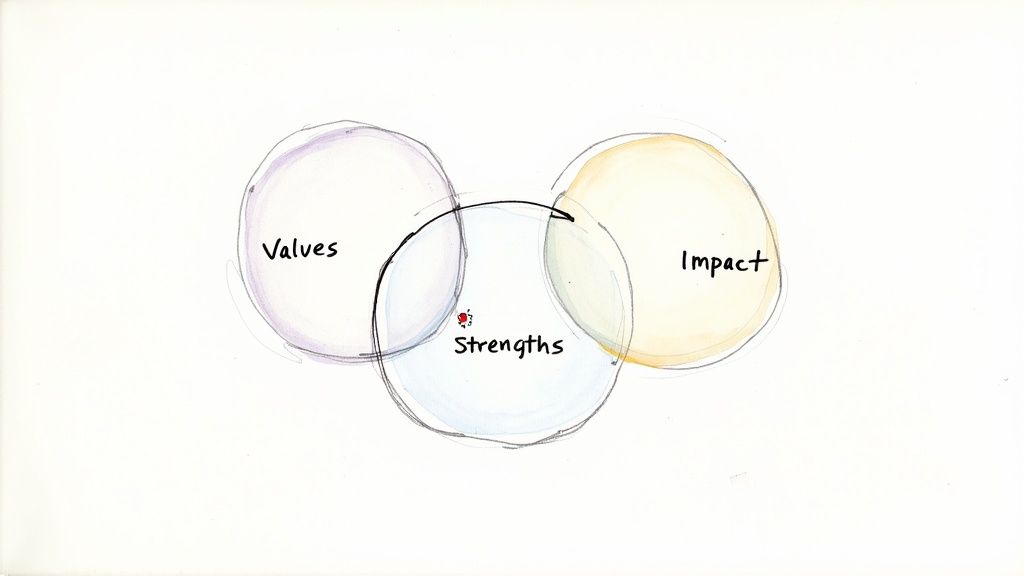
A truly magnetic personal mission statement isn’t something you just pull out of thin air. It’s built, piece by piece, from three core ingredients that define who you are and what you’re about.
Think of it like a three-legged stool. If one leg is missing or wobbly, the whole thing collapses. The same goes for your mission. You need all three pillars to create a statement that's not only authentic but also has real teeth.
These three ingredients are your core values (what you truly stand for), your unique strengths (what you do better than anyone else), and your desired impact (who you serve and how you change their world). The magic isn't just in identifying them, but in digging deep to find the real, specific truths behind each one.
Let’s get our hands dirty and break down how to find yours.
Your core values are your non-negotiables. They’re the principles guiding you when the pressure is on and nobody’s watching. Too many people stop at generic words like “honesty” or “creativity,” but those are just starting points. They’re too vague to mean anything.
The real goal is to define what those words look like in action.
For instance, "honesty" could become "speaking truth to power, even when it’s uncomfortable." "Creativity" might transform into "connecting disparate ideas to build simple solutions for complex problems." See the difference?
Here’s a quick exercise to get you there:
A value isn't an aspiration. It's a gut-level principle you can already see in your past decisions. Your mission statement just gives it a voice.
Getting this foundation right is everything. For anyone looking to build a brand or business that truly stands for something, you can take this a step further by exploring how to discover your foundational story.
Alright, now let's move from what you believe to what you do exceptionally well. Your strengths aren't just things you're "good at"—they’re the unique blend of skills and talents that make you effective. Again, we have to get specific. Vague claims like "I'm a people person" or "I'm a hard worker" are useless here.
We need to translate those into tangible actions.
"A people person" could really mean you have a knack for "making technical concepts accessible to non-technical stakeholders." A "hard worker" might be better described as someone who excels at "turning chaotic projects into streamlined, actionable plans."
Think back to the moments you felt completely in the zone—energized, confident, and effective. What were you actually doing?
Your true strengths live at the intersection of what you're great at and what you actually enjoy. Don't just list your job description; pinpoint the specific actions that make you feel like you’re winning.
This is the final, crucial piece of the puzzle. It connects your values and strengths to the world around you. Your impact answers two simple but powerful questions: Who do you help, and what's the change you create for them?
This is what turns an internal mantra into an external mission.
Your "who" can be a specific audience, a type of client, or your team. The "what" is the transformation you deliver.
Let’s look at a couple of examples:
Once you have clear, honest answers for what you value, what you excel at, and who you're here to serve, you've got all the raw materials you need. All the templates in the world are just containers—now, you have something real to put inside them.
To make this crystal clear, I've broken down these three pillars into a simple table.
This table summarizes the three pillars we just covered. Use the questions to guide your thinking and make sure you're digging deep enough for each component.
With this framework, you're not just guessing anymore. You’re building your mission statement on a rock-solid foundation of self-awareness.
Alright, you've done the deep work—you've dug into your values, pinpointed your strengths, and defined the impact you want to make. Now it's time to put it all together.
But staring at a blank page? It’s paralyzing. That's where a solid personal mission statement template becomes your best friend.
Don't think of these as rigid rules. They’re frameworks. They’re starting blocks designed to get your ideas flowing and give them some structure. We'll start simple and build from there, so you can grab the one that feels right for you and your goals.
The mission right now is progress, not perfection. Let’s get a draft on paper.
This one is short, punchy, and built for action. It’s perfect for a LinkedIn headline, an email signature, or that classic elevator pitch. It cuts straight to the chase and is designed to stick in people's minds.
Think about it: brevity wins. Recent data consistently shows that over 70% of people prefer mission statements that are just one or two sentences. Concise and clear is always more effective.
Template Structure:
To use my strength in [Your #1 Strength] to help [Your Target Audience] achieve [Your Desired Impact].
Here’s how it looks in the real world:
This template forces you to be laser-focused. There's zero room for fluff, which is exactly why it’s a killer for professional bios where every character counts.
If your core values are the engine driving everything you do, this template is for you. It puts your "why" front and center before you even get to the "what" and "how." The result is a statement that feels deeply authentic and principled.
This approach is gold for leaders, creators, and anyone whose work is tied to a core belief system. It doesn't just say what you do—it says why it matters.
Template Structure:
Guided by my core value of [Your Core Value], I leverage my skills in [Your Key Strengths] to create [Your Desired Impact] for [Your Target Audience].
Let's see it in action:
Look, sometimes a single sentence just won't cut it. This expanded template gives you a bit more room to breathe, letting you flesh out the action you take and the ultimate transformation you're aiming for.
This version is perfect for your website's "About" page or as a north star for your career plan. It paints a much fuller picture of who you are and the change you're here to make.
Template Structure:
My mission is to [Action Verb + Your Strengths] for [Your Target Audience]. I do this by [Method or Process], so that they can [Ultimate Outcome/Transformation].
And here's how it plays out:
Pro-Tip: Don't get trapped by the exact wording. These are jumping-off points. Swap "to help" for "to empower," "to build," or "to create." The best statement is the one that sounds like you.
If you want to pull all your self-improvement tools together, checking out a dedicated personal bundle of templates can really help streamline the process.
The most critical step? Just start.
Pick the template that speaks to you and get that first draft down without second-guessing every word.
Here’s a quick game plan:
Remember, this is a living document. The mission you write today will evolve as you do. The point is to create a powerful starting line that gives you direction right now.
Templates are great for structure, but nothing makes the concept click like seeing real-world examples in action. The jump from a rough draft to a final, polished statement happens when you see how others have distilled their values and strengths into something powerful.
Let’s break down a few examples for different roles. I'm not just going to show you the final version; we’re going to look under the hood to see why they work. This will help you spot the patterns and borrow the ideas that click with your own journey.
A developer’s impact is all about creating clean, functional experiences. Their mission statement should reflect that focus on building, solving tough problems, and making tech work for people.
The Statement:
"To build elegant, scalable software that empowers creative teams to bring their visions to life without being limited by technology."
Why It Works:
This statement cuts through the jargon. It clearly communicates the developer’s real purpose: making complex technology feel effortless for the people who use it.
A marketer's mission almost always revolves around connection, storytelling, and growth. Their statement needs to capture that unique ability to bridge the gap between a brand and its audience, which is a totally different ballgame than a technical role.
The Statement:
"Guided by a commitment to authentic connection, I craft data-driven narratives that help mission-driven brands build lasting communities, not just customer lists."
Why It Works:
For any creative, the mission is intensely personal. It’s tied to emotion, expression, and a unique way of seeing the world. The statement has to capture the feeling they want their audience to walk away with.
The Statement:
"To create art that sparks curiosity and encourages viewers to find beauty in the overlooked corners of daily life."
Why It Works:
Your personal mission statement is your professional north star. It should be specific enough to guide your decisions but broad enough to let you grow.
As you start putting your personal brand out there, it helps to see how others have woven their mission into their work. The articles and case studies over on the Legacy Builder blog are packed with examples of pros who are nailing this.
Let's be real—different jobs call for different priorities. A project manager is all about efficiency and team dynamics, while a nurse’s world revolves around compassion and patient care. Getting a feel for these subtle differences will help you sharpen your own statement.
Check out how the focus shifts depending on the role.
Don't just copy these—use them for inspiration. The key takeaway is how each one finds the perfect balance between the "what I do" and the "why it matters." Find that sweet spot for yourself, and you’ll have a mission statement that actually works for you.
So you've crafted the perfect personal mission statement. That's a huge step. But if it just sits in a notebook collecting dust, you're missing the entire point. Its real power isn't in having it; it's in using it.
The goal here is to bake this mission so deeply into your professional life that it becomes your default setting. This is how you turn a simple paragraph from a nice idea into a practical tool that guides your career, day in and day out.
First things first: you need to see it. Constantly. "Out of sight, out of mind" is the enemy here. By placing your mission statement in the digital spaces you live in, you keep your purpose front and center for yourself and everyone in your network.
Think about these simple but powerful placements:
This isn't just about branding—it's about daily accountability. Every time you see it, you're reminded of the standard you've set for yourself and the impact you’re working to create.
A mission statement is most powerful when it moves from a private journal entry to a public declaration. This visibility creates consistency and reinforces your commitment to your own goals.
This is where your mission statement really starts to pay the bills. It becomes your go-to filter for every opportunity that comes your way, helping you cut through the noise and focus on what actually moves the needle.
Before you say "yes" to anything new, run it through the "mission test."
Ask yourself a few hard questions:
A job might dangle a huge salary, but if it forces you to compromise on a core value, your mission statement is the alarm bell you need to hear. A project might sound cool, but if it doesn’t play to your strengths, it's a fast track to burnout. This filter gives you the confidence to say "no" to the distractions so you can save your energy for what truly matters.
Beyond just filtering out the bad stuff, your mission statement is an active tool for building your career. It sharpens how you talk about yourself and makes sure your personal brand feels authentic and consistent everywhere.
Nail Your Interviews: When an interviewer hits you with, "Tell me about yourself," or "Why do you want this job?" your mission statement is your secret weapon. It lets you tell a compelling story about how your personal purpose aligns with their company's goals, instantly making you stand out.
Network with Purpose: Ditch the generic small talk. Introduce yourself by framing what you do within your mission. This sparks deeper, more memorable conversations and naturally attracts people who get what you're about. If you're looking for more ways to weave this into your daily grind, check out tools designed to help you build your legacy daily.
This infographic breaks down how different pros might frame their mission, showing the unique focus each role demands.
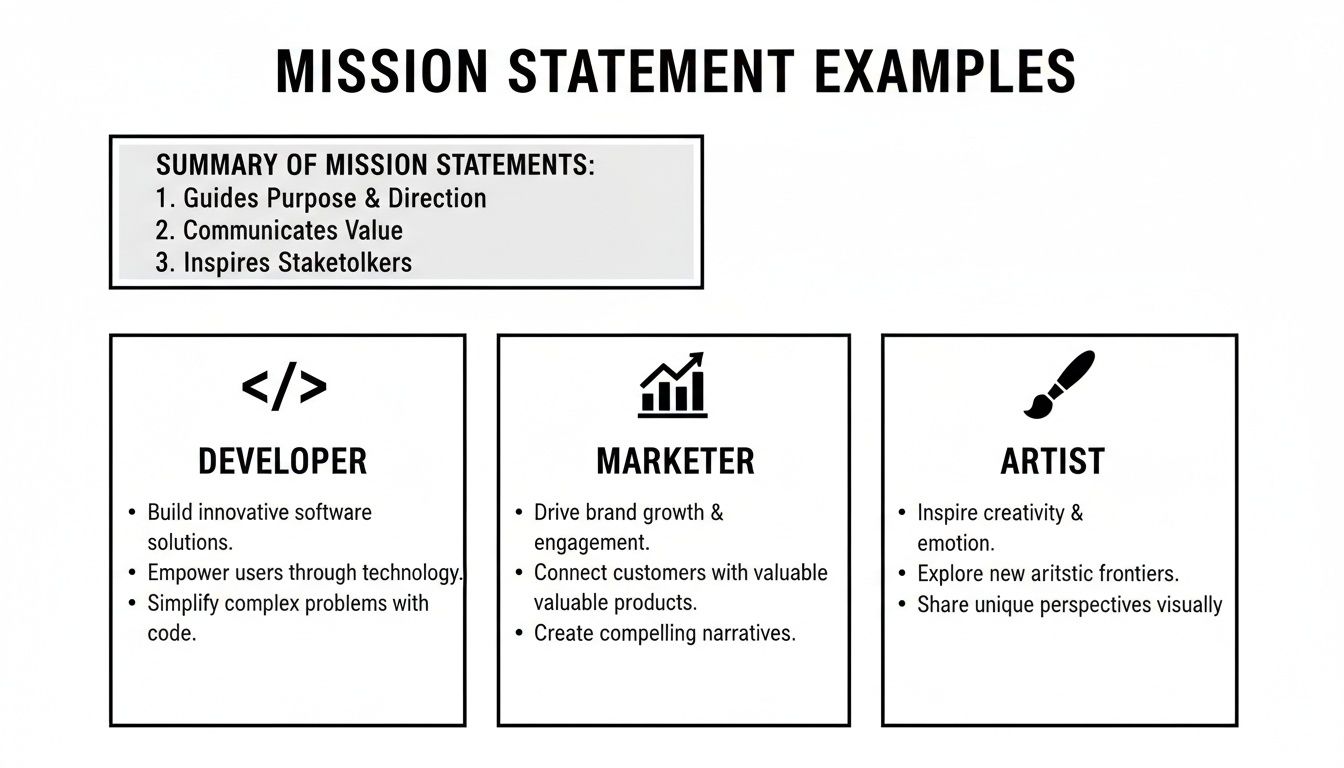
As you can see, a developer is focused on building solutions, a marketer on forging connections, and an artist on sparking emotion. Each is powerful because it's rooted in a clear, personal mission.
When you make your mission a living, breathing part of your daily routine, you guarantee that every move you make is a deliberate step toward the impact you were meant to create.
Even with the best templates in hand, it’s totally normal to hit a few snags when you’re trying to pin down something as big as your life's mission. You’re trying to distill years of experience and ambition into a few powerful words. It's a big task.
Let's walk through some of the most common questions I hear. Think of this as a quick-reference guide to iron out any last-minute wrinkles so you can get your statement dialed in and ready for action.
Your mission statement isn't carved in stone. It’s a living document that should evolve right along with you. Life throws curveballs, careers pivot, and what drives you today might be different from what drives you five years from now.
I tell my clients to give it a solid review at least once a year. This annual check-in is crucial to make sure it still feels right and aligns with where you're headed.
But you should also pull it out and take a hard look anytime you hit a major life milestone, like:
Bottom line: If you look at your daily actions and they feel completely disconnected from what your mission says, that's your cue. It's time for a refresh.
This one trips people up all the time, but the distinction is actually pretty simple. It all boils down to timing and focus.
Your mission statement is about the present. It’s the "what" and the "how." It defines what you do, who you do it for, and the value you're bringing to the table right now. It's your daily roadmap.
Your vision statement, on the other hand, is all about the future. It’s the ultimate outcome you’re working toward—the big, audacious "why" that fuels your journey. It's the destination you're driving to.
Your mission is the work you do today. Your vision is the world you hope to create tomorrow. You need both, but they play different roles.
Specificity is your best friend here. Generic statements are usually filled with vague, feel-good words like "help people" or "make a difference" without any real teeth.
To break free from the generic trap, you have to get specific.
Instead of saying, "I want to help people," drill down. Who are you helping? "I help first-time founders." How do you help them? "I help first-time founders secure their first round of funding by demystifying the pitch process." See the difference?
Same goes for your strengths. Don't say you're a "good communicator." Get specific. Say you "translate complex software features into compelling benefits that a non-technical sales team can actually use." The more detail you add, the more your unique value shines through.
Absolutely. Don't get hung up on forcing everything into a single sentence. While a punchy one-liner is great for a LinkedIn headline or an elevator pitch, clarity is more important than brevity.
If it takes two or three sentences to capture your purpose without adding fluff, go for it. A lot of people I work with actually develop two versions:
Never sacrifice meaning just to hit a specific word count. The "right" length is whatever it takes to create a statement that's clear, authentic, and genuinely you.
At Legacy Builder, we specialize in transforming your personal mission into high-impact content that builds your influence and authority. If you're ready to turn your purpose into a powerful online presence, learn more about our process at https://www.legacybuilder.co.


You could – but most in-house teams struggle with the nuance of growing on specific platforms.
We partner with in-house teams all the time to help them grow on X, LI, and Email.
Consider us the special forces unit you call in to get the job done without anyone knowing (for a fraction of what you would pay).
Short answer – yes.
Long answer – yes because of our process.
We start with an in-depth interview that gives us the opportunity to learn more about you, your stories, and your vision.
We take that and craft your content then we ship it to you. You are then able to give us the final sign-off (and any adjustments to nail it 100%) before we schedule for posting.
No problem.
We have helped clients for years or for just a season.
All the content we create is yours and yours alone.
If you want to take it over or work on transitioning we will help ensure you are set up for success.
We want this to be a living breathing brand. We will give you best practices for posting and make sure you are set up to win – so post away.
Subscribe to our newsletter and get insights on how to grow your personal brand.
