.svg)
Subscribe to our newsletter and get insights on how to grow your personal brand.
Thank you! Your submission has been received!
Oops! Something went wrong while submitting the form.
.svg)


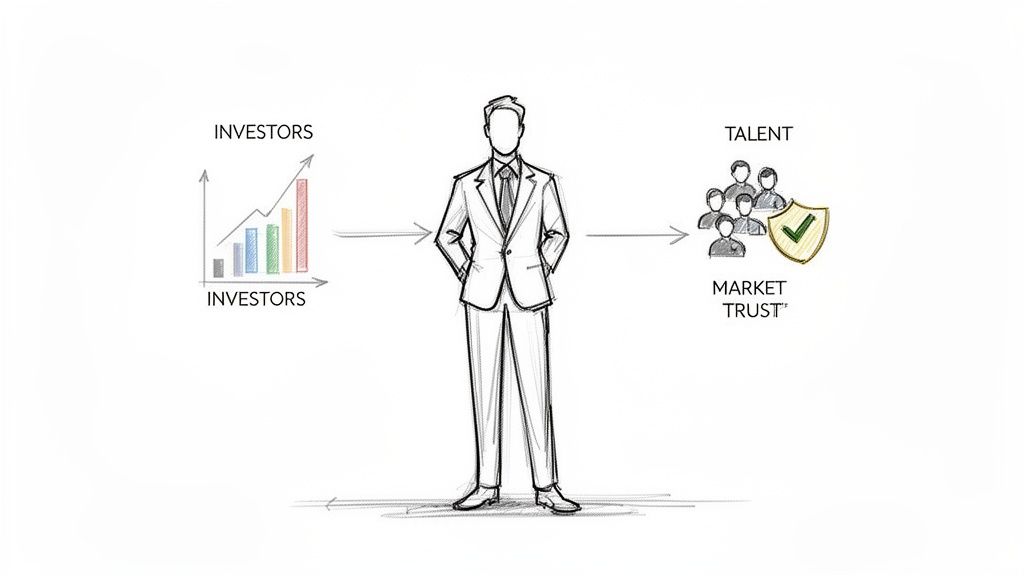
Let's get one thing straight: an executive's personal brand isn't some vanity project or a side-hustle. It's a core business function. It's the deliberate process of building your professional reputation to hit tangible business goals—whether that’s attracting investors, hiring A-players, or building unshakable market trust.
This isn't about relying on your company's logo to do the heavy lifting. It's about turning your personal influence into a measurable asset.
The days of building a reputation behind closed boardroom doors are over. That model is completely broken.
Today, your digital footprint gets to the meeting long before you do. It shapes perceptions before you ever shake a hand. When a CEO or VP shares their genuine perspective on where the industry is headed, they’re doing more than just posting online. They’re humanizing the entire company. They’re building a bridge of trust that corporate marketing, on its own, simply can't.
Don't just take my word for it. The data is clear: a staggering 82% of people trust a company more when its senior leaders are active and visible on social media.
This trust pays dividends. Investors aren’t just backing a balance sheet; they’re backing a visionary. A strong personal brand that broadcasts industry command can be the deciding factor in a funding round.
Think of your personal brand as a form of professional currency. Every thoughtful post, every insightful comment, every shared success story—you're making a deposit. This is the capital that attracts massive opportunities, both for you and your organization.
Just look at the executive job market. In today’s world, 70% of employers admit a personal brand carries more weight than a traditional CV. Candidates with a well-built LinkedIn profile are a mind-blowing 40 times more likely to get hit with job opportunities. The connection between digital presence and career momentum is undeniable. You can dive deeper into the numbers behind this shift by exploring these current personal branding statistics.
This creates a powerful ripple effect across the business:
A well-crafted executive brand is no longer a 'nice-to-have.' It is the ultimate differentiator in a crowded market, serving as a powerful engine for growth, influence, and long-term career resilience.
So how do you prove the ROI on all this? It’s all about connecting your personal branding activities to concrete business metrics. At first, the lines might seem blurry, but when you track the right indicators, the value becomes crystal clear.
This table breaks down how a strong personal brand directly translates into tangible results that your board and shareholders will understand.
| Area of Impact | Key Metric | Business Outcome |
|---|---|---|
| Talent Acquisition | Inbound high-quality applications | Reduced time-to-hire and lower recruitment costs |
| Investor Relations | Positive sentiment in analyst reports | Increased investor confidence and favorable valuations |
| Market Credibility | Earned media mentions & speaking gigs | Enhanced brand awareness and industry authority |
| Sales & Business Dev | Leads generated from personal content | Shortened sales cycles and higher close rates |
By focusing on these areas, you move personal branding from a "cost center" to a strategic growth driver, proving its value with numbers, not just buzzwords.
Your personal brand is not your job title. It's not a list of achievements on your resume, either. It’s the story you tell, the problems you solve, and the unique way you see the world.
Too many executives think their brand is just what they do—"I help SaaS companies scale," for example. That's a function, not a brand. It doesn't tell anyone who you are or why you do it. A real narrative goes deeper, making your brand something you can carry with you, no matter what role you're in.
This isn't about slapping on a marketing tagline. It's about some serious self-reflection. If you get this part right, every piece of content you create and every conversation you have will build on a solid, strategic foundation. For more on this, check out this excellent guide on How to Create a Personal Brand That Opens Doors.
Your brand's "north star" is where three things collide: your passions, your expertise, and what your audience actually needs. Find that sweet spot, and you've got a brand that feels effortless, sounds authoritative, and provides real value.
It's the difference between being just another executive with an opinion and becoming the leader people actively seek out for advice. Think of this as a kind of "business therapy." You're looking for the common threads that run through your entire career.
The most compelling executive brands are built at the convergence of what you love to talk about, what you are uniquely qualified to discuss, and what your audience is desperate to understand.
Once you have your north star, it's time to put your leadership philosophy into words. This is your core belief system—your unique point of view on how things ought to be done in your field.
I once worked with a fintech CEO who built her brand not just on being a finance whiz, but on the principle of "radical transparency in consumer finance."
This philosophy became her guide for everything.
Her message was consistent, making her brand memorable and incredibly credible. She wasn't just another fintech expert; she was a champion for the consumer. That's the goal—moving beyond what you do to establish why you do it.
Every powerful executive brand is centered around a core problem. You are the solution to someone's specific challenge.
Nailing this down positions you as an essential resource, not just another voice. Are you the leader who helps old-school companies finally get with the program on new tech? Or the one who shows startups how to build a culture that top talent flocks to?
For example, a COO’s core problem isn't just "improving operations." That's boring. A much better angle is: "I help high-growth tech companies scale without losing their innovative soul." See the difference? It’s specific, powerful, and immediately shows your value.
Our complete guide on building a personal brand for leaders has even more strategies for zeroing in on this.
Defining your narrative is the most important work you’ll do. It’s your compass, making sure every tweet, post, and keynote is authentic, cohesive, and impossible to ignore.
So you've nailed down your core message. That's a huge step. But a great story is useless if no one hears it. Now we get to the fun part: turning that story into a content machine that builds your authority and, more importantly, gets you seen.
This isn't about becoming a full-time content creator chained to your desk. Forget the idea of posting something brand new every single day. The real secret, the one we use with all our top clients, is a "pillar and repurpose" system. It’s all about working smarter, not harder.
Your content pillars are the 3-5 core topics you want to be known for. Think of them as the intellectual territory you're going to claim and own. These themes come directly from the narrative work you've already done—that sweet spot where your passion, expertise, and your audience's needs all overlap.
This is the foundation for everything you'll post.
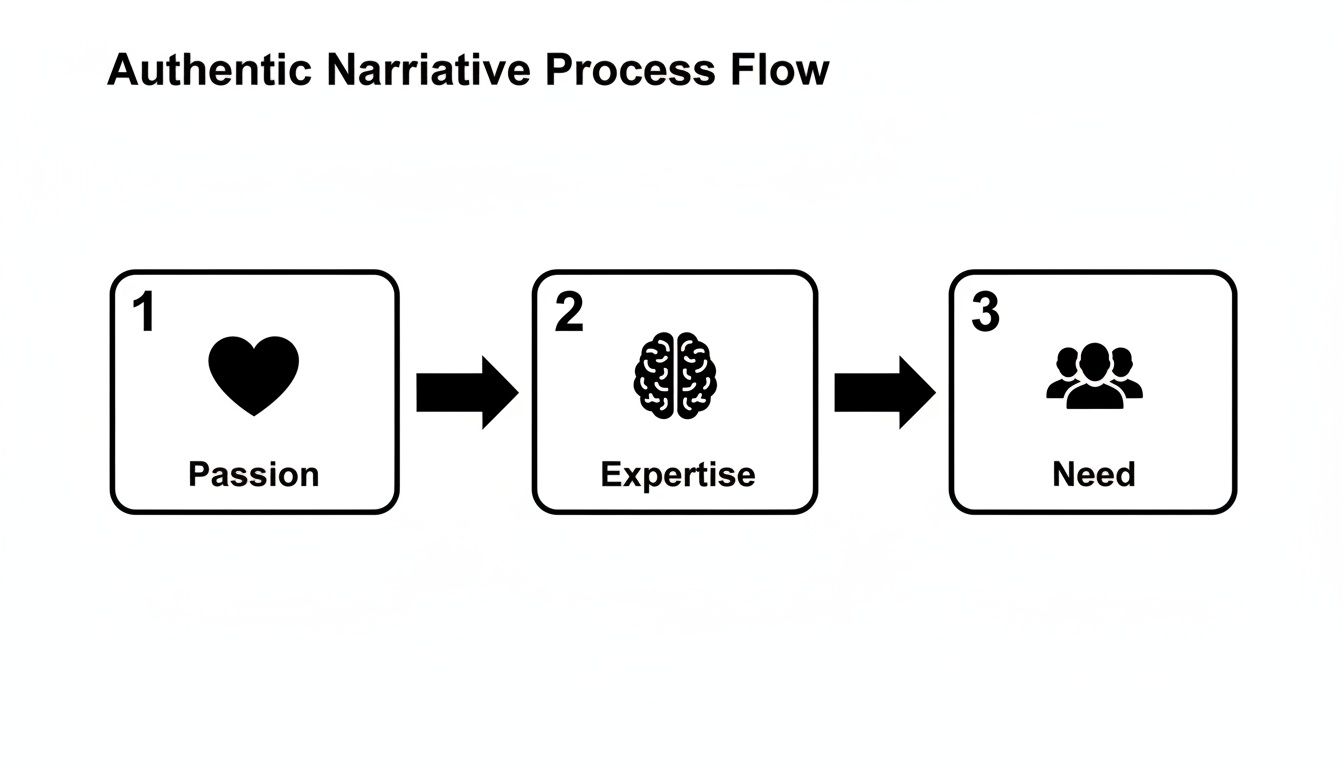
As you can see, truly authentic content doesn’t just appear out of nowhere. It’s born from what you genuinely care about, what you’re a proven expert in, and what your audience actually wants to hear. Your pillars need to live right in the middle of that.
For a CTO, those pillars might look something like this:
Sticking to your pillars ensures every single post reinforces who you are. It makes your brand memorable and positions you as the go-to person in your space.
Here’s where the magic happens. This is the efficiency hack that separates the pros from the amateurs. Instead of frantically brainstorming what to post each day, you focus on creating just one big, valuable "pillar" asset each month.
This could be a deep-dive article, a webinar, a keynote speech, or a podcast interview.
From that one piece of work, you can then slice and dice it into a dozen or more smaller "micro-content" pieces for different platforms.
The goal isn't to create more content, but to distribute one great idea in more ways. A single core concept, delivered across multiple formats, has way more impact than a dozen random thoughts.
Let's say your pillar asset is a 2,000-word article on "How to Scale a Remote Sales Team." You can easily spin that into a week's worth of content, or even more.
This method keeps your message consistent while tailoring it to how people actually use each platform. You’re giving your audience the same core value, just packaged differently. It’s maximum reach with minimum extra effort.
Consistency will beat intensity every single time. A content calendar is your roadmap. It turns your strategy into a reliable system you can actually stick to. The key is to be realistic with your time.
Don't underestimate the power of your own voice. Companies see up to 561% more reach and 800% more engagement when their executives post, compared to just posting from the corporate brand account. Better yet, organizations with leaders who actively build their brand see 20% higher revenue growth on average. If you're curious, you can dig into the data behind the impact of executive branding.
A simple weekly calendar is all you need to build momentum. Here’s a sample schedule that shows how you can mix pillars and formats to stay active and top-of-mind.
| Day | Content Pillar | Format | Platform |
|---|---|---|---|
| Monday | Pillar 1: AI for Legacy Industries | Text Post | |
| Tuesday | Pillar 2: Engineering Teams | Short Video | LinkedIn, X |
| Wednesday | Pillar 1: AI for Legacy Industries | Visual Carousel | |
| Thursday | Pillar 3: Future of Web3 | X Thread | X |
| Friday | Personal Insight / Story | Text & Image Post |
A simple rhythm like this makes you consistently visible without burning you out. It keeps your key messages in front of your audience, turning your voice into real influence. Remember, the distribution plan is just as critical as the content itself.
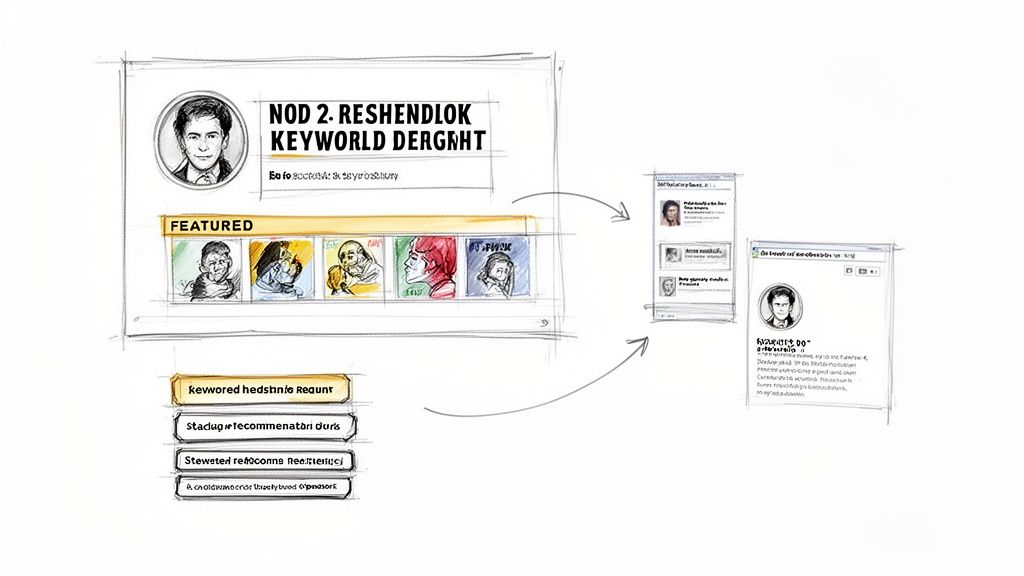
You’ve got your story straight and a plan for your content. Great. Now, let’s make sure your digital storefront—especially your LinkedIn profile—is actually working for you.
A static profile that just lists your past jobs is a massive missed opportunity. We need to turn it from a dusty, digital resume into a dynamic landing page that pulls in opportunities, rather than just sitting there.
Don't underestimate how critical this is. Personal branding for executives is no longer a side project; it’s a core business driver, growing 25% faster than traditional corporate branding. Think about it: a well-crafted LinkedIn profile can generate up to 40 times more opportunities.
And it’s not just about numbers. It’s about connection. Data shows 65% of U.S. consumers feel a stronger emotional bond with brands whose leaders are authentic and visible. Every single piece of your profile needs to work in concert to tell your story and cement your authority.
Most people stop after listing their job title. We’re going to go much deeper. Your LinkedIn profile should be one of your most strategic assets.
If you want the full playbook, we’ve got a complete guide on how to stand out on LinkedIn. But for now, let’s start with a few moves most executives miss.
Your headline is your digital billboard. “CEO at Company X” is lazy. Instead, try something that nails your value proposition right away. Something like: "Fintech CEO Driving Financial Inclusion Through Ethical AI | Forbes 30 Under 30." See the difference? It instantly tells people who you are, what you stand for, and why they should care.
Your "About" section is another goldmine. Don't just copy and paste your resume summary. Write it in the first person. Tell a story that connects your skills, your passion, and the biggest problem you solve for your industry.
Your LinkedIn profile is no longer a historical record of your career. It is the single most important owned asset for your executive brand, acting as the central hub for your thought leadership and professional network.
A static profile gets scrolled past. A dynamic one stops people in their tracks. You bring it to life by showcasing proof of your expertise, and the "Featured" section on LinkedIn is the best, most underused tool for the job.
Use it to pin your absolute best stuff right to the top of your profile.
If you’re serious about making your profile a true content hub, you need to be mastering LinkedIn Creator Mode. This unlocks features like newsletters and live audio events, which are absolute game-changers for amplifying your message.
Finally, remember your digital footprint is bigger than just one platform. Your voice, your visuals, and your core message need to be rock-solid and consistent everywhere you show up professionally.
Do a quick audit. Does your speaker bio for that upcoming conference sound like it was written by the same person behind your personal website and your X (formerly Twitter) profile?
Inconsistencies create confusion and weaken your brand's punch. A unified presence across all channels sends a clear signal of professionalism and solidifies your authority in the market. It’s non-negotiable.
Here's how to scale your brand and bring in help—without losing your voice or your mind.
Let's be honest. Building a personal brand as an executive feels like taking on a second full-time job.
Your most valuable asset is your time. So how do you stay consistent and build a real presence without burning out or dropping the ball on your actual job?
The answer is smart delegation. But this is where most leaders get stuck.
They get trapped by the "authenticity paradox"—the idea that if you're not writing every single word yourself, it's not really you.
That's a myth, and it’s the single biggest thing holding executives back. Authenticity isn't about doing all the grunt work. It’s about owning the strategy, the ideas, and the final message.
The trick is building a system. A system where you are the visionary, and a team you trust handles the execution. You maintain absolute control over the message, they make sure it gets out the door, consistently.
The first move is to separate what only you can do from what someone else can do for you. Getting this clear is how you’ll get hours back in your week while keeping your brand’s soul intact.
Think of it in two buckets: "Core Ownership" and "Tactical Execution."
This isn’t about just handing over your LinkedIn password and praying. It's a structured process.
For example, you could record a 10-minute voice note on your phone about a new industry trend while you're walking your dog. That raw audio file is gold. It becomes the source material for a ghostwriter to draft a post, a designer to pull a killer quote for a graphic, and your VA to schedule everything.
You are the architect of your brand's ideas, not the construction worker laying every brick. True scalability comes from providing the blueprint and trusting your crew to build from it.
The final content is 100% your perspective, but you didn't get bogged down in the mechanics. For a much deeper breakdown of the process we use, check out our guide on how to scale content creation for your personal brand.
Okay, so you know what to delegate. Now, who do you delegate it to?
There's no single right answer. It depends on your budget, what resources you already have, and how much heavy lifting you want to offload.
Here are the usual suspects:
| Support Model | Best For | Pros | Cons |
|---|---|---|---|
| Freelancers | Executives who need a specific skill for a project. | Flexible, pay-as-you-go for things like video editing or copywriting. | Can be inconsistent; you become a project manager for multiple people. |
| Internal Team | Leaders with access to a corporate marketing or comms department. | Already know the company brand, easy workflow, no extra cost. | They aren't personal branding specialists; you're competing for their time. |
| Specialized Agency | Busy executives who want an end-to-end, "done-for-you" partner. | True experts in executive branding; they manage the entire strategy and execution. | A higher investment, and you have to find an agency that gets your voice. |
So, when do you pull the trigger and outsource?
Simple: The moment you can't keep up anymore.
Personal branding is like going to the gym. A few random workouts here and there won't get you results. Consistency is everything. If you find yourself going weeks without posting, that's your sign. It’s not a failure—it's a strategic decision to win the long game.
Look, building a personal brand that actually means something is a long game. It's not a sprint. And even with the best playbook, I've seen countless executives make the same few mistakes that completely kill their momentum.
Knowing what these traps are is half the battle. Let's walk through them so you can avoid them entirely.
One of the biggest mistakes? Inconsistency.
You can't just post like a maniac for a month and then go completely dark for the next three. That just confuses people. Worse, it tells the algorithms on platforms like LinkedIn that you're not a reliable source. If you're struggling to keep a rhythm, that’s your cue to get help.
Another classic mistake is being way too promotional. Let’s be real—no one logs onto social media hoping to get hit with a sales pitch. They’re there for real insights.
If your feed is just a constant stream of company updates or product features, you're going to lose your audience. Fast. This is a tough habit to break for executives who live and breathe business development, but it's crucial.
The fix is simple. I call it the give, give, give, then ask model.
Aim for a ratio where at least 80% of your content is pure, unadulterated value. Share your hard-won lessons, your unique take on industry news, or a behind-the-scenes look at a project. The other 20%? That’s when you can talk about a company win or make a direct ask.
The second your content starts feeling like an obligation instead of a genuine desire to help, people can tell. Credibility is built on generosity, not a constant sales pitch.
Finally, a lot of leaders are afraid to have a real point of view. They play it safe, just reposting an article from a major publication with a generic comment like "Interesting read."
This is the fastest way to become background noise. You'll be completely forgettable.
Don't just be a reporter; be an interpreter. Connect what's happening back to your core message. Tell your audience what a new trend really means for them and what they should do next. A strong, even polarizing, opinion is what makes people remember you. It’s what separates a true thought leader from just another voice in the crowd.
When I talk to executives about building a personal brand, the same questions pop up again and again.
They're not just tactical questions—they're real-world concerns about time, risk, and what "success" actually looks like.
Let's clear the air and get you the straight answers you need.
This is always the first question. Everyone thinks they need to become a full-time content creator. You don't.
It’s about being consistent, not spending all day online.
When you're starting, block out 3-5 hours per week. That's it. This isn't a theory; it's the real number I see work for busy leaders.
Here's how that breaks down:
The goal is to build a system that runs without you having to grind. It gets easier and faster once you find your rhythm.
I get it. The last thing you want is to step on the marketing team's toes or create a PR headache. But this is almost never a real conflict.
Think of it as alignment, not competition.
Your personal brand gives a human face to the corporate message. People trust people, not logos. Your insights and stories add a layer of authenticity that a press release or a corporate blog post just can't match.
Your voice doesn't undermine the company brand; it amplifies it. You become the relatable, trusted expert behind the mission, making the whole company more magnetic.
Have a transparent conversation with your leadership or comms team from the start. Frame it for what it is: a strategic move to attract top talent, earn market trust, and reinforce the company’s vision.
Likes and follower counts are fool's gold. They feel good, but they don't pay the bills or move the needle on your real goals.
If you want to prove the business value, you have to track the metrics that actually matter.
Instead of vanity metrics, focus on these:
At Legacy Builder, we build these systems for you. We turn your expertise into a powerful, consistent presence that drives real business outcomes.
You focus on leading. We'll handle the rest.


You could – but most in-house teams struggle with the nuance of growing on specific platforms.
We partner with in-house teams all the time to help them grow on X, LI, and Email.
Consider us the special forces unit you call in to get the job done without anyone knowing (for a fraction of what you would pay).
Short answer – yes.
Long answer – yes because of our process.
We start with an in-depth interview that gives us the opportunity to learn more about you, your stories, and your vision.
We take that and craft your content then we ship it to you. You are then able to give us the final sign-off (and any adjustments to nail it 100%) before we schedule for posting.
No problem.
We have helped clients for years or for just a season.
All the content we create is yours and yours alone.
If you want to take it over or work on transitioning we will help ensure you are set up for success.
We want this to be a living breathing brand. We will give you best practices for posting and make sure you are set up to win – so post away.
Subscribe to our newsletter and get insights on how to grow your personal brand.
